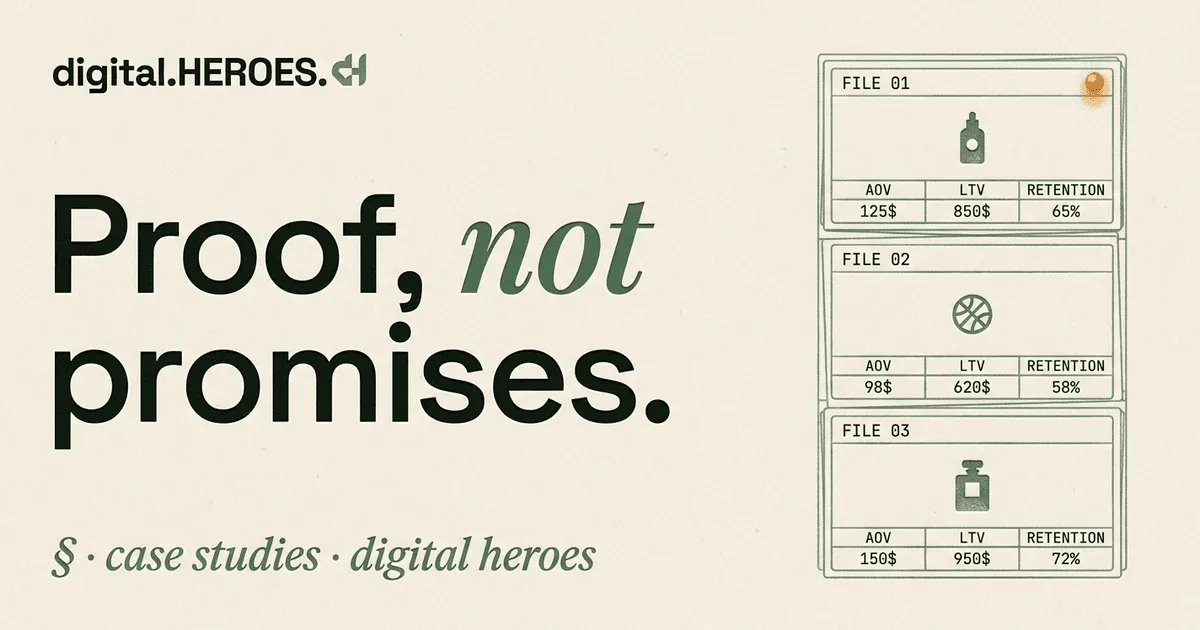










































Named means named.
We name a brand only when that brand has signed off on the specific metrics, quotes, and positioning. When we cannot get explicit permission, we write "a clean beauty brand we worked with" and keep the archetype framing honest.

Forty-six deep dives on how we take DTC brands past seven figures on Shopify. Problem, approach, stack, metrics. Three are named clients. The rest are industry and city archetypes built from patterns across our portfolio.
Type any phrase - title or content and we'll show you exactly where.
Every case study here shows the operating model we ran, the tools we used, and the numbers that followed. Where a client gave permission, you get their real name and real metrics. Where they did not, you get an honest industry archetype. Three clients let us name them: Emani, Big Game Sports, and Noble Paris. The archetypes are patterns we have watched repeat across multiple clients in the same vertical.
All three gave us permission to publish their names, their metrics, and the operating changes that moved the numbers. No redactions. No blurred revenue figures. Behind the work sits our standing as a Shopify Plus partner and our public Trustpilot record across 70+ reviews.
MRR at month 24. +520% growth. Subscription share 42%. Shopify Plus build, Klaviyo retention, MoCRA-ready compliance.
MRR. +340% growth. Performance-led rebuild, Amazon parallel ops, BFCM engineering. Shopify Plus migration from Magento 2.
MRR. +280% growth. Sampling-first acquisition, discovery sets, editorial content system, Shopify Markets across US, EU, UK.
Each archetype is a pattern we have run with multiple clients in the same vertical or city. The revenue ranges are the bands the pattern typically operates in. Industry archetypes group by what brands sell. City archetypes group by operating context: timezone, regulation, and talent pool all shape the playbook. Disclosure framing follows the FTC endorsement guidance. Names are illustrative, the patterns are real, and a banner sits above the fold on every archetype page.
3x AOV through routine builders, subscription design, refill cadence tuned to 45-day serum windows. $250K-$2M ARR.
+420% BFCM conversion through drop mechanics, waitlist operations, exchange-first returns. $500K-$5M ARR.
Scaled from $15K to $180K monthly through appointment booking, bespoke quote flows, insured shipping. $200K-$3M ARR.
65% 6-month subscription retention via cadence tuning, membership tier, skip-before-ship controls. $300K-$4M ARR.
Magento 2 to Shopify Plus B2B migration with NetSuite integration, company accounts, NET-30 workflows. $2M-$20M ARR.
4.2x LTV via ReCharge architecture, breed-and-weight consumption cadence, profile quiz, AAFCO compliance. $400K-$6M ARR.
Seasonal demand-shaping, gear-bundle merchandising, expedition content. Subscription on consumables, deposit flows on big-ticket. $250K-$3M ARR.
Subscription-first DTC supplement playbook with refill cadence, profile-based stacks, FDA-friendly claim discipline. $300K-$5M ARR.
Trust-stack design, registry flows, gift purchase paths, CPSIA-compliant content for parent-buyer brands. $200K-$4M ARR.
Curated multi-vendor home decor on Shopify Markets with vendor onboarding, split-fulfillment ops, freight handling. $500K-$8M ARR.
AR room-preview, custom-quote flows, freight-shipping discipline, white-glove delivery handoff for early-stage furniture. $400K-$6M ARR.
Cohort-based course commerce on Shopify with Klaviyo onboarding, member-only access tiers, completion-tied upsells. $200K-$3M ARR.
Each city archetype is a pattern we have run with multiple operators in that market. Brand names and identifying details are illustrative. The metrics, the operating model, and the decisions are real. Every individual page carries a disclosure banner. We also document time-zone overlap and remote-first cadence per city, in line with the agency-buyer transparency norms in the Google Helpful Content guidance.
Drop mechanics and culture-anchored brand voice in the Atlanta DTC streetwear archetype. MRR archetype.
$80K to $410K MRR (5.1x) Detroit motor-city aftermarket and apparel archetype.
$90K to $480K MRR (5.3x) Jacksonville beaches DTC archetype across surf, swim, and outdoor.
$150K to $700K MRR (4.7x) Las Vegas lifestyle archetype across hospitality, fashion, and creator merch.
$200K to $850K MRR (4.25x) Milwaukee craft beverage archetype with subscription cadence and DTC compliance.
$60K to $310K MRR (5.2x) OKC ranchwear archetype across western boots, hats, and workwear.
$150K to $620K ARR (4.1x) Raleigh research-triangle SaaS + biotech archetype.
$50K to $280K MRR (5.6x) Richmond heritage craft archetype across maker-led, small-batch DTC.
$180K to $720K MRR (4x) Sacramento farm + wellness archetype with subscription and farm-direct DTC.
$250K to $1.1M MRR (4.4x) Salt Lake outdoor archetype across ski, climb, and trail-running brands.
$120K to $540K MRR (4.5x) Baltimore biotech + wellness archetype with university-anchored R&D positioning.
Birmingham heritage jewelry MRR archetype with hallmarking discipline and bespoke quote flows.
$90K to $480K MRR (5.3x) Brighton DTC fashion archetype with creative-led brand voice.
Bristol sustainable lifestyle MRR archetype with B-Corp claims discipline and circular-design merchandising.
$80K to $420K ARR (5.2x) Cambridge deep-tech archetype with research-anchored buyer education.
Edinburgh fintech ARR archetype with FCA-aware copy and trust-stack onboarding.
Glasgow design + streetwear MRR archetype with drop mechanics and creator collab merchandising.
Leeds retail + fintech ARR archetype across BNPL-friendly DTC and lender-side product.
Liverpool music merch MRR archetype with tour-window inventory and fan-first drops.
Manchester fast fashion MRR archetype with weekly drops and creator-paid acquisition mix.
Newcastle gaming merch MRR archetype with esports anchor partnerships and limited drops.
Nottingham health + beauty MRR archetype with refill subscription and clean-claim discipline.
$120K to $560K ARR (4.7x) Oxford biotech archetype with peer-reviewed citation positioning.
Sheffield sports performance MRR archetype with athlete-tested merchandising and cadence-tuned subs.
$60K to $310K ARR (5.2x) Belfast cyber + SaaS archetype with security-buyer trust stack.
$200K to $920K MRR (4.6x) Toronto DTC fashion archetype with bilingual market and US-CA cross-border ops.
$150K to $720K MRR (4.8x) Vancouver athleisure archetype with Pacific-Northwest sustainability positioning.
$100K to $510K MRR (5.1x) Montreal bilingual DTC archetype with FR/EN content ops and Bill 96 compliance.
$80K to $390K ARR (4.9x) Calgary cleantech archetype with energy-transition buyer positioning.
$70K to $340K ARR (4.85x) Edmonton GovTech archetype with public-sector procurement workflows.
$90K to $450K ARR (5x) Ottawa cyber + SaaS archetype with federal-buyer security positioning.
We hold every case study to four rules before it publishes. Each one has to pass all four. The rules borrow from schema.org's Article type conventions for transparent attribution, and from the editorial discipline in Google Search Central's E-E-A-T guidance for case study credibility.
We name a brand only when that brand has signed off on the specific metrics, quotes, and positioning. When we cannot get explicit permission, we write "a clean beauty brand we worked with" and keep the archetype framing honest.

Revenue figures, growth percentages, and conversion rates come straight from the client's Shopify, Klaviyo, or attribution dashboards. Serious inbound prospects can see the screenshots under NDA. No composite metrics.
Every case study names the designer, engineer, growth lead, or strategist on our side who did the work. When the client had a strong in-house operator, we name them too.
Each case names the operating model that produced the result: Clean Shelf Method, Collection Method, or Cold Chain Method. We never claim a single tactic or app changed the business.
We turn down the majority of inbound. Four filters tell us early whether the math works for both sides. They come from real unit-economics patterns Shopify documents in the State of Commerce report, plus the subscription-retention benchmarks Klaviyo publishes annually.
$50K per month minimum, trending up. Below that, you are a product company, not a growth company. We would be the wrong vendor.
40%+ contribution margin after landed costs and fulfilment. Below that, growth spend compounds losses.
The repeat-purchase curve actually curves up. If organic retention is flat, the product is still being discovered.
A founder or senior stakeholder available for a weekly operating review. Growth work is a partnership, not a handoff.
Every case study above came out of the same eight service lines. Each link below goes deeper: scope, methodology, outbound authority references, FAQ, and the team that ships the work.
Liquid, sections, Functions. Plus + B2B fluent.
Premier-partner-grade work for $2M+ DTC brands.
Editorial design that converts. Mobile-first, WCAG-baked.
Next.js, Webflow, WordPress. CWV green on launch.
React Native, Flutter, iOS, Android. Companion + standalone.
Stripe, Postgres, Next.js. First customer in 8 weeks.
Logo + type + color + voice. Brand books that stick.
Block themes, custom plugins, headless. Editor-first.
It starts with a 30-minute diagnostic call. You get an honest read on whether the math works, then a scoped quote within 48 hours.
Published · Last updated .
Pinch, scroll or double-tap to zoom · drag to pan
Share your name and email so we can follow up.
Please enter your name and a valid email.