reported ROAS
2.8x
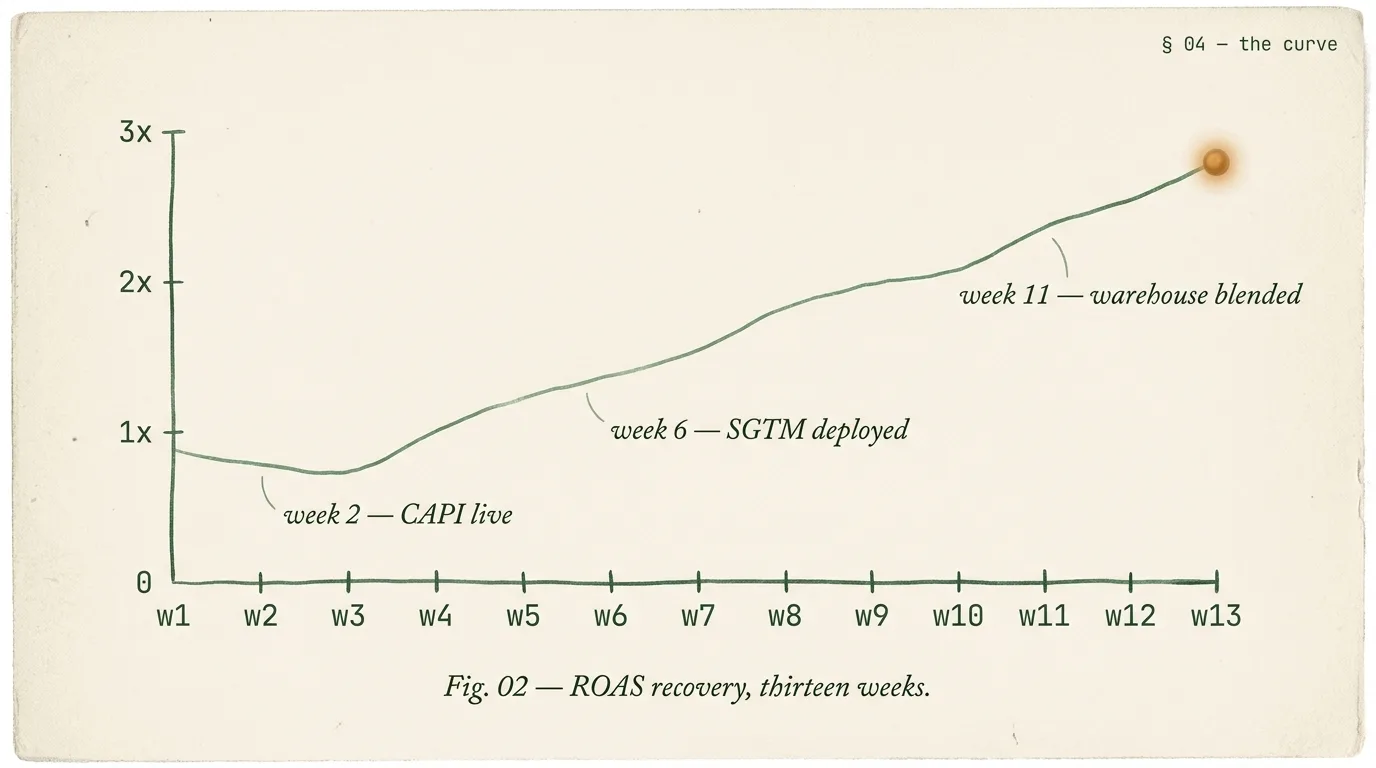
From 0.9x at week 0, climbing through 13 weeks of stack rebuild. Above pre-iOS-18 baseline of 2.1x.
An archetype built from the server-side attribution rebuilds we have shipped for DTC wellness brands. ROAS climbed from 0.9x to 2.8x in thirteen weeks with Meta CAPI, Cloudflare sGTM, and warehouse-blended reporting.
The revenue never dropped. The measurement did. iOS 18 shipped in September 2024 with capped postback windows and tighter App Tracking Transparency enforcement. Safari on iOS started dropping browser-side pixel events. Meta's ad manager, reading only that pixel, reported blended ROAS falling from 2.1x to 0.9x within three weeks.
We rebuilt the stack. Reported ROAS recovered to 2.8x across thirteen weeks, above the pre-iOS-18 level. It landed higher because the new measurement caught conversions the old pixel had been missing all along.
From 0.9x at week 0, climbing through 13 weeks of stack rebuild. Above pre-iOS-18 baseline of 2.1x.
Meta Event Match Quality score post-CAPI + SGTM. From 38% on browser-side pixel alone.
Signed on week 0; CAPI live week 2; SGTM week 6; warehouse blended week 11; pre-iOS-18 baseline cleared week 13.
In September 2024 the founder watched Meta report ROAS sliding week over week: 2.1x, then 1.4x, then 0.9x. Ad spend had not changed. Neither had creative or audience. Shopify revenue was flat. Email revenue was flat. Direct-type-in traffic was flat. The only number falling was the one Meta claimed to drive.
The obvious conclusion was that ads had stopped working. It was wrong. iOS 18's Safari tracking restrictions had started dropping conversion events from the browser-side pixel. Proving that to a founder about to turn ads off was the harder job.
The stack itself was standard 2023 issue. Meta Pixel on every page. Google Analytics 4 through client-side GTM. A handful of server events from Shopify webhooks into Klaviyo, plus weekly CSV exports into the founder's spreadsheet. Nothing was server-side. Nothing was consent-aware beyond a cookie banner. Nothing survived iOS 18's Intelligent Tracking Prevention 2.3 release.
This was not a one-tool fix. It was a full stack replacement. The thirteen-week runway below is what we ran, stage by stage. The first six weeks were pure engineering with nothing to show in reported ROAS. The curve turned in weeks 7 through 13.
This is the stack every mid-market DTC brand should run after iOS 18. Each layer fixes a specific failure of the old setup. The warehouse at the bottom is the single source of truth. Everything above it is instrumentation feeding that truth.
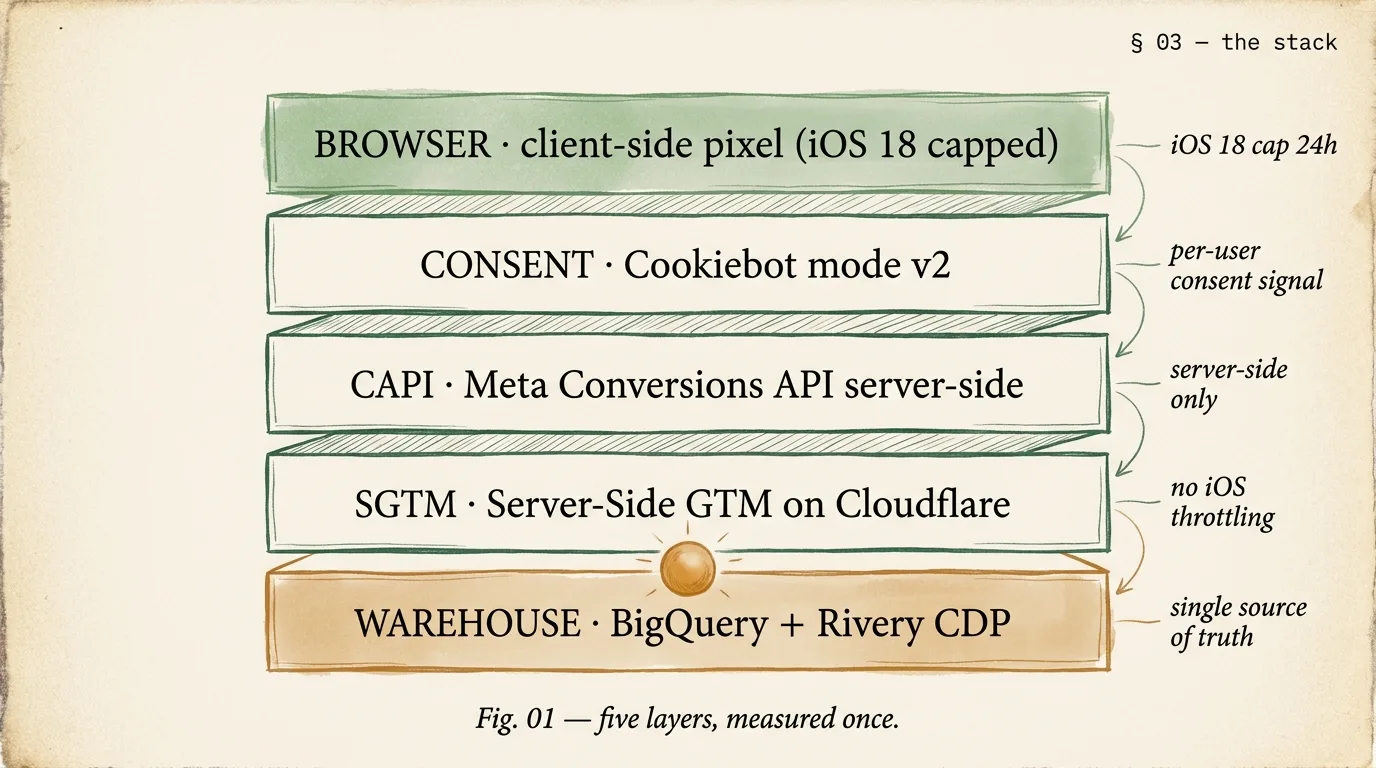
Kept, not trusted. Meta Pixel + GA4 via GTM for audience building, not reporting. iOS 18 capped 24h postback respected.
Google Consent Mode v2 via Cookiebot. Per-user ad_storage + ad_user_data + ad_personalization signals.
Server-side Conversions API via Shopify webhook → Cloudflare Worker → Meta endpoint. Event deduplication via event_id.
sGTM on Cloudflare Workers. Routes events to Meta, GA4, TikTok, Klaviyo, BigQuery. First-party domain, no iOS throttling.
BigQuery via Rivery. Blended CAC, MER, contribution LTV. Single source of truth for founder's Monday meeting.
Looker Studio dashboard on BigQuery. Meta is no longer a reporting surface; it is an audience tool.
"We almost turned off ads because Meta said they were broken. The rebuild showed us we had a measurement problem, not an ads problem. Thirteen weeks later we were spending more and reporting a higher ROAS than before iOS 18."
We run server-side attribution rebuilds in 10 to 14 weeks. Audit in week one, written plan in week two, implementation through week ten, reporting flip in week thirteen.









115 people across five studios in New York, Delhi, London, Sydney and Lucknow, shipping ecommerce, web, software and mobile work for founder-led brands. Senior engineers only, no account-manager relay, and the same team from kickoff to launch.

Content Strategist · APAC · Sydney · 2 posts on the site
Published · Last updated .

Pinch, scroll or double-tap to zoom · drag to pan
Where should we send the proposal?
Please enter your name and a valid email.
Any faster way to reach you? Optional.
Please fill in the one you picked.

