Enterprise software development is building the software that several departments of one company work in together: ERP, CRM and HR systems, portals, internal tools and the integrations between them. Our service covers every step, from discovery and a written scope through architecture, build, testing, data migration and rollout, to support after launch.
Seven systems we build, and the teams that run on them
We build the systems a company runs on once spreadsheets and separate SaaS subscriptions stop keeping up. Each one below can start as a single module for one team and grow into a shared system with one database, roles and an audit trail.
ERP and operations platforms: finance, inventory, purchasing and orders kept in one set of records instead of four spreadsheets (more on our ERP development work).
CRM and sales systems: pipeline, quotes and account history shaped around how your team actually sells (see CRM development).
HRM and people systems: onboarding, attendance, leave and payroll inputs, with what each person can see set by role (see HRM software).
Internal tools, dashboards and reporting: admin screens that replace manual exports, and reports that pull numbers from every department into one view.
Customer, partner and vendor portals: logins that let people outside your company see and update their own orders, tickets or documents.
Workflow and approval automation: requests routed to the right approver, with reminders and a record of who approved what and when.
Enterprise web applications: browser applications for staff or customers, built on React and Next.js with the business rules kept on the server.
figure 1 · seven systems, one database
every system reads and writes the same records, with roles and an audit trail, and talks to the accounting, payroll, sign-in, store and BI tools you keep through their APIs
§ 02 · services
Six things you can hire us to do, alone or together
Each one is also a step in the delivery process further down this page, so you can start with discovery on its own and decide on the rest later.
Discovery and a written scope. A 30-minute call, then a written scope within 48 hours with acceptance criteria, a named team and the weekly cadence.
Architecture and custom development. Our CTO sets the architecture and data model before engineers write code, and the build runs in six-week cycles.
Integration with the systems you keep. Connections to the accounting, payroll, CRM, identity and commerce tools you already pay for, so nobody re-keys data. Our API and integration work covers this on its own as well.
Legacy modernization and data migration. Old systems replaced in phases, including moves from on-premises servers to cloud hosting, with data mapped, tested on a copy and moved at a planned cutover.
Testing against real workflows. Internal QA before any client preview, plus automated tests and a way to roll back in place before the first production release.
Support and change after launch. A named team for roadmap work, integrations and incident support once the system is live.
Planivo: workforce planning for clinics and hospitals
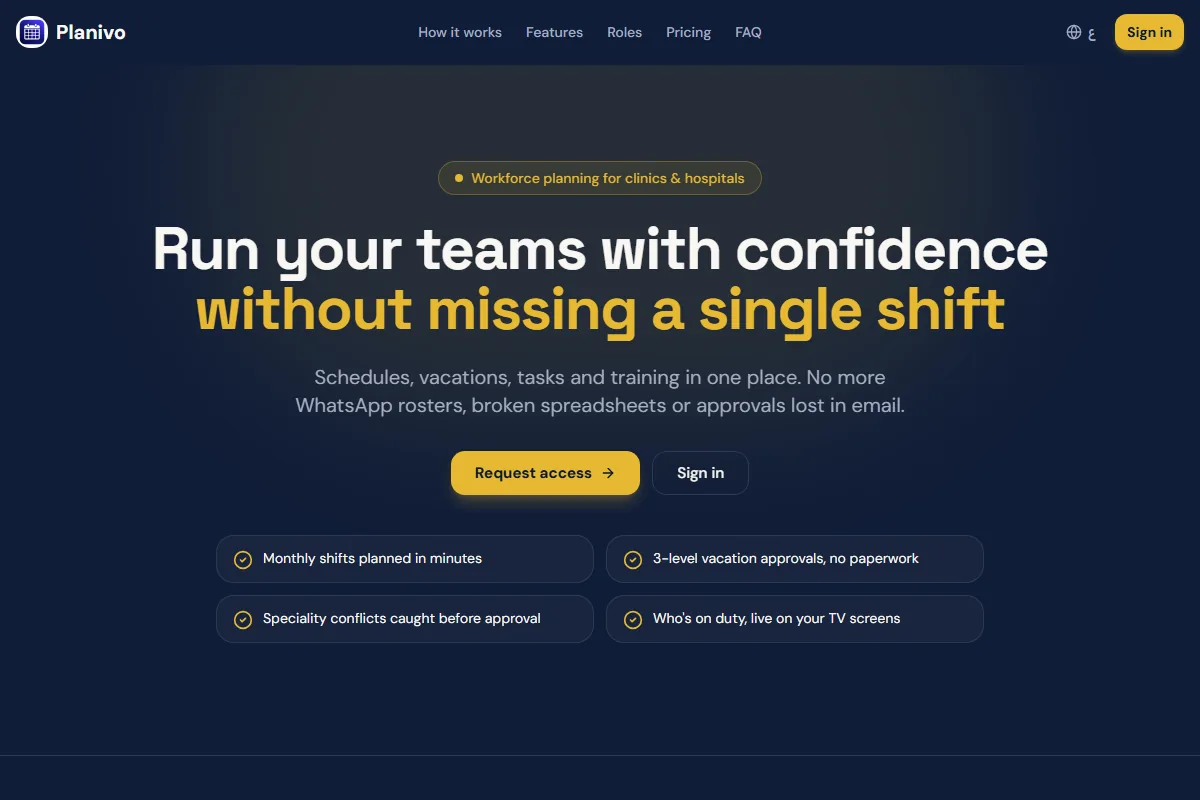
Digital Heroes built the whole Planivo platform, the signed-in app and its website. Organizations use it to plan monthly shifts, run vacation requests through three levels of approval (department head, facility, then workspace) with a check that flags two people of the same speciality away at once, assign tasks, run training sessions with attendance, track licence expiry dates, and show who is on duty on screens in their halls.
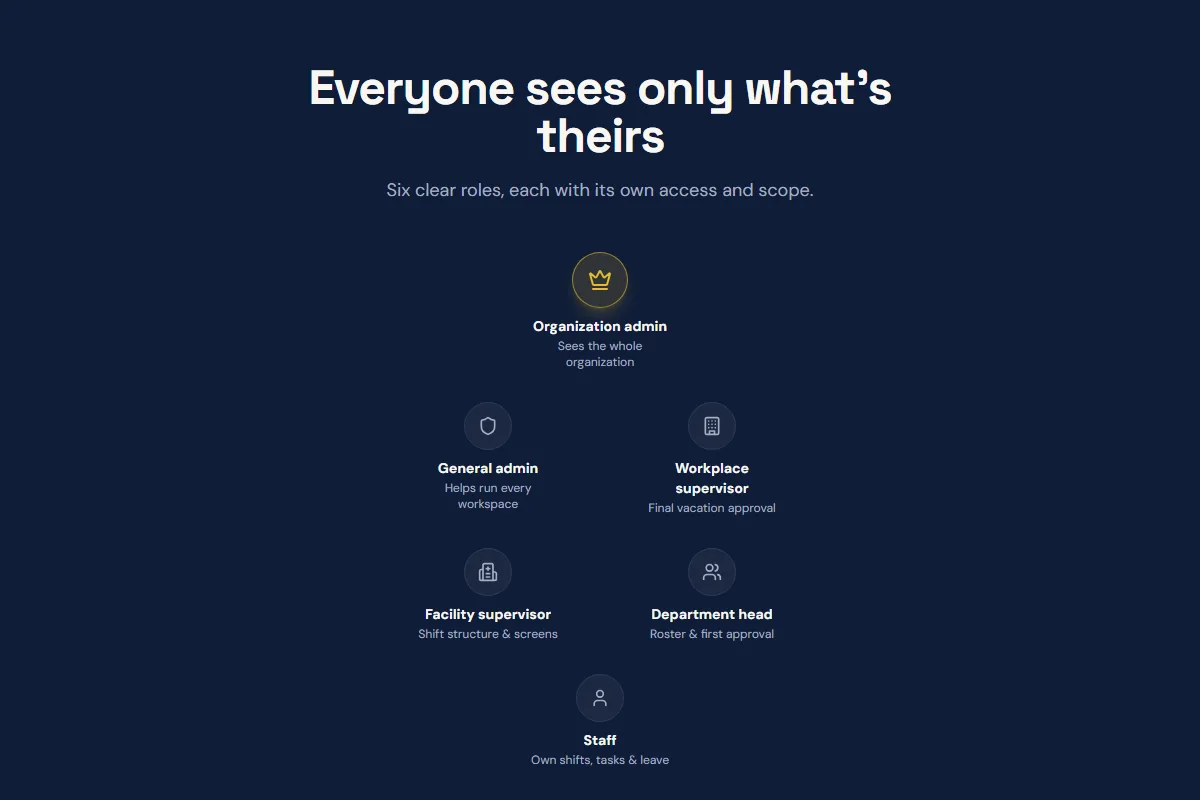
Six roles, six scopes: organization admin, general admin, workplace supervisor, facility supervisor, department head and staff, each seeing only its own part of the organization.
An audit history: every change is recorded with who made it and when.
One system across sites: workspaces, facilities and departments in one organization, replacing rosters kept in chat groups and spreadsheets.
It is the kind of system this page is about: roles and permissions, an approval workflow, an audit trail and a rollout across several facilities. We show it with the client's permission to feature it as our work; there is no client quote and no results figure here because none has been published yet.
Planivo's public site, which we built with the app.The six roles, as Planivo explains them to buyers.
§ 03 · process
From discovery to rollout in seven steps
A build follows the same seven steps every time, and the first working software reaches your team at the end of the first six-week cycle, not at the end of the project.
Discovery call. Thirty minutes on how the business runs, the current stack and the outcome you want. No pitch deck.
Written scope within 48 hours.Acceptance criteria, a named team, the weekly cadence and a flat fee or rate card. If it is not written down, it is not in scope.
Requirements and integrations. How each department really works, its exceptions named, and every integration's API limits checked before the price is fixed.
Architecture and data model. Set by the CTO before code: which stack, which trade-offs, what gets built and what gets bought.
Six-week build cycles. Two live calls a week, a written note every Friday, and every cycle ends in something your team can use.
Testing, migration and rollout. QA before any preview, data moved to a copy first, then one module at a time with a tested way to roll back.
Handover and support. Architecture documentation, runbooks and a knowledge transfer session, then a named team for changes and incidents.
one cycle, week by week · what your team sees from us during step 5, and how step 6 rolls out
figure 2 · seven steps, discovery to rollout
steps 5 and 6 repeat for each module, so working software reaches your team every six weeks
§ 04 · stack
A deliberately boring stack
Your system runs on six tools from our standard stack, and two of them, Cloudflare Workers and Supabase Postgres, already carry our own production work: eight request handlers, bookings and live chat among them.
PostgreSQL was used by 58.2 percent of professional developers in the 2025 Stack Overflow Developer Survey, the most of any database. That matters for a system meant to last years: the next team to maintain it will already know it.
Next.js: web applications and portals
React: the screens staff use every day
Node.js: business rules and integrations on the server
PostgreSQL on Supabase: shared records and row-level security
Cloudflare Workers: APIs and background jobs close to users
React Native: mobile apps for field teams
Every tool on that list is named, documented and widely used on purpose, because a system that has to run for years is no place for this month's framework.
Where AI fits: two rules before a model touches your records
AI tools are now routine in software work, used or planned by 84 percent of developers in Stack Overflow's 2025 Developer Survey against 76 percent a year earlier. Inside an enterprise system, AI earns its place only on narrow jobs: sorting incoming requests, drafting replies and summarizing long records.
Ask any vendor, us included, how two rules are enforced: the model reads data only through the permissions of the person using it, and a person approves anything that changes a record or reaches a customer.
§ 05 · team
Who builds it, where they work and when they answer
Our CTO, Divyansh Singh, sets the architecture of every build: which stack, which trade-offs, what gets built and what gets bought, and what a build has to prove before a client sees it.
The engineers who build your system work from our Delhi and Lucknow offices on hours that face New York. The New York office replies the same day between 9 AM and 6 PM Eastern, Monday to Friday, and an after-hours message about a production problem is picked up within one to two hours.
Digital Heroes is registered in the US as Digital Heroesco LLC, and the entity you contract with is the one named in your MSA. For US engagements the MSA typically defaults to New York law and a New York venue.
Digital Heroes is headquartered in New York, and New York clients can hold kickoffs and design reviews in person at our NoMad office.
How a build review looks at the desk. Stock photo, not our team: “Team Discussing Project at a Computer” by cottonbro studio, Pexels License.
§ 06 · who we build for
Five departments where these projects start
Two of our free tools turn what one department needs into a brief any vendor can price: a requirements document generator, and a user story generator that adds acceptance criteria. The five departments below are the ones these systems serve.
Operations and supply chain: stock that never matches the spreadsheet, purchase orders chased by email, production plans re-keyed by hand. We have written up how this looks in manufacturing.
Finance and accounting: approvals stuck in inboxes, billing that does not reconcile, a month-end close that drags.
HR and people operations: onboarding checklists, attendance and leave, payroll inputs gathered from several places.
Sales and client service: quotes built outside the system, client records split across tools, customers emailing for status, a pattern common in professional services firms.
Worldwide, most custom projects cost $30,000 to $100,000, according to GoodFirms' 2026 Software Development Cost Survey of more than 100 software companies, fielded in September and October 2025. For a medium-sized system, US and Western European firms quote around $50,000 to $250,000. Enterprise projects pass $200,000 and take 12 to 24 months, and the survey finds them priced similarly across regions.
Budget for two costs the bands leave out: the same survey found that scope creep raises a project's cost by 10 to 25 percent, and puts maintenance at 10 to 20 percent of the build each year. Digital Heroes does not publish a price list; we send a written scope with a fee or rate card within 48 hours of a 30-minute call.
Project size, cost and timeline across all the software companies GoodFirms surveyed worldwide, 2026 survey; the last column is the share of those companies whose projects fall in each band. Western firms quote more for a medium project, as the text above says.
Project size
Typical cost
Timeline
Share of companies
Small or MVP
Under $30,000
1 to 3 months
14.1 percent
Medium
$30,000 to $100,000
3 to 6 months
65.7 percent
Large
$100,000 to $200,000
6 to 12 months
14.1 percent
Enterprise
$200,000 and up
12 to 24 months
6.3 percent
Four engagement models, each scoped in writing
Discovery engagement: ends in a written scope you can take to any vendor.
Phased build: six-week cycles, each one ending in a working release.
Dedicated team: a lead, engineers and QA on an evolving roadmap.
Support and change after launch: fixes, updates and new work once the system is live; the smallest retainer we staff is one senior engineer plus one designer.
GoodFirms found 81 percent of software companies offer time and materials, 66 percent fixed price, 59 percent dedicated teams and 47 percent milestone billing, so ask which model a quote assumes before you compare two of them.
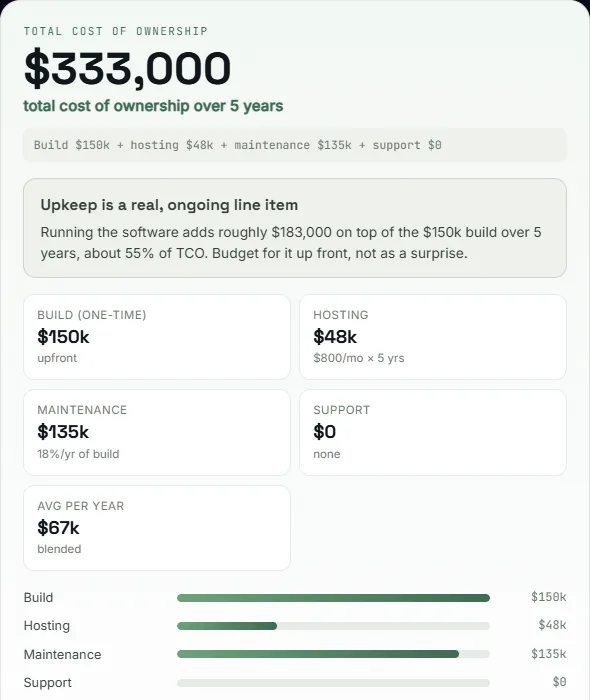
example · our free TCO calculator at its default inputs: a $150,000 build kept for five years
every figure here, maintenance at 18 percent of the build a year included, is an example input you can change, not our rate, a benchmark or a quote
Buy when the process is standard and a product already runs it well. Build when the process is how you win work, or when keeping several tools in sync has become someone's full-time job. Extend when one module is the problem and the rest of the product fits.
Salesforce lists its Sales Cloud Core edition at $195 per user per month, billed annually (checked 3 October 2026). That is $7,020 per seat over three years, so 40 users cost $280,800 at list price before add-ons.
On the build side, GoodFirms puts data-integrated systems in its large band, $100,000 to $200,000 over 6 to 12 months, and enterprise projects from $200,000 over 12 to 24 months. If the system costs 10 to 20 percent of the build a year once it is live, the same three years come to about $120,000 to $300,000 in the large band and at least $220,000 in the enterprise band.
Divide by $7,020 and the large band equals about 17 to 43 seats, the enterprise floor about 31. With fewer seats, the license costs less on price alone; with more, the seat fees pass the build. Either way your team keeps paying for its current tools while the build is under way, so the case for building rests on fit, integrations and headcount growth.
Airtable's Business plan lists at $45 per user per month, billed annually (checked 3 October 2026), and it is the right tool for a team that needs a tracker this week.
Off-the-shelf SaaS, low-code tools and custom enterprise software compared; list prices named with the date they were checked, build figures from GoodFirms' 2026 survey
Question
Off-the-shelf SaaS such as Salesforce, NetSuite or Workday
Low-code tools such as Airtable
Custom enterprise software
Upfront cost
Setup and configuration
Low
Highest: GoodFirms puts data-integrated systems at $100,000 to $200,000 and enterprise projects from $200,000
Ongoing cost
Per-user licenses; Sales Cloud Core lists at $195 per user per month
Per-seat plans; Airtable Business lists at $45 per user per month
Maintenance at 10 to 20 percent of the build a year once live, plus hosting
Fit to your process
You adapt to the product
Good for simple flows, strains on complex rules
Built around how you work
Ownership
The vendor owns the product; you own your data
The vendor owns the platform
Code made for your project is assigned to you on full payment; components we built before it or for reuse stay ours
Integrations
The vendor's APIs and marketplace
Connectors, with limits
Whatever your systems' APIs allow
Time to first use
Days to weeks
Days
The first six-week cycle
Best when
The process is standard
A team needs a tool fast
The process sets you apart, or integration has become the job
What ownership gets you
One set of records instead of re-keyed spreadsheets.
Permissions and an audit trail designed in, not added later.
Integrations that remove manual handoffs between departments.
A roadmap you set, not a vendor's release schedule.
No per-seat fee that grows with headcount; hosting and maintenance remain, as above.
§ 09 · before you sign
Four objections buyers raise, and our answers
The most common objection, why not just buy a product, has its own section above with the numbers; these are the other four.
The final bill will outrun the quote
It can, and the usual cause is scope that grows without a written change. Our scope is the contract: work outside it needs a written change request with its cost and its effect on the date before anyone builds it. Once the build starts, you get a recorded demo of working code each week, and milestone billing ties each invoice to a delivered phase, not to the calendar.
Our backlog is already months long
As one LinkedIn post put it in August 2026, Everything eventually enters the same engineering backlog. An outside team adds capacity without joining that queue: we build in six-week cycles, each ending in something your team uses, with two live calls a week and a written note every Friday.
That queue exists because IT owns identity, access and deployment, and an outside team should work inside those controls, not around them. Repositories and cloud accounts are held in your name and paid for by you, and our engineers are collaborators you can remove.
We will be locked in to your team
On full payment, the code, designs and custom assets made for your project are assigned to you, and they already sit in repositories you own.
We keep the components, libraries and toolchains that existed before your project or were built for reuse across clients. We may show the finished work in our portfolio unless you opt out in writing. If you need strict work for hire terms with no portfolio rights, the statement of work says so and is priced openly. A handover pack with architecture documentation and runbooks lets another competent team take over.
Rollout will break what runs the business today
Rollout goes one module at a time, never as one big switch. Data is moved to a copy first and checked, each release has a tested way to roll back before it reaches production, and your current system keeps running until the new module has handled real work.
§ 10 · security
Security controls we document, and certifications we do not claim
Our three free checkers, for HTTP headers, Content-Security-Policy and HTTPS, test any vendor's live site, ours included: every page built from this site's repository is served with six security headers.
We hold no SOC 2 or ISO 27001 report we can name with its auditor and year, so this page claims neither. Such a report covers the operations of the company audited, so ask any vendor whether it holds one for its own operations, and ask to see it. Here is what we document instead, in the systems we build:
Encryption in transit: TLS on every connection, with HSTS.
Encryption at rest: data in Supabase-hosted Postgres is encrypted at rest with AES-256, as Supabase's security page states.
Row-level security and role-based access: permissions enforced in the database, not only in the screens, using PostgreSQL's row security policies.
Audit logs: who changed which record and when, for finance and HR data.
Secrets on the server: API keys and credentials are kept server side and never shipped to the browser.
Patient-facing healthcare products only: HIPAA-aware architecture within the scope our healthcare page sets.
Enterprise projects fail in predictable places: scope that grows without a written change, decisions that wait two weeks for sign-off, legacy data messier than anyone remembers, and a system nobody but its author can run. Our ranking of eight software development companies for enterprise scores each firm on certificates, bench, references and exit terms.
Seven commitments to request from any vendor
A named architect who owns the design.
A written scope with acceptance criteria within days, not weeks.
Code in your own repository from the first week.
An IP clause you have read.
A data migration plan with a dry run.
Security answers mapped to the NIST SSDF.
References from a system like yours.
Ask us for the last one too: the Planivo build above is one, shown with the client's permission to feature it as our work.
Features to ask for, whoever builds it
Whoever builds it, ask for these in writing:
Permissions per role, enforced in the database.
An audit trail of every change.
Single sign-on through your identity provider.
Documented APIs.
Reports each department can run without a developer.
A data model that takes the next feature without a rebuild.
§ 12 · questions
Questions buyers ask before they commit
How much does it cost to develop custom software?
Worldwide, GoodFirms' 2026 survey puts most custom projects at $30,000 to $100,000 and enterprise builds above $200,000; US and Western European firms quote around $50,000 to $250,000 for a medium system. Hourly rates run from $20 to $50 in Eastern Europe, Latin America and South Asia to $100 to $250 for enterprise work in North America and Western Europe.
What is a custom software development company?
A custom software development company designs and builds software to one client's specification, then hands over the code, documentation and access needed to run it. Digital Heroes is one: we scope in writing, build in six-week cycles and assign the code made for your project to you on full payment.
What are the top 10 custom software development companies?
Any top 10 depends on who compiled it and how. Directories such as Clutch show client ratings and review counts, while some lists written by vendors rank their own author first, so read the method before the order. Shortlist on fit, not rank: who will own the architecture, and whether the scope and code will be in your name.
What is enterprise software development?
It is the design and build of software that a whole organization runs on, such as systems for finance, operations, sales and HR and the links between them. It differs from ordinary app development in four ways: many user roles, records shared across departments, an audit trail of every change, and a working life measured in years.
What are enterprise application services?
Enterprise application services are the work of building, connecting, modernizing and supporting the applications a company runs on: discovery, architecture, development, integration with existing systems, data migration, testing, rollout and support. Some providers also administer licensed platforms such as Salesforce or SAP; we build custom systems and connect them to the platforms you keep.
What is an example of enterprise software?
An ERP that runs finance, inventory and orders is the textbook example, and a CRM that runs the sales pipeline is another. The platforms buyers meet most come from large enterprise software companies such as SAP, Oracle, Microsoft, Salesforce, Workday and ServiceNow, which sell to organizations by subscription or license. Custom enterprise software usually extends or connects products like these.
What is an enterprise software company?
It is a company that builds or licenses software for organizations rather than consumers. Product vendors license one platform, such as an ERP or a CRM, to many organizations. Custom builders, Digital Heroes among them, build to one client's specification and hand over the code. A company can use both: a platform for standard work, custom software for the rest.
What are the 7 stages of SDLC?
IBM lists the seven stages of the software development lifecycle as planning, analysis, design, coding, testing, deployment and maintenance. Our process follows the same order: a discovery call and written scope, requirements, architecture and data model, six-week build cycles, testing against real workflows, migration and rollout, then support after launch.
What does an enterprise developer do?
An enterprise developer builds and maintains the systems a company runs on: data models, business rules, user roles, integrations and the tests that keep them working. Enterprise application developers focus on the apps people use on top, such as portals, dashboards and approval flows.
What is the 40/20/40 rule in software engineering?
It is a rule of thumb that splits a project's effort 40, 20 and 40 percent, with only 20 percent spent writing code. It is a guideline, not a law, but its point holds: most enterprise work happens away from the keyboard.
What are the big 3 of web development?
HTML, CSS and JavaScript: HTML gives a page its structure, CSS its layout and look, and JavaScript its behavior in the browser. React and Next.js, on our stack, are JavaScript tools that produce all three, while business rules stay on the server.
Should we build custom enterprise software or buy an off-the-shelf product?
Buy when the process is standard and a product runs it well; build when the process is how you win work, or when syncing several tools has become someone's job. At list price a Sales Cloud Core seat costs $7,020 over three years, so a large custom system equals about 17 to 43 seats; seat count, fit and integrations decide.
Last reviewed .
next step
Scope your build on a 30-minute call
Bring the system you want to replace; you leave the call knowing what a written scope for it has to answer. Book a call.
Published reviews from our Fiverr profile, reproduced word for word.
397 public reviews across
4 gigs, from clients in
36 countries.
Read them all on Fiverr.
Really impressed with the final platform. The marketplace is clean, responsive, and everything works exactly as discussed. Every small refinement was handled with care. Very happy with the final outcome.
kyronova123
United States · $100-$200 · 7 days
Very happy with the final website! The design is clean, mobile friendly, and performs smoothly. Highly recommend for responsive full stack websites.
freddie_181
Canada · $100-$200 · 8 days
I came here expecting someone to fix a few bugs, but what I really got was someone who took the time to understand how the whole website actually works. The updates blend in perfectly with the existing site, nothing feels patched or out of place. Would definitely recommend them!!
lazaruscrane
United States · $100-$200 · 4 days
What impressed us the most was the thorough testing and attention to detail. Throughout the project, we received clear progress updates, and every concern we raised was addressed quickly and professionally. Communication was excellent, and the final delivery exceeded our expectations.
okojie121
United States · $50-$100 · 4 days
Very professional to work with, attentive to details and very responsive. Everytime that we have corrections they respond rapidly and correct them within the next day or so. This is the level of quality of work we have been looking for
tuxedogroup
Canada · $1,000-$1,500 · 9 weeks
Great work very fast delivery and work done very well cannot wait to see all the other projects these guys are working on for our team
tuxedogroup
Canada · $1,000-$1,500 · 4 weeks
Reviews are reproduced as published on Fiverr, captured 2026-08-03.
Fiverr shows the buyer's username and country publicly; no other client detail is used here.
Why work with Digital Heroes
115 people across five studios in New York, Delhi, London, Sydney and Lucknow, shipping
ecommerce, web, software and mobile work for founder-led brands. Senior engineers only,
no account-manager relay, and the same team from kickoff to launch.
Shopify Select Partner, as listed in the Shopify Partner Directory
Tier 1 registered supplier on the United Nations Global Marketplace, which requires audited company documentation
Top Rated Plus on Upwork, the bracket for the top 3% of talent by client outcomes
397 public five-star-weighted reviews across four Fiverr gigs, from clients in 36 countries
DUNS verified business, No. 650878346, so procurement can check us before signing
Listed by Clutch in Top 1000 Global B2B Companies and Top Web Designers 2024
Verified profiles on GoodFirms, DesignRush, Digital.com, AppFutura and TopDevelopers
2,000+ brands built across 40+ countries, with $50M+ in client revenue scaled