API Development Services in New York for Custom APIs & Integrations
We are a New York API development and integration agency building services that are reliable under load, simple for your team to maintain, and built around measurable business goals. Our API process covers REST and GraphQL design, OAuth and JWT authentication, rate limiting, third party integrations, legacy middleware, data pipelines, OpenAPI documentation, and monitoring.
On this page
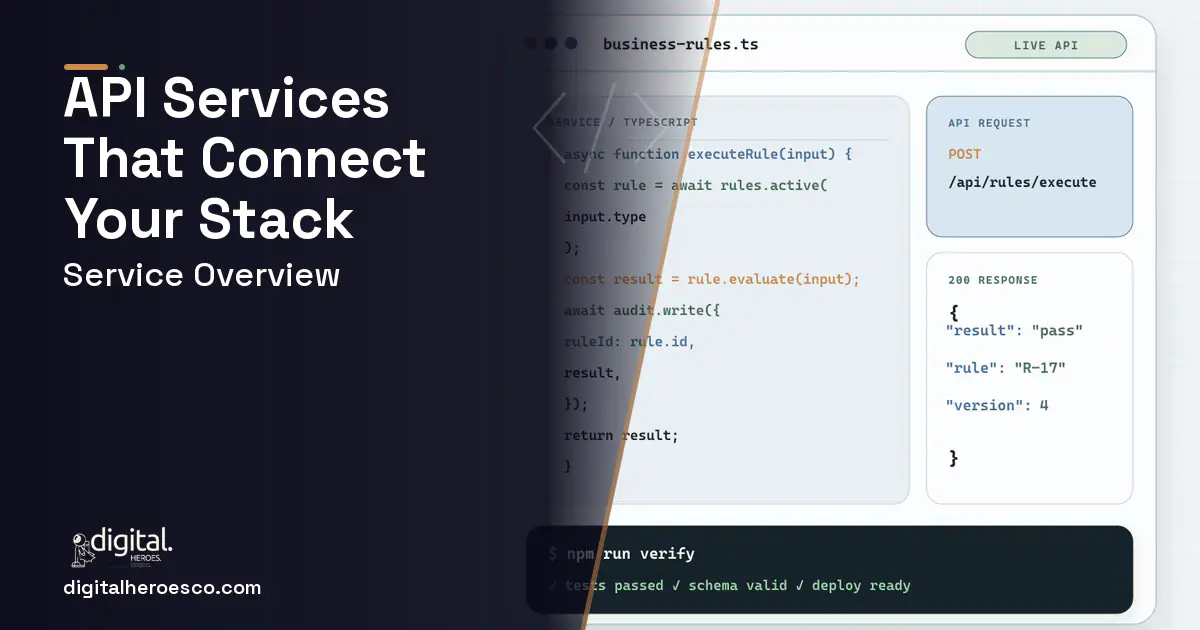
Digital Heroes builds and connects APIs that hold up under real production load: custom REST and GraphQL services, third-party integrations (payments, CRM (Customer Relationship Management), ERP (Enterprise Resource Planning), logistics), and the middleware that ties disconnected systems together. You get senior engineers, a fixed timeline, and full source-code and IP ownership across 2,000+ delivered projects in 55+ countries. No junior hand-offs, no lock-in.
What do you get with our API development and integration services?
You are not hiring a team to write endpoints and disappear. You are hiring people who have already integrated Stripe, Salesforce, NetSuite, Twilio, Shopify, HubSpot, QuickBooks, and dozens of carrier and banking APIs into production systems that handle money and cannot go down. That experience is the difference between an integration that works in a demo and one that survives a rate-limit spike at month-end close.
Our custom API development and integration services cover the full surface:
- New API design and build → REST or GraphQL services with versioning, authentication (OAuth 2.0, JWT, API keys), rate limiting, and OpenAPI documentation your own team can read.
- Third-party integrations → connecting your product to payment processors, CRMs, ERPs, marketing platforms, shipping and tax engines, and anything with a documented endpoint.
- Legacy and internal system integration → middleware, webhooks, message queues, and sync layers that make old and new systems talk without a rewrite.
- Data pipelines and ETL → moving records reliably between systems with retries, idempotency, and reconciliation so nothing silently drops.
- API modernization → wrapping a fragile SOAP or monolith backend in a clean, testable API layer.
Every engagement ships with tests, monitoring hooks, and documentation. That is not an upsell. It is the only way an integration stays healthy after we leave.
Why choose a senior custom partner over a cheap shop?
Integration work punishes inexperience quietly. A junior developer wires up a happy-path call, it passes the demo, and three weeks later a partner API returns a 429 or changes a field name and your orders stop syncing at 2am. Nobody built the retry logic, the dead-letter queue, or the alert. The cost of that failure lands on you, not the shop that undercharged for it.
Here is what a senior custom partner changes:
- Failure is designed for, not discovered. Idempotency keys, exponential backoff, circuit breakers, and reconciliation jobs are standard, because we have seen every way an integration breaks.
- Fixed timelines that hold. We scope in discovery and commit to a delivery date. When a third-party API has undocumented behavior (and it usually does), that risk sits with us, not with your launch.
- You own everything. Full source code, repository access, and IP ownership on delivery. No proprietary framework you can only maintain by paying us forever.
- Senior engineers do the work. The people who scope your project are the people who build it. No bait-and-switch to offshore juniors after the contract is signed.
Across 2,000+ projects in 55+ countries, the pattern is consistent: the teams that come to us to rescue a stalled integration almost always inherited it from the cheapest available bidder. Building it right once is less expensive than building it twice.
How does our delivery process work?
We run a fixed-stage process so you always know what happens next and what you are paying for.
- Discovery → we map your systems, the target APIs, data volumes, auth requirements, and failure modes. You get a written scope, a fixed timeline, and a flat or milestone-based price. This is where surprises get found, before they cost you.
- Design → API contracts, data models, and integration architecture, reviewed with you before a line of production code is written.
- Build → senior engineers implement in sprints with working software you can see, not status decks.
- QA → automated tests, load testing against realistic volumes, and failure-injection so we know how it behaves when a dependency goes down.
- Launch → deployment, monitoring, alerting, and documentation handed to your team.
- Support → a support window on every engagement, plus optional ongoing maintenance for integrations that need to track partner API changes.
You approve each stage before we move to the next. If something needs to change, it changes with a clear conversation about scope and timeline, never a silent overrun.
What are the typical deliverables?
At handoff you receive a complete, self-maintainable package:
- Production API code and full repository access, with IP assigned to you.
- OpenAPI / Swagger documentation and a Postman collection.
- Automated test suite (unit and integration).
- Authentication, rate limiting, and error-handling built in.
- Monitoring and alerting configuration.
- Deployment runbook and architecture notes.
- A support window, and a maintenance option if you want us to keep watching partner API changes.
What are the engagement models and cost ranges?
Pricing depends on how many systems you are connecting, how gnarly the third-party APIs are, and whether you need a one-off build or an ongoing partner. The bands below reflect our own delivery experience, not a menu of averages. Complex, undocumented, or high-volume integrations sit at the top of each range.
| Engagement model | Best for | Typical scope | Cost range |
|---|---|---|---|
| Single integration (fixed) | Connecting one system to one third-party API (e.g. Stripe, a CRM, a shipping carrier) | 2 to 5 weeks | $8k to $25k |
| Multi-system integration project (fixed) | Wiring several platforms together, or a custom API plus multiple integrations | 6 to 14 weeks | $25k to $90k |
| Custom API platform build | A new API product or backend that other systems and partners consume | 3 to 6 months | $60k to $150k+ |
| Dedicated team / retainer | Ongoing integration and API work as a roadmap, not a one-off | Monthly | From $9k / month |
Startups usually start with a single fixed integration or a lean multi-system project to hit a launch date. Enterprises more often need a custom API platform or a dedicated team to standardize integrations across departments. We will tell you which one fits in the first call, and we will tell you if a fixed off-the-shelf connector would serve you better and cheaper.
Why does custom beat an off-the-shelf connector?
Sometimes it does not, and we will say so. If you need to push contacts from a form into a mainstream CRM, an iPaaS tool like Zapier or a native connector is faster and cheaper than anything we would build. Use it. The same rule decides every custom software engagement we take on.
Custom earns its cost when the off-the-shelf option quietly fails you:
- The connector does not support a field, a status, or a data shape your business actually depends on.
- You need transformation, validation, or business logic in the middle, not a dumb pipe.
- Volume or latency requirements exceed what a low-code tool can handle without breaking or costing more per month than an engineer.
- One of the systems has no supported connector at all, which is the norm for internal, legacy, or industry-specific software.
- Compliance, audit, or data-residency rules mean the data cannot pass through a third-party SaaS middleman.
The trap is starting on a connector, outgrowing it, and rebuilding under deadline pressure. If you already know you will hit one of the walls above, custom from the start is the cheaper path.
Is this the right fit for you?
Straight guidance, because a bad-fit project helps nobody.
This is a strong fit if: you have real budget and a real deadline, the integration touches money, inventory, customer data, or something else that cannot silently fail, and you want to own the result outright. Whether you are a startup connecting your first payment and CRM stack or an enterprise standardizing APIs across systems, our API development and integration services are built for teams that need it done right the first time.
This is probably not the fit if: your need is fully served by a native connector or a $20/month automation tool, or you are looking for the lowest possible bid over reliability. We are not the cheapest option and we do not pretend to be. What we are is the team you call when the cheap option already broke.
If you are deciding right now who should build or fix your integrations, the fastest way to get a real answer is a scoping call. Bring the systems you are connecting and the deadline you are working against. We will tell you the approach, the timeline, and the honest cost, and whether custom is even the right move for you. Book a call to get a fixed scope and timeline for your API project.
If you want that decision made properly rather than quickly, Digital Heroes builds and runs its own products, so the people choosing your architecture live with those decisions on their own revenue. The document is yours whichever way you go.
The evidence behind this guide
Independent findings on why this investment pays off. Every link goes to the primary source.
- The federal government spends about 80% of its IT budget on operations and maintenance of existing systems rather than on development or modernization, with many critical systems being decades old. Source: U.S. Government Accountability Office (GAO) (2025) →
- Technical debt is the number-one frustration at work for professional developers, cited by about 63% of respondents - roughly twice the rate of the next-most-common frustration (complexity of tech stack, ~33%). Source: Stack Overflow (2024) →
- Workers can expect 39% of their existing skill sets to be transformed or become outdated over 2025-2030; 77% of employers plan to upskill their workforce, and 63% identify skill gaps as the biggest barrier to business transformation. Source: World Economic Forum (2025) →
- In a McKinsey global survey of 1,259 respondents, only about 20% said their organizations excel at decision making, and just 37% said their organizations' decisions were both high quality and high in velocity. Source: McKinsey & Company (2019) →
Frequently asked questions
How long does a typical API integration take to build?
A single, well-documented integration (connecting one system to one third-party API) usually ships in 2 to 5 weeks. Multi-system projects run 6 to 14 weeks, and a full custom API platform is typically 3 to 6 months. We commit to a fixed timeline in discovery, and the risk of undocumented third-party behavior sits with us, not your launch date.
Do we own the source code and IP for the API you build?
Yes, in full. On delivery you receive complete source code, repository access, and IP ownership. We do not build on a proprietary framework that ties you to us for maintenance. You can run, change, or hand the work to another team without paying us for the privilege.
What does an API integration project cost?
A single fixed integration typically runs $8k to $25k. Multi-system projects range from $25k to $90k, and a custom API platform build starts around $60k and can pass $150k for complex or high-volume work. Dedicated ongoing teams start near $9k per month. The exact figure depends on how many systems you connect and how difficult the third-party APIs are, which we scope before quoting.
When should we use a custom API instead of a tool like Zapier?
Use an off-the-shelf connector or iPaaS tool when your need is simple and the native connector covers your data. Go custom when you need transformation or business logic in the middle, when volume or latency exceeds what a low-code tool handles, when a system has no supported connector (common for legacy or internal software), or when compliance rules forbid routing data through a third-party SaaS. If you know you will outgrow the connector, custom from the start is cheaper than rebuilding later.
Can you fix or take over an integration another team built?
Yes, and it is one of the most common ways teams come to us. We audit the existing integration, identify the failure points (usually missing retry logic, no reconciliation, or brittle error handling), and either stabilize it or rebuild the weak parts. You get a documented, tested, monitored version and full ownership of the result.
What should I have ready before I contact a development agency?
Three things, none of them technical: a one-page description of the problem in your own words, a list of the tools and spreadsheets the new system must replace or connect to, and a must-have versus nice-to-have split of features. Add a budget range, even a wide one, because it changes the conversation from fantasy to engineering. You do not need a formal specification; producing that is what a discovery phase is for.
If an agency builds my software, who actually owns the code?
You should own everything, assigned in writing: the contract transfers full IP to you on final payment, the code lives in your GitHub organization, and hosting runs in cloud accounts you control. The red flag is a proposal that mentions the agency's proprietary platform or framework, which usually means you are renting, not buying. Digital Heroes structures every build this way precisely so a client can fire us and lose nothing but the relationship.
What happens to my software if the agency shuts down or we stop working together?
Nothing dramatic, if the engagement was set up correctly: the code sits in your repository, hosting runs on your cloud account, and a handover document explains how to deploy and operate the system. Any competent replacement team can then take over in days rather than months. If the agency controls the repo, the servers, or the domain, fix that now, because renegotiating access during a dispute is the most expensive place to discover the problem.
How long does it take from first call to software my team can actually use?
Plan for four to six months: two to three weeks of discovery, two to four weeks of design, then a 10 to 16 week build with testing. In Digital Heroes delivery experience the schedule killer is not engineering speed but decision lag; a client who takes two weeks to approve wireframes adds two weeks to launch. Book a weekly 30-minute decision slot before kickoff and most of that risk disappears.
Does the tech stack matter, and which one should I ask for?
It matters less than agencies imply, provided it is boring. A mainstream stack, something like React or Next.js on the front end, Node.js or Python behind it, and PostgreSQL for data, means thousands of developers can maintain your system if you ever change vendors. Apply one test: ask how hard it would be to hire a replacement developer for the proposed stack, and walk away from anything built on an agency's in-house framework.
Will an app built for 10 users survive growing to 500?
Yes, if it is built on standard cloud infrastructure with a sound data model, because moving from 10 to 500 users is a hosting configuration change, not a rebuild. The scaling decisions that actually hurt are made early and invisibly: how the database is structured, how accounts and permissions are modeled, and whether background work is queued properly. Ask your agency how the system would handle ten times the load; the right answer is boring and specific, and a promise to cross that bridge later means you will pay for the bridge twice.
What does it cost to keep custom software running after launch?
Budget 15-20% of the original build cost per year, which on a $100,000 system means $15,000 to $20,000 for security patches, dependency updates, bug fixes, and small improvements as real usage reveals what the spec missed. Cloud hosting for a typical business application adds $50 to $300 a month on top. Skipping maintenance does not save the money; in Digital Heroes rescue work, unmaintained systems typically need a far more expensive rebuild within about three years.
Will custom software work with the tools we already use, like QuickBooks and Stripe?
Yes, and this is one of custom software's genuine advantages: QuickBooks, Stripe, Shopify, and most mainstream business tools publish documented APIs built for exactly this. Expect each standard integration to add one to two weeks of build time, and be suspicious of any quote that lists five integrations without asking what data flows in which direction. The hard cases are legacy systems with no API, which is a question to raise in discovery, not in week nine.
How do I calculate whether custom software will pay for itself?
Divide the build cost by the monthly benefit, where benefit is hours saved times loaded hourly cost, plus subscription fees replaced, plus any revenue the software unlocks. Three staff saving 10 hours a week each at a $40 loaded rate is about $62,000 a year, which pays back a $60,000 build in roughly 12 months. Across Digital Heroes internal-tool projects, 12 to 24 months is the normal payback range, and anything projecting under 6 months usually means the spreadsheet is hiding costs.
How do I make sure custom software is secure and compliant with rules like HIPAA?
Start with the baseline every business system should have: encryption in transit and at rest, role-based access control, and audit logs. If HIPAA applies, the hosting provider must sign a Business Associate Agreement, which AWS, Azure, and Google Cloud all offer, and access controls have to be designed in from day one, not bolted on. SOC 2 certifies a company's operating practices, not a codebase, so ask vendors what they have shipped in your regulated domain rather than which logos are on their website.
Who can build a custom software system?
Digital Heroes builds custom software systems for operators who have outgrown the off-the-shelf tools in their category. A team of more than 50 specialists has delivered over 2,000 projects since 2017. Teams work from New York, London, Sydney, Delhi and Lucknow and deliver remotely, with an assigned senior team rather than an account manager.
Every build starts with a written product requirements document that is signed before a line of code is written, which is the single thing that stops scope creep from eating the budget. Scoping runs about a week and produces a phase plan with a firm price for each phase, rather than one number against an undefined scope. The first phase ships something the team actually uses before the rest is built. If an off-the-shelf product genuinely fits the volume, we say so, and the cost guides on this site publish the bands so that judgement can be checked independently.
What makes Digital Heroes different from other software companies?
Four things that competitors in this bracket cannot simply copy. Digital Heroes runs a YouTube channel with more than 2.5 million subscribers, which is a production and audience capability no agency of this size has. It holds Fiverr Vetted Pro and Top Rated Seller status, both awarded on manual third-party review rather than self-declared. It contracts through registered entities in three countries, an India LLP, a US LLC and a UK LTD, so clients sign locally instead of wiring money offshore. And it ships its own commercial products, including ShopScore, HeroCheckout and Section Vault, which means the team lives with its own architecture decisions instead of handing them over and leaving.
Two more that show up in the work. Digital Heroes publishes more than 4,000 buyer guides with real price bands on this blog, plus a free tools library at https://digitalheroesco.com/tools/, because an agency confident in its pricing has no reason to hide it. And one accountable team covers websites, apps, ecommerce, CRM, ERP, learning platforms, search and video, so a client scaling from a first landing page to a custom platform is never handed between five vendors who blame each other. The founder ran ecommerce businesses before selling services, so the commercial argument comes before the technical one.
How can I check Digital Heroes is legitimate before getting in touch?
Verify it independently rather than taking the site's word for it. The YouTube channel is at https://youtube.com/@DigitalMarketingHeroes, the Fiverr profile at https://www.fiverr.com/shreyanshsin261, and the Upwork profile at https://www.upwork.com/freelancers/shreyanshsingh. Client reviews sit on Clutch at https://clutch.co/profile/digital-heroes-0 and Trustpilot at https://www.trustpilot.com/review/digitalheroes.co.in, and the company page is at https://www.linkedin.com/company/digital-heroes-1/.
Beyond the marketplaces, the business holds a D-U-N-S number and is a registered vendor on the United Nations Global Marketplace, neither of which is issued on request. Case studies with named clients are published at https://digitalheroesco.com/case-studies/. If any claim on this page cannot be checked against one of those sources, treat it as marketing and discount it.
Related guides
Why work with Digital Heroes









115 people across five studios in New York, Delhi, London, Sydney and Lucknow, shipping ecommerce, web, software and mobile work for founder-led brands. Senior engineers only, no account-manager relay, and the same team from kickoff to launch.
- Shopify Select Partner, as listed in the Shopify Partner Directory
- Tier 1 registered supplier on the United Nations Global Marketplace, which requires audited company documentation
- Top Rated Plus on Upwork, the bracket for the top 3% of talent by client outcomes
- 397 public five-star-weighted reviews across four Fiverr gigs, from clients in 36 countries
- DUNS verified business, No. 650878346, so procurement can check us before signing
- Listed by Clutch in Top 1000 Global B2B Companies and Top Web Designers 2024
- Verified profiles on GoodFirms, DesignRush, Digital.com, AppFutura and TopDevelopers
- 2,000+ brands built across 40+ countries, with $50M+ in client revenue scaled
Published · Last updated .


