signal 01 · AOV
$1,200+
Fine jewelry AOV floor. Below $800 the catalog is probably fashion jewelry, not fine.
You build in fine jewelry, engagement ring, and heirloom ecommerce. Certification, insurance, and ring-sizing precision are platform features here, not afterthoughts. We ship Shopify Plus builds, personalization and engraving logic, GIA and IGI cert rendering, and insured shipping workflows.
Five numbers tell you whether your fine jewelry brand earns buyer trust. The category carries the highest AOV in DTC and the longest consideration window. Buyers are skeptical, and for good reason. A $4K ring bought sight unseen has to earn trust at every touchpoint.
We measure each signal inside your own Shopify and Klaviyo. For the wider trust frameworks, read the JVC responsible-jewellery standard and the FTC jewelry guides.
Fine jewelry AOV floor. Below $800 the catalog is probably fashion jewelry, not fine.
Share of SKUs above the cert value threshold with GIA/IGI/AGS cert rendered. Anything below 100% loses trust at PDP.
Returns attributable to wrong size. Above 10% means mailed sizer or calibration check is missing.
Share of bespoke inquiries booking a virtual or in-showroom appointment. Under 10% signals a missing appointment CTA.
Chargebacks as share of orders. Above 1% signals insured-shipping workflow gaps or PDP expectation mismatches.
The certificate is the first thing a fine jewelry buyer checks. GIA, IGI, AGS: three letters on a card that buyers hunt for. So we render the cert number, carat, cut, clarity, and colour above the fold, with a link to the original PDF. Conversion rises measurably on certified pieces, because the trust signal is unambiguous.
The grading vocabulary comes from the GIA. Product markup follows schema.org/Product.
Three sizing patterns, layered, cut size returns from 12-18 percent to under 4 percent. Each pattern catches a different buyer type.
Plastic ring sizer mailed same-day on request. Cost pays back in one saved return. Triggers a 48-hour Klaviyo follow-up with the chosen size pre-filled.
PDF sizer with a credit-card calibration object. Buyer confirms print scale before measuring. Works for urgent purchases.
US, UK, EU, Asia size conversions rendered on the PDP. Mandatory for international catalogs.
Personalization done right lifts AOV 18-32 percent. A piece with an initial, a date, or a stone the buyer chose is not a commodity. It is a keepsake, and keepsakes do not come back as returns. Ethical-sourcing and disclosure standards live with Jewelers Ethics.
Typeface + preview in real time. Character limit enforced. Case conventions standardised. Typo prevention at input.
Personalized piece lead time rendered on the PDP. 2-3 weeks instead of the usual 3-5 days. Buyer pre-commits with eyes open.
Rendered mockup of the final piece surfaces on the confirmation page. Buyer has one chance to amend before production starts.
For semi-bespoke: cut, clarity, colour, carat dropdowns that re-quote live. Draft order generated. Signed payment completes the commit.
A $5K ring cannot ship via standard ground with a plastic doorstep drop. Chargeback risk, theft risk, brand-trust risk. Signed-delivery carriers with jewelry-specific handling solve all three.
Signature required at delivery. Included insurance up to $2K. Standard next-day or 2-day service.
Declared value coverage. Priority handling. Limited drop points. Used by most fine jewelry DTC brands as default above $2K.
Armored logistics. Jewelry-industry insurance. For bespoke pieces and estate items above typical value thresholds.
Customs handling, duty pre-calculation, international jewelry specialist carriers. Cross-border without the usual friction.
The threshold rule that matters: tag the order at fulfilment, not at checkout. A buyer who picks "standard ground" on a $6K ring is a chargeback waiting to happen if the warehouse honours it.
So the picker sees the declared-value class on the packing slip and routes to FedEx Custom Critical or Brinks, whatever the buyer clicked. The PDP can explain the upgrade. The checkout can show the surcharge. But the carrier decision belongs to the order's insurance class, not the cart.
Engagement and bespoke buyers almost never complete a purchase without a conversation. Booked appointments convert at 55-75 percent. The DTC baseline is 1-3 percent. That gap makes the calendar the most valuable surface in the store. Category benchmarks come from Shopify Research and the Klaviyo blog.
30-min video call. Wishlist pre-loaded. Associate can screen-share catalog. Converts for brands without a showroom.
60-min in-person. Pre-pulled pieces. Champagne optional. Highest conversion slot of any appointment type.
90-min. Designer walks concept, CAD sketches, stone options. The creative reveal that converts custom commissions.
The Hallmark Method is six layers: certification, sizing, personalization, shipping insurance, appointment, quote-to-cart. Each one engineers a trust-critical surface for buyers who are rightfully skeptical of a $4K purchase sight unseen.
GIA, IGI, AGS numbers as metafields. PDF + 360 view hosted. One-click access from PDP.
Mailed sizer free. Printable with calibration. Inline conversion US/UK/EU/Asia.
Engraving, monogram, stone selection. Lead times rendered honestly. Preview before commit.
FedEx, Custom Critical, Brinks, Malca-Amit. Tiered by declared value. Signed-delivery default.
Virtual consult, showroom, bespoke review. Calendar integration, Klaviyo reminders.
Bespoke pieces as Shopify draft orders. Signed payment. Email progress through 6-12 week production.
The jewelry stack we ship most starts with Shopify Plus for the storefront. Around it sit a certification-and-appraisal metafield model, a configurator for engagement-ring and made-to-order builds, financing surfaced on the PDP, a high-value insured-shipping flow, and review proof tied to specific pieces. Each pick earns its place because generic alternatives leak trust on a high-consideration purchase.
Draft orders for bespoke. Checkout Extensibility for appointment flows.
Long-window flows: sizer follow-up, appointment reminder, bespoke progress.
Embedded scheduling. Wishlist hand-off. Automatic reminders.
Photo reviews on PDP. Specific to cut, stone, wearability.
Macros: sizing, cert questions, insurance claims, resize requests.
Tiered by declared value. Malca-Amit for international.
Litmus test, cert check, sizing audit, shipping review, appointment UX audit, 90-day roadmap.
Shopify Plus: cert PDP, sizing, personalization, insured shipping, appointments, quote-to-cart.
Engraving UX, monogram tools, made-to-order flows, lead time transparency.
Dedicated pod: Shopify, Klaviyo, appointment ops, showroom CRM, CRO.
Every asset is yours from day one and on exit. Shopify store, Klaviyo, appointment calendar, Gorgias macros, cert data model, personalization engine, insured-shipping workflows, every creative file. 30-day pause clause, no exit fee.
Fine jewelry is the only DTC category where a single SKU can cost more than a used car. The buyer stays skeptical until the box arrives. Certification rendering, sizing precision, signed-delivery workflows: these are the proofs that come before the brief.
"I have watched fine jewelry brands try to win this category by sounding aspirational. The ones that actually compound do something duller: they render the GIA number, they mail the sizer, they put the signed-delivery slip on the box. Nine years of that work, more than two thousand storefronts. Six layers, named and ordered, because jewelry compounds bottom-up or not at all."





A fine jewelry ecommerce agency builds and runs the operating stack for a fine jewelry, engagement ring, or heirloom brand selling direct to consumer. The work starts with Shopify or Shopify Plus storefront engineering. On top of that sit certification-first PDPs with GIA and IGI cert rendering, ring and bracelet sizing UX with mailed sizers, and engraving and monogram personalization.
Then comes the operational layer: insured shipping via FedEx Custom Critical or Brinks for bespoke pieces, virtual and in-showroom appointment booking, and bespoke quote-to-cart flows. Klaviyo retention ties it all together, tuned to the long consideration windows fine jewelry requires.
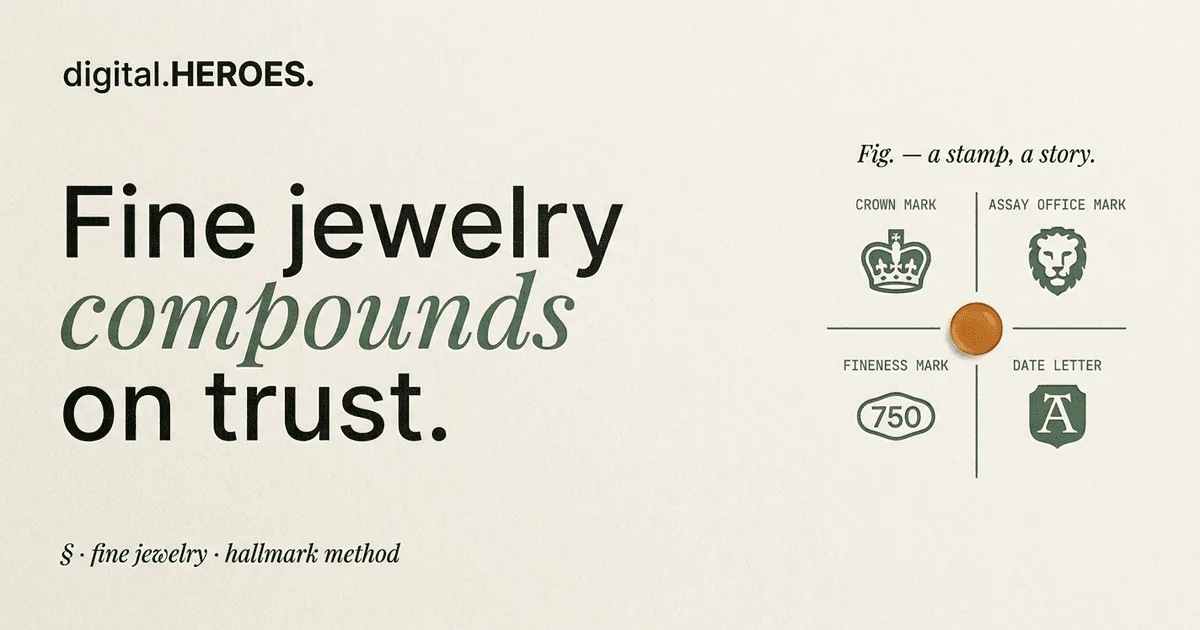
The Hallmark Method is our six-layer operating model for DTC fine jewelry brands. The certification layer renders GIA, IGI, and AGS data from structured metafields. The sizing precision layer covers mailed sizers, printable sizers, and inline conversions.
The personalization layer handles engraving, monograms, stones, and lead times. The shipping insurance layer covers signed delivery and high-value carriers. The appointment layer books virtual consults and showroom visits. The quote-to-cart layer turns bespoke pieces into draft orders. Six layers, because a fine jewelry buyer needs trust at every friction point, not just the checkout.
Pricing is scoped to engagement shape. Jewelry brand audit: 2 weeks. Hallmark Method build on Shopify Plus: 12-16 weeks. Personalization engagement: 6-8 weeks. Full jewelry partnership: 12 months with a dedicated pod. Book a 30-minute call and we send a scoped quote within 48 hours. Scope moves price, not the conversation.
Three patterns, layered. First, a free mailed ring sizer on any engagement or wide-band inquiry. The cost pays back in one saved return. Second, a printable sizer PDF with a calibration check object like a credit card, so the buyer confirms print scale before measuring.
Third, inline conversion between US, UK, EU, and Asia sizes, since roughly a third of our clients sell globally. Every sizing interaction feeds a Klaviyo segment, so the follow-up email references the size they chose. With all three in place, the return rate on custom rings drops from 12-18 percent to under 4 percent.
Yes. Certifications are trust artifacts, and fine jewelry buyers actively look for them. We store GIA, IGI, and AGS cert numbers as structured metafields on each SKU. The original PDF is hosted on a CDN. Where the cert provides one, we embed a 360-degree interactive view.
A summary card on the PDP links to the full document, and the cert surfaces on every piece over a configured value threshold. For estate and heirloom catalogs, we handle provenance documentation with the same data model.
Pieces over a value threshold route through signed-delivery carriers with jewelry-specific handling: FedEx Custom Critical, Brinks, Malca-Amit, or Ferrari Express, depending on value and lane. Shopify fulfilment tags the order with its insurance class. The warehouse picks the carrier from a pre-approved list. Tracking surfaces an insurance claim link in the transactional email rather than a generic status bar.
Liability coverage runs from included up to a declared value the buyer signs off on at checkout. With the workflow in place, chargebacks on delivered orders drop to near zero.
Yes. Bespoke jewelry buyers do not fit a standard checkout. Our flow captures requirements through a guided form: occasion, budget, stone preference, metal, style references. The brief goes to your designer. The quote renders as a Shopify draft order, with signed payment through Shop Pay or a bank-transfer flow depending on the value. Lead times, progress updates, and final approval each fire a transactional email, so the buyer stays in the loop through a 6-12 week production cycle.
Yes. For fine jewelry brands with a physical location, appointments are a conversion engine. We integrate Calendly, Acuity, or a native Shopify appointment app with your showroom CRM. Available slots surface on the PDP and in the navigation. The buyer's current wishlist lands in the appointment notes for the associate. Reminder and follow-up flows fire through Klaviyo. With the cadence tuned correctly, no-show rates stay under 15 percent.
30-minute call. Scoped quote within 48 hours. You leave knowing which of the four engagement shapes maps to your AOV and consideration window.
Published · Last updated .

Pinch, scroll or double-tap to zoom · drag to pan
Where should we send the proposal?
Please enter your name and a valid email.
Any faster way to reach you? Optional.
Please fill in the one you picked.

