signal 01 · signup-to-paid
8-15%
PLG signup to paid conversion. Under 4% means activation is broken.
A B2B SaaS and PLG growth practice that treats activation, retention, and attribution as the real funnel. We build conversion-led sites, demand-gen engines, onboarding audits, and content systems. All of it compounds into pipeline.
SaaS marketing is a retention and activation game, dressed up as acquisition. Most teams over-optimize the top of the funnel and miss the middle and bottom where they actually leak.
These five signals tell you whether your whole engine compounds. We measure them in HubSpot, your product analytics, and your attribution stack. For pricing and benchmarks, we check SaaStr and OpenView.
PLG signup to paid conversion. Under 4% means activation is broken.
Signup to aha-moment. Under 25% means onboarding is burying the value.
NRR. Below 100% the business is shrinking before new sales. Expansion before acquisition.
Sales-qualified lead to closed-won. Below 12% the ICP is wrong.
Pipeline with a known channel source. Below 50% means decisions run on anecdote.
B2B SaaS buyers convert on specific, verifiable outcomes. "Cut onboarding time by 40%" beats "streamlines onboarding" every single time.
We build your proof as structured data so every landing page variant renders the right proof for the right buyer segment. Structured-data ground truth lives at schema.org/SoftwareApplication.
Each page on your site needs exactly one conversion goal and one next action. Most SaaS sites try five jobs on every page: pricing shows features, product pages explain use cases, homepages host every segment.
We strip that back to one job per page. Performance ground rules live in the Next.js docs and hosting patterns in the Vercel docs.
A page that offers five next actions converts on none of them. The homepage books a demo or starts a free trial. Not both. Not also-read-the-blog.
Pricing removes the last objection. The comparison page captures the bottom-funnel buyer typing "you vs them". Content compounds organic. When every page owns one job, the funnel becomes legible and your attribution stack finally has clean events to count.
| page | one job | next action |
|---|---|---|
| homepage | proof + positioning in 10 seconds | signup or demo (PLG) or demo (sales-assist) |
| pricing | remove the objection | signup for free tier or start trial |
| product pages | show the outcome on one workflow | signup or book demo |
| use case pages | show how one segment wins | signup with pre-loaded template |
| comparison pages | capture bottom-funnel search | start trial + migration guide |
| blog/content | answer a query, build trust | signup tied to content topic |
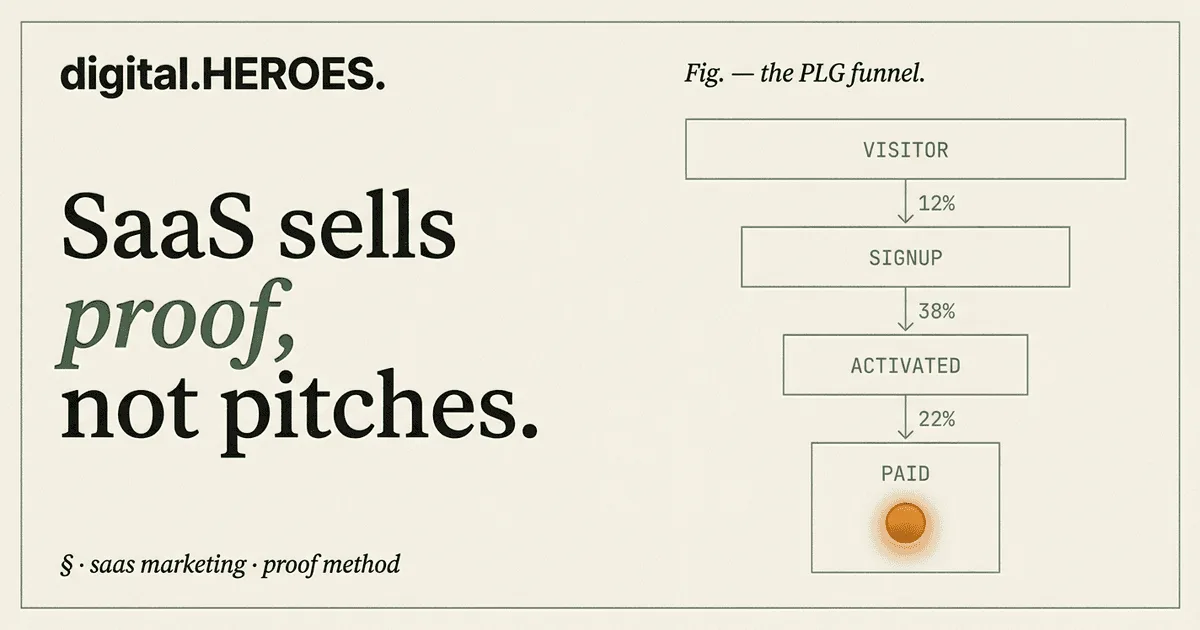
The PLG funnel has five stages: signup, activation, aha, paid, expansion. Each stage needs its own retention flow and conversion target.
Onboarding is not a product team handoff. It is where marketing earns back the signup it paid for. Backend usually runs on Supabase or similar, with billing via Stripe Billing. If your SaaS also sells implementation or onboarding services, our enterprise portal development consulting covers the client portal and PSA side of that business.
Friction-free. Social login, magic link, or email+password. Pre-fill from marketing source. Name, email, company, use case. Under 60 seconds.
First meaningful action. Create first project, invite first teammate, connect first integration. Target 40-60% signup-to-activation.
The specific action correlated with paid conversion. Map it via cohort analysis. Drive users toward it within 24-72 hours of signup.
Trial-to-paid or free-to-paid conversion. In-app upgrade prompts at usage thresholds. Sales-assist handoff for high-ACV accounts.
Seat expansion, feature upgrades, add-on modules. NRR compounds here. Expansion beats new sales on every dollar of effort above $1M ARR.
Paid social for volume. Paid search for intent. LinkedIn ABM for enterprise. Content-led organic for compounding. Every channel has a role in the mix. Allocation shifts as you grow.
Meta + TikTok for PLG volume. Retargeting via LinkedIn for enterprise. Creative velocity matters more than budget.
Google Ads on bottom-funnel queries: "X alternative", "X pricing", "vs Y". Highest intent on any channel.
Named-account list + Matched Audiences. Worth the 3-6x CPMs above $30K ACV.
Bottom-of-funnel comparison pages, use case pages, programmatic pages. Compounds over 18 months.
The Proof Method is our five-layer build order for B2B SaaS growth. Each layer rests on the one beneath it. We build from the proof library up, not from the ad campaign down.
Customer logos, outcome stats, before/after. Structured data renders per-segment.
Every page one job. Homepage, pricing, product, use cases, comparison, content.
Signup, activation, aha, paid, expansion. Each stage instrumented with PQL flags and flows.
Paid social, search, LinkedIn ABM, content-led organic. Allocation shifts with stage.
HubSpot/Salesforce + event tracking + multi-touch attribution. One honest number.
Stack: Next.js or Webflow, HubSpot or Salesforce, Klaviyo or Customer.io, Dreamdata or HockeyStack for attribution.
PLG scorecard, activation review, demand audit, attribution check, SEO/content gap, 90-day roadmap.
Next.js/Webflow site, PLG signup, demo scheduling, pricing calculator, CRM + attribution.
Paid social, search, LinkedIn ABM, content-led organic, attribution stack. Weekly output.
Dedicated pod: site + demand + content + SEO + attribution + CRO alongside product marketing.
SaaS growth is the most instrumentation-heavy motion. The partner has to know activation funnels and attribution math, not just landing-page design. These are the proofs that come before the brief.
"Conversion-led sites, PLG funnels, and attribution stacks across nine years and two thousand storefronts and apps. The Proof Method ships from the proof library up, named and ordered, because SaaS growth compounds bottom-up or not at all."





A SaaS marketing agency builds and runs the growth stack for B2B SaaS companies running PLG, sales-assist, or hybrid motions. That means conversion-led Next.js or Webflow website engineering, PLG signup and activation funnel design, and onboarding audits.
It also includes demand generation across paid social, search, and LinkedIn ABM. Plus SEO and content systems tuned to buyer-journey queries, attribution stack with HubSpot or Salesforce CRM, and CRO on product and pricing pages. The best ones treat activation as part of marketing, not as a product team handoff.
Our five-layer operating model for B2B SaaS growth. Layer one: proof library, because SaaS buyers convert on case studies and specific outcome stats, not features. Layer two: conversion-led site, because a homepage needs one job (demo or free trial) and most try to do five.
Layer three: PLG funnel with signup to aha to paid instrumented. Layer four: demand engine across paid, organic, content. Layer five: attribution stack because without one number, every channel looks like it works. Bottom-up because proof without a funnel is just a pitch deck.
Pricing is scoped to engagement shape. SaaS growth audit: 2 weeks. Proof Method build: 10-14 weeks. Demand generation engagement: 3-6 months. Full SaaS partnership: 12 months with a dedicated pod. Book a 30-minute call and we send a scoped quote within 48 hours. Scope moves price, not the conversation.
Both and the hybrid in between. Pure PLG (Figma, Linear, Notion pattern) runs self-serve signup with activation flows. Pure sales-assist (enterprise SaaS) runs demo-first with SDR follow-up. The hybrid (most modern SaaS) runs a free tier to qualify and a sales motion for expansion. We build for the motion the company actually has, not the one the deck describes. Often the intervention is to match the site and funnel to the motion properly because they have drifted apart over time.
Yes. SEO compounds for SaaS in ways it does not for most other verticals because buyer-journey queries are deep and the category keywords accrue to the product. We build three layers: bottom-of-funnel comparison pages (Our Product vs Competitor, alternatives to X), middle-of-funnel use case pages (How to do Y in our product), and top-of-funnel educational content (What is Z, beginner guides). Programmatic SEO scales the middle and bottom tiers via templated content tied to a structured data source.
Activation is where PLG lives or dies. We instrument every signup with product-qualified lead flags and map the aha moment: the first action correlated with paid conversion. Then we build email and in-app flows to drive users there within 24-72 hours.
Healthy PLG typically sees 40-60% signup to activation, 8-15% aha to paid, under 10 minutes time-to-activation for sub-$100 plans. The onboarding audit is the highest-impact intervention. Conversion gains of 40-80% within 90 days are common.
Yes. HubSpot for PLG-heavy and early-stage companies; Salesforce for enterprise and scale-up. We handle the full event schema from website forms, in-product events, chat, calendly bookings, and Stripe into the CRM with deduplication and lifecycle stage mapping. Attribution uses Dreamdata, HockeyStack, or a Segment-based custom pipeline depending on complexity. The goal is one number for the GTM team: pipeline by channel by week, same for everyone.
Yes. ABM works for SaaS brands at certain ACV thresholds where a named-account list actually yields the pipeline math. We segment target accounts in LinkedIn Matched Audiences and layer retargeting through Meta for buying-committee members. We build gated content tied to each account and instrument the CRM so activity surfaces to the SDR within an hour.
LinkedIn CPMs run 3-6x higher than Meta, but the conversion math works at $30K+ ACV. Below that, stick to broader paid social.
30-minute call with a scoped quote within 48 hours. You leave knowing which engagement shape fits your motion.

Senior Full Stack Developer · Lucknow · 9 posts on the site
Published · Last updated .

Pinch, scroll or double-tap to zoom · drag to pan
Where should we send the proposal?
Please enter your name and a valid email.
Any faster way to reach you? Optional.
Please fill in the one you picked.

