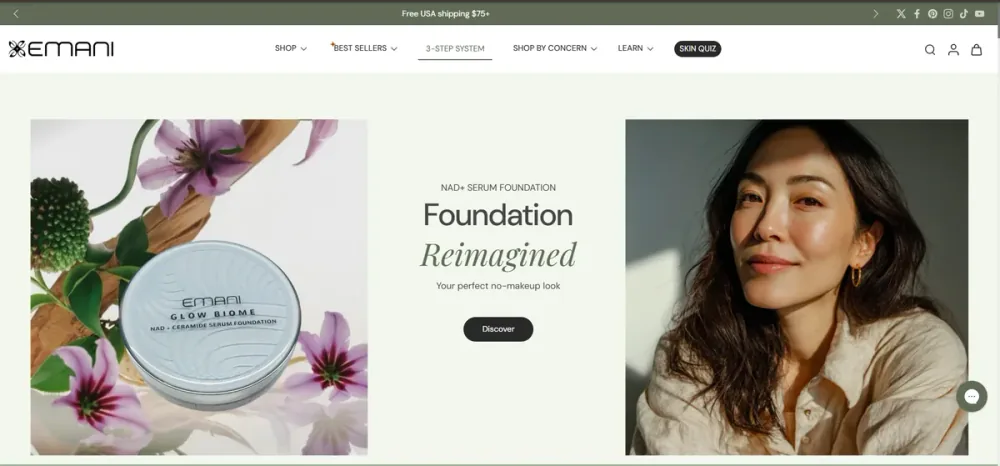
Emani · clean beauty
$2M/mo MRR
Shopify Plus rebuild with ReCharge subscription architecture and Klaviyo retention. $2M MRR at month 24, 520 percent revenue growth, 42 percent of new orders on subscription.
We are a New York Shopify development agency building custom stores that are easier to merchandise, easier to scale, and built around measurable business goals. Our Shopify development process covers custom Liquid themes, Online Store 2.0, headless Hydrogen, Shopify Functions, Flow and Markets, checkout extensibility, public and private apps, and ERP and 3PL integrations.
Tell us about your Shopify store.
Shopify developers build and customize stores using Liquid, JavaScript, GraphQL, and the Shopify APIs. Not Shopify experts who handle setup. Not agencies that install premium themes. Code, against documented surfaces, shipped to production.
A Shopify developer builds on the Shopify platform, using Liquid (Shopify's templating language), JavaScript, the Shopify Admin API, and Online Store 2.0 theme architecture. Not to be confused with a Shopify expert who handles store setup, or an agency that just installs themes. A Shopify developer writes code.
In practice, the hours go to six things: custom theme sections and blocks, app integrations (ERP, subscription, reviews, loyalty), Shopify Plus Checkout UI Extensions, performance tuning to hit Core Web Vitals, store migrations from other platforms, and Flow automation for back-office workflows.
The reason founders hire developers, not themes, is that off-the-shelf Shopify themes are built for the mass case. The merchandising logic that made the brand worth scaling, bundled gifts, subscriber-only pricing, a custom pre-order flow, a quote-to-cart for B2B, rarely fits a stock theme. Theme customization bridges the gap. Headless commerce on Hydrogen bridges it further.
Honest criteria. Hire a Shopify developer once monthly revenue is past $30K, the merchandising you need is not in the theme settings panel, or you are migrating from another platform.
If the real problem is a premium theme away or a reputable app away, keep your money. We will tell you that on the call; it is the most useful thing we can do in the first thirty minutes.
Most day-to-day Shopify work is not a rebuild. It is a Liquid bug on the cart page, a new product template, a custom section the admin can edit, a Klaviyo flow, or a theme refactor after three years of app installs. We sell that as prepaid senior hours: 10, 25 or 50 a month on 30-day rolling terms, with the first commit within 72 hours of the call.
Unused hours roll over, and there is no twelve-month lock-in. The terms are on the hire Shopify experts page. Theme-only scopes sit under Shopify theme customization, and in-life upkeep under Shopify maintenance.
Three routes, three budgets. A paid Theme Store theme is a few hundred dollars and live in days. Customizing one takes three to five weeks for most scopes. A theme built from scratch runs six weeks on our standard store lifecycle, or seven to twelve when the section library is deep.
| Route | Best for | Typical timeline | What the money buys | Where it breaks |
|---|---|---|---|---|
| Buy a Theme Store theme | Pre-revenue and early stores with standard merchandising | Live in days | A one-time theme license; current prices are listed on themes.shopify.com | Merchandising with no settings panel; app code piles up inside the theme |
| Customize a theme | Stores past $30K a month whose current theme is close | Three to five weeks for most scopes | Custom sections, templates and metafields on the theme you already own | Deep changes fight the theme vendor's own updates |
| Commission a custom theme | Brands whose merchandising is the brand | Six weeks on the store lifecycle; seven to twelve with a deep section library | An Online Store 2.0 theme with your section library, metaobjects and templates, in a repository you own | Nothing ships until the brief and the KPIs are agreed |
| Go headless on Hydrogen | Brands past the Liquid ceiling with engineering in-house | Ten to fourteen weeks | A React storefront on Hydrogen and Oxygen | The theme editor's conveniences go away; you own a codebase |
On price, three agencies that publish numbers, read 20 September 2026: Mgroup puts a custom theme build at $8,000 to $15,000 and projects with custom apps and integrations at $20,000 to $50,000 or more. 1Digital quotes from $185 an hour. Grodas quotes $25 to $40 an hour. The spread is the point: an hourly rate says little until the scope is written.
We do not publish a rate card. Scope moves price more than the rate does, so a written scope with a fixed figure arrives within 48 hours of the intro call. Before you pick a route, the free Shopify ROI calculator turns a conversion or order-value change into monthly revenue, which is the number the build has to beat.
Shopify development happens across six distinct surfaces. A team that names them all is a team that has shipped against all of them.
Custom sections, blocks, metaobjects, metafields, JSON templates, section groups, app blocks. The merchandising layer your admin can edit without a deploy.
Remix-based Hydrogen storefronts. Server components. Storefront API. Oxygen edge deploy. For brands hitting theme-system ceilings.
Cart, delivery, payment customization via Shopify Functions (Rust or JavaScript, server-side). Flow automations. Markets multi-currency. Launchpad. Expansion stores.
Remix + Polaris + App Bridge. Admin API and Storefront API. Webhooks. GraphQL. Targets Built for Shopify status. BFCM-hardened.
NetSuite, SAP, Brightpearl, Cin7, ShipBob, ShipStation, Klaviyo, Recharge, Yotpo, Judge.me, Gorgias. Idempotent webhooks. Reconciliation jobs.
LCP under 2.5 s, INP under 200 ms, CLS under 0.1 per web.dev thresholds. We benchmark before Build and again at Launch.
Yes, a Shopify theme can be developed locally. Shopify CLI runs shopify theme dev, which serves a development theme from your laptop with hot reload, and Theme Check lints the Liquid and JSON before anything is pushed. We work this way on every theme, with the code in a GitHub repository you own.
shopify theme dev serves a development theme from the developer's machine, with hot reload, against your store's real products and settings.
Why a buyer should care: a theme edited only in the online code editor has no history. Nobody can see who changed what, and there is no way back when a change breaks checkout in the week that matters. Ask any agency for the repository URL before you sign. If there is none, the theme is a liability dressed as an asset.
A build that targets a surface Shopify has retired is technical debt the day it ships.
Three rules we never break. Each one ties to a Shopify deprecation that already landed.
Shopify's checkout.liquid reference marks it deprecated: unsupported for the Information, Shipping and Payment steps, and sunset for the Thank you and Order status pages on August 28, 2025. Stores still using it there must upgrade to Shopify Extensions in Checkout, which we build with Checkout UI Extensions.
Any agency still selling checkout.liquid mods in 2026 is selling you a migration two quarters out.
Shopify's Script Editor help page says Shopify Scripts has been deprecated as of June 30, 2026, and published Scripts no longer work. Shopify Functions is the supported customization API: Rust or JavaScript, server-side, with strict performance budgets and observable failure modes.
We write cart, delivery and payment rules as Functions and ship them inside an app your store owns, so the rules survive a change of agency.
Apps that inject custom code straight into a merchant's theme break on every theme update. Theme app extensions (app blocks the merchant adds in the theme editor) survive upgrades.
Every public app we ship targets Built for Shopify status, which Shopify calls the highest level of recognition an app can reach, with extra promotion in the Shopify App Store.
A theme cannot rank a store on its own, but it decides four things Google measures: speed, layout stability, how the page responds to taps, and whether every template has an editable title and description. Google's Core Web Vitals thresholds are LCP 2.5 seconds, INP 200 milliseconds and CLS 0.1, measured at the 75th percentile of real visits.
| Signal | Google's threshold | What in the theme moves it | How to check it |
|---|---|---|---|
| Largest Contentful Paint (LCP) | 2.5 seconds or under | Hero image size and format, render-blocking app scripts, web font loading | Field data in our free Shopify speed test, with a per-app weight table |
| Interaction to Next Paint (INP) | 200 milliseconds or under | JavaScript on the cart drawer, the variant picker and third-party apps | 28-day field data in the Core Web Vitals checker |
| Cumulative Layout Shift (CLS) | 0.1 or under | Images without width and height, late-loading announcement bars and review widgets | A product page run through the Lighthouse score checker |
All three are measured at the 75th percentile of real visits, per Google's Core Web Vitals guidance, so a fast laptop in the office proves nothing. Beyond speed, the theme decides whether every template has an editable title and description, whether product pages carry structured data, and whether the layout holds at 360 pixels wide.
Two things we hold ourselves to. Big Game Sports came off Magento 2 onto a Shopify Plus storefront with a 1.9 second LCP. And on custom builds, if LCP, INP or CLS miss target in the first 90 days under normal traffic, we fix it at no cost, in writing. For a store that already trades, start with Shopify speed optimization or Shopify SEO.
Three brands above $420K a month in revenue, each a different kind of Shopify build: a Shopify Plus rebuild with subscription architecture, a Magento 2 to Shopify Plus migration, and an editorial storefront taken into three markets on Shopify Markets. All three were shipped by our team, a Shopify Premier Partner.
Shopify Plus rebuild with ReCharge subscription architecture and Klaviyo retention. $2M MRR at month 24, 520 percent revenue growth, 42 percent of new orders on subscription.

Magento 2 to Shopify Plus migration. $850K MRR, 340 percent revenue growth, a 1.9 second LCP on the new storefront, with Amazon running alongside direct sales.

Editorial Shopify storefront with a sampling-first acquisition mechanic, taken into three markets with Shopify Markets. $420K MRR, 280 percent growth.
We migrate stores from WooCommerce, Magento 1 and 2, BigCommerce, Wix and Squarespace. WooCommerce runs 6 to 10 weeks and Magento 2 runs 8 to 14; Magento 1 runs 10 to 16 because its legacy password hash forces a reset. Every migration ships with a URL-by-URL 301 map validated before launch and a 90-day watch on rankings and crawl errors.
Field inventory, URL crawl, data volume sizing, an SEO risk register and a redirect map outline. The deliverable is yours whether or not we do the build.
A staging store with all of your real data, so you test with your catalog, your customers and your orders rather than a sample.
A two-hour DNS switch, a delta sync of orders placed during staging, and the 301 map deployed before the first live order.
A 90-day post-launch dashboard with weekly rank, crawl error and Core Web Vitals checks, because Google recrawls over weeks and redirect edge cases surface late.
The redirect rules we follow are Google's own, in its guide to site moves with URL changes. If an agency cannot show you its redirect map before cutover, it does not have one. Per-platform detail: WooCommerce, Magento, BigCommerce, Wix and Squarespace, with the full method on the Shopify migration page.
Every Shopify engagement runs the same five phases: Discover, Design, Build, Launch, Optimize. Standard custom stores ship in six weeks. Plus migrations and headless Hydrogen run 8 to 14.
The build runs in fortnightly sprints with daily IST standups and weekly Loom reviews. You always know which phase you are in and what the next one looks like. No black box.
Brief, KPIs, brand voice, stack audit, content inventory. Output: a one-page brief everyone signs.
Wireframes, visual system, PDP, PLP and checkout comps, prototype.
Liquid and JavaScript, Online Store 2.0 sections, apps, content, integrations, Core Web Vitals pass. Weekly Loom reviews.
QA matrix, staging sign-off, DNS cutover, post-launch monitoring. Search Console verified, redirects audited.
A/B tests, cohort analysis, AOV lifts, monthly revenue review. Optional hours retainer for ongoing work.
Each shape has a different scope, timeline, and deliverable set. Pick the one that matches the moment you are in.
Fit confirmed on the intro call. Written scope within 48 hours.
Prepaid senior Shopify developer hours, 10, 25 or 50 a month, on 30-day rolling terms. Unused hours roll over. For a dedicated Shopify Plus developer, book the block with one named engineer on it. Detail at hire Shopify experts.
Discover, Design, Build, Launch, Optimize. Theme, apps, content, migration, performance, all in. The default engagement.
Plus migration, B2B with company accounts, Markets multi-currency, Checkout Extensibility, Functions, Flow, multi-store. Detail at Shopify Plus agency.
Hydrogen on Oxygen. Storefront API. Server components. For brands hitting Liquid ceilings. Detail at headless Hydrogen.
Scope in writing within 48 hours of an intro call.
The build is where the relationship starts, not where it ends. After launch we run a prepaid block of senior hours on 30-day rolling terms: unused hours roll over, the SLA is tiered and attached to the invoice, and there is no twelve-month lock-in. The hours go to bug fixes, new sections, performance monitoring and conversion rate work.
Blocks of 10, 25 or 50 senior hours a month on 30-day rolling terms, with a tiered SLA on the invoice so response times are a commitment you can hold us to. Project builds close with a Loom walkthrough and 30 days of support.
Bug fixes in Liquid and JavaScript, new sections and templates, app integration changes, performance monitoring against the Core Web Vitals thresholds above, and the admin training nobody budgets for. Every change follows the same five-step path as the build, so the repository stays the source of truth.
A/B tests and cohort analysis against one KPI a month, order-value work on bundles and subscriptions, and a monthly revenue review. The Emani subscription architecture is what this looks like at scale: 42 percent of new orders on subscription by month nine.
Ignore the pitch and inspect the work. Ask for three live stores like yours, open them on a phone, run Lighthouse on a product page. Ask who wrote the Liquid and whether that person is still on the team. Ask for the repository, a staging theme and a written fix window after launch.
A Quora thread we read in September 2026 asks exactly this, and most of the answers are agencies pitching themselves. One reply gets it right: "The flashy portfolio matters far less than people expect." Here is what to check instead, and how we answer each one.
A freelancer on Upwork or Fiverr is the right call for a bounded task with a clear brief. The risk is cover: who picks it up when they are ill in the week before Black Friday. An agency costs more per hour and gives you a bench, QA and a second engineer who has read the code. We sell both shapes, hours blocks and projects, and the Upwork profile behind our Top Rated Plus badge is public.
The three stores above are named, and each links to its case study. Theme problems show up as slow product pages, broken filters and layout shifts long before they show up in a portfolio. Ask every agency on your shortlist for three live store URLs, open them on a phone and run Lighthouse on a product page of each.
Ask for the contract terms in writing before the build starts: notice period, roll-over, response times, what happens to your repository if you leave. Ours are in the section above: 30-day rolling blocks, a repository in your name, and 30 days of support after a project closes.
Shopify's Partner Directory is public, so confirm any partner claim there, including ours. Then read reviews a third party verified. Clutch shows a 5.0 rating from 66 verified reviews, read 2026-10-07, on our Clutch profile. A badge on a website is a claim; a directory listing and verified reviews are evidence.
Ask which AI tools touch your theme code and who reviews the output. Our answer: an assistant may draft Liquid or a test, but every change still takes the five-step path above, a named developer's pull request review and a Theme Check pass, before it reaches a staging theme. Our CTO's team built the live chat assistant on this site, so the rule is strict rather than vague.
Shopify development is a high-trust hire. These are the proofs that come before the brief.
Founded in 2017 by Prasun Anand. Two thousand brands shipped. Three Shopify stores at $420K a month or more, each named in the proof section above.




The questions buyers ask Google, Quora and other agencies before the intro call, answered directly, with the Shopify documentation index at help.shopify.com for the rest.
Published rates vary widely. Three agencies we read on 20 September 2026 quote $25 to $40 an hour (Grodas), from $185 an hour (1Digital), and $8,000 to $15,000 for a custom theme build (Mgroup). We price from a written scope, sent within 48 hours of an intro call, rather than from a rate card.
For a brand selling physical products direct to consumers, yes. The platform now carries checkout customization through Checkout Extensibility, server-side pricing rules through Functions, multi-currency through Markets and a headless path through Hydrogen, so a store rarely outgrows it. It is a poorer fit for a catalog of services or a marketplace, where the product model does not match.
Yes, in three shapes. A freelancer suits a bounded task with a clear brief. A prepaid block of senior hours covers fixes and new sections on a store that already trades. A project covers a full build: our custom store build runs six weeks from brief to launch, and an hours block starts with a first commit within 72 hours.
Yes. The shopify theme dev command in Shopify CLI serves a development theme from your machine with hot reload, against your store's products, and Theme Check lints the Liquid and JSON before you push. Keep the theme in a GitHub repository connected to the store, so every change is a reviewed pull request, never an edit in the code editor.
Vet the work, not the pitch. Ask for three live stores like yours and run Lighthouse on a product page of each. Ask who wrote the Liquid and whether they are still on the team. Ask for a fixed written scope, a staging theme you can preview, a repository in your name and a 30-day fix window after launch. Then confirm the partner claim in Shopify's directory.
Yes. We move stores from WooCommerce, Magento 1 and 2, BigCommerce, Wix and Squarespace onto a Shopify theme, with products, customers, orders and URLs carried over. WooCommerce runs 6 to 10 weeks and Magento 8 to 16 depending on the version. A URL-by-URL 301 map, validated before launch, is part of every migration, and we watch rankings and crawl errors for 90 days after cutover. Method on the Shopify migration page.
Shopify runs a partner program, and its public Partner Directory lists the agencies in it by the services they offer. Digital Heroes is a Shopify Premier Partner. Treat any tier as a starting point rather than a verdict: confirm it in the directory, read reviews a third party verified, and open the agency's live stores on a phone before you sign anything.
Through speed, stability and metadata. Google measures Largest Contentful Paint, Interaction to Next Paint and Cumulative Layout Shift from real visits, with thresholds of 2.5 seconds, 200 milliseconds and 0.1 at the 75th percentile. A custom theme controls image sizing, script weight, layout stability, valid HTML and editable titles on every template. Check yours with our free Shopify speed test.
Six weeks from brief to launch for a standard custom store: Discover in week one, Design in weeks two and three, Build in weeks four and five, Launch in week six, Optimize from week seven. Shopify Plus engagements and headless Hydrogen builds run eight to fourteen weeks. Catalog size, third-party integrations and brand-system maturity are the three variables that move the timeline.
Shopify's free Dawn and Horizon themes, and the premium themes Impulse, Prestige and Broadcast. We also build from scratch on Online Store 2.0 when a brand needs merchandising logic the off-the-shelf themes cannot handle: metaobjects, custom blocks, JSON template variants and section groups the admin edits without a deploy. See Shopify theme customization for theme-specific work.
Last reviewed .
A 30-minute intro call to diagnose the surface you actually need: theme, Plus, headless, or an hours block.
You leave with a clear recommendation. We follow up with a written scope within 48 hours.
No sales pitch · we diagnose the surface honestly · written scope inside 48 hours
Published reviews from our Fiverr profile, reproduced word for word. 397 public reviews across 4 gigs, from clients in 36 countries. Read them all on Fiverr.
working with Shreyansh has been great. Swift with response and very good with updating the website as requested. It has been a pleasure working with him and looking forward to working with him in the future
The final store looks absolutely stunning and perfectly captures the luxury feel I wanted for my fragrance brand I’m really excited to launch it
Truly one of the best projects delivered. Quick responses within a few hours. There were quite a number of things that I didn't mention upfront in the project brief that were later discovered as issues that needed to be corrected promptly. He delivered it, no questions asked, no extra payments demanded. This is one of those rare instances where a long term partnership seems possible with a freelancer.
Very professional and gives attention to details. The final work exceeded my expectations! I was expecting an ok but functional website and what I received was a highly attractive and upscale one! He is definitely the one to hire when it comes to creating a Shopify store. I highly recommend him!
The team understood my vision perfectly bold, streetwear vibe with a clean, mobile-first layout. The customization page for customers to upload their own designs works flawlessly, and the ready-made product pages are sleek and user-friendly.
Very good, quick delivery and high level of work and professionalism and continued giving and providing support after the final delivery, which was very helpful. Made sure all issues i had was addressed and fixed and that the final product was to my needs and expectations
Reviews are reproduced as published on Fiverr, captured 2026-08-03. Fiverr shows the buyer's username and country publicly; no other client detail is used here.






115 people across five studios in New York, Delhi, London, Sydney and Lucknow, shipping ecommerce, web, software and mobile work for founder-led brands. Senior engineers only, no account-manager relay, and the same team from kickoff to launch.
Published · Last updated .

Pinch, scroll or double-tap to zoom · drag to pan
Where should we send the proposal?
Please enter your name and a valid email.
Any faster way to reach you? Optional.
Please fill in the one you picked.