config/
What the merchant controls.
settings_schema.json defines every knob inside the theme editor. settings_data.json stores what the merchant picked. A custom theme stands or falls on how this schema is shaped.
We are a New York Shopify theme customization agency building themes that are easier to edit, faster to load, and built around measurable business goals. Our Shopify theme customization process covers a Liquid audit, custom sections and blocks, Online Store 2.0 migration, Core Web Vitals budgets, WCAG 2.2 accessibility, and merchant editor handoff.
Every Shopify theme, from Dawn to a full custom build, follows the same seven-folder structure: Config controls what merchants can edit. Layout wraps every page. Templates choose which page shell to use. Sections and blocks are modular, merchant-editable units. Snippets are reusable fragments. Assets are compiled CSS and JavaScript. A development practice that only touches three of these seven is customizing a surface, not engineering a storefront. See the Shopify theme architecture docs for the full reference.
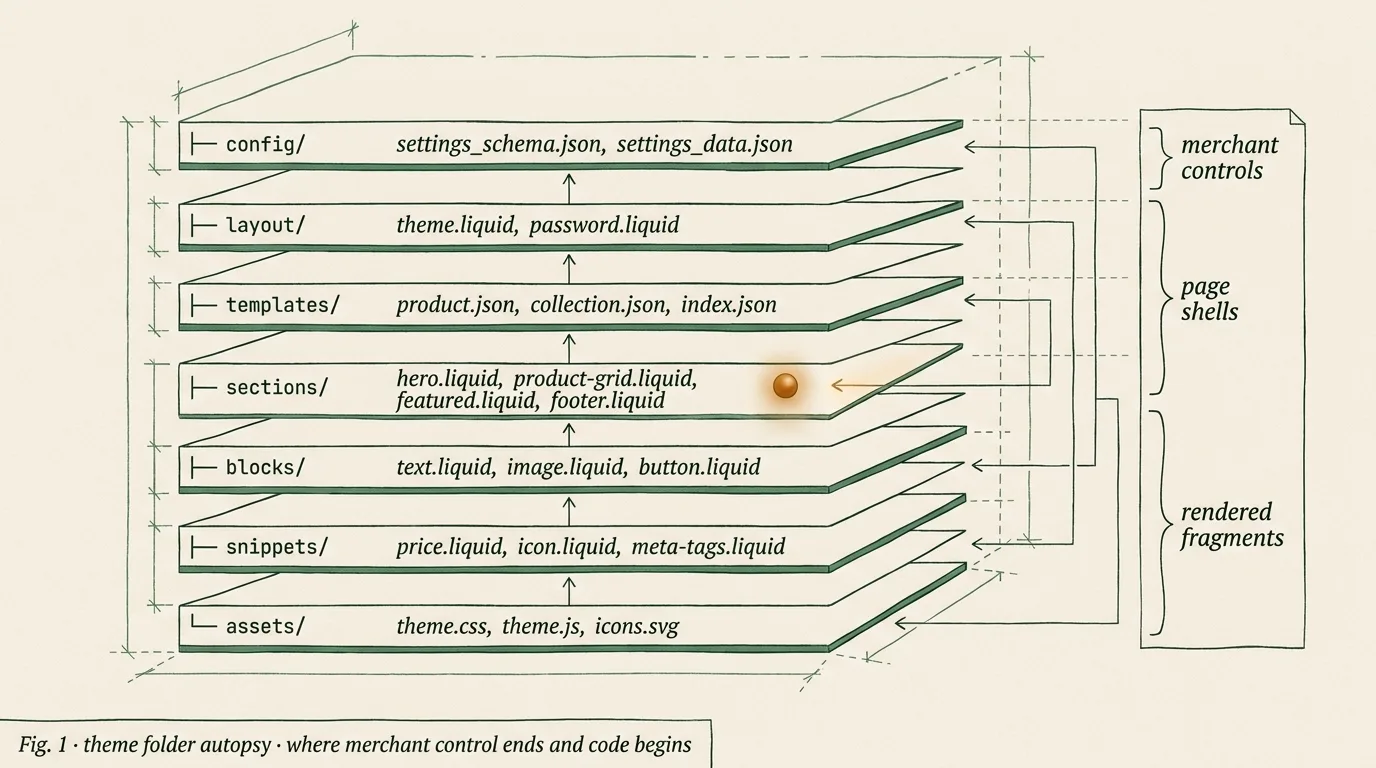
settings_schema.json defines every knob inside the theme editor. settings_data.json stores what the merchant picked. A custom theme stands or falls on how this schema is shaped.
theme.liquid is the chrome around every page: head, nav, footer, script loader. One file, rendered every request. Any mistake here is a mistake on every URL.
product.json, collection.json, page.json define which sections appear in which order. Online Store 2.0 moved these from Liquid to JSON so merchants can reorder sections without code.
Each .liquid file is a merchant-editable unit. Sections are page-level; blocks are smaller pieces inside a section. The richness of this library is the difference between a theme that ships once and a theme that keeps shipping.
Price blocks, icon sprites, meta tags, product cards. The snippet library is where Liquid debt accumulates fastest; copy-pasted partials across themes is the most common inherited problem we unpick on week one.
Compiled CSS, JavaScript, icons, fonts. Every asset here is a page-weight line item. A good theme under-budgets this folder; a bad theme ships 400KB of JavaScript to render a product card.
The decision is rarely technical. It comes down to catalog size, team composition, and how much custom behavior Liquid can't handle. Below is the honest decision matrix we walk every buyer through on the first call.
| Traditional Liquid | Online Store 2.0 | Headless / Hydrogen | |
|---|---|---|---|
| render model | server-side Liquid on Shopify | server-side Liquid + JSON templates | React on Oxygen edge |
| merchant control | fixed templates, limited reorder | every page shell reorderable | code-first, Sanity or Contentful for CMS |
| catalog ceiling | fine to 500K SKUs | fine to 500K SKUs | no practical ceiling |
| dev team needed | Liquid + CSS + light JS | Liquid + JSON schemas | React, TypeScript, GraphQL, CI |
| speed ceiling | excellent if disciplined | excellent with lean sections | best available, at engineering cost |
| best for | legacy themes being refactored | 80% of modern custom builds | multi-brand, multi-property, app-shared code |
| wrong for | new merchant teams needing flexibility | brands that need non-Shopify cart logic | catalogs under 20K SKUs with a lean team |
Eight of every ten custom themes we ship are OS 2.0 on Liquid. Headless is the exception we talk most brands out of.
Every page is a stack of sections. Each section is a Liquid file with its own schema, merchant-editable settings, and block library. The animation below shows a homepage being composed: five sections, one merchant-editable moment, fifteen seconds. Learn more in the Shopify Liquid sections documentation.
The Liquid Audit is a two-week, eight-point pre-engagement diagnostic on every inherited theme. No design work, no speculative rewrites. You get a written report showing where the theme costs you revenue, where app tax sits, and what customization or a custom build would change. You keep the report whether you hire us.
Largest Contentful Paint measured on a mid-tier Android over throttled 4G. Target under 2.5 seconds. Anything over three is costing revenue before the first scroll.
Interaction to Next Paint across the first ten taps. Target under 200 milliseconds. Heavy app JavaScript is the usual offender; we quantify it per app before we touch code.
Every installed app listed by the bytes it injects into every page. Render-blocking scripts, remote fonts, synchronous requests. The tradeoffs become decisions, not accidents.
Dead partials, duplicated snippets, uncached loops, inline styles inherited from contractor sprints. Graded A to F with a ticketed remediation list.
Percentage of templates on JSON over Liquid. Depth of section and block use. Whether the merchant gets meaningful control in the theme editor or only surface-level toggles.
Contrast, focus order, keyboard traversal, form labels, motion preferences, screen-reader semantics. The US ADA lawsuit floor is rising; we treat AA as a table stake, not a feature.
Redirect coverage, canonical integrity, schema depth, hreflang, sitemap health. A theme swap with a broken redirect map can erase six months of organic in a week. We catch it before launch.
How much of the storefront a non-developer can edit without calling us. The measure of a well-built custom theme is how rarely it sends the merchant back to code.
Audit scope is two weeks. Deliverable is a written report plus a 90-minute walkthrough. The fee is refundable against any engagement that follows.
Most agencies blur the two to keep quotes simple. We split them because budgets, timelines, and deliverables differ genuinely. The wrong lane costs you weeks. Pick the lane that matches your problem.
Dawn, Horizon, Impulse, Prestige, or Broadcast already cover 70% of the storefront. The gap is four to eight specific things: a new section type, a custom product page, a Liquid refactor on the cart, an accessibility pass, a speed regression fix. Timeline three to five weeks, single delivery track.
The design system has matured past any template. The merchandising needs richer section types than a base theme exposes. App bloat has turned a bought theme into a maintenance tax. Seven to twelve weeks, design + development tracks, section library built from the schema up.
We recommend the smaller lane whenever the math works. Bespoke is the answer less often than the bespoke-first agencies admit.
Five bases cover almost every customization we see. Each has a different speed profile, section library depth, and fit for merchandise-heavy versus editorial-heavy stores. Here's how we choose.
| base | speed out of box | section library | best for | wrong for |
|---|---|---|---|---|
| Dawn Shopify free |
excellent | lean, reference-grade | new stores, design-led brands | merchandise-heavy catalogs |
| Horizon Shopify free |
excellent | editorial + merchandising | 2025 launches, content-rich brands | stores still on OS 1.0 migration |
| Impulse premium |
good, needs pruning | heavy, campaign-led | fashion, campaign-driven DTC | simple single-SKU stores |
| Prestige premium |
good, editorial bias | image-led, press-friendly | luxury, beauty, editorial brands | high-SKU merchandising catalogs |
| Broadcast premium |
good, many options | kitchen-sink flexibility | merchants wanting max in-editor control | teams that want a lean codebase |
We ship customization on all five. For new builds in 2026 we default to Horizon or a bespoke theme; Dawn remains the correct choice for design-led, content-lean stores.
Every custom theme build ships with a published performance SLA. We measure on mid-tier Android over throttled 4G, using Shopify's CrUX dataset as the referee. If the number misses target at launch, we fix it free. Before-and-after Lighthouse numbers for every project are published below.
| metric | before (inherited theme) | after (DH custom build) | target |
|---|---|---|---|
| LCP | 4.1 s | 1.9 s | < 2.5 s |
| INP | 340 ms | 140 ms | < 200 ms |
| CLS | 0.24 | 0.04 | < 0.1 |
| Lighthouse mobile | 52 | 94 | > 90 |
| JS transfer (product page) | 412 KB | 108 KB | < 150 KB |
| time to first byte | 680 ms | 210 ms | < 400 ms |
Fig. 3 · representative before/after from a 2025 Shopify Plus custom theme launch. Real client numbers; anonymized on request.
Lighthouse CI runs on every pull request. A regression blocks merge. The budget is not a one-time metric, it is the build pipeline.
Real-world data via the Chrome User Experience Report is the number Google uses for rankings. It is the number we measure against, not synthetic runs alone.
If LCP, INP, or CLS miss target in the first 90 days under normal traffic, we fix at no cost. In writing on every custom build statement of work.
US ADA lawsuits against Shopify stores have climbed every year since 2019. Most themes ship without a single screen reader test. We ship to WCAG 2.2 AA baseline on every customization and custom build, and we publish the checklist we run against.
Body text at 4.5:1 against its background, large text at 3:1, every interactive state checked against its resting state. Dark mode sweeps done alongside light mode, not after.
Visible focus rings on every interactive element. Tab order follows reading order. Skip links to the main product list. No keyboard traps in mega menus or cart drawers.
Headings in order, landmarks named, buttons as buttons, links as links. No div-soup navigation. Every form input labeled; every icon-only control announced to screen readers.
prefers-reduced-motion respected across every animation, parallax, autoplay, and hover transform. Motion is additive, never load-bearing for meaning or navigation.
NVDA on Windows, VoiceOver on macOS and iOS, TalkBack on Android. Product page, cart, checkout, and the five highest-traffic collection pages tested manually, not only by axe or a browser plugin.
Inline errors associated to their inputs via aria-describedby. Error summaries at the top of long forms. Required fields marked in text, not only by color.
Every product image carries real alt text pulled from the product metafield, not a placeholder. Videos captioned. Audio transcribed. Decorative images marked aria-hidden.
Pre-launch, a manual walkthrough in NVDA and VoiceOver on the product-detail, cart, and checkout flows. Blocker-level issues fail the launch gate. Written audit report delivered with the theme.
Three custom theme engagements shipped in the last 18 months. Numbers are real. Brands are named with permission; anonymized stats sit behind the benchmark table above.
An inherited theme from a contractor sprint, running 4.1-second LCP on product pages and 340ms INP. We rebuilt from an empty theme against Horizon's schema patterns, cut the JavaScript payload by 74%, shipped 22 custom Liquid sections, and migrated every product template to OS 2.0 JSON. Lighthouse mobile landed at 94 in week one and held through six months of campaign work.
Beauty brand on a lightly modified Dawn, healthy speed baseline, weak accessibility. We wrote six new Liquid sections for ingredient storytelling, fixed contrast and focus-order failures flagged in an axe audit, and shipped a screen-reader-tested product page. Zero performance regression, WCAG 2.2 AA across product-detail and checkout. Handoff kit included a training session for the in-house marketer.
Shopify store on Impulse, 14 apps installed, LCP at 3.8 seconds, Lighthouse mobile at 44. We audited every app by injected weight, deferred four, replaced two with native sections, and removed three unused ones. No redesign, no section changes. Three weeks of pure app tax and Liquid debt work. Core Web Vitals moved from red to green across product and collection templates.
Theme work on the wrong brief harms both sides. A custom build for someone who needed customization costs eight weeks of frustration. Here's the honest filter we run on every intro call.
You own the theme code on day one and on exit. It lives in a private GitHub repository under your organization. You get a documented component library, Loom walkthrough, and 30 days of support at close. If we're not the right partner, you can leave cleanly. The theme is yours, not ours.
Pick the shape that matches your moment. We confirm fit on the intro call and send a scoped quote within 48 hours. Scope moves price, not the conversation.
Eight-point pre-engagement diagnostic: LCP, INP, app tax, Liquid debt, OS 2.0 readiness, WCAG baseline, SEO continuity, merchant flexibility. Written report plus walkthrough. Refundable against any project that follows.
Scoped work on an existing theme base. Two to six new custom sections, Liquid debt cleanup, speed work, accessibility fixes, and a documented handoff kit. Single delivery track.
Bespoke theme from an empty repository. Design system, 20 to 40 custom Liquid sections, OS 2.0 JSON templates, performance budget in CI, WCAG 2.2 AA baseline, 90-day SLA.
Block-of-hours or fixed-monthly retainer. Seasonal sections, Liquid fixes, app integration cleanup, performance monitoring, editor-side training. The most common shape after a custom build ships.
Quotes sent within 48 hours of an intro call. No proprietary tooling, no licensing fees, no code held hostage on exit.
A custom theme touches every revenue surface, so it's a high-trust hire. These are the proofs that come before the brief.
"Nine years writing Liquid by hand. Two thousand storefronts. We tell you whether your project is a five-week customization or a twelve-week rebuild, even when the smaller answer costs us less."





Online Store 2.0 reached real maturity in 2026. Theme blocks (the section-inside-section pattern) shipped to all themes. Shopify Magic's AI theme tooling flooded the low end. And the contract for what "custom theme" means tightened up. The phrase now implies hand-written Liquid against sections-and-blocks architecture, not a Dawn fork with three color swaps.
The two specs that matter are public and stable. Shopify's theme architecture docs cover layout, sections, blocks, and theme-app-extension surfaces a 2026 theme must use. The sections and blocks reference spells out the JSON schema for theme settings merchants can edit without code.
Anyone shipping a theme in 2026 that ties merchant-editable copy to Liquid file edits has built an Online Store 1.0 theme with a 2.0 sticker.
The AI floor matters because it changed what buyers ask for. Magic-generated themes ship a passable hero and okay PDP for free. The gap a custom theme fills is the merchant-control layer, Lighthouse score, WCAG 2.2 AA baseline, and a section system that survives a year of merchandising. The bar is higher. The work is more deliberate.
What this means for your project: A 2026 theme engagement should produce a Lighthouse target in writing, a sections-and-blocks inventory before any Liquid is written, and a WCAG 2.2 AA pass on launch checklist. If the deliverable is just "custom design" with no performance, accessibility, or merchant-control commitments, the brief is from 2021.
Related reading: See our custom Shopify theme development guide, the Online Store 2.0 explained primer, the best free Shopify themes for DTC roundup, plus our Shopify development and Shopify Plus agency pages.
Shopify theme development is the craft of building or editing code that renders a storefront. A theme is seven folders: config, layout, templates, sections, blocks, snippets, and assets, organized as Liquid templates, JSON schemas, CSS, and JavaScript.
Work ranges from light customization of Dawn or Prestige, through section-level and Liquid work, up to building a theme from an empty repository. Good theme development delivers measurable Core Web Vitals, WCAG 2.2 AA accessibility, and theme editor controls that merchants can actually use.
Start with customization if Dawn or a premium theme covers 70% of your storefront and the gaps are specific: custom product pages, new section library, speed fixes, or accessibility remediation.
Choose a full custom build when the design system outgrows any template, merchandising needs richer sections than the base exposes, or app bloat turns a bought theme into maintenance overhead. We recommend the smaller lane whenever possible; we build bespoke only when customization would cost more to maintain over time.
Liquid is Shopify's open-source templating language. It renders product data, collection logic, cart state, and merchant settings into HTML at request time.
Your team doesn't need to write Liquid to run the store. The theme editor exposes merchant controls via section schemas and block settings. Teams working on campaigns, new sections, or app integration will write Liquid. We hand off every theme with a documented component library and a Loom walkthrough so in-house developers can extend it without us.
A theme customization project runs three to five weeks for most scopes. A custom theme built from scratch runs seven to twelve weeks, depending on section library depth, animation ambition, and the number of page templates in play. The Liquid Audit adds two weeks before code and is refundable against any engagement that follows. Rush work is possible but we refuse to compress quality assurance and accessibility testing; the timeline moves, not the standard.
Yes, and it should be the primary reason to commission one. A well-built theme ships with LCP under 2.5s on mid-tier mobile over throttled 4G, INP under 200ms, and CLS under 0.1. We publish before-and-after Lighthouse numbers on every launch.
SEO gains come from structured data coverage, canonical integrity, hreflang for international stores, and speed itself. Google confirmed Core Web Vitals as a ranking factor in 2021, and enforcement has tightened every year.
A theme built against Shopify's current API contract won't break on platform updates. Liquid objects, metafield structure, and section schemas are stable interfaces that the platform versions carefully.
App installs cause more regressions. Some apps inject scripts globally instead of scoping them to templates. Our builds route third-party code through a script manager so we can defer, scope, or remove injections without touching app code. In-life retainers cover app installs, platform updates, and seasonal campaign work.
Both. We have an opinion about which fits which brand. Liquid themes win for most catalogs under 50K SKUs, where headless rebuild cost rarely justifies the marginal speed gain.
Hydrogen on Oxygen wins for brands that need deep component reuse across multiple properties, custom cart logic Liquid can't express cleanly, or a storefront that shares code with a mobile app. We talk you out of headless rebuilds more often than into them.
You do. The theme lives in your Shopify store and a private GitHub repository under your organization from day one. Every Liquid file, section schema, asset, and JSON template is yours.
On exit, we transfer full repository ownership, hand off a written component library, record a Loom walkthrough for your team, and close with 30 days of support. We don't gate access to force retention. If we're the right partner, you'll renew because the work is good, not because code is held hostage.
Two weeks, eight-point scorecard, written report. You leave knowing exactly what customization or a custom build would change. We follow up with a scoped quote within 48 hours.
Published reviews from our Fiverr profile, reproduced word for word. 397 public reviews across 4 gigs, from clients in 36 countries. Read them all on Fiverr.
Great experience working together. Communication was clear, delivery was on time, and the store looks clean and professional. Revisions were handled quickly and exactly as requested. Highly recommended for Shopify customization.
Top notch work…. I would recommend him and his team to anyone that needs any type of website built or updated….. They took my website from a zero to a hero in under one week.
Great experience overall. Communication was smooth, updates were clear, and the final store looks professional and works perfectly on mobile. Would definitely recommend.
Great experience overall. Communication was clear, delivery was fast, and everything was set up exactly as discussed. Very happy with the result.
Excellent experience working with this team. The speed of delivery was impressive, without compromising on quality. They were highly flexible with changes, responsive throughout the process, and genuinely easy to work with. Communication was smooth, timelines were respected, and the overall collaboration was enjoyable. Highly recommended for anyone looking for a reliable and efficient website development partner.
I truly love this company! Fixed all the errors from the previous company we worked with. Honest, professional, knowledgeable, and so easy to communicate with! I would not hesitate to use them again and again!!!
Reviews are reproduced as published on Fiverr, captured 2026-08-03. Fiverr shows the buyer's username and country publicly; no other client detail is used here.





115 people across five studios in New York, Delhi, London, Sydney and Lucknow, shipping ecommerce, web, software and mobile work for founder-led brands. Senior engineers only, no account-manager relay, and the same team from kickoff to launch.

Senior Full Stack Developer · Lucknow · 9 posts on the site
Published · Last updated .

Pinch, scroll or double-tap to zoom · drag to pan
Where should we send the proposal?
Please enter your name and a valid email.
Any faster way to reach you? Optional.
Please fill in the one you picked.

