01 · membership
Membership platform development.
Multi-tier memberships with gated content, creator dashboards and payouts on Stripe Connect from day one. Not a Thursday spreadsheet the founder runs by hand.
Ship the membership core →Memberships, subscriptions, live video, community and storefronts on one codebase, with Stripe Connect payouts, DMCA-aware content workflows and tiered creator pricing. Engineered from New York, Delhi and Lucknow, with a written scope within 48 hours of the first call.
A creator economy platform is the software a creator runs a business from: it builds, distributes, monetizes and manages content and an audience in one place. A creator tool does one job, the way Canva does design. Kajabi, Substack and Skool are platforms. That is the definition used by the creatoreconomytools.com directory, read 7 October 2026.
The same directory sorts 24 incumbents into five categories: four all-in-one platforms, six community platforms, five newsletter and publishing platforms, four video and podcast platforms, and five course platforms. Anyone commissioning a platform is replacing one of those. The table below names the incumbent by creator type and the build shape that replaces it.
| creator type | rented incumbent | what we build instead |
|---|---|---|
| Newsletter writer | Substack, Beehiiv | Paid newsletter platform: publishing, paywall, referrals, deliverability |
| Membership creator | Patreon, Ko-fi | Membership platform with tiers, gated content and Connect payouts |
| Community host | Skool, Circle, Discord | Community platform with tier-gated spaces, events and moderation |
| Educator or coach | Kajabi | Course and coaching platform, built with our edtech practice |
| Video and social creator | YouTube, TikTok, Instagram | Media app or live-streaming MVP on Mux or Cloudflare Stream |
The incumbent names come from the directory's "largest by creator volume" grouping, read 7 October 2026. The build shapes in the third column are ours.
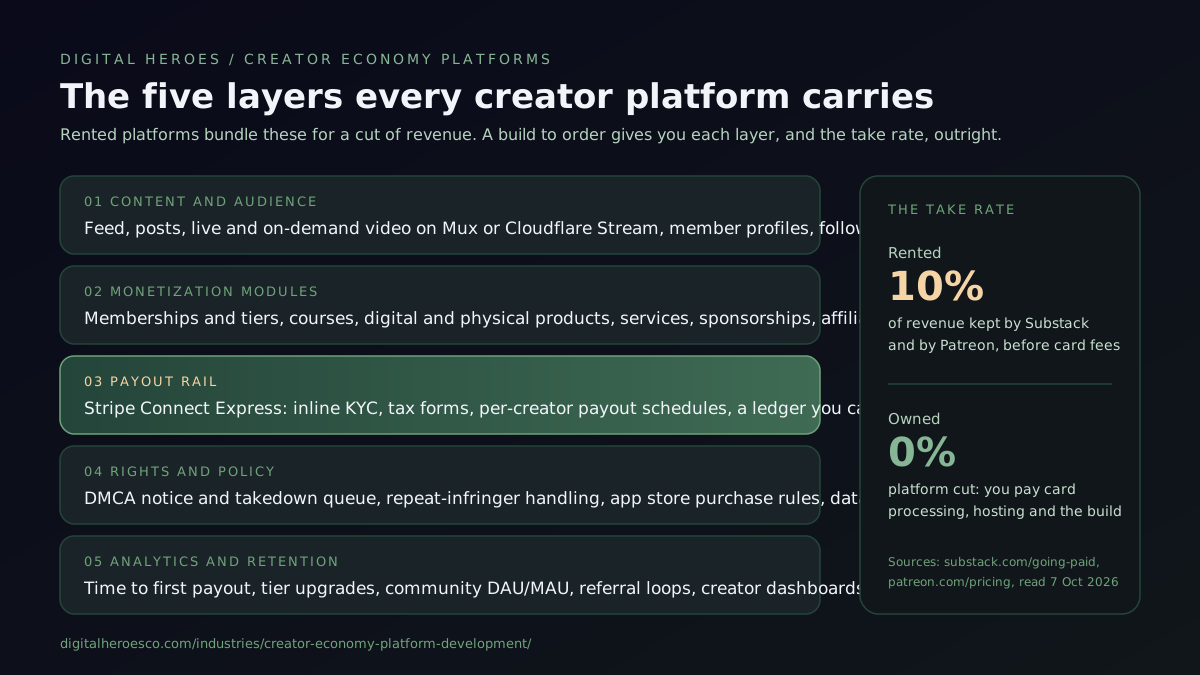
Renting is the right call until the platform's cut outgrows the cost of owning one. Substack writers keep 90% of revenue minus card fees, Patreon charges 10% of income plus processing, and YouTube pays creators 55% of net ad revenue on watch pages. On a platform you own, the only recurring cut is the payment processor's.
| platform | what it keeps | source, read 7 October 2026 |
|---|---|---|
| Substack | 10%: "writers keep 90% of their revenue minus credit card fees" | Substack, going paid |
| Patreon | 10% of income, plus payment processing, currency conversion and payout fees | Patreon pricing |
| YouTube | 45% of net ad revenue on watch pages and 55% of the Shorts creator pool; creators get the rest | YouTube partner earnings overview |
| Exclu | 0% platform commission for direct sales, as its featured listing in the directory states | creatoreconomytools.com |
| A platform you own | Card processing fees, hosting, and the build itself | Stripe Connect documentation |
The arithmetic: $100,000 a month of creator revenue on a 10% platform cut is $120,000 a year. That is more than the whole of GoodFirms' 2026 band for a medium custom build, $30,000 to $100,000. Below that revenue, rent. Above it, the build can pay for itself inside year one and the take rate becomes yours to set.
AppSumo's creator economy guide uses Vine as the warning: when it shut down, millions of creators lost access to their followers overnight. Its conclusion is that a channel you own, such as a newsletter, SMS list or website, is the safest place to monetize. Wikipedia makes the same point from the other side: most of the benefit from uploads accrues to the platforms.
A platform you commission is that owned channel at company scale. The member list, the payment relationship and the content live in your database, under your terms, and no policy change upstream can take them from your creators.
A creator platform is a payments company wearing a content feed. Payout rails, rights workflows, tier pricing and retention loops are invisible in the demo and unforgiving in production. Eight build shapes cover most of what founders bring us, each on the same six-week cycle with a written scope inside 48 hours of the first call.
Multi-tier memberships with gated content, creator dashboards and payouts on Stripe Connect from day one. Not a Thursday spreadsheet the founder runs by hand.
Ship the membership core →iOS and Android subscription apps with store-compliant purchase flows, offline reading and push re-engagement, built in React Native by default so one codebase ships to both stores.
Launch a subscription app that clears review →Live video on Mux or Cloudflare Stream with chat, tipping and live-to-VOD. Scoped to a streamable MVP inside one or two cycles, not a year of codec archaeology.
Go live without building a CDN →Merch and digital-product storefronts creators theme themselves: drops, bundles and a checkout that converts on a phone at midnight when the video goes up.
Open the merch rail →Paid-community engines with tier-gated spaces, events and moderation tooling. Community is the retention layer: in our Austin archetype it moved DAU/MAU from 22% to 48%.
Build the space members return to →Fan clubs, superfan tiers and interactive drops designed as retention loops, not one-off downloads. The fan journey gets mapped screen by screen before code.
Design the superfan loop →Publishing, paywalls, referral mechanics and the deliverability plumbing that decides whether a paid newsletter is a business or an inbox rumor.
Make the paywall pay →Audio and video media apps with adaptive playback, entitlement checks and creator analytics. We build the differentiating experience and buy the commodity video layer.
Ship the media app in weeks →AppSumo's guide lists six ways creators earn: affiliate sales, subscriptions and communities, digital products, physical products, professional services, and advertising and brand partnerships. Rented platforms are built around one or two: Substack around subscriptions, Patreon around memberships. A build that carries all six keeps a creator's whole income inside your product, which is the strongest reason a creator has to stay.
Tracked links, a commission ledger and payouts on the same Connect rail as everything else. AppSumo notes some affiliate brands pay 30% or more, so the ledger has to be auditable by the creator.
Tiers on Stripe Billing, dunning that recovers failed cards, gated spaces and Discord perks mapped to the tier. The module every other line hangs off.
Courses, templates, downloads and paid video with entitlement checks, signed URLs and playback that stops working when the subscription does. When completion records matter more than sales, compare custom LMS developers in the USA instead.
A merch rail on Shopify with drops, bundles and print-on-demand fulfilment, surfaced inside the creator's own space rather than on a separate store nobody visits.
Booking, paid one-to-one calls and invoicing for creators who coach or consult, with the fee split and payout handled by the platform, not by a spreadsheet.
Rate cards, a sponsor marketplace and campaign reporting. AppSumo quotes mid-tier creators at $500 to $5,000 per sponsored Instagram post and macro creators at $5,000 to $10,000, which is money a platform can route and report on.
Creator platforms answer to three rulebooks at once: payment regulation on payouts, copyright law on content, and app-store policy on distribution. None of these are certificates a development partner can hand you. What we control is whether the architecture keeps you on the right side of each one by default.
Express accounts with inline KYC, automated tax-form generation and configurable payout schedules. All of it is built against Stripe Connect documentation, so money movement never depends on a founder's Thursday.
Notice-and-takedown queues, repeat-infringer handling and audit trails structured around the safe-harbor requirements in the U.S. Copyright Office's DMCA materials. Designed in, not bolted on after the first strike.
Purchase flows, subscription disclosures and UGC moderation baselines checked against the App Store Review Guidelines and Google Play policy before submission, not after rejection.
Encoding, adaptive delivery, signed playback and live-to-VOD on Mux or Cloudflare Stream. Your video budget goes to the experience, not to rebuilding a transcoder.
Data minimization, deletion workflows and consent records aligned with EU data-protection law. Fan data is trust capital, and platforms that leak it do not get a second audience.
The three rails most creator platforms run on: Connect for money, Mux or Stream for video, and Discord's developer platform for community bots, tier-perk gating and milestone alerts.
Four failure patterns show up in almost every creator platform we inherit: payouts run by hand, one flat price, no community layer, and homegrown video. Each has a structural fix, and each fix is cheaper the earlier it lands, because every one of them touches the payout ledger.
A founder running payouts by hand tops out around a couple hundred creators. We migrate you to Stripe Connect Express with inline KYC and automated tax forms. In the Austin archetype, time-to-first-payout dropped from 14 days to 4, and the paid-creator roster grew from 320 to 2,180.
Flat per-creator pricing means your best creators never expand and your struggling ones churn silently. The fix is tiered plans with feature gating that scales with creator success. The Austin pattern's Free, Pro and Scale ladder moved net revenue retention from 88% to 124%.
Creators without a peer network churn after their first paying month. The answer is a structured community with tier-based perks: office hours, private channels, milestone bots. In the Austin archetype that lifted community DAU/MAU from 22% to 48% and made retention a product feature instead of a hope.
Building your own transcoding pipeline or improvising DMCA handling drains cycles that should ship product. We buy the video layer from Mux or Cloudflare Stream, wire signed playback for paywalled content, and structure takedown workflows before the first infringement notice arrives.
AppSumo counts as many as 50 million independent creators, and Goldman Sachs Research, cited on Wikipedia, expects the creator economy to approach half a trillion dollars by 2027. Wikipedia also records that the large majority of creators earn nothing and as few as 0.1% earn a living from their channels. Both numbers should shape the platform you build.
AppSumo's guide puts YouTube at over one and a half billion unique visitors a month against about 220 million Netflix users in early 2022. Demand for creator content is not the risk in your plan.
If as few as one creator in a thousand earns a living, the free tier must cost you almost nothing to serve, paid tiers should gate on the creator's own revenue, and a take rate belongs only at the top. The Austin archetype's ladder is Free, Pro at $29 a month and Scale at $99 plus a 2% take rate.
A creator who earns a little waits on the money more anxiously than one who earns a lot. Cutting onboarding-to-first-payout from 14 days to 4 is the single change in the Austin archetype that the rest of the growth depended on.
Creator platforms are SaaS-shaped custom builds, so the honest ranges are benchmark bands. GoodFirms' 2026 cost survey of more than 100 firms sorts projects into four bands: small under $30,000 in one to three months, medium at $30,000 to $100,000 in three to six, large at $100,000 to $200,000 in six to twelve, enterprise above $200,000 over one to two years.
The same survey finds firms in Western markets quoting about $50,000 to $250,000 for a medium build, and scope creep adding 10 to 25 percent where it happens, which is why every scope here is written and itemized. The stage-by-stage planning math, including a build-versus-buy table, lives in our SaaS development cost guide.
| GoodFirms 2026 band | range and timeline | creator platform shape it usually fits |
|---|---|---|
| Small | under $30,000, one to three months | A Connect payout migration or a storefront launch on an existing platform |
| Medium | $30,000 to $100,000, three to six months | A membership or subscription MVP with auth, billing, publishing and one payout rail |
| Large | $100,000 to $200,000, six to twelve months | A multi-tenant platform with video, community and several revenue lines |
| Enterprise | above $200,000, one to two years | Scale-stage work: SSO, RBAC, audit logs, multi-region deployment |
Bands are GoodFirms' survey figures, not our prices. Scope moves price, and every quote arrives in writing within 48 hours of the intro call, itemized by build shape.
A composite drawn from multiple Austin creator-economy SaaS engagements, with the disclosure carried on the case study itself. It shows what the five layers above look like once payouts, tiers and community are fixed in one 22-week program, and it is the source for every Austin figure on this page.
$60K to $410K MRR in 18 months.
NRR via creator-tier expansion.
Paid-creator pipeline growth post-PLG onboarding.
Onboarding-to-first-payout, down from 14 days.
The pattern: a creator-economy SaaS at $60K MRR, founder-led, with manual Thursday payouts capping the roster, no community layer, and flat pricing with no expansion path. The rebuild ran 22 weeks across five workstreams: a Stripe Connect Express migration with inline KYC, an 8-minute onboarding-to-first-product flow, Free, Pro and Scale creator tiers, a tier-perked Discord community, and creator-led referral mechanics.
Community DAU/MAU moved from 22% to 48%. The paid roster grew from 320 to 2,180 creators. Read the full Austin creator-economy archetype, or see fan monetization applied to the merch rail in the Liverpool music-merch archetype: 6.9x MRR in 16 months on drop cycles and fan-club mechanics.
The cadence is the contract. Every build runs in six-week cycles with a demo every Friday and daily standups on India time, so you watch the platform grow weekly instead of hoping at the end of a quarter.
A 30-minute call on your creators, your monetization model and your stage. A written scope with build shapes, timeline and a fixed fee lands inside 48 hours of that first call.
Weeks one to two: the creator journey, the payout and rights data model, the tier ladder, and a clickable prototype of the publish-to-earn screens before a line of production code.
Weeks two to five: senior engineers on a staging environment you can click from day three. Connect sandbox and video pipeline wired early, weekly Friday demos, payout edge cases seeded and tested.
Week six: production cutover or app-store submission, monitoring and moderation runbooks live, and a go-live checklist your team co-signs before the first creator cohort lands.
The next six-week cycle is scoped from live data: time-to-first-payout, tier upgrade rates, community DAU/MAU. Not from a backlog written before creators existed.
Payouts, video and email are solved problems with excellent documentation. We buy those rails and spend the novelty budget on the experience your creators and fans actually touch. Next.js and TypeScript on the web, React Native by default on mobile, PostgreSQL underneath, Stripe Connect and Billing for money, Mux or Cloudflare Stream for video.
Five reasons, each one you can check: where the team sits, when it is awake relative to you, how often it demos, what Clutch records, and the software we run ourselves. None of them is a badge; all of them show up in the first six-week cycle.
Two staffed HQs, engineering in Lucknow, and team members who work remotely from London and Sydney. No fake local offices, no bait-and-switch juniors. The engineers on the call are the engineers on the build.
US mornings overlap Delhi evenings, so blockers raised at your standup are often resolved before your next one. A near-continuous build day without the handoff tax.
The cadence is public and non-negotiable. You see working software weekly; a slipping build has nowhere to hide by week two.
Clutch shows a 5.0 rating from 66 verified reviews, read 2026-10-07. Every scope arrives itemized in writing within 48 hours.
We operate our own ERP and client portals daily, and the live chat assistant on this site is our build too. We know what post-launch software life feels like because we live it. That operator instinct ships with your platform.
One build shape, scoped, priced and shipped on the six-week cadence: a membership MVP, a Connect payout migration, a streaming launch. Best when the outcome is nameable.
A standing senior pod running successive six-week cycles. Features, tier experiments and retention work are scoped from live creator data each cycle.
Senior platform engineers embedded in your standup, your repo, your review process. You direct; we ship at your bar or above it.
Not sure which shape? Start from the cost bands above. The bands there map one-to-one onto these engagement shapes.
The stage-gated plan we use to take a platform from written scope to first paying creator without over-building.
The activation benchmarks behind fixes like a 14-day-to-4-day time-to-first-payout, and how to instrument them.
The decision tree for fan and media apps, where video playback and push engagement decide the answer.
It depends on the format. The creatoreconomytools.com directory names the largest by creator volume: YouTube, TikTok and Instagram for video, Substack and Beehiiv for newsletters, Patreon and Ko-fi for memberships, Kajabi for courses, Skool and Circle for communities. Profit follows the take rate, and Substack and Patreon each keep 10%, so an owned platform wins at scale.
The audience is. AppSumo counts as many as 50 million independent creators, and Goldman Sachs Research, cited on Wikipedia, expects the creator economy to approach half a trillion dollars by 2027. The earnings are concentrated: Wikipedia records that most creators earn nothing and as few as 0.1% earn a living, which is why platforms compete on payouts and tiers.
This page does not rank niches, because the sourced data is about formats, not topics. AppSumo quotes sponsored Instagram posts at $500 to $5,000 for mid-tier creators and $5,000 to $10,000 for macro creators, with some affiliate programs paying 30% or more. For a platform, the niche matters less than which of those revenue lines its creators can sell.
YouTube publishes a share, not a rate: its partner earnings page states creators get 55% of net ad revenue on watch-page videos and 45% of the Shorts creator pool, so 1,000 views earn whatever advertisers paid for that audience. Membership and newsletter platforms pay per subscriber instead, which is why a small paying audience can out-earn a large free one.
Use GoodFirms' 2026 survey bands as the benchmark: medium builds at $30,000 to $100,000 over three to six months cover a membership or subscription MVP, large builds at $100,000 to $200,000 cover a multi-tenant platform with video and community, and enterprise work sits above $200,000. Every engagement starts with a 30-minute call and a written, itemized scope inside 48 hours.
A Connect payout migration or storefront launch fits inside one six-week cycle. A membership or subscription MVP with auth, billing, publishing and one payout rail sits in GoodFirms' medium band, three to six months. The Austin archetype's five-workstream rebuild ran 22 weeks. The constant across all of them: a demo every Friday and a staging environment you can click from the first week of build.
On Stripe Connect Express, with KYC and bank-account collection inline during onboarding, automated tax-form generation and payout schedules configurable per creator. Manual payouts cap a platform at a couple hundred creators. In the Austin archetype, the Connect migration cut onboarding-to-first-payout from 14 days to 4 and let the paid roster grow from 320 to 2,180 creators.
Buy it. Mux and Cloudflare Stream handle encoding, adaptive delivery, signed playback for paywalled content and live-to-VOD at a fraction of what a homegrown pipeline costs to build and operate. The differentiating layer is what sits on top: the publishing flow, the entitlements, the fan experience. That is where your build budget should live.
As architecture, not as an emergency. UGC platforms get a notice-and-takedown queue, repeat-infringer handling and audit trails structured around the DMCA safe-harbor requirements, plus moderation tooling and runbooks handed over at launch. Legal counsel owns your policy; our job is making sure the software can execute it the day the first notice arrives.
Tiers that scale with creator success, with a small take rate at the top tier. Flat per-creator pricing gives successful creators no reason to upgrade and struggling ones no reason to stay. The Austin archetype's Free, Pro and Scale ladder gates features by the creator's own revenue, and it moved net revenue retention from 88% to 124%.
Yes. The failures are predictable and avoidable. Digital-content purchase rules, subscription disclosure requirements and UGC moderation baselines are checked against the App Store Review Guidelines and Google Play policy during design, not after a rejection. We plan the purchase architecture around current platform policy before the first sprint: what sells in-app, what lives on the web.
Last reviewed .
A 30-minute call on your creators, your payout rail and your stage. You leave knowing which build shape fits and which cost band it sits in; the written scope follows within 48 hours.
Creators selling courses? See our edtech software practice. Selling merch DTC? Our fashion & apparel practice runs that rail.

Chief Technology Officer · Lucknow · 57 posts on the site
Published · Last updated .

Pinch, scroll or double-tap to zoom · drag to pan
Where should we send the proposal?
Please enter your name and a valid email.
Any faster way to reach you? Optional.
Please fill in the one you picked.

