Custom healthcare software development for US clinics, digital health startups and wellness operators: patient portals, telehealth, booking and practice tools, built HIPAA compliant, with written safeguards and a BAA we sign. We do not build clinical EHR systems.
What custom healthcare software development covers
Custom healthcare software development is building software around one clinic's or health company's own workflow, instead of renting a packaged product. Every build here includes discovery and a written scope, design, web or app engineering, testing, launch and the cycles after it, with the HIPAA-aware safeguards written down for your counsel.
This software sits beside the EHR a practice already runs: nine in ten US office-based physicians used a certified EHR in 2024, according to ASTP/ONC Data Brief 84. We build the layer patients and staff touch around it.
Seven kinds of product we take on
Patient portals: intake forms, documents, secure messages and visit history behind role-based access, built as a web portal your patients sign in to.
Telehealth: scheduling, intake, video visits and payment for one service line, scoped as an MVP first.
Booking and reminders: self-serve scheduling across providers and locations, with confirmations by email and reminders by email or text.
Practice-management tools (not clinical EHR): intake queues, staff schedules, reporting and admin dashboards, with no claims and no clinical records, built the way we build practice tools for any service business.
Wellness and fitness apps: programs, check-ins and subscriptions on iOS and Android.
Care-plan and coaching dashboards: one screen for coaches and members showing adherence and next steps, with the dashboards designed before they are built.
Provider directories: searchable provider profiles with location and availability.
What every build includes
Discovery, with a written scope within 48 hours of the first call.
figure 1 · where Digital Heroes works in a healthcare product
above the line: the apps people use and the data layer under them, which we build
below it: the clinical systems we leave to specialists
scope in fifteen seconds · what we build, what we do not, and how a build stays HIPAA compliant
§ 02 · proof you can open
Work you can open today, and our closest case
Start with a healthcare system we built for a client, then what you can check yourself: three tools we built and run on this site, and the industry archetype closest to this work. Each one is our own work and is labelled that way.
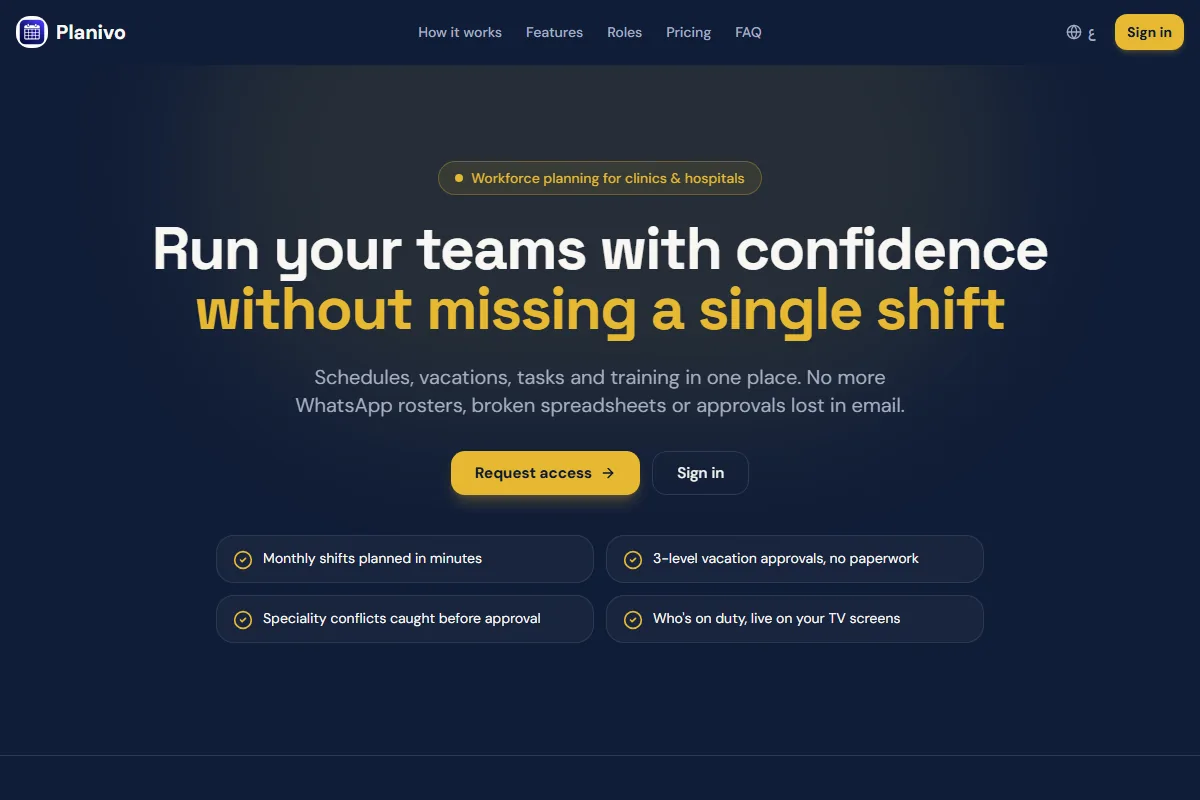
Planivo: staff scheduling for clinics and hospitals
We built the whole Planivo platform, the signed-in app and its website: monthly shift rosters, vacation approvals in three levels with a check that flags two people of the same speciality away at once, certification reminders before a licence expires, training sessions with attendance, live duty screens for hospital halls, and an audit history of every change, with six roles that each see only their own scope.
It is a practice tool for staff, not a patient app. Shown with the client's permission to feature it as our work; no quote or results figure has been published.
Planivo's public site, built by us with the app.
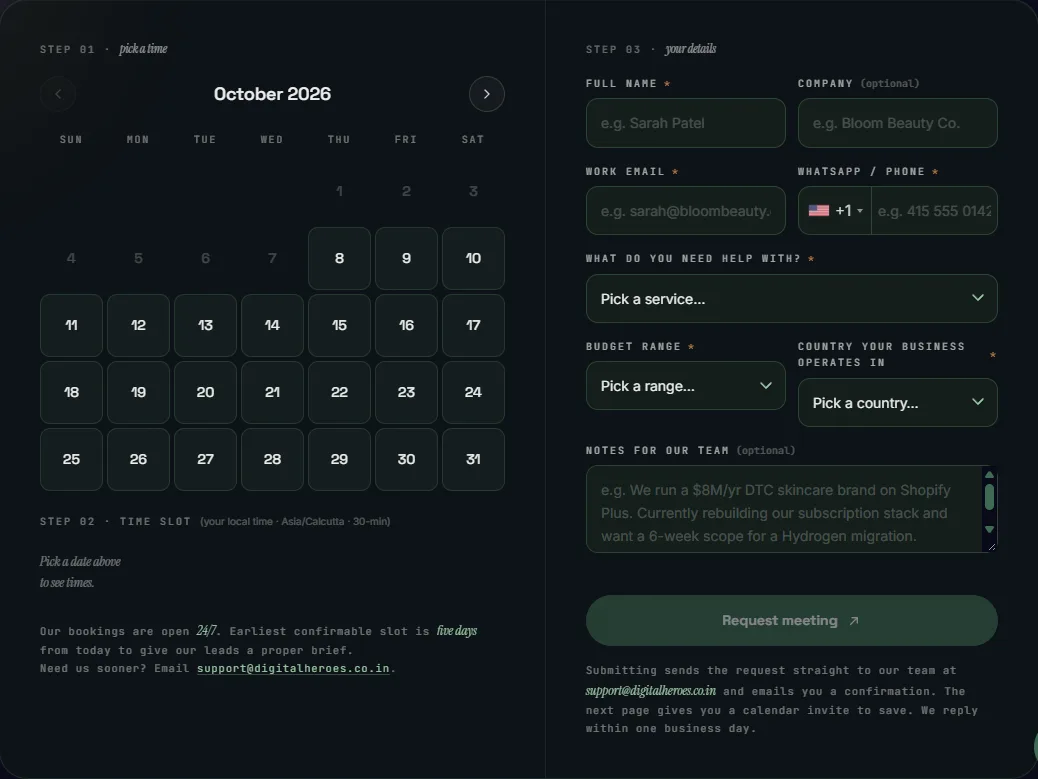
Self-serve booking
Our booking page lets you request a call time at least five days out and gives you a calendar invite file to save for every booked call.
Our own booking page. It books calls with Digital Heroes, not a client's patients.
Live chat with a person behind it
The chat on this site is ours too: an AI copilot in our ERP can answer first, and a person on our team can take over any thread.
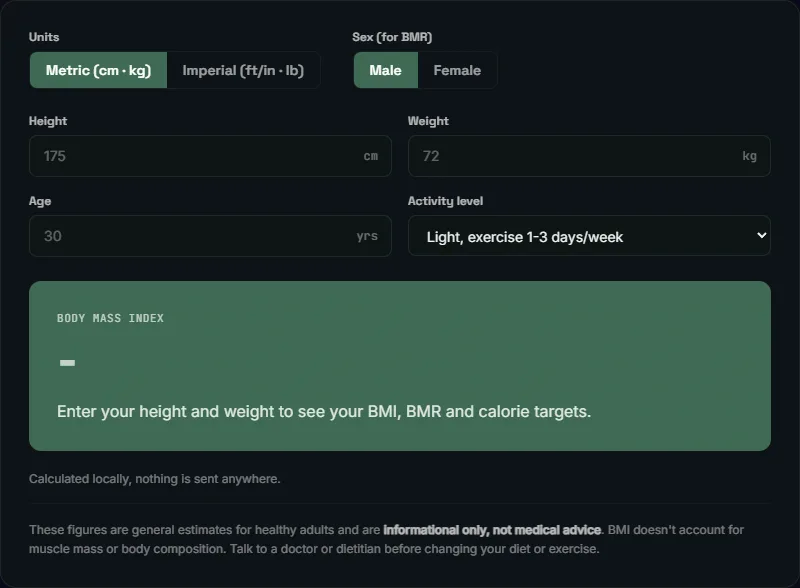
Three health calculators
Our BMI, calorie and sleep calculators compute in the browser, and their own code makes no network requests.
A free tool we built and run. It is our own work, not a client's.
Our closest published case is an industry archetype, not a named client.
The Baltimore biotech-wellness archetype is drawn from patterns across multiple wellness supplement engagements. It is a Shopify Plus commerce build, not a patient portal, and it shows what the consumer side of a health brand returns when it is engineered with care.
archetype figures · a wellness supplement store on Shopify Plus, not healthcare software
4.5x
MRR · $120K → $540K in 18 months
68%
M12 cohort retention
$74→$112
AOV after bundle merchandising
36%
subscription attach · the operational change
Metrics representative of the archetype; specific brands within the pattern range plus or minus 20 percent on each line.
We map each of the five technical safeguards in the HIPAA Security Rule, 45 CFR 164.312, to a control we build. Some features need no health data stored at all: our three free health calculators compute in the browser, and their own code makes zero network requests. Each line below names the control itself, so your counsel can check it against the rule rather than against a badge.
Access control
Role-based access enforced by row-level security in Postgres, on Supabase.
Audit controls
An audit log of who viewed or changed a record.
Integrity
Only the roles row-level security allows can alter a record, and each change is written to the audit log.
Person or entity authentication
Sign-in on Supabase Auth before any record is shown.
Transmission security
Encryption in transit, plus encryption at rest for stored data.
There is no HIPAA certification to buy. The Security Rule asks for periodic evaluation instead, so what we hand your counsel is the written list of the safeguards we built.
How we keep a build HIPAA compliant
We sign a BAA with you. Whenever our team will create, receive, keep or send protected health information for you, Digital Heroes signs a business associate agreement before any of it moves.
We host under the cloud's own BAA. Healthcare builds run on AWS, Microsoft Azure or Google Cloud, each covered by that provider's business associate agreement, and the written scope names which one before a line of code is written.
An outside firm has reviewed our HIPAA practices. An independent firm, not our own team, reviewed how we handle protected health information.
Every vendor that holds protected health information for you needs a business associate agreement with you. Supabase, for example, documents a BAA for its hosted platform and says self-hosted Supabase is outside it, so hosting is chosen in the written scope, before any data moves. Where the data lives and who can see it is answered in the FAQ.
AI features follow the same rule: a model provider that receives protected health information is a business associate and needs a BAA, like any other vendor that holds it. Before you approve an AI feature, ask which provider it calls and whether that provider signs one.
safeguards path · one request meets the five controls in the order they run
§ 04 · cost and time
Cost and time benchmarks you can check
Typical US quotes for a health app with few features run $70,000 to $100,000, and such an app can take three to six months to develop, according to the developer price guide that a 2022 paper in JMIR Formative Research cites. More user roles, integrations and safeguards push both numbers up, so the kind of product matters more than its feature count.
What moves the cost of each kind of healthcare software
Solution type
Who uses it
Stores protected health information?
Usual connections
Price it with
Booking and reminders
Patients, front desk
Usually, when a provider runs it
Calendars, email and text, deposits
Custom software cost calculator
Patient portal
Patients, staff, admins
Yes
Sign-in, documents, email, payments
Custom software cost calculator
Telehealth MVP
Patients, clinicians, admins
Yes
Video, scheduling, payments
Mobile app cost calculator (HIPAA line)
Practice-management tool
Staff, managers
Sometimes, if intake data is kept
Calendars, email, reporting
Custom software cost calculator
Wellness or fitness app
Members, coaches
Health data, often outside HIPAA
Subscriptions, notifications
Mobile app cost calculator
Read across a row: one kind of user is cheap, while several roles with different access take a large share of the build and most of the testing, so a three-role portal needs more build than a booking tool.
Paying by the hour instead? Typical US rates for app development consultants run $100 to $250 an hour, according to a 2023 guide in BMC Medicine.
On our side, time is planned in six-week cycles across five stages, Discover, Design, Build, Launch and Optimize, and the written scope says how many cycles a first release needs. Waits on another organization's sign-off, such as a video or messaging vendor's BAA or an app store review, add time no vendor controls.
These four people are on our side of a build, each described in the words of their own published profile. Each name links to that profile, and the records under them are ones you can look up.
“Navya brings five years of project management to Digital Heroes healthcare, wellness, logistics, real estate, manufacturing, retail and education builds, running sprint planning, scope and client communication from kickoff to launch.”
On Clutch, Digital Heroes is rated 5.0 from 66 verified client reviews, as checked on 5 October 2026.
§ 06 · build or buy
Benefits of building, and when to buy instead
Many teams look at custom software after a packaged product hits a wall: intake that does not match the front desk, tools that do not talk to each other, or a service the product cannot follow. Check that wall first.
SimplePractice and Jane sell practice software for health and wellness clinics, Doxy.me sells a telemedicine platform, and if your organization runs Epic, MyChart is the portal your patients already use. Custom pays off when the workflow is your product, spans several tools, or needs a data model you own.
What owning it gives you
The workflow follows your service: intake order, eligibility questions and deposit rules work the way your front desk already works.
One patient journey across the tools you already pay for, instead of a hand-off between separate logins.
A data model you own, so reports answer your own questions.
Your brand on every screen, where a packaged portal shows the vendor's.
You decide what changes next, and when, instead of waiting on a vendor's roadmap.
A readiness check before you build
Answer four questions before you build. Can you wait months for a first release? Does someone on your side own the product after launch? Can your clinical staff give time to discovery and weekly demos without leaving care? Will the workflow still look like this in two years? Two or more answers of no point to buying.
Buy, extend or build: four ways to get patient-facing software
Option
What it is, in the vendor's own terms
Fits when
Watch for
Practice software
SimplePractice: EHR and practice software for health and wellness professionals. Jane: practice management software for health and wellness clinics
Your scheduling, intake and billing match how the product works
Monthly plans and a data model you cannot change
Telemedicine platform
Doxy.me: a telemedicine platform
You need video visits now and a standard waiting room is enough
The patient journey and branding follow the vendor
Your EHR's own portal
MyChart, Epic's patient portal
Your organization runs Epic and patients already have accounts
Extending it runs through Epic and its rules
Custom patient-facing build
A development firm such as Digital Heroes
The workflow is your product, spans several tools, or must be owned
You fund hosting and maintenance, so insist on a written scope and a plan for year two
The trade is real: you fund hosting and maintenance, and a first release takes months, not days.
§ 07 · fit
Who we build for
We build for four kinds of health business, and each can check something of ours first: clinics and digital health startups, the booking page and live chat we run on this site; wellness, fitness and coaching operators and health brands, our four health and wellness archetype case studies and three health calculators.
Outpatient practices and clinic groups
Therapy, dental, physical therapy and wellness clinics: booking, intake, portals and practice tools.
Digital health startups
Telehealth MVPs and patient apps for a first service line.
Not for: health plans that need a claims engine, medtech firms that need device firmware, or any other clinical system listed under what we do not build.
§ 08 · connections
The connections a portal or booking build needs
A patient portal or booking build draws on five kinds of system, each picked in the written scope. Any of them that will hold protected health information must sign a business associate agreement with you first.
Calendars: appointments go out as standard calendar invites, the same kind of file our own booking page gives you to save.
Email and text messages: confirmations, reminders and reschedule links; our own ERP and live chat already send transactional email.
Payments: deposits, visit fees and subscriptions through a payment processor.
Video visits: a video provider for telehealth, picked for its BAA terms.
Sign-in and roles: Supabase Auth for sign-in, with role-based access enforced by row-level security in Postgres.
Never connected: EHR systems such as Epic, Oracle Health and MEDITECH; records that live in the EHR stay there. FHIR or HL7 interfaces into an EHR are EHR integration work, which we refer to a specialist.
How booking and intake data reach the chart without an EHR integration: your staff see each booking and intake answer in a dashboard, an export or a notification, and they decide what is copied into the chart.
§ 09 · apps
Custom healthcare app development
Custom healthcare app development covers patient apps, staff apps and wellness apps for iOS and Android. We build them in React Native or Flutter, which ship to both stores from one codebase, and we plan for Apple's rules on health data from the first sprint.
Patient apps: booking, intake, messages and visit history.
Staff apps: schedules, check-ins and task lists.
Wellness apps: programs, check-ins and subscriptions.
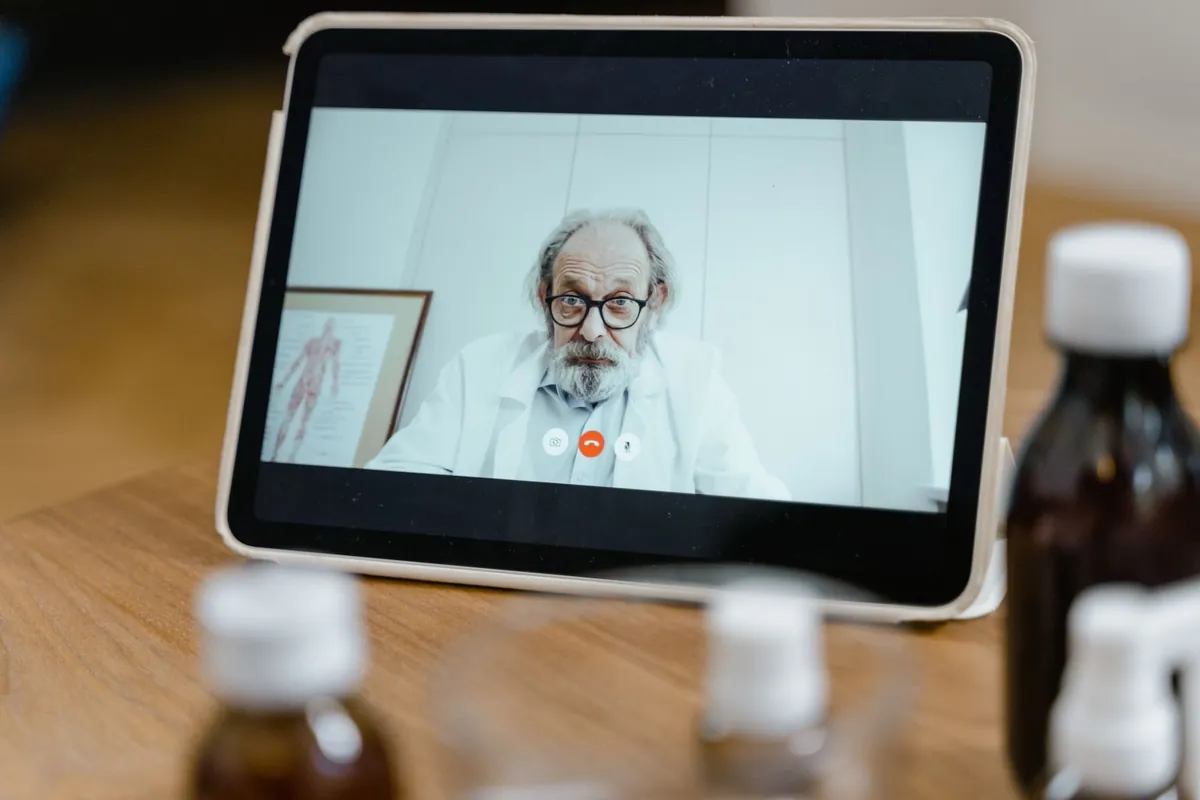
A telehealth video visit, the kind of patient app we build. Stock photo, not a client: “A Doctor on the Video Call” by Tima Miroshnichenko, Pexels License.
App Store guideline 5.1.3 says data gathered in the health, fitness and medical research context may not be used or shared with third parties for advertising, marketing or data mining, that an app must disclose the specific health data it collects from the device, and that it may not store personal health information in iCloud.
§ 10 · process
Five stages from scope to year two
Every engagement runs five stages in six-week cycles: Discover, Design, Build, Launch and Optimize. In a health build, Discover maps how the clinical workflow runs today, before any feature list.
Discover: how the clinical workflow runs and the check against what we do not build, then the written scope.
Design: flows before screens, so the booking path, the intake path and the patient view versus the staff view are agreed before anyone draws a button.
Build: sign-in, roles and the audit log first, features on top, with working software demoed every week.
Launch: app store submission or production cutover, then monitoring.
Optimize: the next six-week cycle, set by what patients and staff actually use.
After launch, Optimize continues in the same cycles, or a dedicated senior team takes the roadmap.
§ 11 · the stack
The stack we ship on
Four systems we run for our own business sit on this stack: this site with its booking page, and its live chat, both on Cloudflare Workers, with the chat's records in Supabase Postgres; and our client portal and our ERP, both on Next.js and Supabase. A healthcare build uses the same parts, picked per product.
Next.js and React· portals, booking flows, dashboards
Cloudflare Workers· APIs and reminders at the edge
React Native· iOS and Android, one codebase
Flutter· iOS and Android, one codebase
§ 12 · objections
Five worries buyers raise, answered
Four of these come from buyers in public threads about hiring a healthcare software firm, and the fifth is the ownership question every buyer should ask. Each answer gives you a test to run, the cause behind the worry, or the honest cost.
They say HIPAA compliant but never say how
Ask to see the safeguards working, not described. In a weekly demo, open a test record and show the audit log entry it writes, then sign in as a role that should not see it. A vendor that can do that has built the controls. A badge cannot prove it: HIPAA has no certificate to buy.
Integrations sink the schedule
One buyer on Reddit in March 2026 put it as most projects fail during integrations, not coding. They fail when they surface late: each connected system brings its own sign-in, data mapping and failure handling, and a vendor that will hold health data must sign a BAA first.
So every integration, with its BAA, is named in the written scope before a price, and a later addition is an explicit change order, priced and your call. Because our builds do not write into your EHR, none of them waits on a health system's EHR sandbox or access approval.
Timelines grow and clinical staff time drains
Staff time is not zero, so plan for it. Discover needs time from someone who runs the workflow; after that, the weekly demo is where your team checks the work. Cycles are six weeks long, and a change is an explicit change order, priced and your call. If no one can give that time, buying is the better answer.
A generalist learns healthcare on your budget
Fair worry: we are a custom software company, not a healthcare-only firm. In a health build we take on parts we already run ourselves: booking, calendar invites, email, sign-in and dashboards, in our own booking page, client portal and ERP. Every BAA a build needs is named in the written scope before the price.
Who owns the code when you part ways
You do. The code, the repos and the pipeline are yours from day one, and every build ends with a documented codebase and a handover, so your team is never locked out.
§ 13 · choosing a vendor
Questions to put to any healthcare software vendor
Judge a shortlist on evidence rather than on the order of any published list. Put these six questions to every vendor, us included, and compare the answers side by side.
Which shipped work can I open?Ours: the tools and archetype in the proof section; Planivo, a staff scheduling system for clinics and hospitals, is the client build.
Where does protected health information appear, in the database and on screen?Ours: only with hosts that sign a BAA with you, and on screen only for the roles that need it, under the safeguards above.
Which integrations have you shipped, and which do you refuse?Ours: calendar invites, transactional email and sign-in run in our own systems; the rest are scoped as in the connections section, and we refuse EHR integration.
Who signs which business associate agreement?Ours: we sign one with you whenever our team handles protected health information, and the host (AWS, Microsoft Azure or Google Cloud) signs its own.
Can I talk to a client from a year or more back?Ask this of every vendor; a firm with no client willing to take that call is a risk.
What arrives before the price?Ours: a written scope within 48 hours of the first call.
§ 14 · FAQ
Short answers to common questions
The first eight questions are worded the way people search for them. The last four are the ones buyers raise in public forum threads about hiring a healthcare software firm, answered with what we can show.
How much does it cost to develop a healthcare app?
Typical US quotes for a health app with few features run $70,000 to $100,000, according to the developer price guide a 2022 JMIR Formative Research paper cites. More user roles, integrations and HIPAA safeguards push the cost up, so the written scope matters more than the feature count.
Start with a written risk analysis of where electronic protected health information is stored and sent. Then build the five technical safeguards in 45 CFR 164.312: access control, audit controls, integrity, person or entity authentication and transmission security. Host only with vendors that sign a business associate agreement, and keep the evidence for your counsel.
First check that HIPAA applies: it covers health plans, clearinghouses and providers that send claims and other standard transactions electronically, plus their business associates, while a consumer wellness app outside HIPAA can fall under the FTC's Health Breach Notification Rule instead. There is no certification to buy; the Security Rule asks for periodic evaluation. NIST SP 800-66 maps each safeguard to practical steps.
How to develop a healthcare app?
Start with the one workflow the app must prove, such as booking a visit. Decide early whether it stores protected health information, because that sets your HIPAA scope and your hosting. Then agree the patient and staff flows separately, build on a stack your team can maintain, test with real users and plan for Apple's health data rules.
Apple's App Review guideline 5.1.3 bars using or sharing health data for advertising or data mining, and bars storing personal health information in iCloud.
What is SDLC in healthcare?
SDLC, the software development life cycle, is the sequence of planning, design, building, testing, release and maintenance. In healthcare two steps get heavier: a documented risk analysis of how the software handles electronic protected health information, which the HIPAA Security Rule requires, and secure development practices such as those in NIST's Secure Software Development Framework.
What are the top healthcare software development companies?
It depends on what you are building. Sort the field by kind first: large consultancies for enterprise rollouts and legacy systems, healthcare-only firms, EHR integration specialists and product studios for patient-facing apps. Then test each shortlisted firm on shipped work you can open, HIPAA safeguards in writing, what it refuses to build and a client you can call.
Digital Heroes is a custom software company that builds the patient-facing layer, so we sit nearest the last group. For app firms, also install two health apps each one has shipped. Our own answers to these tests are in the vendor questions above.
What is custom software development?
Custom software development is scoping, designing, building and supporting software made for one organization's own workflow, instead of buying a packaged product. A custom software development company is the firm that does that work. In healthcare it might be a patient portal shaped around your intake, a booking flow across your locations, or a telehealth service under your own brand.
Digital Heroes is one such company, founded in 2017 with headquarters in New York and Delhi, and every build ends with a documented codebase you own.
What are the top 3 EHR systems in healthcare?
By share of US non-federal acute care hospitals in 2024, the top three EHR developers were Epic at 50.8%, Oracle Health (formerly Cerner) at 20.1% and MEDITECH at 15.6%, per ASTP/ONC Data Brief 83. TruBridge at 7.1% and MEDHOST at 1.4% complete the top five.
Counted by clinicians reporting to Medicare's Promoting Interoperability program in 2024, the order is Epic 62.8%, Oracle Health 10.5% and athenahealth 7.8%, per ASTP/ONC Quick-Stat 30. The phrase big 4 has no official meaning; read as hospital EHR developers, it is Epic, Oracle Health, MEDITECH and TruBridge.
Who is Epic's biggest competitor?
Oracle Health, formerly Cerner. In 2024 it ran 20.1% of US non-federal acute care hospitals to Epic's 50.8%, and 10.5% of clinicians in Medicare's Promoting Interoperability program used its technology to Epic's 62.8%, per ASTP/ONC (Data Brief 83 and Quick-Stat 30). By those shares Epic is also the largest healthcare software company in US hospitals, though revenue rankings can differ.
How long does it take to build custom healthcare software, and what makes it take longer?
A health app with few features can take three to six months of development, according to the developer price guide a 2022 JMIR Formative Research paper cites. We plan in six-week cycles across Discover, Design, Build, Launch and Optimize, and the written scope, sent within 48 hours of the first call, states how many cycles a first release needs.
Four things add time. More user roles, which take a large share of the build and most of the testing. Each added integration, scoped, built and tested on its own. Storing protected health information, which adds the written risk analysis and a business associate agreement with every vendor that holds it. And any wait on another organization's sign-off, such as a vendor's BAA or an app store review.
Do you integrate with Epic or other EHR systems?
No. Epic and other EHR integrations, clinical claims engines, and medical-device firmware sit outside our scope, and we say so up front rather than learning it on your budget. We build the patient- and consumer-facing layer: wellness platforms, portals, booking systems, tracking apps, and telehealth MVPs. If your roadmap needs deep clinical-systems work, we will tell you on the first call and help you find the right specialist for that slice.
Where does patient data live in the software, and who can see it?
Start from the written risk analysis the HIPAA Security Rule requires, which maps where it is stored and sent. In our builds it is stored only with hosts that sign a business associate agreement with you, row-level security and role-based access decide who can read each record, and an audit log records who viewed or changed it.
Any vendor that creates, receives, keeps or sends it for you is a business associate under the law and needs a BAA with you, Digital Heroes included if our engineers ever need production data, and we sign it.
What happens after launch, and in year two?
After launch the work moves into Optimize, the fifth stage of our process: six-week cycles set by what patients and staff actually use. Teams that want standing capacity take a dedicated senior team. Whoever you hire, settle three things for year two in writing: who reviews access, who renews the BAAs and who answers when something breaks.
Last reviewed .
Book a scoping call
Book a 30-minute call. We walk through the workflow and the HIPAA scope with you, and the written scope follows. Self-serve booking, five-day lead time.
Published reviews from our Fiverr profile, reproduced word for word.
397 public reviews across
4 gigs, from clients in
36 countries.
Read them all on Fiverr.
very very best team in the world, they are very confidence person they told and know everything about the project they understand me fast and know exactly what they want to make
fenixx12
United States · $100-$200 · 3 days
The part I appreciated most was how every decision was explained from a business perspective rather than just a design perspective. The site feels polished, easy to navigate, and genuinely reflects the premium image we wanted for our laptop brand. Highly recommended for full stack website!!
oziaslux
United States · $100-$200 · 5 days
Very good result we are happy with the look of the new website and its functionality, definitely gonaa work again with them on our future projects. The team is very good at communicating and created a chat where we could all stay in touch along the project.
tuxedogroup
Canada · $1,000-$1,500 · 9 weeks
I liked that the project never felt uncertain because I always knew what stage it was at. The ideas we discussed were implemented really well, and the final website has a polished look with smooth performance. It turned out even better than I originally expected.
finley_jett12
United States · $100-$200 · 5 days
Whole team was excellent the project delivered phase one excellent thank you guys looking for forward to work on our next project in future thank you very much. It was a pleasure to work with you guys.
nick70787
Australia · $4,000 and above · 4 weeks
Overall happy with the service, quick response always, the website is very nice we are now testing all the tools given to us and very excited to start posting listings with it.
tuxedogroup
Canada · $1,500-$2,000 · 6 weeks
Reviews are reproduced as published on Fiverr, captured 2026-08-03.
Fiverr shows the buyer's username and country publicly; no other client detail is used here.