signal 01 · sell-through
70% by day 21.
Sell-through percentage 21 days post-drop. Below 55% means pricing or demand sizing is off. Above 90% within the first week means you under-produced and left revenue on the table.
A DTC apparel and streetwear ecommerce practice. We treat the season as a calendar, not a content plan. The drop engine runs on Shopify Plus: size and fit UX, exchange-first returns on Loop and ReturnLogic, EU GPSR compliance, and wholesale ops that sit beside your showroom.
Your brand does not have a marketing problem. It has a calendar problem. Before you fund a new paid push, ship a new collection, or rebuild on Shopify, score yourself against five signals. Each one has a pass or fail benchmark. Fail three or more, and the fix is operational, not creative. The numbers are already there: in your Shopify analytics, your Klaviyo cohort data, and your returns platform.
Sell-through percentage 21 days post-drop. Below 55% means pricing or demand sizing is off. Above 90% within the first week means you under-produced and left revenue on the table.
Overall return rate on apparel. Above 35% means the size and fit UX is broken. Exchange-first returns and a sizing quiz move this number faster than any production change.
Percentage of waitlist subscribers who convert within 48 hours of a drop. Under 25% means the waitlist is a content list, not a buyer list. Above 50% means the pre-access mechanic is earning its keep.
Share of year-one customers who buy a second drop. Below 25% means each collection is an island. Above 50% means the brand aesthetic has earned buyer identity.
Share of Google organic traffic arriving on brand-name queries. In fashion, the crown signal. Crosses 50%, paid CAC drops structurally. The brand is now a destination.
Brands passing four of five are ready for a growth partnership. Two or fewer and the Collection Method rebuild is the place to start. We will tell you which, on the intro call, in plain numbers.
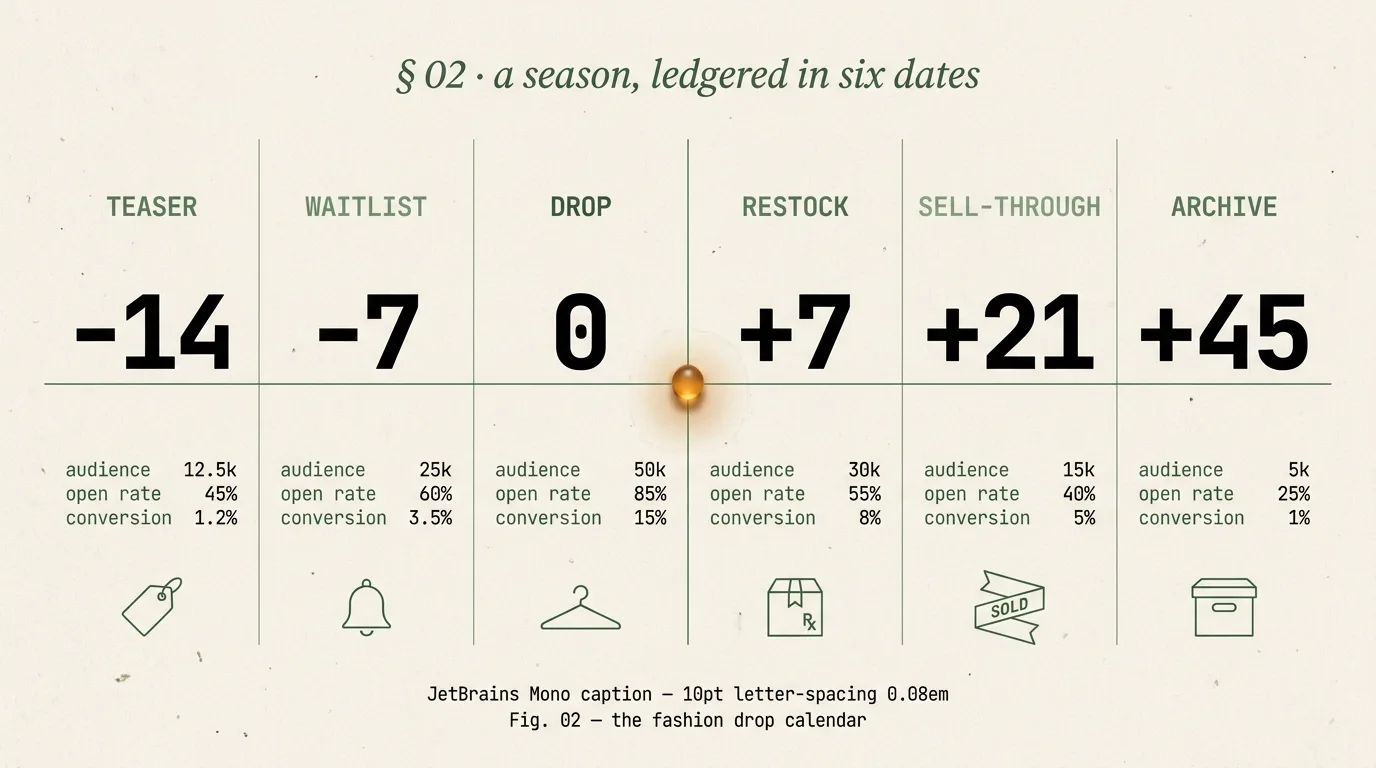
Fashion runs on six dates, not on continuous posting. Teaser, waitlist, drop, restock, sell-through, archive. Each date has a mechanic, a Klaviyo flow, a Shopify Flow rule, and a sell-through target. Run drops without this calendar and you are doing six jobs at once. Run with it and you do one job, six times.
Editorial imagery only. No buy button. The goal is waitlist capture and earned share, not conversion. Teaser creative lives on Instagram, TikTok, email, and a locked product page with a single email form.
Klaviyo and Attentive lists open. Pre-access tiers get segmented. A short sizing survey fires, feeding production allocation one last time before final units lock.
Pre-access window opens 24 to 48 hours before public. Queue and inventory protection on Shopify Plus. Shop Pay acceleration on checkout. Conversion rate spikes 4 to 8x baseline for the first hour. The system has to hold.
Sold-through SKUs reopen on restock signal. Back-in-stock flows fire within two minutes of inventory replenishment via Klaviyo. A single restock recovers 15 to 25 percent of missed first-drop revenue.
Final markdown or sell-through window. End-of-collection retention offers. Archive pricing logic runs via Shopify Flow. Data from here feeds the next drop's sizing curve.
The SKU retires. Inventory routes to wholesale, sample sale, or resale. Product-page URL redirects forward to the next drop so organic search equity transfers instead of being written off.
A size chart asks you to translate abstract measurements into your own body. Almost nobody has a tape measure handy. Three patterns beat the traditional chart. Together they lift conversion 18 to 34 percent and cut the return rate 9 to 22 points. Pick your pattern by category and catalog size. Care-label and cotton-fibre guidance from Cotton Works and the Cotton Incorporated sustainability brief feeds the fit-note rewrite.
| Reference-garment quiz | ML size predictor | Per-SKU fit note | |
|---|---|---|---|
| best for | contemporary, streetwear, denim | catalogs above 200 SKUs with fit variance | niche, luxury, runway-adjacent drops |
| mechanic | "what pair of jeans fit you well?" pulls the catalog buyer identity | True Fit, Fit Analytics, or Bold Metrics ML model | plain-language paragraph written by the design team per SKU |
| return rate impact | −11 points | −18 points | −9 points |
| conversion uplift | +22% | +18% | +14% |
| effort | 3 weeks build, content rewrite | 2 weeks install, requires returns data | ongoing per drop, design-team time |
| wrong when | catalog fits run true and uniform | under 100 SKUs or under 6 months of return data | drops of 40+ SKUs; scale breaks the model |
We pick the pattern on the intro call by catalog, fit variance, and current return rate. Running all three at once makes each less effective.
Pure cash refunds kill fashion margin. Most buyers hitting a size issue would gladly swap for another size, if the flow made that easier than a refund. Four levers move retained revenue from 15 percent to 42 percent within 90 days. The FTC textile rules set the baseline first: they define what your size and content labelling must declare before any exchange flow makes margin sense.
The returns portal lands on "exchange for another size" as the default option. Cash refund requires one extra click and a short reason select. Loop Returns and ReturnLogic both support the flow natively.
Pick store credit and you get 10 to 15 percent extra, right away, usable on the next drop. Revenue that would have walked out as a refund now stays at 60 to 70 percent.
Every return picks a structured reason: too small, too big, color, quality, or fit note was wrong. That data feeds the next drop's sizing curve and the per-SKU fit-note rewrite queue.
Returns for size issues fire a sizing-quiz link before the refund confirms. If the quiz suggests a different size, the exchange offer appears with one-tap confirmation.
Fashion stack sprawl is the silent killer. Six categories, one pick per category, deep integration. This is our 2026-Q2 default set. We revisit it every six months. Reference benchmarks: Shopify State of Commerce for category benchmarks and Postscript for the SMS layer alongside Attentive.
Drop mechanics, B2B wholesale portal, Shopify Markets for international. The only platform where drop, wholesale, and international coexist without a middleware tax.
Exchange-first flows, instant store credit with bonus, return reason telemetry. The retained-revenue engine that pays back its subscription in month one. Exchange-first returns are a margin line for every apparel brand; Loop Returns and the rest of the DTC app stack we install are ranked with the stage where each pays back.
Klaviyo as system of record, Attentive on SMS. Drop-tuned flows: teaser, waitlist, pre-access, drop-live, restock, sell-through, archive. Each wired to Shopify Flow.
Photo and video reviews on the PDP, attribute filtering on fit, height, size-ordered. Syndicates to Google Shopping and retail marketplaces.
Macros tuned for fashion tickets: sizing help, delivery ETA, exchange handoff, quality issue. AI-assist layer cuts response time 40% when macros are built right.
Branded shipment-tracking page carrying next-drop teaser, referral code, sizing FAQ. 40% open rate on a transactional page.
Fashion is the category where a wrong engagement costs both sides the most. Drop calendars do not forgive late launches. Here is our honest filter before the intro call.
You own the Shopify store, the Klaviyo account, the Loop configuration, the Okendo review library, the Gorgias macros, the catalog metafields, and every piece of creative shipped. Day one and on exit. 30-day pause clause, no exit fee.
We confirm fit on the intro call and send a scoped quote within 48 hours. Four engagement shapes: a two-week diagnostic, a 10-14 week Collection build, a four-to-six week returns retrofit, or a 12-month full pod partnership.
Brand litmus test, drop-engine diagnostic, size and fit UX audit, returns math review, GPSR readiness, 90-day roadmap.
Shopify Plus build using the Collection Method. Drop calendar engine, waitlist, size UX, exchange returns, restock logic, editorial lookbook.
Loop or ReturnLogic architecture, exchange-first flow, size-based routing, retained-revenue instrumentation.
Dedicated pod: Shopify build, drop operations, Klaviyo and Attentive flows, retail and wholesale portal, ongoing CRO.
Quotes within 48 hours of intro call. Ad spend billed direct to platforms; we never hold media budgets.
A drop calendar puts your whole season on one launch date. So your build partner has to know fashion operations, not just Shopify. These are the proofs that come before the brief.
"Drop engines, exchange-first returns, and Shopify Plus wholesale across nine years and two thousand storefronts. We turn down more fashion projects than we take, because a drop calendar does not forgive a late launch. And our name ships with the collection."





A fashion ecommerce agency builds and runs the operating stack behind a direct-to-consumer apparel, streetwear, or accessories brand. For us, that starts on Shopify or Shopify Plus. We engineer the storefront and the drop calendar mechanics: waitlist, pre-access, and restock.
From there it widens. Size and fit matching UX. Exchange-first returns on Loop or ReturnLogic. Klaviyo and Attentive flows tuned to drops. We also run editorial lookbook content systems, EU GPSR and textile-labeling compliance, and wholesale portal operations for brands with a showroom alongside DTC.
Our six-phase operating model for fashion drops. Teaser at day -14 for waitlist capture. Waitlist at day -7 for pre-access and sizing intent. Drop at day 0 with queue and inventory protection. Restock at day +7 to recover missed revenue. Sell-through at day +21 to close the collection. Archive at day +45 with redirect logic so organic equity transfers to the next drop. Six phases, one calendar, predictable sell-through.
Pricing is scoped to engagement shape. Fashion drop audit: 2 weeks. Collection Method build on Shopify Plus: 10-14 weeks. Returns and exchanges retrofit: 4-6 weeks. Full fashion partnership: 12 months with a dedicated pod. Book a 30-minute call and we send a scoped quote within 48 hours. Scope moves price, not the conversation.
Fashion returns run 25 to 40 percent on apparel, versus 3 to 8 percent on beauty. The fix is not more friction in the checkout. It is better sizing intent before the buy. We layer three patterns.
A sizing quiz asks about reference garments the buyer already owns. Per-SKU fit notes, written in plain language by the design team, say how each piece really fits. An exchange-first returns flow on Loop or ReturnLogic keeps exchanges free, while cash refunds take one extra step. Retained revenue typically moves from 15 percent to 42 percent within 90 days.
GPSR is the EU General Product Safety Regulation, in effect since December 2024. If your brand ships apparel, accessories, or textiles into the EU, you must comply. That means naming a responsible person with an EU address, providing product traceability information, maintaining technical files, and surfacing warnings where they apply.
Our Shopify build stores the required data as structured metafields. It then renders the mandatory information on PDPs, on invoices, and in the shipping-label flow for EU orders. Brands that ignored GPSR saw marketplace delistings through Q1 2025.
Drop mechanics live inside Shopify Plus through three patterns. First, pre-access. Shopify Flow and customer segmentation give the waitlist a 24 or 48 hour head start before the public drop. Second, inventory protection. Queue systems or Shopify's native bot protection stop resellers. Third, back-in-stock. Klaviyo flows fire on restock signals within two minutes of inventory replenishment. Together they turn a drop from a content event into an operating rhythm.
Yes. Most fashion brands above a certain scale run DTC and wholesale in parallel. Some also carry a showroom or consignment channel. Shopify Plus supports a B2B wholesale portal natively through company accounts, NET-30 terms, and catalog pricing tiers. We sync the wholesale catalog from the same product data as DTC. Channel-specific pricing and inventory allocation stop wholesale orders from eating DTC stock. Buyers get their own operating rhythm, separate from consumers.
Three triggers. First, drop volume: brands running more than one drop a month hit standard Shopify checkout and queue limits fast. Second, wholesale: the B2B portal and company accounts only run at Plus. Third, international: Shopify Markets and Markets Pro plus EU GPSR logic are simpler at Plus. We run the fit assessment on the intro call against those three triggers, not against revenue alone.
A 30-minute call to run the fashion brand litmus test on your numbers. You leave knowing which of the four engagement shapes fits your stage. We follow up with a scoped quote within 48 hours.

Senior Copywriter · New-york · 14 posts on the site
Published · Last updated .

Pinch, scroll or double-tap to zoom · drag to pan
Where should we send the proposal?
Please enter your name and a valid email.
Any faster way to reach you? Optional.
Please fill in the one you picked.

