Skip to content
§
§ · best shopify apps dtc

Best Shopify apps for DTC brands. 20 picks for 2026.

Hand-picked across seven categories: email, reviews, subscriptions, attribution, cart and testing, loyalty and returns, support. A fee for each, a revenue floor for each, and a does-not-fit line on every pick.

disclosure

Now the disclosure, because a list that hides who wrote it is an advert. Digital Heroes compiled this page. We build three Shopify products of our own, ShopScore, HeroCheckout and Section Vault, and none of them is on this list. The order is our assessment against the criteria below, not a measured benchmark; 13 of the 20 apps appear in our case studies. There are no affiliate links; each vendor link goes to its site or App Store listing.

quick answer

The best Shopify apps for DTC brands are the ones whose revenue floor you have crossed: Klaviyo for email, Judge.me or Okendo for reviews, Recharge for subscriptions, Littledata plus Triple Whale for attribution, Rebuy for cart offers and Gorgias for support. This list of 20 gives each one its fee, the stage it fits and where it stops paying back.

tl;dr
  • 20 Shopify apps in seven categories, 13 of them named in our case studies, with no affiliate links anywhere on this page.
  • Each pick carries a revenue floor (when it pays back), a does-not-fit line (when it is the wrong buy) and the cheaper alternative.
  • New in October 2026: Okendo for Shopify Plus reviews, Littledata for server-side tracking, Rebuy and Intelligems for the cart, Smile for loyalty and Loop for returns.
  • An install order by constraint, so a brand with a fixed budget knows which app to add next, and a table of all 20.
  • A free 30-minute call reviews your installed apps, flags duplicates and quantifies the monthly saving.
rank board · weighted score → re-sort → top pick
§ 01 · methodology

20 apps. Picked for fit, not for affiliate revenue.

Digital Heroes has built Shopify stores since 2017, and the case studies on this site name 13 of these 20 picks: Klaviyo, Recharge, Okendo, Gorgias, Judge.me, Postscript, Northbeam and Triple Whale among them. The other seven are judged on the pricing and features each vendor publishes, linked on every card. There are no affiliate links on this page.

Every pick carries a revenue floor (when it pays back), a does-not-fit line (when it is the wrong buy) and the cheaper alternative where one exists. Apps that look fine on the App Store but fail in production are excluded, with the reasons in the "what we left out" section near the end.

How we evaluated

  • Named in our case studies for 13 of the 20 picks. Littledata, Rebuy, ReConvert, Shop Quiz, Intelligems, Re:amaze and Tidio are not in a case study; their entries rest on the pricing and features the vendor publishes
  • Fee disclosure as the vendor publishes it, platform fees and per-action costs included. Every fee was read on 2026-10-07 from the vendor pricing page or Shopify App Store listing linked on its card. Check that page before you budget
  • A revenue floor where the app pays back, and a does-not-fit line for every pick
  • Documented integration with Shopify Plus, Online Store 2.0 and checkout extensibility where relevant
  • At least one credible alternative named when one exists
  • We excluded ourselves. Digital Heroes builds ShopScore, HeroCheckout and Section Vault, and none of them is on this list
§ 02 · install order

Install order. Which app to add first.

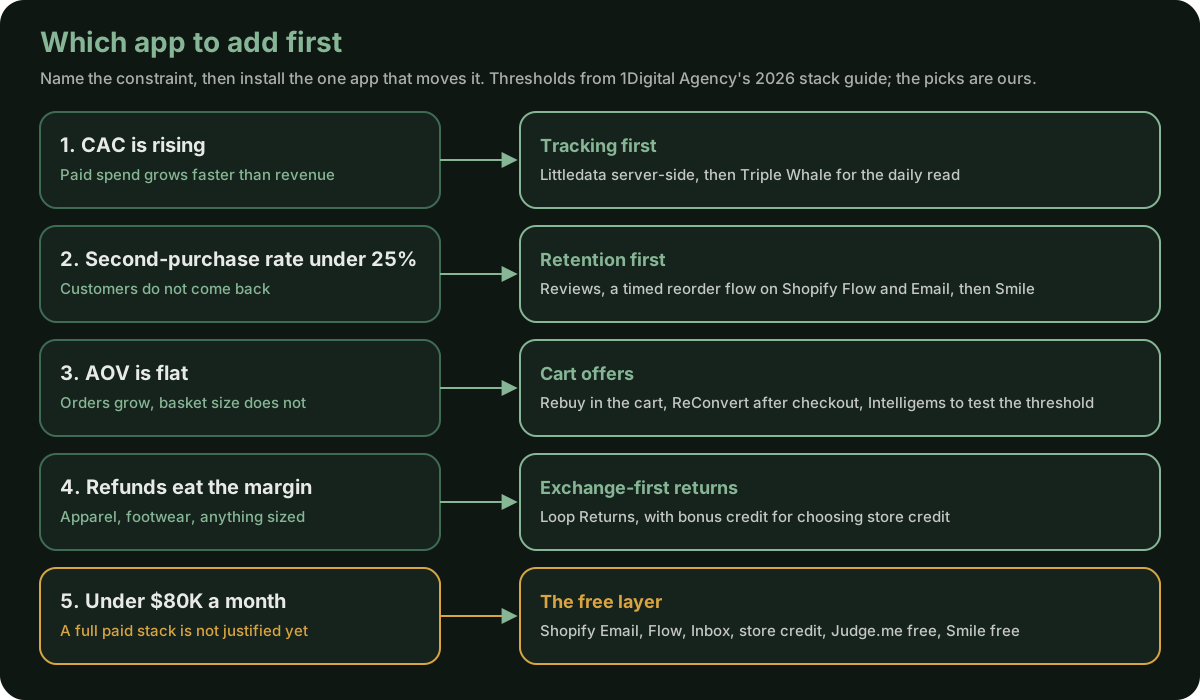
A brand with a fixed budget does not need the whole stack; it needs the next app. 1Digital Agency's 2026 stack guide sequences by constraint: tracking and attribution first when customer acquisition cost is rising, retention first when the second-purchase rate is under 25%. We use the same rule, with our own picks in each slot.

Diagram of which Shopify app to add first, by constraint: tracking when acquisition cost rises, retention when the second-purchase rate is under 25 percent, cart offers when order value is flat, exchange-first returns when refunds eat margin, and the free layer under $80K a month.
install order · name the constraint, add one app, measure, repeat

The floor matters as much as the order

The same guide prices a full 15-app stack at about $3,500 to $7,000 a month and says it is justified above roughly $80K in monthly revenue. Below that, the free layer does the work: Shopify Email, Shopify Flow, Shopify Inbox, the built-in store credit, Judge.me free and Smile free. Add a paid app only when you can name the number it should move.

What our builds taught us about the order

On our subscription builds the number that moved retention was the subscription app's cadence and skip settings, not a loyalty program. The craft coffee roaster archetype reached 65% six-month retention through cadence tuning and skip-before-ship on Recharge, and Emani ran 4% monthly subscription churn, pauses included, on Recharge. That is why loyalty sits at pick 16, after reviews and subscriptions.

§ 03 · email + sms

Email + SMS. The owned-channel layer.

Email is the first paid app most DTC brands buy and the one most often bought too early. Klaviyo is the default once the list is worth segmenting; Postscript adds SMS once email is mature. Below Klaviyo, Omnisend or Shopify Email carries the same welcome and abandoned-cart flows for less; above Postscript, Attentive adds enterprise compliance.

pick 01

Klaviyo

Email + SMS · email from $20/mo · App Store listing, read 2026-10-07

The DTC default. Native Shopify integration, the deepest segmentation and a strong flow library. Fees scale with active profiles, so the bill grows with the list.

Adopt at: $250K ARR. Warning: the February 2025 billing change counts active profiles, so a stale list raises the bill. Run a profile cleanup quarterly. See our Klaviyo integration guide.

Does not fit: brands under $250K ARR, where Shopify Email or Omnisend runs the same two flows for less, and any brand that will not maintain the list.

pick 02

Postscript

SMS · $49/mo minimum spend, Growth $100/mo, plus per message · App Store listing, read 2026-10-07

SMS for brands with established email. Conversational flows, segmentation parity with Klaviyo and transparent per-message pricing.

Adopt at: $1M+ ARR (SMS works after email is mature). Warning: over-send and carriers filter you. Build the segments before you turn on broadcasts.

Does not fit: brands still growing the email list, and enterprise brands that need the compliance tooling Attentive sells.

Omnisend below Klaviyo, Attentive above Postscript

Under Klaviyo: Omnisend, which Needle's 2026 marketing-app guide frames as a simple competitor to Klaviyo that puts email, SMS and popups in one tool. Above Postscript: Attentive, framed there as enterprise SMS and MMS with high-touch compliance and mobile list capture. Attentive is the SMS tool in several of our DTC case studies, including the DTC skincare archetype.

§ 04 · reviews + ugc

Reviews. From the free tier to the Shopify Plus pick.

Reviews are the first paid category on this list because they are the first install that moves conversion. Judge.me is the floor, Loox the visual pick, Yotpo the suite, and Okendo the Shopify Plus answer for brands past $5M that run Klaviyo. Pick one; running two review widgets doubles the script weight and the bill.

pick 03

Judge.me

Reviews · free / $15/mo · App Store listing, read 2026-10-07

The default under $500K revenue. The Forever Free plan covers unlimited reviews, photos and videos; the $15/mo Awesome plan adds automatic reminders, AI replies and 130+ integrations, Klaviyo among them. It is the reviews app in our Atlanta streetwear archetype.

Pick when: early stage, budget constrained.

Does not fit: stores past the $500K mark this pick is scoped to, or brands whose conversion case rests on a photo and video carousel.

pick 04

Loox

Reviews · free plan, Convert $49.99/mo · App Store listing, read 2026-10-07

Photo and video reviews for visual categories: beauty, fashion, home goods. The carousel widget is the product; text reviews are secondary.

Pick when: visual product, $250K+ ARR.

Does not fit: stores under $250K ARR, or categories with little worth photographing.

pick 05

Yotpo

Reviews + loyalty · reviews free to 50 orders/mo, Starter $15/mo · App Store listing, read 2026-10-07

Reviews, loyalty and SMS in one suite for established brands. 1Digital's 2026 stack guide flags Klaviyo and Yotpo Loyalty as the two apps with the steepest volume-based pricing.

Pick when: $2M+ ARR, one vendor for reviews, loyalty and SMS.

Does not fit: brands under $2M ARR, or anyone happy running separate tools. The suite only pays back when you consolidate three jobs onto one vendor.

pick 06 · new

Okendo

Reviews + surveys · free to 50 orders/mo, then $19, $119 or $299/mo · okendo.io

The Shopify Plus reviews pick for $5M+ brands. Reviews, UGC and zero-party survey data feed Klaviyo flows, and Klaviyo is listed under "works with" on its App Store listing (tiers read 2026-10-07). Historical reviews moved to Okendo in our Big Game Sports migration.

Pick when: Shopify Plus, Klaviyo-led marketing, and an order volume in the Growth or Power tier, which the listing caps at 1,500 and 3,500 orders a month.

Does not fit: stores inside the free and $19 tiers, up to 200 orders a month, where Judge.me does the job for free, and brands that want SMS from the same vendor, which is Yotpo's case.

See our deeper comparison: Yotpo vs Loox vs Judge.me.

§ 05 · subscriptions

Subscriptions. For consumable and replenishment categories.

The subscription app is the one choice that is hard to undo, because it owns the customer portal, the cancel flow and a fee on every renewal. Recharge is the default, Skio the portal-first challenger. Our six-app comparison with the cost of each at 500 subscribers is on the subscription apps page.

pick 07

Recharge

Subscriptions · $25/mo to 50 subscribers, Starter $99/mo + 1.49% + 19 cents a transaction · App Store listing, read 2026-10-07

The market default at $1M+ subscription revenue. Deepest customer portal, most mature dunning and the broadest integration list (Klaviyo, Gorgias, Postscript). Emani's subscription churn, pauses included, ran at 4% a month on Recharge.

Adopt at: $200K subscription MRR. Warning: the percentage fee compounds with volume. At the Starter rate, 1.49% of $1M in monthly subscription revenue is $14,900 a month, before the 19 cents per transaction.

Does not fit: build-a-box and bundle subscriptions, where Awtomic or Appstle fit better, and stores under 50 subscriptions, where Seal's free tier does the job.

pick 08

Skio

Subscriptions · $599/mo, or $499/mo billed annually, + 1% + 20 cents a transaction · App Store listing, read 2026-10-07

Modern challenger with a cleaner customer portal, faster checkout and passwordless login. Migration tooling out of Recharge is mature.

Adopt at: brand-led, $500K+ subscription MRR. Warning: the ecosystem is smaller than Recharge's. Verify your loyalty, Klaviyo and SMS integrations first.

Does not fit: stores under $500K subscription MRR, where $599 a month is the biggest line in the stack, and catalogs that need build-a-box.

Seven criteria for the subscription choice

Stay AI's 2026 comparison scores seven apps on seven criteria: billing flexibility, customer portal, churn tooling, analytics, integrations, migration support and no-code access. It places Appstle for build-a-box and Seal as the low-cost option. Use those seven criteria whatever you buy; the vendor that wrote them is also on the list, so read its own ranking with that in mind.

See our setup guide: Recharge setup + churn-flow architecture.

§ 06 · attribution + tracking

Attribution and tracking. Post iOS 14.5 reality.

An attribution dashboard is only as good as the tracking under it. 1Digital's guide puts the gap left by iOS privacy changes and cookie limits at 20 to 35% of tracked conversions without server-side tracking. So the order here is tracking first, then the dashboard: Littledata, then Triple Whale, then Northbeam once paid spend passes $200K a month.

pick 09

Northbeam

Attribution · Starter $1,500, Professional $3,500/mo, both by quote · northbeam.io/pricing, read 2026-10-07

Media-mix modeling plus multi-touch attribution. Best for brands spending $200K+ a month on paid, where channel mix matters more than per-campaign ROAS.

Adopt at: $200K/mo paid spend. Warning: setup quality determines attribution quality, so budget weeks for it, not days.

Does not fit: brands under $200K a month in paid spend; the model needs volume to beat Triple Whale's rules.

pick 10

Triple Whale

Attribution + dashboards · free plan, Foundation $219/mo · App Store listing, read 2026-10-07

Faster onboarding, daily-dashboard focus, lighter modeling. Best for brands with $50K to $500K a month in paid spend who want one screen for the daily review. Named in our Big Game Sports build.

Adopt at: $50K/mo paid spend. Warning: the attribution model is more rules-based than Northbeam's. Read it with judgment.

Does not fit: brands under $50K a month in paid spend, where Shopify's own reports and GA4 with clean tracking are enough.

pick 11 · new

Littledata

Server-side tracking · from $0.35 per order, or Scale from $159/mo · littledata.io

The tracking layer under the two picks above. 1Digital says Littledata reclassifies 25 to 30% of GA4 "direct" sessions to their real channel. Destinations on every plan include GA4, Meta, Google Ads, TikTok, Klaviyo and Recharge (pricing read 2026-10-07).

Adopt at: the first month you spend on paid ads; it costs less than one wrong budget decision.

Does not fit: stores with no paid spend and no GA4 reporting. 1Digital's pick for this layer is Elevar; we list Littledata because its pricing page is public and linked above.

See our comparison: Northbeam vs Triple Whale.

§ 07 · cart + testing

Cart offers and testing. The AOV layer.

Average order value has three levers: an offer in the cart, an offer after the payment, and a test of the price or shipping threshold. Rebuy covers the first, ReConvert the second, Intelligems the third, and Shop Quiz feeds all three. Dash's 30-app list keeps bundling and upselling as a category of its own; so do we.

pick 12 · new

Rebuy

Cart upsells + bundles · free Monetize tier, packages from $25/mo, Platform One $534/mo · rebuyengine.com

In-cart cross-sells, bundles and a smart cart. 1Digital cites AOV lifts of 12 to 18% across Rebuy's published case studies in consumables and apparel. This is the in-cart layer; ReConvert is the after-checkout one (pricing read 2026-10-07).

Adopt at: $500K+ ARR with a catalog wide enough to cross-sell.

Does not fit: single-product stores, and stores under 500 orders a month, where Shopify's own Bundles app and a theme cart drawer cover it for free.

pick 13

ReConvert

Post-purchase upsell · free to 50 orders, Growth $9.99/mo · App Store listing, read 2026-10-07

Thank-you-page upsells and post-purchase offers, after the payment. The lift depends on having something to cross-sell, so pair it with a catalog, not a hero SKU. On Shopify Plus the same offers can run inside checkout extensibility.

Does not fit: single-product stores and narrow ranges.

pick 14

Shop Quiz

Product quizzes · free to 100 responses/mo, Basic $39/mo · App Store listing, read 2026-10-07

RevenueHunt's quiz app, listed on the App Store as RevenueHunt Product Quiz Maker. Recommendation quizzes for beauty, supplements, vitamins and configurable categories, with an email capture built in.

Does not fit: single-product or non-configurable catalogs. At $39/mo it needs a range wide enough for a recommendation to carry meaning.

pick 15 · new

Intelligems

A/B + price testing · modules from $69/mo, Unlimited $1,279/mo · intelligems.io

The Shopify-specific A/B platform for price, shipping-threshold, content, merchandising and checkout tests, on Shopify's own pricing API now that Google Optimize is gone. Unlimited is $1,279 a month on a discount against a $2,894 list price, with a three-month minimum (read 2026-10-07).

Adopt at: enough orders to finish a test in a month; every module except price testing has a 14-day trial.

Does not fit: stores under a few hundred orders a month, where no test reaches significance, and anyone who only wants to test copy, which a theme section and Shopify's own analytics can do.

§ 08 · loyalty + returns

Loyalty and returns. The retention layer, in the right order.

Three of the five forum threads we read for this page are about retention or loyalty, and loyalty is the app operators buy too early. A Shopify Community thread collects eleven loyalty apps with no resolution. Our order: fix returns first, because that is measured money, then add a program once the repeat data exists.

pick 16 · new

Smile.io

Loyalty · free to 200 orders/mo, then $15, $79, $199 or $999/mo · smile.io

Points, referrals and VIP tiers. Of the eleven apps in that community thread (Smile, Rivo, Stamped, Growave, Loloyal, LoyaltyLion and more), Smile's free tier to 200 orders a month is why it is the one we start with (pricing read 2026-10-07). Install it after the repeat-purchase data exists, not before.

Adopt at: a measured second-purchase rate and a median reorder gap you can name.

Does not fit: brands under a year old with no repeat pattern yet, and brands that would rather issue store credit, which Shopify does natively. People understand ten dollars of credit; 800 points need explaining.

pick 17 · new

Loop Returns

Returns + exchanges · Checkout+ free, Essential from $155/mo, Advanced from $340/mo · loopreturns.com

Exchange-first returns. 1Digital reports that exchange-first flows retain 40 to 60% of revenue that would otherwise leave as refunds, and that a $5 to $10 bonus credit for choosing store credit sees roughly 80% redemption. Bonus credit sits on Loop's Advanced plan (pricing read 2026-10-07).

Adopt at: apparel and footwear at $1M+ ARR, where returns are a monthly margin line.

Does not fit: consumables with near-zero returns, and stores losing less than $155 a month to refunds, where Shopify's native returns and store credit do the job.

§ 09 · support

Support. The forgotten layer.

Support tooling is the last category most brands budget for and the first one customers feel. The choice is a Shopify-native helpdesk with order context in every ticket, a cheaper per-user helpdesk, or live chat with a simple AI agent until ticket volume justifies more. Shopify Inbox is the free floor under all three.

pick 18

Gorgias

Helpdesk · Starter $10/mo for 50 tickets, Basic $60/mo · App Store listing, read 2026-10-07

Shopify-native helpdesk with order context in every ticket. The standard pick at $1M+ ARR, and the support tool in our Emani build.

Does not fit: stores under $1M ARR, where ticket-based pricing is hard to justify.

pick 19

Re:amaze

Helpdesk · from $29/user/mo · App Store listing, read 2026-10-07

Cheaper than Gorgias for a small team, with similar core features. Pick it when budget matters more than the polish gap.

Does not fit: teams that will feel the polish gap this entry openly trades away, and the per-user price means the saving narrows as the support team grows.

pick 20

Tidio

Live chat + AI · free, paid plans from $29/mo · App Store listing, read 2026-10-07

Live chat plus a simple AI support agent. Pick it under $500K revenue when a full helpdesk feels like overkill.

Does not fit: stores past $500K revenue, where this entry itself sends you to a full helpdesk.

See our Gorgias setup guide: Gorgias customer-support setup.

§ 10 · at a glance

All 20 at a glance.

The same 20 picks in one table: category, the fee as listed, the stage where it pays back and the short form of each does-not-fit line. Every fee was read from the vendor pricing page or App Store listing on 2026-10-07, and each card links its source.

# App Category Fee as listed Adopt at Does not fit
01KlaviyoEmail + SMSemail from $20/mo$250K ARRUnder $250K ARR
02PostscriptSMS$49/mo minimum, Growth $100/mo, + per message$1M+ ARREmail list still growing
03Judge.meReviewsfree / $15/moDay onePast $500K, visual carousel needs
04LooxReviewsfree plan, Convert $49.99/mo$250K+ ARR, visual productNon-visual categories
05YotpoReviews + loyaltyreviews free to 50 orders, Starter $15/mo$2M+ ARRUnder $2M, separate tools preferred
06OkendoReviews + surveysfree to 50 orders, then $19 to $299/moShopify Plus, $5M+Up to 200 orders a month
07RechargeSubscriptionsStarter $99/mo + 1.49% + 19 cents$200K subscription MRRBuild-a-box, under 50 subscribers
08SkioSubscriptions$599/mo, $499/mo billed annually$500K+ subscription MRRUnder $500K MRR, build-a-box
09NorthbeamAttributionStarter $1,500, Professional $3,500/mo$200K/mo paid spendUnder $200K/mo paid
10Triple WhaleAttributionfree plan, Foundation $219/mo$50K/mo paid spendUnder $50K/mo paid
11LittledataServer-side trackingfrom $0.35/order, Scale $159/moFirst month of paid adsNo paid spend
12RebuyCart upsells + bundlesfree tier, packages from $25/mo$500K+ ARR, wide catalogSingle product, under 500 orders
13ReConvertPost-purchase upsellfree to 50 orders, then $9.99/moAny catalog with cross-sellsSingle product
14Shop QuizProduct quizzesfree to 100 responses, Basic $39/moConfigurable catalogsSingle product
15IntelligemsA/B + price testingmodules from $69/mo, Unlimited $1,279/moEnough orders to finish a test monthlyA few hundred orders a month
16Smile.ioLoyaltyfree to 200 orders, then $15 to $999/moMeasured repeat dataUnder a year old
17Loop ReturnsReturns + exchangesfree tier, Essential from $155/moApparel at $1M+ ARRNear-zero returns
18GorgiasHelpdeskStarter $10/mo, Basic $60/mo$1M+ ARRUnder $1M ARR
19Re:amazeHelpdeskfrom $29/user/moSmall support teamLarge teams, polish matters
20TidioLive chat + AIfree, paid from $29/moUnder $500K revenuePast $500K revenue
§ 11 · the stack thread

Two years in. Which apps earned their place?

The Reddit thread that ranks beside this page, from r/EcommerceWebsite in May 2026, is a founder's own stack review two years into a Shopify DTC brand. Its lessons match ours: pay for Klaviyo when the list earns it, let reviews do the conversion work, and leave loyalty until the repeat data exists.

Paying for Klaviyo at $1K a month in revenue

The thread says not to. Agreed, and it is why our Klaviyo floor is $250K ARR. The welcome and abandoned-cart flows run on Shopify Email until the list is worth segmenting. A Reddit thread from August 2026 put the general rule in one line: "I'd rather start with one thing and actually know whether it's doing anything."

Reviews as the biggest conversion lever

The thread found reviews moved conversion more than any CRO tweak. Agreed. Its own answer was Judge.me at $15 a month, which is why reviews are the first paid category on this list and Judge.me is the floor pick. Move to Loox or Okendo only when the category or the volume asks for it.

Loyalty at six to nine months in

The thread calls its early loyalty program wasted energy. Agreed, and it is why Smile sits at pick 16 with an adopt-at of measured repeat data rather than a revenue figure. On our subscription builds the retention lever was cadence and skip settings inside Recharge, as the craft coffee roaster archetype above shows, not a points balance.

Attribution apps before the retention math

The thread says founders over-index on attribution apps. Partly agreed. Attribution comes first only when acquisition cost is rising, which is the install-order rule above. Otherwise the two retention numbers in the FAQ, second-order rate and median reorder gap, come before any dashboard, and they are free to pull from Shopify analytics.

Where that brand should focus next

The thread asks whether to try influencers, scale ads without an agency, or go wholesale. Our read: if Google Shopping is beating Meta, search demand exists, so build the product and collection pages for the terms that already convert. Scale ads one variable a week, judged on blended numbers, never platform ROAS. For wholesale, a password-protected collection and draft orders get the first twenty accounts before B2B on Plus is worth it.

§ 12 · what we excluded

What we left out. And why.

Three kinds of app are missing on purpose. Each one looks fine on the App Store and costs a store something it does not see on the invoice: a locked templating layer, a bundle it has not grown into, or a price that only appears on a sales call. The reasons are below, so you can disagree with them.

Page builders (Shogun, GemPages, PageFly).

They lock you into a closed templating layer. Online Store 2.0 sections do most of what they do natively. Removing one later means rebuilding the pages it made, because that content stays inside the app.

Bundled "all-in-one" suites at MVP stage.

Buying email, reviews, loyalty and SMS bundled from one vendor under $500K revenue is overkill. The modular best-of-breed stack costs less and scales better. Yotpo and Okendo both earn their place on this list only past the stage where a suite consolidates three paid jobs.

Apps with no transparent pricing.

If the listing requires a sales call to learn the price, the price is high enough that they hide it. We default-skip these on small-store recommendations. Okendo stays because its App Store listing publishes four priced tiers up to 3,500 orders a month.

§ 13 · questions

Twelve honest answers.

What are some examples of DTC brands?

Allbirds, Everlane, Glossier, Dollar Shave Club, Casper, Warby Parker, Away and Mejuri are the usual examples: brands that sell through their own storefront rather than through retailers. TrendTrack's 2026 list of the top 20 DTC brands, compiled from data on hundreds of Shopify stores, opens with Allbirds, Everlane, Vuori and Glossier.

What are the top 100 DTC brands?

There is no agreed top 100; every list ranks by its own method, so the names change with the publisher. TrendTrack's 2026 ranking stops at 20 and includes Allbirds, Casper, Liquid Death, Magic Spoon and Warby Parker. For an operator, the useful question is not the ranking but the stack those brands run, which this page covers.

What are B2C apps?

B2C apps are applications a business offers directly to consumers: a brand's own shopping app, a food delivery app, a bank's mobile app. They are a different thing from Shopify apps, which are add-ons a merchant installs inside the store admin. This page covers the second kind, the apps a DTC brand installs to run its Shopify store.

What are the top DTC brands in the USA?

Most names on TrendTrack's 2026 top-20 list are US brands: Allbirds, Vuori, Glossier, Casper, Our Place, Caraway, Liquid Death, Magic Spoon, Warby Parker, Away, Chewy, Parade and Liquid I.V. The list was compiled from data on hundreds of Shopify stores, so it leans toward brands that run on Shopify, which is also where this page's app picks apply.

Is Amazon a DTC site?

No. Amazon is a marketplace and a retailer: when a brand sells there, Amazon owns the checkout, the customer record and a share of the margin. DTC means the brand sells through its own storefront and keeps the customer relationship. Many DTC brands also list on Amazon as a second channel, but that is wholesale-style distribution, not direct-to-consumer selling.

Do Shopify apps slow down my store?

Yes, when their scripts load on pages that do not use them. The r/shopify thread on this got the right answer: pixels, oversized images and heavy scripts cost more than most apps. After each install, switch off the app embeds the storefront does not need, and compare LCP before and after. Our Shopify speed optimization service goes deeper.

Which Shopify apps actually improve customer retention?

Start with two numbers from Shopify analytics, not an app: the share who order again within 90 days, and the median days between first and second order, split by first product. Then fix the free layer: one reorder email at that median day through Shopify Flow and Email. Only then test one paid app, with a holdout group.

Which Shopify apps are essential for a new DTC brand?

Three apps cover most of what a sub-$500K DTC brand needs: Klaviyo for email, where the welcome and abandoned-cart flows pay back first; Judge.me for reviews, free to start; and one support tool, Tidio free or Re:amaze. Add Postscript past $1M ARR and Recharge only for subscriptions. Every extra app is a script on every page.

How much do Shopify apps typically cost per month?

A lean three-app stack from this list costs $64 a month at first paid tiers: Klaviyo email $20, Judge.me $15, Tidio $29, and the last two have free plans. 1Digital Agency prices a full 15-app stack at $3,500 to $7,000 a month, justified above roughly $80K in monthly revenue. The install order section says what to add next.

Should I use Shopify Email or Klaviyo?

Shopify Email is fine at the start: it is built in, runs the welcome and abandoned-cart flows, and has a free monthly allowance. Move to Klaviyo once you need segmentation beyond those two flows, A/B testing and revenue attribution per flow, which for most brands lands around $250K ARR. Our Klaviyo integration guide walks through the migration.

Are page builder apps (PageFly, Shogun) worth it?

Rarely. Online Store 2.0 sections do most of what page builders do natively, and you own theme sections outright. Page builder content stays locked inside the app. Page builders make sense for marketing teams without developer access who ship landing pages weekly. For most brands, custom Shopify theme customization sections are cheaper long-term and faster on the production page.

Do I need both Okendo and Yotpo?

No. Both do reviews and loyalty, so running both doubles the widget weight and the bill. Pick Okendo when you are on Shopify Plus, run Klaviyo, and want review and survey data feeding the flows. Pick Yotpo when you want SMS from the same vendor as reviews and loyalty, past the $2M ARR mark where that consolidation pays back.

Last reviewed .

§ 14 · audit your stack

App-stack audit. In 30 minutes.

Free 30-minute call. We review your installed apps, flag duplicates, suggest swaps and quantify the monthly saving. No retainer commitment. Clutch shows a 5.0 rating from 66 verified reviews, read 2026-10-07.

Why work with Digital Heroes

Shopify Premier Partner accreditation United Nations Global Marketplace Tier 1 registration Upwork Top Rated Plus status Trustpilot rating from verified client reviews DUNS registered business verification Clutch Top Web Designers 2024 listing GoodFirms verified development company listing DesignRush ranked agency listing Clutch Top 1000 Global B2B Companies listing

115 people across five studios in New York, Delhi, London, Sydney and Lucknow, shipping ecommerce, web, software and mobile work for founder-led brands. Senior engineers only, no account-manager relay, and the same team from kickoff to launch.

  • Shopify Premier Partner, the tier Shopify reserves for agencies with a sustained delivery record on Plus builds
  • Tier 1 registered supplier on the United Nations Global Marketplace, which requires audited company documentation
  • Top Rated Plus on Upwork, the bracket for the top 3% of talent by client outcomes
  • 397 public five-star-weighted reviews across four Fiverr gigs, from clients in 36 countries
  • DUNS verified business, No. 650878346, so procurement can check us before signing
  • Listed by Clutch in Top 1000 Global B2B Companies and Top Web Designers 2024
  • Verified profiles on GoodFirms, DesignRush, Digital.com, AppFutura and TopDevelopers
  • 2,000+ brands built across 55+ countries, with $50M+ in client revenue scaled

Published · Last updated .

Online now

Talk to a Developer Now

Reply