job 01 · see it
In-room preview.
3D models, layered photography and a dimension line under every price, so scale stops being a guess.
An ecommerce practice for sofa, seating, case goods and decor brands that sell direct. In furniture the hard part starts after the click, so we build the whole chain: Shopify Plus, Magento or WooCommerce storefronts, AR room preview, size-first configurators, financing beside the price, LTL and white-glove freight tiers, trade accounts and the migration that gets you there.
A furniture store earns the sale three times: on the product page, at the cart and at the door. We build the storefront, then the parts a general agency leaves out: in-room preview, a size-first configurator, financing beside the price, freight tiers per SKU, scheduled delivery, returns routed away from reverse freight and the weeks of nurture in between.
You measure all of it in Shopify, Klaviyo and your freight broker's portal, which is why we build on those systems rather than around them.
3D models, layered photography and a dimension line under every price, so scale stops being a guess.
Size, finish and fabric on one surface, a live price and a draft order that carries every choice to production.
The monthly figure beside the price, prequalification in the cart, the schedule signed at checkout.
Parcel, LTL curbside, threshold or white glove, chosen per SKU and quoted honestly before the cart.
Returns re-homed locally, and dated production and delivery updates so nobody files a dispute out of silence.
Of the 248 home and furniture ecommerce agencies that ecommerceguide tracks, 71 percent list Shopify, 39 percent Shopify Plus, 27 percent Adobe Commerce (Magento), 24 percent WooCommerce, 16 percent BigCommerce and 15 percent headless. We build on Shopify, Shopify Plus and Shopify Hydrogen, and we keep Magento and WooCommerce benches in house. We do not run a BigCommerce bench.

| Platform | Agencies listing it | Digital Heroes |
|---|---|---|
| Shopify | 71% | Yes, in-house bench |
| Shopify Plus | 39% | Yes, our default for furniture |
| Adobe Commerce (Magento) | 27% | Yes, build and migrate |
| WooCommerce | 24% | Yes, build and migrate |
| BigCommerce | 16% | No bench |
| Headless | 15% | Yes, Shopify Hydrogen |
Native B2B, Shopify Flow for promotional logic, metafields for freight classes and lead times. See our Shopify Plus practice.
When a configurator needs its own React state and routing. The archetype on this page runs on Hydrogen with Remix routes and the Storefront API.
A store that should stay gets a Magento or WooCommerce build from our own bench. A store that should leave gets the migration below.
More than half of those 248 agencies, 54 percent, list replatforming and migration as a service. Ours covers attribute mapping, variant ceilings, customer and order history, a redirect map for every URL, a rehearsed cutover and a 90 day revenue watch.
The fields that break in a furniture move are the ones a generic import script ignores: width, depth and height as filterable attributes, fabric and finish swatches as media, lead time per SKU and the freight class each piece ships under. We map those by hand before the import runs. The live store keeps trading until the switch, the same promise MAK Digital Design makes on its furniture page. The difference is in the field map.
Product types, configurable attributes, multi store decisions and B2B rebuilds. See Magento to Shopify migration.
Plugin audit, catalog and customer imports, order history and subscription planning. See WooCommerce to Shopify migration.
Field mapping, 301 redirect maps, rehearsed cutover and a 90 day revenue watch, published before you leave the platform you are on. See Shopify migration.
Scale is the first doubt on a furniture product page, and in-room preview answers it. Shopify accepts GLB and USDZ 3D models up to 500 MB per model, and the viewer uses the phone's camera to place the piece in the customer's own room. We commission models for the SKUs that carry size risk, then compress them so they load on mobile.
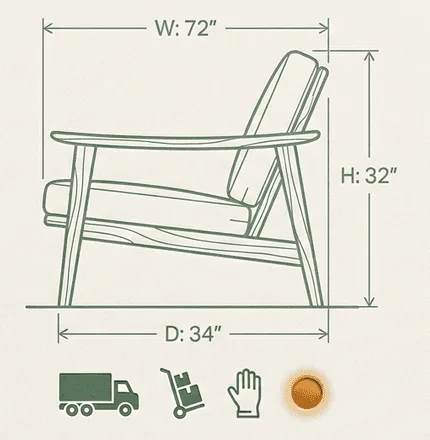
Where a 3D budget is not there yet, layered product photography does most of the work. The configurator archetype on this site used layered photos rather than renders and still held time on the product page above four minutes. A dimension line with width, depth and height sits under every price either way, in text a search engine can read.
The pieces a buyer cannot return cheaply get a model first. Lamps and cushions get photography.
The 500 MB ceiling is a limit, not a target. Shopify optimizes any model over 15 MB itself; we decimate meshes and compress textures before upload so it never has to.
Fabric and finish swapped as image layers on one base shot, which is how the archetype's preview was built.
Width, depth, height, seat height and box size as text under the price, plus a doorway check before the cart.
Buyers choose size with a tape measure and fabric with their eyes, so the configurator asks in that order. In our furniture configurator archetype, three choices on one surface (seven fabrics, three widths by two depths, four finishes) lifted average order value from $642 to $1,468 across 90 day averages, and returns on configured orders ran 22 percent below stock SKUs.
In that build 34 percent of product page visitors engaged at least one choice, 78 percent of those completed all three and 41 percent added to cart. The fabric, dimension and finish choices, the live price and the cart mutation sit in React state on Hydrogen, the Storefront API supplies per-variant pricing, and the final price lands before add to cart.
Sectional arrangement, width, depth. The logical choice, and it narrows everything after it.
Leg color, frame finish, metal or wood. Structural choices with a visible price delta.
Swatch samples mailed, live preview on the page. The emotional decision, taken last.
A decor catalog runs into thousands of variants, and Stryde's agency list singles out one firm purely for managing large catalogs and product variants. We start with Shopify Search and Discovery, Shopify's own free app: filters across several attributes, synonym groups, product boosts and related products on the product page.
Then we add the filters furniture buyers actually use: width range, seat depth, material, lead time and in stock now. The bigger win is upstream. In the configurator archetype we consolidated 168 SKUs to 84 by moving fabric and dimension into options, which halved the catalog and made every filter honest. MAK Digital Design names Searchanise as its standard filtering add-on; we reach for a paid search app only when Shopify's own runs out of road.
Width, depth and seat height stored as metafields so a buyer can filter to what fits the wall.
Synonym groups for the words shoppers type: couch and sofa, dresser and chest, sideboard and credenza.
Fabric and dimension as options on one product rather than a product each, the consolidation that halved the archetype's catalog.
A monthly figure beside the price answers the objection before the buyer forms it. We place Affirm, Klarna, Afterpay or Shop Pay Installments in three spots: the product page, where the monthly amount sits under the price; the cart, where prequalification runs without leaving checkout; and checkout itself, where the schedule is signed. Our BNPL integration guide covers the setup.
The full price and the monthly figure on one line, so the buyer reads both before deciding anything.
A soft check inline in the cart, no redirect away from the store, the answer back in seconds.
Signing and the payment schedule, completed at checkout through Shop Pay Installments or the provider's own gateway.
Buyers pay for white-glove delivery when the offer is honest up front: a dated window, placement in the room they choose, assembly included, packaging taken away. The price of that tier is a line item rather than a surprise at checkout, and the tier itself is decided per SKU, as a metafield, the moment the product page loads.

Boxed pieces under the carrier limit: lamps, stools, flat-pack side tables. UPS, FedEx or USPS to the doorstep.
A pallet on a freight truck to the curb with an appointment window; the buyer carries it in.
Through the first door, into the garage, lobby or hallway. No unpacking and no assembly.
Room of choice, assembled, packaging removed, through a specialist last-mile carrier: Metropolitan Warehouse & Delivery and AIT both sell room-of-choice white glove delivery. Stairs, door widths and elevator access are captured at the cart, so delivery day holds no dispute.
The freight tier is not a checkout dropdown. It is a metafield decision made at product page load. The per-SKU shipping class (parcel, LTL, threshold or white glove) drives four things at once: the broker quote, the assembly time estimate, the room access questions and the cadence of production updates.
Brands that treat freight as a post-cart variable ship pieces into the wrong tier, eat the rate difference and meet the dispute weeks later. Get the metafield right and the rest of the operation follows it.
Shipping a returned sofa back across the country can cost more than the margin on the order. Our returns-to-re-home flow sends the piece somewhere local instead: a regional liquidator that collects, a consignment platform, or a charity pickup through Habitat for Humanity ReStore or The Salvation Army. The buyer ships nothing back.
The first return fix is upstream. In the configurator archetype, returns on configured orders ran 22 percent lower than on stock SKUs, because a buyer who chose the width and the fabric knew what was coming through the door.
A regional liquidator collects from the buyer's home. We confirm the receipt, refund and write off the residual.
A consignment platform lists the piece for resale instead of it travelling back to the warehouse.
Most Habitat for Humanity ReStores offer furniture pickup, and The Salvation Army books donation pickups online by zip code.
A sofa is not bought on the first visit. Stryde's 2026 agency list frames furniture purchases as taking weeks or months and puts remarketing, email flows and content journeys at the center of the job, with financing, bundles, reviews and customer photos doing the persuading at high order values. We build both halves of that timeline in Klaviyo.
The list to work is the configurers. In our archetype 34 percent of visitors configured a piece and 41 percent of those added to cart, so roughly six in ten finished designs left the site with no cart. Each one is a named, rendered piece attached to an email address, which is a better remarketing audience than any lookalike.
A sample request starts a series timed to the mail: it has arrived, here is the piece in that fabric, here is the monthly figure.
The email shows the exact piece they built, with its price and lead time, and a one-tap return to the saved build.
The same configured image goes into Meta and Pinterest, not a generic catalog shot.
The review request goes out through Okendo a week after delivery and asks for a room photo, so the next buyer sees the sofa in a real room, not a studio.
Timeline, next step, production start date.
Fabric confirmed, a photo when the piece passes QC.
Carrier, tracking, the terminal it will reach.
Room of choice, stairs and access confirmed the day before.
Photo, signature, satisfaction check.
With photo upload, back into flow 04.
Support tickets land in Gorgias with the order, the production stage and the delivery window attached, so "where is my sofa" is answered from the record rather than guessed. Silence over a weeks-long wait is how a dispute starts.
Furniture shoppers begin with a room, not a SKU. Stryde names Pinterest, Instagram, YouTube and AI search as the discovery channels for home, and queries like "modern living room ideas" and "best sectional for small spaces" as the ones shoppers type first. A store that only ranks for its own product names misses that whole first step.
Room-led collections and sizing guides that answer the question before the product name exists. Built on our Shopify SEO process, with the product page SEO guide for the SKU level.
The catalog feed publishes every piece as a shoppable pin, and the room photos from reviews give the pins something to live in.
Meta, Google and TikTok programs built around the feed and creative that shows the piece in a space. See paid acquisition.
Dimensions, lead time, delivery tiers and the returns policy written as text on the page, where an answer engine can quote them, not locked in an image.
Stryde's agency list names marketplace and retail channel alignment, across Amazon, Wayfair, retail partners and DTC, as a core job of a furniture agency. The build requirement is plain: one stock figure across channels, price parity you can defend and attribution that tells you which channel each order came from.
Shopify Marketplace Connect, Shopify's own app, lists and syncs products and orders with Amazon, Walmart and Target Plus in the US and with eBay. Wayfair is not on that list; its supplier integration is a separate feed we wire through our API and integration practice. The rule we hold to: the configurable piece and the swatch program stay DTC, the stock SKUs go to the marketplaces.
Shopify holds the count; every channel reads it. Overselling on a marketplace means cancelling orders you have already taken.
One price across channels, with the DTC store winning on configuration, swatches and financing rather than on undercutting.
Orders tagged by channel in Shopify so the margin after fees and freight is reported per channel, not blended.
Trade covers interior designers, stagers and contract buyers, and 78 of the 248 agencies in ecommerceguide's directory, 31 percent, list B2B and wholesale. On Shopify Plus that line runs natively: trade customers are set up as companies, each with its own pricing, products, payment terms and shipping methods.
Our Shopify B2B process covers company accounts, catalog price lists, volume tiers, NET 30 terms, quote to order flows, buyer permissions and ERP, CRM and tax integrations. MAK Digital Design names bulk ordering, accounts and flexible pricing as standard and NetSuite, HubSpot and Acumatica as integrations; we connect the same systems through the API practice above. The B2B industry page goes deeper on self-serve wholesale.
Company accounts with their own price list, a saved ship-to for each project and a buyer who can order without a rep.
A configured piece becomes a quote, the quote becomes an order on net terms, and the order reaches production like any other.
NetSuite, HubSpot or whatever you already run stays the record; Shopify reads from it and writes orders back.
The furniture operating model has six layers, built bottom-up: in-room visualization, size-first configuration, financing beside the price, scheduled white-glove delivery, reverse-freight routing and the flows before and after the order. Order matters. A visualization or sizing failure leaks margin before any downstream delivery layer can recover it.
GLB and USDZ models on every SKU above the size threshold, a dimension line under every price.
Size, finish, fabric. Live preview, live price, the production window stated before the cart.
Affirm, Klarna, Afterpay or Shop Pay Installments beside the price and again in the cart.
Tier by item. Scheduled delivery, room of choice, assembly priced honestly as a line item.
Local liquidation, consignment or charity pickup instead of a truck back across the country.
Swatch, abandoned configuration and retargeting flows first; dated production and delivery updates once the order lands.
Stack: Shopify Plus, Klaviyo, Shopify 3D and AR, Okendo, Gorgias, Affirm, Klarna, Shopify Flow. Scope moves the price, not the conversation: after a 30 minute call you get a written scope within 48 hours.
A full build runs 12 to 16 weeks; the configurator archetype cut over in week 13 after its A/B test cleared significance. MAK Digital Design quotes two to four months for a furniture build, so the market agrees. Before the call, run your own numbers in our AOV calculator and ecommerce profit calculator.
Preview readiness, sizing information, financing placement, freight tiers, delivery comms, returns routing, 90 day roadmap.
Storefront, AR, configurator, financing, LTL and white-glove routing, returns-to-re-home, nurture and post-purchase flows.
Size, finish and fabric UX with live preview and draft order hand-off on the store you have.
Dedicated pod: storefront, AR operations, freight broker integrations, trade accounts, ongoing conversion work.
The method only pays when the margin after landed freight can carry it. These are the questions we ask on the first call, and the honest answers that end it early.
The store, the Klaviyo account, the 3D models, the freight broker contracts, the configurator code and every creative asset. Yours from day one and on exit, with the source and the admin logins in your name.
The directory that ranks above this page orders its 248 agencies by the client brands each names on its own site: 232 name at least one, and only 49 have a client the directory could corroborate. So check names and records, not adjectives. Our furniture work here is published as archetypes drawn from several engagements, and each case study says so on the page.
On Clutch, Digital Heroes shows a 5.0 rating from 66 verified reviews, read on 7 October 2026. Founded 2017. Offices in New York, New Delhi, Lucknow (engineering), London and Sydney. D-U-N-S 650878346 for procurement teams.
“Builds brands rather than just websites: 2,000+ shipped and more than $10M in client sales.”
Runs the engineering pods, including the Shopify, Magento and WooCommerce benches that build furniture stores, and still reads the scope before it goes out.
“Background runs across Shopify Plus, brand strategy, and DTC growth, at the intersection of operating discipline and design taste.”




It plans for what happens after the click. A general agency ships a theme and a checkout. A furniture practice adds in-room preview, a size-first configurator, financing on the product page, per-SKU freight tiers, delivery scheduling, returns routed away from reverse freight and the nurture a decision that takes weeks needs.
Shopify and Shopify Plus first, Shopify Hydrogen when a configurator needs a custom front end, and Magento (Adobe Commerce) or WooCommerce when that is where the store already lives and should stay. We do not run a BigCommerce bench. Of the 248 home and furniture agencies ecommerceguide tracks, 71 percent list Shopify and 16 percent BigCommerce.
Yes. The cutover is rehearsed on a copy before the real one, so the live store keeps trading until the switch. The furniture-specific work is mapping dimension and material attributes, swatch media and freight-class fields so they survive the move, plus a redirect map for every product and collection URL and a 90 day revenue watch.
Yes. Our API and integration practice connects the store to the systems you already run, so stock, orders, lead times and trade customers stay in one place. Our CTO leads architecture and code review on API, integration and CRM builds.
Yes. On Shopify Plus, B2B runs natively: designers and contract buyers are set up as companies, each with its own pricing, products, payment terms and shipping methods. We add quote to order flows, volume tiers and net terms, and connect the trade book to your ERP or CRM. Our Shopify B2B page lists the full process.
A full build runs 12 to 16 weeks in our shapes. The configurator archetype cut over to 100 percent of traffic in week 13 after an A/B test. A standalone configurator retrofit is six to eight weeks, and a two week audit comes first. MAK Digital Design, a competitor, quotes two to four months, so the market agrees.
Yes, through the same team. Shopify SEO covers collection architecture, filtered URL control, product page content and Core Web Vitals. Paid acquisition runs Meta, Google and TikTok with room-scene creative and the product feed. For furniture we add inspiration-led content, because shoppers start with queries like "modern living room ideas" rather than a product name.
Yes, and it is usually the right first move. The two week audit scores the store on in-room preview, sizing information, financing placement, freight tiers, delivery communication and returns routing, then sets a 90 day roadmap.
Usually yes, if the margin survives the marketplace fee and the channels share one inventory. Shopify Marketplace Connect syncs products and orders with Amazon, Walmart, Target Plus and eBay. Wayfair runs on its own supplier integration. The job is one stock figure, price parity and knowing which channel each order came from.
Furniture decisions take weeks, so the flows are built for that. Swatch sample requests trigger a follow-up series, an abandoned configuration email shows the exact piece they built, and retargeting carries the same render into Meta and Pinterest. Reviews with room photos and financing reminders do the persuading. In our archetype, six in ten configured pieces left without a cart.
Last reviewed .
A 30 minute call, then a written scope within 48 hours.
Published · Last updated .

Pinch, scroll or double-tap to zoom · drag to pan
Where should we send the proposal?
Please enter your name and a valid email.
Any faster way to reach you? Optional.
Please fill in the one you picked.