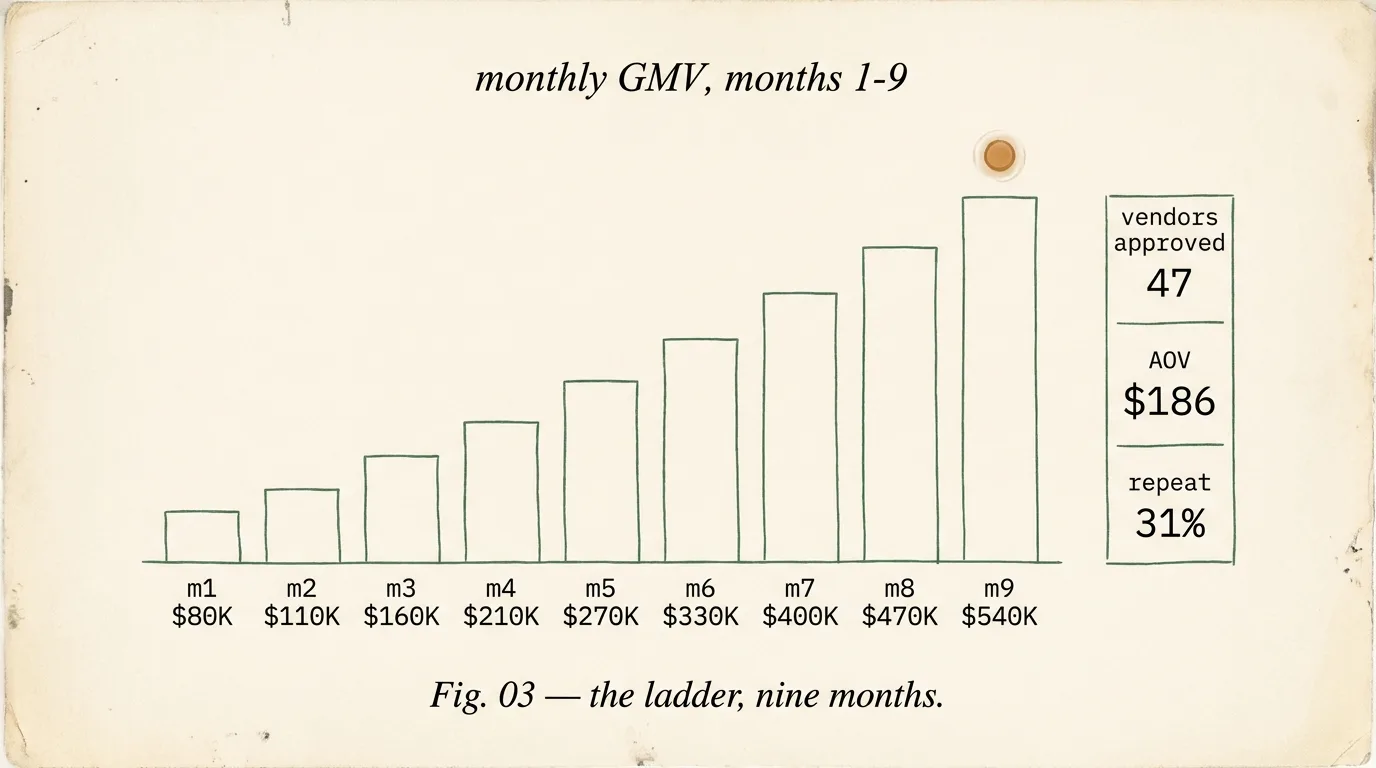
monthly GMV
6.7x
Nine-month ramp from $80K to $540K. Month-over-month growth held above 20% through months 3 through 7.
A multi-vendor marketplace archetype on Shopify Plus. Forty-seven curated vendors, one checkout, and a climb from $80K to $540K in monthly GMV across nine months. Drawn from real home decor work, not a single client story.
This is an archetype built from multi-vendor home decor work we have shipped on Shopify Plus. One founder. Forty-seven vetted independent makers across lighting, textile, ceramic, and wood. One unified checkout, one brand surface. The numbers below are composites representative of the work, not a single client's verified figures. Every lever named here is one we have pulled.
Nine-month ramp from $80K to $540K. Month-over-month growth held above 20% through months 3 through 7.
Curated independent makers. 184 applications, 61 invited to onboarding, 47 shipped a first order within four weeks of invite.
Orders from returning customers at month 9. The target was 22% at month 12. The retention curve moved faster than modeled.
The founder had spent two years curating independent home decor makers across three US regions. Ceramicists in North Carolina. Textile artists in New Mexico. Lighting studios in Brooklyn, wood ateliers in Oregon. Each one sold through their own low-traffic Instagram and Etsy storefronts.
Her thesis was simple. Put them all under one curated marketplace with editorial photography, one trusted checkout, and a shared shipping logistics layer. Every maker sells more. Shoppers get a single home decor destination that feels boutique, not algorithmic.
The operational challenge was harder than the commercial one. Every maker had their own SKU-naming habits, image resolutions, inventory systems, shipping origins, and lead times. Some fulfilled same-day from a studio. Others made to order on four-week turnarounds. Three were already overwhelmed by their existing order volume, and worried about losing their voice inside a marketplace.
The first big decision was architectural. Build a genuine multi-vendor marketplace, with separate vendor accounts, commission splits, and per-vendor analytics? Or run one Shopify Plus store with a tag-based "collection" per maker? We chose the latter.
The mechanics makers actually needed (per-vendor fulfillment routing, commission payouts, inventory sync) can be solved cleanly with multi-vendor apps plus a thin custom layer. That spared the founder the platform complexity of a true marketplace rebuild. The practice behind this archetype is our decor ecommerce agency work, which covers marketplaces, trade accounts and freight tiers.
The core tension was curation versus velocity. Vet hard enough that the brand holds. Onboard fast enough that makers do not drift back to Etsy while you deliberate. The funnel below is what we built, and it held through forty-seven approved vendors.
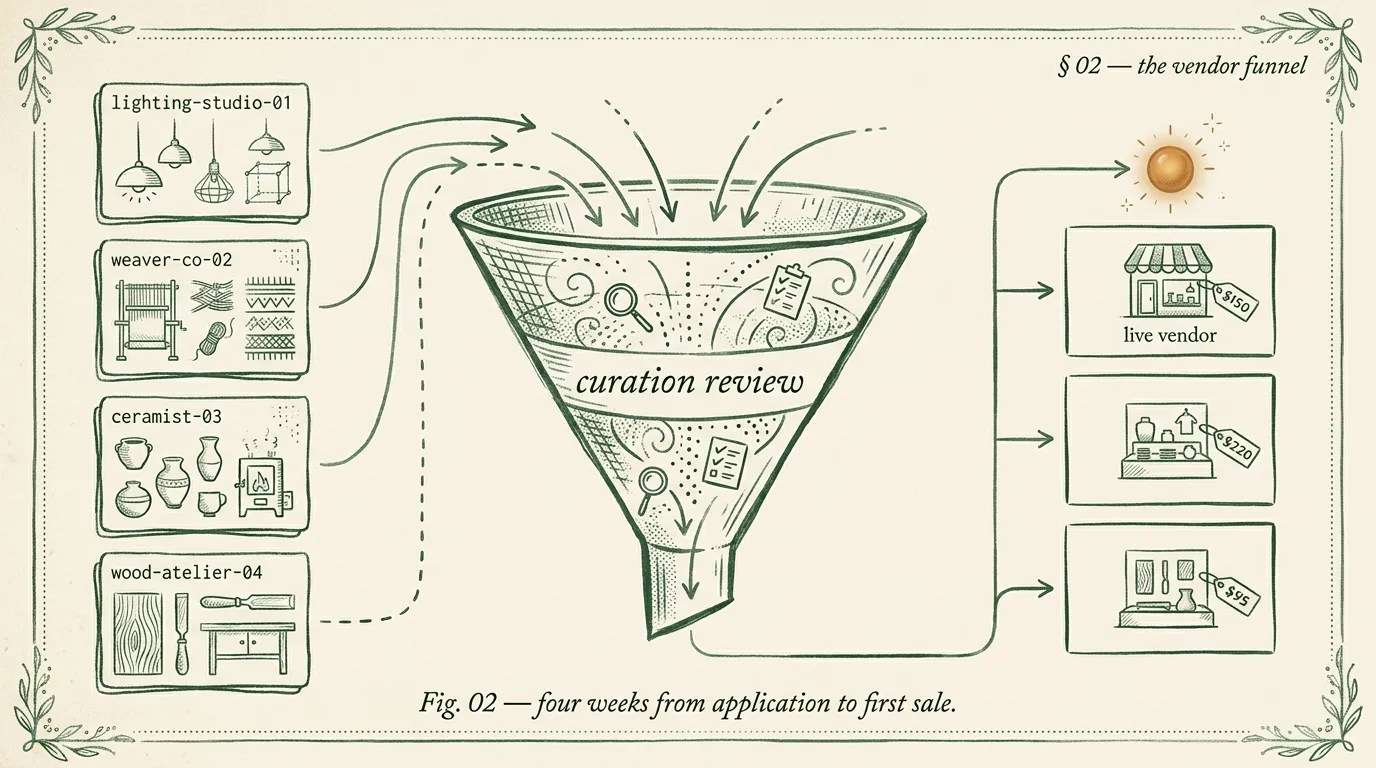
Typeform. 9 questions, 3 image uploads, Instagram handle. 184 applications in the first 60 days after the founder opened submissions.
Founder plus creative director, 15-minute review per applicant. 61 invited. Rejection feedback written individually; 22 reapplied later with improved portfolios.
Ten-day sprint: contract signed, product photography standards reviewed, SKUs uploaded, shipping origin configured, Stripe Connect payout live.
Vendor collection page published, featured in the founder's editorial drop email, first 3 SKUs pinned to the homepage rotation. First sale within 14 days median.
The playbook was a twelve-week build followed by a nine-month ramp. In week one we mapped the vendor operations the founder already ran in her head. Everything downstream fell out of that map. The six rules below held the brand together as vendor count grew from 8 to 47.
Shopify Plus on a custom Online Store 2.0 theme. Metaobjects for vendor profiles, ShopStorefront API for custom collection pages.
Custom thin layer on Shopify tags + metafields. Vendor collection pages auto-filter products by vendor tag.
Stripe Connect for per-vendor payouts. Marketplace keeps 15%, vendor receives 85% on net-14.
ShipStation with per-vendor warehouse ID. Orders route by line-item vendor tag. Combined tracking email when split.
Klaviyo flows segmented by first-vendor-purchased, enabling cross-vendor discovery campaigns.
Custom Xano + Next.js portal for vendor order visibility, payout history, product upload.
GMV compounded faster than modeled because vendor velocity compounded. Every new vendor brought their own email list, averaging 4,200 subscribers. The editorial drop cadence then turned first-purchase shoppers into cross-vendor repeat buyers: 31 percent by month 9.
"They understood that the marketplace is not the technology. It is the forty-seven makers trusting us with their livelihoods. The build held; the relationships held; the GMV followed."
We run marketplace builds in three shapes: the curated ten-vendor minimum viable marketplace, the fifty-vendor regional marketplace, and the two-hundred-vendor national platform. You get a scoped quote in 48 hours.









115 people across five studios in New York, Delhi, London, Sydney and Lucknow, shipping ecommerce, web, software and mobile work for founder-led brands. Senior engineers only, no account-manager relay, and the same team from kickoff to launch.
Published · Last updated .

Pinch, scroll or double-tap to zoom · drag to pan
Where should we send the proposal?
Please enter your name and a valid email.
Any faster way to reach you? Optional.
Please fill in the one you picked.

