Custom Software Development Services
Custom software development is the design, build and upkeep of software made for one company's way of working, not sold to everyone. Customized or bespoke, the work is the same: scope, design, build, integrate, test, launch and support.
Tell us what the software has to do.
On this page
What every custom software development engagement covers
- Discovery and scoping: a written scope and named team within 48 hours of a call, then a two-week discovery sprint before any fixed build price.
- Design: screens for each user role, and the data model, agreed before code.
- Development: the web or mobile app, usually on Next.js, React and Node.js, in repositories held in your name.
- Integration and migration: connections to the tools you keep, and records moved out of old or legacy systems and checked.
- Testing and launch: QA before you see a build, and a tested way to roll back.
- Support or handover: a named team after launch, or the documents to run it yourself.
Seven kinds of custom software we build
- Web apps and client portals: sign-ins where customers, partners or staff see and update their own records.
- Workflow and approval systems: requests that reach the right approver in order, with reminders and a record of each decision.
- Internal tools and dashboards: admin screens and reports that replace exports and copy and paste.
- CRM and ERP systems: customers, orders, stock and money kept in one set of records.
- APIs and integrations: connections between the accounting, payment and sign-in tools you already pay for.
- Mobile apps for iOS and Android: apps for customers or field staff that work on the same records as the web app.
- SaaS products: software you sell by subscription, with separate accounts, roles and billing for each customer.
Where AI belongs in a custom build
We add AI to a system where a narrow job repeats: answering staff questions from your own records, sorting incoming requests, or drafting a reply for a person to send. Our CTO leads that work, including the live chat assistant on this site.
Before any model is wired in, agree two rules with whoever builds it: the assistant reads only what the signed-in person may open, and no record changes until a person approves it.
Planivo, a whole platform we built in 2026
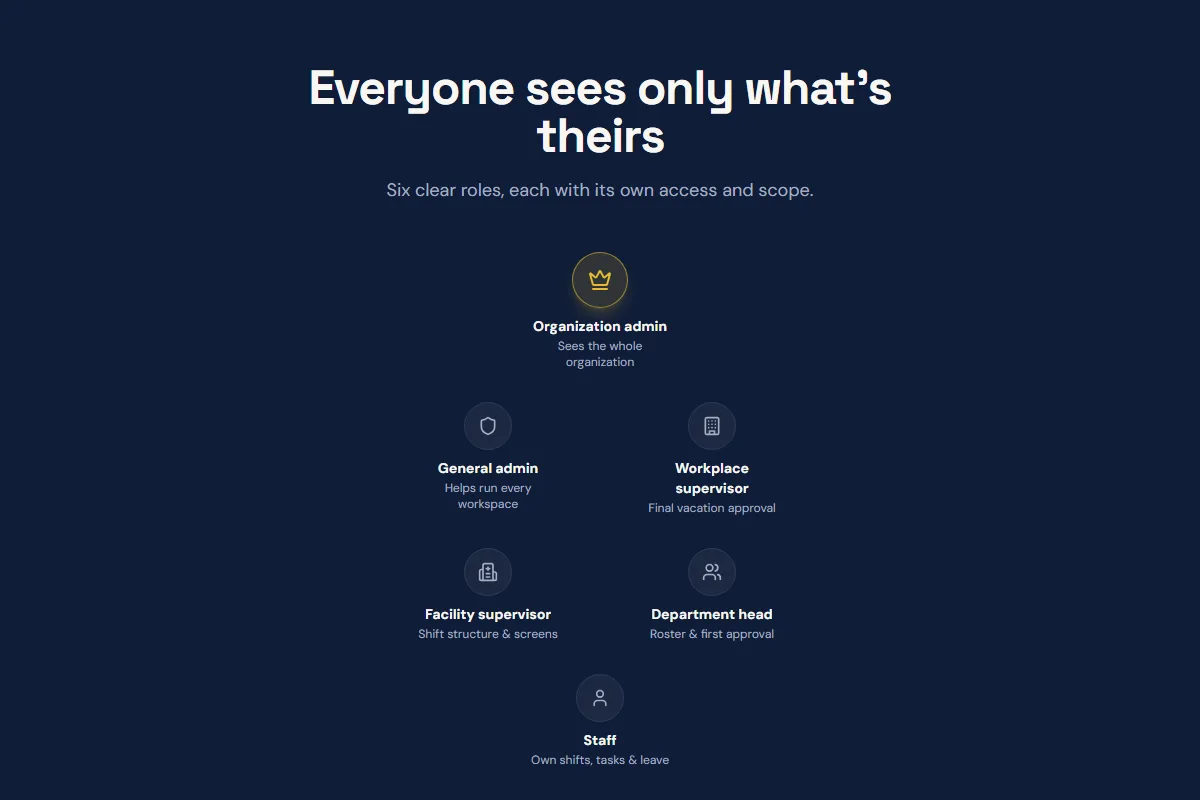
Planivo plans staff rosters for clinics and hospitals, and we built all of it in 2026: the signed-in app and the public site. The custom part is the rules. Leave requests pass a department head, then the facility, then the workspace; the system warns when two specialists of the same kind would be off together; and each of six roles sees only its own slice.
We show more of its screens and its full feature list with our enterprise software work.
Clients rate our work 5.0 on Clutch across 66 verified reviews (checked 6 October 2026).
The buyers who come to us, and the problem each brings
We build for the five buyers below, and two of our free calculators settle the question that comes before any of them, whether you need an outside team at all: one compares hiring in-house, an agency and a freelancer on the same hours, and the other prices a no-code platform against a custom build over two to five years.
- Founders with demand already shown: a first version that does one job well enough for paying users, built so the next version extends it.
- Operations leads whose process lives in spreadsheets, a few SaaS tools that never share data, and one person's memory.
- Companies outgrowing per-seat software that fits half their process and charges again for every new hire.
- Owners of a legacy system nobody wants to touch, replaced in phases while the old one keeps running.
- Product teams short of senior engineers, who add a dedicated team of a lead, engineers and QA to their own roadmap.
Six of our industry pages go deeper on one sector each: patient portals and booking tools for healthcare (not clinical EHR), payment integrations and KYC flows for fintech, listing search and tenant portals for real estate, course platforms for education, online ordering for restaurants, and donor CRMs for nonprofits.
Doubts we hear before a contract is signed
Each answer below rests on something you can check in our contract or on this site, not on a promise.
The budget will double before launch
GoodFirms' 2026 cost survey found scope creep adds 10 to 25 percent where it happens, so the defence is paperwork, not optimism. Anything outside the written scope gets its own change request, priced and dated, before work starts. And once the build begins, a week without a recorded demo of working code is a week we do not invoice.
An offshore team will answer slowly
We were founded in 2017 and are headquartered in New York, where a team replies on the same business day, 9 AM to 6 PM Eastern. Engineering sits in Delhi and Lucknow on hours that overlap New York's.
If your contract requires every engineer to be in the US, we are not the right firm, and our ranked list of software development companies in the USA shows where each firm's engineers work. Our US company is Digital Heroesco LLC; your MSA names the entity you contract with, and for US work it usually names New York law.
We will be stuck with whoever built it
Not by contract. Everything written specifically for your project becomes yours once the final invoice is paid, under our MSA; we keep the libraries and tools we had before or built for reuse. Repositories and cloud accounts sit in your name, our engineers are collaborators you can remove, and the handover pack gives the next team architecture notes, runbooks and a walkthrough.
Every agency sounds the same
Then test us on something small first. Discovery is a two-week sprint, priced on its own, and it can end in a verdict to buy: if a product on the market already does the job, we name it instead of quoting a build. The six checks further down make any two proposals comparable.
Bespoke or off the shelf: how to decide
Buy first when a packaged product already runs the process the way you want it run: HubSpot, Airtable, Monday.com and Retool cover a lot of ground, and Bubble builds simple apps without code. Commission bespoke software when the process is the reason customers choose you, when staff spend hours moving data between tools, or when seat fees climb with every hire.
What you keep when the software is yours
- One set of records instead of the same customer typed into four tools.
- Your own roadmap: features ship when you need them, not when a vendor schedules them.
- Seat fees end, so a new hire adds no licence cost, though hosting and upkeep continue.
- Everything written for your project is yours once paid for, so another team can take over.
- Permissions and an audit trail designed in from the first release.
Four drawbacks of customized software to budget for
- More money up front: most projects cost $30,000 to $100,000 in GoodFirms' 2026 survey, against a monthly subscription.
- Months before first use: a packaged tool works this week; a custom build takes months. With us, discovery fills the first two weeks, build sprints of one to two weeks follow, and you see working code in a recorded demo at the end of the first sprint.
- Upkeep is yours: fixes, updates and hosting carry on every year after launch, at the yearly share the cost section gives.
- Dependence on the builder: without documentation you are tied to whoever wrote it, which is why a handover pack belongs in the contract.
To test payback on your own numbers, the software ROI calculator turns hours saved, team size and build cost into a payback period, and the build vs buy calculator compares five years of cost against seat fees. If buying wins on those numbers, our discovery can end in a recommendation to buy. For the wider argument, read how SaaS and custom software differ.
Price and timeline benchmarks from a 2026 survey
GoodFirms surveyed more than 100 software firms in September and October 2025 for its 2026 cost report. Worldwide, most projects fall between $30,000 and $100,000 and take three to six months. For a medium-sized build, firms in Western markets quote about $50,000 to $250,000, by the same report, and the US is one of those markets. Enterprise systems start above $200,000 and run 12 to 24 months.
Upkeep sits outside those bands: by the same survey it runs 10 to 20 percent of the build cost each year, and scope creep adds the overrun described under the doubts above.
We do not print a price list. The first call is free and takes 30 minutes, and a written scope and quote follow within two days. A fixed price for the build comes after a two-week discovery sprint, priced on its own. The sprint ends either in that price or in advice to buy an existing product instead, and you keep its requirements and system map either way.
For a rough figure first, our free software development cost calculator works from hours and a blended rate.
Four ways to contract the work
| Model | How it is priced | Who pays for an overrun | Best when | Share of firms offering it |
|---|---|---|---|---|
| Time and materials | Hours worked at agreed rates | You do, since every extra hour is billed | The scope will change as you learn | 81.3 percent |
| Fixed price | One price for a written scope | The vendor, inside the written scope; changes are priced separately | The scope is known and stable | 65.6 percent |
| Dedicated team | A monthly retainer for a lead, engineers and QA | You do, since the retainer runs until the work is done | A roadmap runs for many months | 59.4 percent |
| Milestone based | A payment for each delivered phase | Shared: the vendor within a priced phase, you when phases are added | You want each payment tied to a result | 46.9 percent |
The written scope we send names a flat fee or a rate card, and a longer roadmap can run as a dedicated team. Read the five things that move a custom software budget before you compare quotes.
From first call to handover, in seven steps
IBM's guide to the software development lifecycle names seven stages, and each hands the next a concrete result. Our builds follow the same order; here is what each stage produces when we run it.
- Planning. A 30-minute call about the problem, then a written scope within two days: what will be built, how we will know it works, and who builds it.
- Analysis. Requirements workshops with the people who will use the software, a map of every system the build touches, and a risk register, all before the price is final.
- Design. Screens, user roles and the data model are drawn and agreed first; our CTO signs off the architecture before any engineer starts.
- Coding. From about day 15, after discovery, sprints run one to two weeks; every week ends in a recorded demo of working code and a short note on what shipped and what slipped.
- Testing. Our own QA team tests each build before you see a preview.
- Deployment. A tested way to roll back is in place before the first release, and larger systems go live one module at a time.
- Maintenance. A named team keeps fixing and improving it, or you take a handover pack (architecture notes, runbooks, a walkthrough) and run it yourselves.

each service covers one or two stages, and coding and testing repeat every sprint until the system is ready to launch
For a schedule built from your own numbers, the free software project timeline calculator turns build hours and team size into weeks.
Twelve languages and frameworks, one in-house bench
Every language and framework in this section is covered by developers already on our team, twelve in all, so the stack follows what your system needs rather than who we can hire. Two are in production on this site: Cloudflare Workers serve its booking and chat APIs, and PostgreSQL on Supabase stores the chat's conversations.
- Web apps, portals and internal tools: Next.js and React, or Laravel and Angular when your current system already runs on them. For a single PHP engineer on that system, see hire PHP developers in India.
- Records, roles and approvals: PostgreSQL on Supabase, with row-level security deciding who sees which record.
- APIs, integrations and background jobs: Node.js, with Cloudflare Workers running the APIs at the network edge.
- Mobile apps: React Native by default; Flutter, Swift or Kotlin when the app calls for them. For a Kotlin engineer on your own team, see Android app developers for hire.
- AI features and data work: Python.
Our CTO, Divyansh Singh, decides the architecture of every build, including which parts are built and which are bought, and reviews the code of our API, CRM and AI chatbot work.
The rest of the bench is in-house too: the engineers who cover these twelve stacks, and a QA team that tests every build before you see a preview. Where they work and when they answer is under the second doubt above.
How your idea, code and data stay protected
Your code sits in repositories held in your name from the first sprint, the finished system carries the four controls below, and two of our free checkers let you test a vendor's live site yourself: the SSL certificate inspector lists the domains its certificate covers, and the cookie analyzer shows whether its sign-in cookies are marked Secure and HttpOnly.
This page claims no SOC 2 or ISO 27001 report. If any vendor claims one, ask for the auditor's name and the report date before you count it. Our enterprise software development companies ranking checks what each firm's certificate really covers. What we do write into the systems we build:
- Encryption: in transit over TLS, and at rest in Supabase-hosted PostgreSQL, which Supabase encrypts with AES-256.
- Access by role: row-level security and role-based access, enforced in the database rather than only hidden in the screens.
- An audit log: who changed which record, and when.
- Secrets on the server: keys stay server side and are never sent to the browser, as this site's own chat API is built.
Confidentiality is in the contract as well. Finished work can appear in our portfolio, but a written opt-out keeps yours off it, and a strict work for hire contract with no portfolio rights can be added to the statement of work at a price stated up front. Once a scoping call is booked, a one-page mutual NDA is signed before we walk you through past client work.
To question any vendor, use the OWASP Top 10, 2025 edition, for common web application risks and the Secure Software Development Framework (NIST SP 800-218) for how the team builds.
Six checks that make any two quotes comparable
Two jobs stay with you whoever you hire: bring the people who will use the system into the requirements before they are written, and name one person on your side to watch the timeline every week. Then put these six requests to every vendor on your list and compare the answers line by line.
- The brief they priced. If you have none, make one with our free requirements document generator, so every vendor quotes the same thing.
- The hours and the rate behind the total. Our free quote checker turns any quote into an implied hourly rate.
- The name of the person who sets the architecture.
- How a change of scope is priced and dated.
- Where the code lives during the build, and when it becomes yours.
- What you receive at the end: documentation, runbooks and every login.
This page already gives our own answers to four of them: who sets the architecture in the stack section, how a change is priced and who owns the code under the doubts above, and the handover pack in step 7 of the process. The rest of our terms, from the MSA to support after launch, are on our custom software development company page.
Once you choose, our free SOW generator turns the agreed scope into a statement of work you can download as a PDF.
Quick answers on cost, stages and bespoke work
How much does it cost to develop custom software?
It depends on how many people will use it, how many outside systems it connects to and how much old data has to move. As a benchmark, GoodFirms' 2026 survey of more than 100 firms finds firms in Western markets quoting about $50,000 to $250,000 when the build is medium-sized. The cost section shows how we price yours.
What are custom software development services?
They are the paid work of designing, building, testing and supporting software for one organization's own processes, instead of licensing a product made for everyone. A full engagement runs from discovery and a written scope through design, development, integration, testing and launch to support or a handover, and what is written for you becomes yours once paid for.
How much do software development services typically cost?
Time and materials is the most offered model: 81.3 percent of firms in GoodFirms' 2026 survey offer it. Rates of $20 to $50 an hour are most common, mainly from teams in South and Southeast Asia, Latin America and Eastern Europe, while $100 to $250 an hour is standard for enterprise work in the US, Canada and Western Europe.
What is bespoke software development?
Bespoke software development is building software to one organization's specification; bespoke is the British word for what US buyers usually call custom. Instead of changing your process to fit a packaged product, the software is designed around how your team already works, and the organization that pays for it owns what is built for it.
How much does bespoke software cost?
It depends mostly on size. GoodFirms' 2026 survey sorts projects into four bands: small builds under $30,000 in one to three months, medium ones at $30,000 to $100,000 in three to six, large ones at $100,000 to $200,000 in six to twelve, and enterprise systems above $200,000 over one to two years.
What are examples of bespoke software?
A staff scheduling system with layered approvals for a group of clinics, a portal where distributors place orders, a quoting tool that encodes a firm's pricing rules, a dashboard that pulls figures from four separate tools, and a mobile app for field teams. Planivo, the clinic scheduling platform we built in 2026, is the first kind.
What are the disadvantages of bespoke software?
It costs more up front and takes months, not days, before anyone uses it. You also carry the upkeep: by GoodFirms' 2026 survey, fixes and updates after launch cost 10 to 20 percent of the original build every year. And without documentation you depend on whoever wrote it, so ask for a handover pack before you sign.
What are the 7 stages of SDLC?
In IBM's order, they are planning, analysis, design, coding, testing, deployment, then maintenance. Each stage hands the next a concrete result: a project plan, detailed requirements, a design document, a working prototype, tested software, a live release, then ongoing fixes. Our process section shows what each stage looks like in a build with us.
What are the 7 models of SDLC?
Lists differ, and IBM names eight common models: waterfall, V-model, agile, lean, iterative, spiral, big bang and rapid application development. Waterfall and the V-model run the stages once, in order; agile, iterative and spiral repeat them in cycles. We build in sprints of one to two weeks, which is an iterative approach.
What is the 40/20/40 rule in software engineering?
A rule of thumb from software engineering teaching: only 20 percent of a project's effort goes into writing code. Course notes from the University of Alaska Anchorage state the 20 percent, and their chart puts 35 percent into specification, requirements and design and 45 percent into testing. Our process gives the rest to planning, analysis, design and testing.
How long does a custom software project take?
Most take three to six months: in GoodFirms' 2026 survey, 65.7 percent of the firms asked put their projects in that medium band. With us, discovery takes the first two weeks, build sprints of one to two weeks start around day 15, and you see working code in a recorded demo at the end of the first sprint.
How do I choose a custom software development partner?
Shortlist vendors who have built something close to your system, send each the same written brief, and compare their answers to the six checks above line by line. Then ask each for a reference call with a past client. We arrange one or two once a scoping call is booked and the mutual NDA is signed.
Last reviewed .
Send us the problem, get a written scope back
Tell us what the software has to do and who will use it. After a 30-minute call you get a written scope and quote within two days, and a fixed build price after discovery. Book a call.
What clients say after launch.
Published reviews from our Fiverr profile, reproduced word for word. 397 public reviews across 4 gigs, from clients in 36 countries. Read them all on Fiverr.
Very professional to work with, attentive to details and very responsive. Everytime that we have corrections they respond rapidly and correct them within the next day or so. This is the level of quality of work we have been looking for
Great work very fast delivery and work done very well cannot wait to see all the other projects these guys are working on for our team
I had the pleasure of collaborating with @shreyanshsin261. Despite my initial apprehensions about working with a freelancer, their level of professionalism and understanding immediately put me at ease. Everything was handled promptly, and all requested tasks were completed. I highly recommend them.
Fantastic experience working with this developer on a custom e-commerce and web-to-print platform for our multiple product lines. They understood our specific requirements immediately, delivered a flawless product on budget
Excellent job overall. We made lots of additional asks along the way and they adapted and concurred each and every ask. Very helpful when it came to creating new accounts to link up with our website. Guided us every step of the way, would definitely recommend.
incredible experience with this team They built my website exactly how I envisioned clean, modern and optimized for conversions they kept me updated throughout, and even suggested improvements I hadn’t thought of. Everything was delivered on time and works perfectly across devices. You can tell they genuinely care about the quality of their work highly recommended !!
Reviews are reproduced as published on Fiverr, captured 2026-08-03. Fiverr shows the buyer's username and country publicly; no other client detail is used here.
Why work with Digital Heroes









115 people across five studios in New York, Delhi, London, Sydney and Lucknow, shipping ecommerce, web, software and mobile work for founder-led brands. Senior engineers only, no account-manager relay, and the same team from kickoff to launch.
- Shopify Select Partner, as listed in the Shopify Partner Directory
- Tier 1 registered supplier on the United Nations Global Marketplace, which requires audited company documentation
- Top Rated Plus on Upwork, the bracket for the top 3% of talent by client outcomes
- 397 public five-star-weighted reviews across four Fiverr gigs, from clients in 36 countries
- DUNS verified business, No. 650878346, so procurement can check us before signing
- Listed by Clutch in Top 1000 Global B2B Companies and Top Web Designers 2024
- Verified profiles on GoodFirms, DesignRush, Digital.com, AppFutura and TopDevelopers
- 2,000+ brands built across 40+ countries, with $50M+ in client revenue scaled

More from Divyansh.
Chief Technology Officer · Lucknow · 50 posts on the site
Published · Last updated .


