Skip to content
§
§ · services · solution types

Custom Software Development Solutions

Custom software development solutions are systems built for one company's problem, usually at the point where a bought product stops fitting. This page sorts them into six kinds and, for each, names the product to try first, the sign that building is worth it, and a cost band with its source.

§ 01 · the short answer

What gets built, and what to try first

in one paragraph

Most custom software development solutions fall into six kinds: workflow automation, internal tools, client portals, reporting dashboards, integration layers and AI features added to systems you already run. Each has a product worth trying first. Build only when the product cannot hold your rules, when its price grows faster than the work it saves, or when the software is part of what your customers pay for.

Six kinds of custom software solution: the problem each solves, the product to try before building, and the point at which a build makes sense
SolutionThe problem it solvesTry this firstBuild it when
Workflow automationApprovals that live in email and chat, so nobody can say where one is stuckZapier or Microsoft Power AutomateThe rules branch in ways a trigger and an action cannot hold
Internal toolsStaff fixing records in spreadsheets or straight in the databaseRetool or AirtableA large team uses it all day, or it must live in your product's code
Client portalsCustomers emailing to ask about status, files and ordersThe portal in your CRM or help desk, or Airtable PortalsThe portal holds logic your CRM does not, or customers pay for it
Reporting dashboardsMonthly figures rebuilt by hand from exportsGoogle's Data Studio, Power BI or MetabaseThe numbers need business rules first, or customers see them in your product
Integration layersOne customer typed into several tools that never agreeVendor connectors, Zapier, or Workato at enterprise scaleVolume, data checks or failure handling outgrow a connector
AI featuresStaff answering the same questions from scattered recordsThe AI inside tools you already license, such as Agentforce or FinAnswers must come from your records, under each user's permissions

This page is about what gets built. Who builds it, and how to check a vendor's claims, is on our custom software development company page, and what a full engagement covers, from discovery to support, is under custom software development services.

§ 02 · the catalogue

The six solution types, card by card

Each card gives the job, the cheaper route, the signal that a build is worth it, and a benchmark band with its source. Where we have built one, the card says what we built. Where we have not, it says that too.

type 01

Workflow automation

the problem
A leave request, a purchase order or a refund moves by email and chat. Steps get skipped, nobody can see where an item is waiting, and the record of who approved what sits in someone's inbox.
try first
Zapier links more than 9,000 apps, by its own count, with triggers and actions, and Microsoft's Power Automate does the same across apps, systems and websites, which suits a company already on Microsoft 365. Many CRMs and project tools also carry approval steps of their own. For a chain with one or two approvers, these are enough.
build when
The rules branch: three levels of approval, an exception for one department, a check against who else is away that week. Build too when a failed run must never pass in silence, or when an auditor will ask who changed what. Chains of triggers grow hard to test as the conditions multiply.
benchmark
A workflow system built as a focused first version falls in our band of $40,000 to $150,000. GoodFirms' 2026 cost survey lists automation tools among its large projects, at $100,000 to $200,000 over six to twelve months.
from our work
Planivo is this kind: in 2026 we built the whole platform, which plans staff for clinics and hospitals. Each vacation request climbs three approval levels, the system flags it when someone with the same speciality is already off, and reminders go out before a certification runs out.
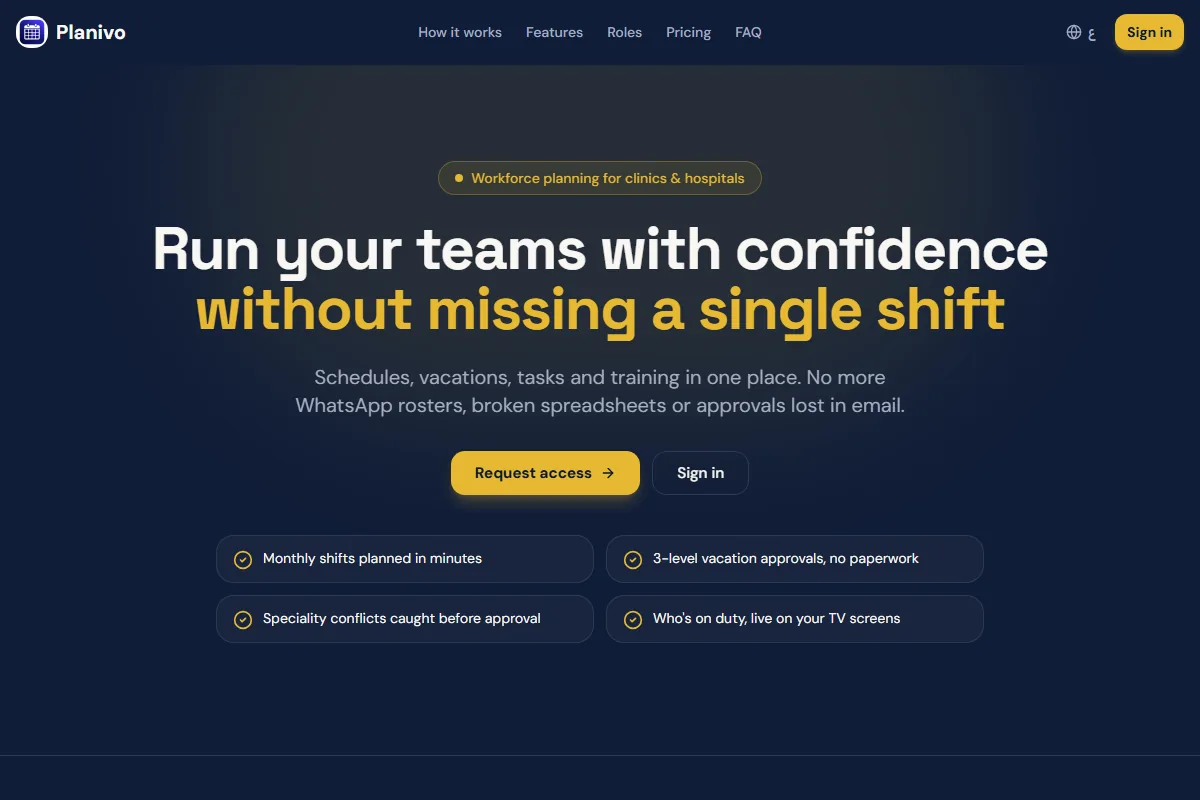
Planivo's home page, which we built with the app, naming the problem it replaces (rosters on WhatsApp, broken spreadsheets, approvals lost in email) and listing three-level vacation approvals and speciality conflict checks
Planivo's public site states the workflow problem in its own words: rosters, spreadsheets and approvals lost in email. planivo.me
type 02

Internal tools

the problem
Operations or support staff edit records in a shared spreadsheet, or ask an engineer to change a value in the database. Mistakes are hard to trace, and the engineer becomes the queue.
try first
Retool builds admin screens on top of the databases and APIs you already have. Airtable gives a team a database that feels like a spreadsheet, with forms and simple apps and no code. Both suit a tool that a handful of people use.
build when
A large team uses the tool all day, it needs permissions finer than the platform offers, or it has to ship inside your product's own codebase so one team maintains everything. It also pays once the platform's per-user price is more than the tool saves.
benchmark
Our delivery band for an internal tool or simple web app is $25,000 to $60,000, as our AI software development page states.
from our work
SpeedyPrint, an online print store in South Africa that we built in 2026, is run from an admin panel of this kind. It handles orders, products, templates and users, with separate roles for customers, admins and production staff.
type 03

Client portals

the problem
Customers or partners email to ask where an order is, send files as attachments and place repeat orders by phone. Every one of those questions costs a staff reply.
try first
If your customers already sit in a CRM or help desk, use its portal. HubSpot's customer portal lets customers follow their tickets and search the knowledge base, and Airtable Portals let guest users outside your company work in your Airtable data.
build when
The portal does real work your CRM cannot: pricing rules, a design editor, proofs to approve, uploads that feed production. Build too when the portal is part of what customers pay for, or when licence fees for outside users grow with every new customer.
benchmark
Our team's pricing guide puts a custom web application or portal at $20,000 to $50,000 and up, over 10 to 16 weeks. At enterprise scale, GoodFirms' 2026 survey puts web portals at $100,000 to $150,000 and up.
from our work
SpeedyPrint's customer side. Shoppers lay out their own labels, stamps, trophies and race numbers in an editor that runs in the browser, upload a CSV file when each piece needs its own name or number, then follow every order through its proofs and status history.
type 04

Reporting dashboards

the problem
Someone exports figures from three tools each month, pastes them into a spreadsheet and sends a version that is out of date by the time it lands. Each team ends up quoting its own number.
try first
Google's Data Studio has a tier with no charge for creators and viewers, Power BI is Microsoft's business intelligence platform, and Metabase is open source and can run on your own server. Metabase also sells analytics you embed for customers, so try that before building charts yourself.
build when
The figures need cleaning and business rules before any chart can be trusted, so the real build is the data pipeline behind the dashboard. Or customers must see their own numbers inside your product, each limited to their own account, in ways an embedded tool cannot match.
benchmark
No survey we trust prices a dashboard on its own, and no band of ours does either. The nearest we publish is the one for an internal tool or simple web app, in the internal tools card above. When the work is mostly joining data from many systems, GoodFirms' 2026 survey counts data-integrated systems among its large projects, at $100,000 to $200,000.
from our work
We have no client dashboard we can show on this page, so we show none.
type 05

Integration layers

the problem
The same customer is typed into the CRM, the accounting tool and the help desk, and the three never agree. A payment arrives but the order does not change, so someone checks by hand.
try first
The connector in each vendor's own marketplace, if one covers your two systems. After that, Zapier for low volume links between apps, or an integration platform such as Workato, which connects apps, data and workflows for large companies.
build when
Volume is high, the data must be checked and reshaped on the way through, a failure must retry and alert someone, or one of the systems has no connector at all. A custom layer also keeps the rules in code you own and can test. Our API and integration page covers this work in depth.
benchmark
GoodFirms does not price an integration on its own. Its 2026 survey names integrations as a cost driver that grows with the number of systems and the data passing between them, and files data-integrated systems under large projects, $100,000 to $200,000. A single link between two tools is a far smaller job, priced after discovery.
from our work
SpeedyPrint's checkout runs on PayFast and listens for PayFast's payment webhooks, and the same system sends its transactional email. On this site, Cloudflare Workers serve the booking and chat APIs.
type 06

AI features inside existing systems

the problem
Staff answer the same questions from documents spread across drives, sort incoming requests by hand, and write replies that repeat what the records already say.
try first
The AI already sold inside tools you pay for. Salesforce's Agentforce builds AI agents that work across the Salesforce platform, and Intercom's Fin answers customers on Intercom or on other help desks, Zendesk, HubSpot and Salesforce among them. Turning on a feature you already license is a cheaper test than any build.
build when
The answers must come from your own records, and each person may see only what their role allows. Build too when the AI should act, such as drafting a change to a record, and a person must approve it before anything is saved.
benchmark
Most AI firms in GoodFirms' 2026 survey price an AI MVP at $50,000 to $125,000. Adding AI to a build is a different sum: most participants said AI integration alone can raise a project's cost by up to 30 percent. The survey's advice is not to add AI because it is in fashion.
from our work
Two of our own systems are this kind, both built in-house: the assistant that answers in this site's live chat, and the AI copilot inside our CRM. Our CTO leads that work, and more of it is on our AI software development page.
§ 03 · the honest answer

When a business does not need custom software

A view you will meet in buyer forums is that most companies do not need custom software at all. In five situations, we agree.

  • The process is standard. Payroll, bookkeeping, email marketing and a basic sales pipeline run much the same way in most companies, and mature products already encode them.
  • Nobody has used the idea yet. A product without paying users should be tested with a no-code prototype, a spreadsheet or a service delivered by hand before anyone writes code.
  • The pain is a missing setting, not a missing system. Many complaints about a tool end once someone reads its admin guide or switches on a feature already paid for.
  • The budget cannot carry upkeep. Fixes, updates and hosting continue every year after launch, and GoodFirms' 2026 survey puts maintenance at 10 to 20 percent of the build cost a year.
  • Nobody will own it. Software with no owner inside the business drifts: requests pile up, nobody checks the releases, and staff slide back to the spreadsheet.

Three questions to answer first

  1. Have the people who will use it tried the products on the market, and what exactly stopped them?
  2. What does the problem cost today, in hours a week, errors a month or sales lost?
  3. Who on your side will own the software after launch, and how much of their week can it take?

If the answers point to buying, our discovery sprint says so, names the product, and you keep the requirements and system map it produced. Our smallest engagement is one senior engineer plus one designer, so for a job smaller than that we will point you to a freelancer or a smaller agency.

§ 04 · the other side

Four signs a build is worth the money

None of these signs means the products in the cards are poor. Each means the cost of bending your business to fit a product has grown larger than the cost of shaping software to fit your business.

  1. Your process is the reason customers pick you. If the way you quote, schedule or deliver is what sets you apart, a product made for everyone pulls you toward working like everyone.
  2. People carry data between tools by hand. Count it. Three people spending ten hours a week each, at a loaded cost of $40 an hour, is $62,400 a year of copying.
  3. Seat fees climb with every hire. A price per user that is fair for ten people can be heavy for two hundred, so compare five years of both before you decide.
  4. You keep hitting the product's walls. Permissions it cannot express, data it will not export, API limits that throttle your volume, or a rule about where your data must be stored.

To test the money on your own numbers, the free build vs buy calculator compares a build with five years of seat fees, the no-code vs custom calculator does the same for platforms such as Bubble and Webflow, and the software ROI calculator turns hours saved into a payback period.

Most solutions sit beside software you keep

A custom build rarely replaces everything. The usual shape is a layer over products you keep: a portal that reads from the CRM, an approval flow that posts to the accounting tool, an assistant inside the help desk. Our CTO, Divyansh Singh, decides what gets built and what gets bought, and signs off that plan before any engineer starts.

For the wider comparison of renting software and owning it, read SaaS vs custom software.

§ 05 · cost

Costs outside the bands, and our own range

Every band in the cards is for the build alone. Three costs sit outside them. Upkeep comes first: GoodFirms' 2026 survey of more than 100 software firms puts maintenance, fixes and updates after launch at 10 to 20 percent of the build cost a year. Then overruns, since projects hit by scope creep cost 10 to 25 percent more by the same survey. Then hosting, which grows with use.

Rates depend heavily on where the team sits. In the same survey, 56.3 percent of firms bill $20 to $50 an hour, mostly from South and Southeast Asia, Africa, Eastern Europe and Latin America, whereas the standard in the US, Canada and Western Europe is $100 to $250 an hour.

Across all six types, our own ranges are $40,000 to $150,000 for a focused first version, and $250,000 to $500,000 or more for a complex enterprise platform. Scope, integrations, security and data migration decide where a project lands. A SaaS MVP runs $30,000 to $80,000.

What moves a budget inside those ranges is on our custom software cost page, and the free software development cost calculator gives a rough figure from hours and a blended rate.

§ 06 · working with us

How we scope a solution before quoting it

We do not print a price list, because each of the six types varies widely inside itself. The first call costs nothing and lasts 30 minutes, and if the work suits us, a written scope and a quote reach you within 48 hours of it. A fixed price for the build comes only after a two-week discovery sprint, which is priced on its own.

Discovery maps every system the solution will touch and ends one of two ways: a fixed bid against the written requirements, or a recommendation to buy, with the product named.

Each week of the build closes with a recorded demo of code that runs, and a week with no demo is not invoiced. The code sits in repositories held in your name, and ownership of everything written for your project passes to you once the final invoice is paid.

Our headquarters is in New York, and engineering is done in Delhi and Lucknow during hours that overlap the New York working day. On Clutch we hold 5.0 from 66 verified reviews (checked 13 October 2026).

Still choosing who should build it? We publish scored lists, ourselves included and disclosed, of custom software development companies in the USA and of software development companies in the USA.

§ 07 · questions

Short answers on cost, scale and starting points

How much does it cost to develop custom software?

The type of solution decides most of it, along with how many systems it touches. We put a focused first version at $40,000 to $150,000 and a complex enterprise platform at $250,000 to $500,000 or more. Across the wider market, GoodFirms' 2026 survey finds most projects between $30,000 and $100,000. The cards above give a band for each solution type.

How can I develop my own custom software?

For a simple internal tool, you often can: Airtable needs no code, and Retool suits someone comfortable with a little SQL or JavaScript. Write down first what the software must do, who will use it and which tools it must talk to; our free requirements document generator turns that into a brief. Once the tool handles money, customer data or more than a few users, bring in engineers.

What are the top 10 custom software development companies?

No neutral top ten exists. The lists that rank for this question come from vendors, directories and forum posts, each on its own criteria. We publish two scored lists, with the disclosure that we placed ourselves first: nine custom software firms in the USA and ten US software firms. On ours or anyone's, read the criteria before the ranking.

How do custom software development solutions affect scalability?

They scale as well as their first design allows, so the choices that matter are made early. Model the data so a second site or product line is a new record, not a rewrite. Enforce permissions in the database rather than only hiding buttons. Move slow work, such as imports and email, into background jobs. And let the parts talk through APIs, so one can change without breaking the others.

Do most companies need custom software?

No. Most of what a company runs, from payroll to its sales pipeline, is better bought, because the products already encode how those jobs are done. Custom software earns its cost in the one or two places where your way of working really is different, or where staff lose hours between tools. The section on when you do not need it lists five situations.

Can a custom solution work with the software we already use?

Usually that is the point of it. Most custom solutions read from and write to the products you keep, through each product's API: a portal over your CRM, or an approval flow that posts to your accounting tool. Before any fixed price, our discovery sprint maps every system the build touches, so a product with no API is found before it becomes a surprise.

Should we start with low code or a custom build?

Start with low code when the tool is internal, the rules are simple and few people use it. Before you commit, check that you can export both the data and the logic, because rebuilding later is the real cost of outgrowing a platform. Our no-code vs custom calculator compares the two over two to five years on your own numbers.

How long does a custom solution take to build?

Discovery takes two weeks. With us, an MVP usually takes 8 to 12 weeks and a production platform 16 to 28, and our pricing guide puts a custom portal at 10 to 16 weeks. The first recorded demo of running code arrives when the first build sprint ends, so progress is visible long before launch.

Last reviewed .

§ 08 · next step

Bring the problem, not a specification

Tell us what keeps going wrong and which tools you already pay for. On a free 30-minute call we will say which of the six types it is and whether a product you can buy would do the job. If building makes sense, you get a written scope and a quote inside 48 hours. Book a call.

Why work with Digital Heroes

Shopify Select Partner, as listed in the Shopify Partner Directory United Nations Global Marketplace Tier 1 registration Upwork Top Rated Plus status Trustpilot rating from verified client reviews DUNS registered business verification Clutch Top Web Designers 2024 listing GoodFirms verified development company listing DesignRush ranked agency listing Clutch Top 1000 Global B2B Companies listing

115 people across five studios in New York, Delhi, London, Sydney and Lucknow, shipping ecommerce, web, software and mobile work for founder-led brands. Senior engineers only, no account-manager relay, and the same team from kickoff to launch.

  • Shopify Select Partner, as listed in the Shopify Partner Directory
  • Tier 1 registered supplier on the United Nations Global Marketplace, which requires audited company documentation
  • Top Rated Plus on Upwork, the bracket for the top 3% of talent by client outcomes
  • 397 public five-star-weighted reviews across four Fiverr gigs, from clients in 36 countries
  • DUNS verified business, No. 650878346, so procurement can check us before signing
  • Listed by Clutch in Top 1000 Global B2B Companies and Top Web Designers 2024
  • Verified profiles on GoodFirms, DesignRush, Digital.com, AppFutura and TopDevelopers
  • 2,000+ brands built across 40+ countries, with $50M+ in client revenue scaled

Published .

Online now

Talk to a Developer Now

Reply












