Custom Healthcare Software Development Services
Six services for clinics, digital health startups and wellness operators, each with its deliverables, its timeline and a benchmark you can check: patient portals, telehealth MVPs, booking and reminders, practice tools, HIPAA aware hosting and support, and rescue of an app another team started.
On this page
Six services, side by side
Custom healthcare software development services are the separate jobs a clinic or health company can commission: a portal patients sign in to, a first telehealth service, online booking with reminders, tools for staff, hosting with support, or the rescue of software that stalled. We sell each one on its own, and each block below lists what you receive, how long it takes and one published benchmark to hold the result against.
All six sit on the patient and staff side of care. None of them writes into an electronic health record; the work that would is listed under what these services leave out.
| Service | What you get first | Our timeline | Benchmark |
|---|---|---|---|
| Patient portal | Sign-in, intake forms, documents and secure messages for one patient journey | 8 to 12 weeks after a two-week discovery | 87% of people encouraged by their provider used a portal, against 57% who were not (ASTP, 2024) |
| Telehealth MVP | Booking, intake, a video visit and payment for one visit type | 8 to 12 weeks after a two-week discovery, plus vendor and store waits | An app with few features: $70,000 to $100,000 over 3 to 6 months (JMIR Formative Research, 2022) |
| Booking and reminders | Self-serve booking with confirmations, reminders and reschedule links | 8 to 12 weeks after a two-week discovery | Text reminders took missed visits from 21% to 15% (BMJ Open, 2016) |
| Practice management tools | One staff workflow, such as rosters, leave or an intake queue, with roles and reports | 8 to 12 weeks for one workflow; 16 to 28 for a platform | A medium custom project: $30,000 to $100,000 over 3 to 6 months (GoodFirms, 2026) |
| HIPAA aware hosting and support | Hosting under your cloud provider's BAA, backups, monitoring and fixes | From launch, billed monthly | Maintenance, fixes and updates: 10% to 20% a year on average (GoodFirms, 2026) |
| Rescue of an existing app | Discovery on the code you hold, ending in a fixed bid or advice to buy instead | Two-week discovery first, then a fixed bid | App development consultants: $100 to $250 an hour (BMC Medicine, 2023) |
The timelines are our own planning bands. After discovery, an MVP first release usually takes us 8 to 12 weeks and a production platform 16 to 28. The benchmarks come from outside sources, each linked in its block, so a quote from us or anyone else can be checked against something other than the vendor's word.
Patient portal development
A patient portal gives your patients one sign-in for the things the front desk now handles by phone, email and clipboard: forms before a visit, documents, messages and their own appointment history. It suits a practice whose EHR portal does not cover its intake, or a health startup whose product is the portal itself.
deliverables
- Sign-in with separate roles for patients, front desk staff and admins, each limited to the records that role may open.
- Intake and consent forms patients complete before the visit, with the answers waiting in a staff view.
- Document upload and download, such as referral letters or insurance cards.
- Secure messages between a patient and named staff, with a notification that carries no health detail.
- An invitation your staff send from the desk, because a portal nobody mentions stays empty.
- Sign-out after a set idle time, the automatic logoff the HIPAA Security Rule lists among its technical safeguards.
- Optional: an AI assistant for common questions, from the team that built this site's live chat assistant.
- Timeline
- Two weeks of discovery, then a first release in our 8 to 12 week MVP band. Every extra role with its own view adds design and testing, so a portal for several kinds of staff can move toward the 16 to 28 week band.
- Health data
- Yes. Intake answers and messages are protected health information once a provider runs the portal, so the hosting sits under a business associate agreement from the first release.
- Benchmark
- In 2024, 87% of people whose provider encouraged them to use a portal accessed it at least once in the year, against 57% of those who were not encouraged, and 59% of people nationally already had more than one portal, by ASTP Data Brief 77. That is why the invitation is a deliverable, not an extra.
- Not included
- Pulling records out of your EHR. Lab results and clinical notes stay in the EHR's own portal, and the custom portal handles what that one does not.
A telehealth MVP for one service line
A telehealth MVP proves one virtual service before you fund a platform: one visit type, one kind of clinician, one way to pay. It fits a startup testing demand for a new service, or a clinic adding video visits for a single specialty without changing everything else it runs.
deliverables
- Booking and an intake questionnaire for the one visit type.
- A video visit through a provider that signs a business associate agreement with you, chosen and named in the written scope.
- Payment at booking or after the visit, through a payment processor.
- A clinician queue that shows today's visits and who is waiting.
- A follow-up booking link sent once the visit ends.
- Web first. When patients need an app, iOS and Android come from one React Native codebase, the framework behind the AirTrainr athlete and trainer mobile apps we built.
- Timeline
- Two weeks of discovery, then the 8 to 12 week MVP band. Two waits sit outside any developer's control and belong in your plan: the video provider's BAA paperwork and, for an app, the store review.
- Health data
- Yes, from the first booking, so every vendor in the visit path is chosen for the agreement it will sign.
- Benchmark
- Even an app with few features costs $70,000 to $100,000 and three to six months of work, by a developer price guide cited in a 2022 study in JMIR Formative Research. An MVP that holds to one visit type is how you stay near that floor.
- Not included
- Writing the visit into your EHR, and insurance claims for the visit. Both sit under what these services leave out.
Online booking and appointment reminders
Booking and reminders take scheduling off the phone. Patients pick a slot across your providers and locations, and the messages that follow are what bring them in on the day. It suits a practice losing staff hours to booking calls, or one whose missed visits leave gaps in the day.
deliverables
- Self-serve booking by provider, location and visit type, with the slot rules your desk follows today, such as buffers and longer first visits.
- A confirmation email with a calendar invite file, the kind our own booking page sends for every call booked with us.
- A sequence of reminders by email or text, not a single message, each with reschedule and cancel links.
- Optional deposits at booking, through a payment processor.
- A staff dashboard of the day's bookings, cancellations and open slots.
- Timeline
- Two weeks of discovery, then the 8 to 12 week MVP band. Many locations, each with its own rules, add time; one location with a few visit types adds little.
- Health data
- Usually. A schedule showing who sees which provider counts as protected health information when a provider runs it. Keep reminder text to the time and the place, never the reason for the visit, because a lock screen shows it to whoever holds the phone.
- Benchmark
- Across the randomized studies pooled in a 2016 BMJ Open meta-analysis, patients sent text notifications missed 15% of appointments, against 21% of those sent none, and several notifications worked better than one. Hence a sequence rather than a single reminder.
- Not included
- Writing bookings into your EHR's own schedule. Your staff carry across what the chart needs, as with every service on this page.
Practice management tools for staff, not charts
Practice tools are the software your staff use to run the practice rather than to treat patients: rosters, leave, task lists, intake queues and the reports managers ask for every week. They suit a clinic or group that does this work in spreadsheets and group chats, or one that has outgrown a product covering only half of it.
deliverables
- One workflow first, such as shift rosters, leave approvals or an intake queue, following the approval order your managers already use.
- A role for each level of staff, so a department sees its own people and nobody else's.
- Reminders before a certification or license lapses.
- An audit history of every change, and who made it.
- Reports and exports that answer the questions managers ask each week.
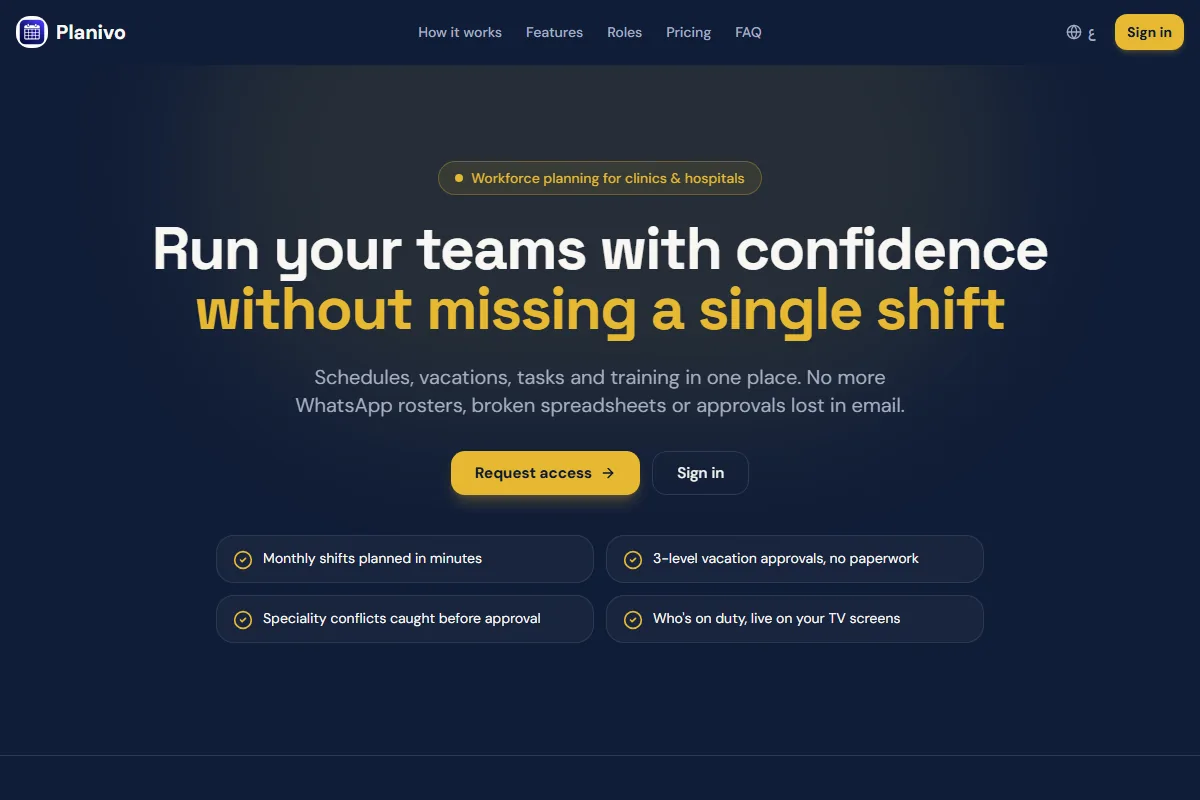
Planivo, a practice tool we built
In 2026 we built all of Planivo, the app and its website, for workforce planning in clinics and hospitals. It plans monthly shift rosters, sends each vacation request up three approval levels and flags clashes inside a specialty, tracks tasks and training attendance, warns before certifications expire, drives duty display screens and keeps an audit history, across six roles.
Shown with the client's permission. No results figure has been published for it, so none is given here.
- Timeline
- One workflow fits the 8 to 12 week MVP band after discovery. Several sites, roles and levels of approval move it into the production platform band of 16 to 28 weeks.
- Health data
- Sometimes. Rosters and leave hold none; an intake queue with patient names does, and then it is hosted like a portal.
- Benchmark
- The medium band in the GoodFirms 2026 cost survey of software firms is $30,000 to $100,000 delivered over three to six months, a fair yardstick for one staff workflow built well.
- Not included
- Billing, medical coding and claims. A practice tool here runs people and tasks, not money owed by insurers.
HIPAA aware hosting and support after launch
Hosting and support keep a live system safe and working after the build team moves on. The service fits anyone running one of the services above, and anyone whose health app is live with nobody looking after it.
deliverables
- Hosting in your own AWS, Microsoft Azure or Google Cloud account, on your billing, under that provider's business associate agreement.
- Only services the provider lists as covered for health data; AWS, for one, publishes a HIPAA Eligible Services Reference for exactly this check.
- A written data backup plan and disaster recovery plan, both required under 45 CFR 164.308(a)(7).
- Monitoring, security patches and dependency updates.
- Production emergencies covered around the clock from our Delhi and Sydney offices, and someone picks up an out-of-hours message inside one to two hours.
- Timeline
- Starts at launch and runs month to month. A retainer starts at one senior engineer and one designer.
- Health data
- Yes, whenever the system holds it, and our business associate agreement with you is signed before our team has access.
- Benchmark
- The GoodFirms 2026 survey puts post-launch maintenance, bug fixes and updates at an average of 10% to 20% a year, and our own mobile app cost calculator budgets 15% to 20% of the build each year. Plan for it when you sign for the build, not after the first outage.
- Not included
- A HIPAA certificate, since nobody issues an official one. The Security Rule asks instead for a periodic technical and nontechnical evaluation, under 45 CFR 164.308(a)(8), so put one on the support calendar each year.
Rescue of an app another team started
A rescue picks up healthcare software that stalled: a prototype that works in a demo but not with patients, a build whose first developer left, or an app that went live without the safeguards it needs. It suits any owner who holds the code but has lost the team. Before you call anyone, move the repository, hosting, domains and vendor accounts into your own name.
deliverables
- Before the call, our discovery lead reads the product as it runs today, the repository if you share it, and any documents you have.
- A two-week discovery sprint on that code, priced on its own, producing the system map, the risk register and the first architecture decision records.
- The security work every discovery includes: a threat model, a data-flow diagram and a review of how secrets are handled.
- A written scope with a fixed bid for the work that follows, or advice to buy an existing product instead. You keep the scope and the system map either way.
- Where the answer is a replacement, it can be built in phases while the old system keeps running.
- Timeline
- Two weeks of discovery first. The work after it is priced against the written scope, never guessed before anyone has read the code.
- Health data
- Often already in the system, so the business associate agreement is signed before discovery begins, not after it ends.
- Benchmark
- If a firm quotes you hourly to finish someone else's code, a 2023 guide for clinicians in BMC Medicine lists app development consultants at $100 to $250 an hour. Discovery, priced on its own, tells you what those hours would buy before you commit to them.
- Not included
- Connecting the rescued app to your EHR, as with every service on this page.
What these services leave out
Four kinds of work sit outside all six services. We name them before any quote, so a scope never drifts into them by accident and you can take that part of the work to the right firm early.
- Clinical EHR systems: charting, orders and the clinical record itself.
- EHR integrations, including FHIR APIs and HL7 interfaces: work inside or against the record, which belongs with your EHR vendor or an integration specialist.
- Claims engines: insurance claims, coding and remittance.
- Medical-device firmware: the code that runs on the device.
So how does a booking or an intake form reach the chart? A member of staff moves it. Each service puts the information in front of them, on a screen, in a file or in an alert, and the chart stays theirs to update. If your plan depends on data flowing into the record on its own, we will say so on the first call rather than halfway through a build.
Our healthcare software overview explains where this layer sits beside the EHR, and when buying a packaged product beats building at all.
Which service to start with
Most practices need one of the six first, not all of them at once. Match the problem in front of you today to the service that answers it, and add the next one when the first is in use.
- Patients miss appointments, or phone in to book every one
- Booking and reminders
- Paper or emailed forms arrive before every visit
- Patient portal
- You want to offer video visits for one specialty
- Telehealth MVP
- Rosters and leave live in spreadsheets and group chats
- Practice management tool
- An app is half built and its developer has gone
- Rescue, then hosting
- The software is live, but nobody answers when it breaks
- Hosting and support
How any of the six begins
It begins with a 30-minute call booked on our booking page. When the work fits us, you have a written scope and quote within 48 hours of that call; when it does not, we tell you while you are still on it. A paid two-week discovery sprint follows and ends in a fixed price for the build, or in advice to buy an existing product that does the job.
Once building starts, sprints run one to two weeks, you watch a recorded demo of the software working each week, and we do not bill a week that has none. The code lives in repositories and cloud accounts in your name, and under our MSA what we write for you becomes yours on full payment. Contract terms and the team behind them are set out where we describe ourselves as a custom software development company.
The project manager who signs this page, Navya S., runs sprint planning, scope and client communication on our healthcare and wellness builds. On Clutch, Digital Heroes holds 5.0 from 66 verified reviews (checked 13 October 2026).
Price bands before discovery
Our band for a focused first version, which is what each of the first four services delivers, is $40,000 to $150,000; complex enterprise platforms run $250,000 to $500,000 or more. Our mobile app cost calculator adds $30,000 to $100,000 for an app that keeps protected health information, and the project timeline calculator turns hours into weeks. Discovery replaces both ranges with one number and one date.
What every service ships with
Whichever of the six you buy, three commitments come with it, and the five safeguards below go into every build that will hold protected health information.
- A business associate agreement from us. Digital Heroes signs one with you whenever our team will handle protected health information, and it is in place before the first record reaches us.
- A host that signs its own. You pick AWS, Microsoft Azure or Google Cloud in the written scope; whichever it is signs its own agreement with you, and the build stays inside the services that agreement covers.
- An outside review. Our HIPAA practices have been checked by an independent firm rather than graded by ourselves.
Five safeguards inside the build
- Nobody sees a record before signing in, and each person signs in with an account of their own.
- Which records a person may open is checked in the database, not only hidden on the screen.
- Every view and every change of a record goes into an audit log.
- Only the roles allowed to change a record can change it, and each change is logged.
- Data is encrypted in transit and at rest.
Each line answers a standard in 45 CFR 164.312, so your counsel can check the list against the rule itself. Health data also leaks through places a feature list forgets: a text on a lock screen, an admin table that puts a name beside a condition, a spreadsheet export left in a shared folder. Agree in discovery which screens, messages and files may carry it.
Questions buyers ask about these services
How much does it cost to develop a healthcare app?
Expect five figures at the least, and often six. A developer price guide quoted in JMIR Formative Research in 2022 puts even an app with few features at $70,000 to $100,000. Our own bands are under price bands before discovery, and the mobile app cost calculator prices your own scope line by line, with a line for HIPAA health data.
What is SDLC in healthcare?
The software development life cycle: plan, analyze, design, build, test, release and maintain. Healthcare adds duties along the way. The HIPAA Security Rule, at 45 CFR 164.308, requires a risk analysis of the electronic protected health information a system holds, backup and disaster recovery plans, and a periodic evaluation once the system runs. In our services, discovery produces the threat model and data-flow diagram a risk analysis builds on, and the evaluation belongs to hosting and support.
What are the top healthcare software development companies?
No neutral answer exists, and many published lists are written by vendors, some without saying so. Shortlist by the service you need instead: EHR integration specialists for work inside the record, large consultancies for hospital-wide programs, and product studios for portals, booking and telehealth. Digital Heroes belongs in the last group. Ask every firm for live work you can open and for the services it turns down.
Who is Epic's biggest competitor?
That is Oracle Health, formerly Cerner. In 2024, Epic held 50.8% of the US non-federal acute care hospital market and Oracle Health 20.1%, by Appendix Table 1 of ASTP/ONC Data Brief 83. For the services on this page the choice matters little: none of the six connects to either system, so the EHR you run does not change their scope.
Does my product need to be a HIPAA build?
It depends on who runs it, and your counsel should confirm. Under 45 CFR 160.103, HIPAA covers health plans, clearinghouses and providers who send standard transactions electronically, plus the business associates handling data for them. A consumer health app outside that circle can still be covered by the Health Breach Notification Rule the FTC enforces, 16 CFR Part 318. Discovery settles which case is yours, because hosting and price follow from it.
Can you take over a healthcare app another firm started?
Yes; that is the rescue service. Before you call anyone, get the repository, hosting and domains into your own name. Discovery comes first: two weeks, priced on its own, reading the code you hold and ending in a written scope with a fixed bid, or advice to buy an existing product instead. You keep the scope and the system map either way, so no build money is committed before anyone has read the code.
Do you connect to an EHR through FHIR or HL7?
No. Interfaces into an EHR, whether FHIR APIs or HL7 feeds, are EHR integration work, and we refer it to your EHR vendor or an integration specialist. Our services sit beside the record: staff see what patients send in a dashboard, a file or an alert, and copy into the chart what belongs there. One result: none of the six timelines waits on a health system to approve EHR sandbox access.
How long does a patient portal or telehealth MVP take?
Once the two-week discovery sprint is done, an MVP first release usually takes us 8 to 12 weeks and a production platform 16 to 28. Three things stretch a health build: more roles that each need their own view, a vendor's BAA paperwork, and app store review. Discovery ends with the date in writing, next to the price.
Can a patient portal include an AI assistant?
Yes, for narrow jobs such as answering common questions or sorting incoming messages for staff; this site's live chat assistant is our own build. Any AI vendor that gets protected health information counts as a business associate and must sign an agreement with you, so the simplest first version answers from public information only and sees no patient data at all.
Last reviewed .
Pick one service, get a written scope
Tell us which of the six you need, who will use it and whether it will hold health data. After a 30-minute call, you receive the written scope and quote inside 48 hours. Book a call.
Why work with Digital Heroes









115 people across five studios in New York, Delhi, London, Sydney and Lucknow, shipping ecommerce, web, software and mobile work for founder-led brands. Senior engineers only, no account-manager relay, and the same team from kickoff to launch.
- Shopify Select Partner, as listed in the Shopify Partner Directory
- Tier 1 registered supplier on the United Nations Global Marketplace, which requires audited company documentation
- Top Rated Plus on Upwork, the bracket for the top 3% of talent by client outcomes
- 397 public five-star-weighted reviews across four Fiverr gigs, from clients in 36 countries
- DUNS verified business, No. 650878346, so procurement can check us before signing
- Listed by Clutch in Top 1000 Global B2B Companies and Top Web Designers 2024
- Verified profiles on GoodFirms, DesignRush, Digital.com, AppFutura and TopDevelopers
- 2,000+ brands built across 40+ countries, with $50M+ in client revenue scaled

More from Navya.
Senior Project Manager · Lucknow · 10 posts on the site
Published .


