Skip to content
§
§ · wellness · consumer health apps

Wellness App Development Services

Meditation, sleep, nutrition, habit and mood apps for iOS and Android, built in React Native or Flutter, with the claim wording and the health data rules settled in the written scope before a screen is drawn.

§ 01 · the short answer

What a wellness app is, and where the claim line sits

Wellness app development is designing and building a mobile app that helps people keep a healthy habit, such as meditating, sleeping on a schedule, eating well or noticing their mood, without diagnosing or treating a disease. We build these apps for iOS and Android, together with the backend, the admin your team publishes content from, and the subscription flow.

What separates a wellness app from a medical device is mainly what it claims to do, so two apps with the same code can land on different sides. FDA's General Wellness guidance, reissued on January 6, 2026, treats claims about weight management, physical fitness, relaxation or stress management, mental acuity, self-esteem and sleep management, among others, as general wellness. A claim that an app helps treat an anxiety disorder is not one of them.

So the wording on your store listing, onboarding screens and ads is part of the build. Ask for a draft of it in discovery, and leave the final call to your counsel. We do not build apps that diagnose or treat a condition, clinical EHR systems or device firmware, and if a roadmap reaches that line we say so in the written scope.

Diagram: how the wording of a wellness app's claim decides whether it stays a general wellness product Three bands from top to bottom. General wellness claims: track sleep trends, promote relaxation or manage stress, encourage healthy eating. Wellness claims that name a condition: track sleep, work and exercise, which as part of a healthy lifestyle may help living well with anxiety. A dashed line marks where FDA's guidance draws the boundary. Below it, claims that make the app a device question: help treat an anxiety disorder, treat or diagnose obesity, cite a diagnostic threshold. General wellness claims Wellness claims that name a condition Track sleep trends Promote relaxation or manage stress Encourage healthy eating Track sleep, work and exercise, which, as part of a healthy lifestyle, may help living well with anxiety The line in FDA's guidance Claims that make it a device question Help treat an anxiety disorder Treat or diagnose obesity Cite a diagnostic threshold
figure 1 · the same sleep or mood feature, worded three ways
examples paraphrased from FDA's General Wellness guidance, January 6, 2026

What a build with us includes

  • A written scope within 48 hours of the first call, then a two-week discovery sprint priced on its own.
  • Product and interface design, starting with the first week a new user spends in the app.
  • iOS and Android apps from one codebase in React Native or Flutter.
  • The backend, an admin for programs and audio, and subscriptions through each store's billing.
  • A first version scoped as an MVP, then releases set by what users actually open.
§ 02 · app types

Types of wellness apps we build

Five kinds of product cover most wellness briefs we see. Each one touches different health data and carries a different wording risk, so the table after the cards puts the two side by side.

Meditation and mindfulness

Guided audio, timers, breathing exercises and short courses, with downloads so a session plays offline. A finished session can be saved to Apple Health as a mindful session and to Health Connect as a mindfulness session. Plan the recordings as their own budget line; the app only plays them.

Sleep

Wind-down routines, sleep sounds, bedtime and wake reminders, and a sleep diary. With permission, the app reads sleep from Apple Health's sleep analysis data or Health Connect's sleep sessions instead of asking people to type it. Our free sleep calculator works out bedtimes from 90-minute cycles, a small piece of the same logic.

Nutrition and hydration

Food logs, calorie and macro targets, water reminders and weigh-ins. Health Connect has record types for nutrition, hydration and weight, so a log can sit with the rest of a user's data. Our free calorie calculator starts from the Mifflin-St Jeor equation, the kind of first estimate a nutrition app shows on day one.

Habit and routine

Daily check-ins, streaks, a calendar view and reminders for small routines such as a walk, a glass of water or an hour without screens. Our free habit tracker keeps every streak in the browser's own storage and uploads nothing. Data that never leaves the device cannot leak from a server, which makes this the simplest privacy design available.

Mental wellbeing and mood

Mood check-ins, journaling prompts, gratitude logs and peer support. From iOS 18, HealthKit stores State of Mind entries, so a mood log can live with other health data. Any mood app should show where to get urgent help; in the US that is the 988 Suicide and Crisis Lifeline, by call, text or chat.

Workouts and movement

Workout programs, coaching platforms, wearables and live classes are a different build with their own page: fitness app development.

Each app type, the health data it can touch, and how its claim reads under FDA's wellness guidance
App typeHealth data it can read or writeA claim that stays wellnessA claim that raises a device question
Meditation and mindfulnessApple Health mindful sessions; Health Connect mindfulness sessionsPromote relaxation or manage stressHelp treat an anxiety disorder
SleepApple Health sleep analysis; Health Connect sleep sessionsTrack sleep trendsDiagnose or treat a sleep disorder, or cite a diagnostic threshold
Nutrition and hydrationHealth Connect nutrition, hydration and weight recordsEncourage healthy eating or help with weight loss goalsTreat or diagnose obesity, or treat an eating disorder
Habit and routineOften none; it can stay on the deviceEncourage sleep and a balanced diet, which may help living well with type 2 diabetesGive outputs used to make treatment decisions, such as medication dosing
Mental wellbeing and moodHealthKit State of Mind, iOS 18 and laterTrack sleep, work and exercise, which may help living well with anxietyScreen for or monitor a mental health condition

The claim columns paraphrase examples in FDA's guidance. Read down the last column and one pattern repeats: the moment a screen names a condition as something the app finds or fixes, the product leaves the wellness lane, whatever the code does.

§ 03 · proof you can open

What we have built that comes closest

We have not yet published a meditation, sleep or nutrition app case with user or retention numbers, so this page shows none. What follows is work you can open: a client mobile build in sports training, the wellness tools we run on this site, and the AI assistant behind our own chat.

client build · sports training · airtrainr.com

AirTrainr: the athlete and trainer apps

The athlete and trainer mobile apps are ours, written in React Native with Expo on a Supabase backend. On AirTrainr, as its own site describes it, athletes find a local trainer, message them, book sessions and pay. It is a training marketplace rather than a wellness app, and it shares the parts a coaching or mindfulness product needs: two kinds of user, profiles, booking and messaging.

our own software

An AI assistant with a person behind it

The live chat on this site and the AI copilot in our CRM are built and run in-house: an assistant can answer first and a person on our team can take over any conversation. An AI coach in a wellness app needs the same hand-off, and its replies have to keep to the wellness wording in section 01.

free tools on this site

Four wellness tools we built and run

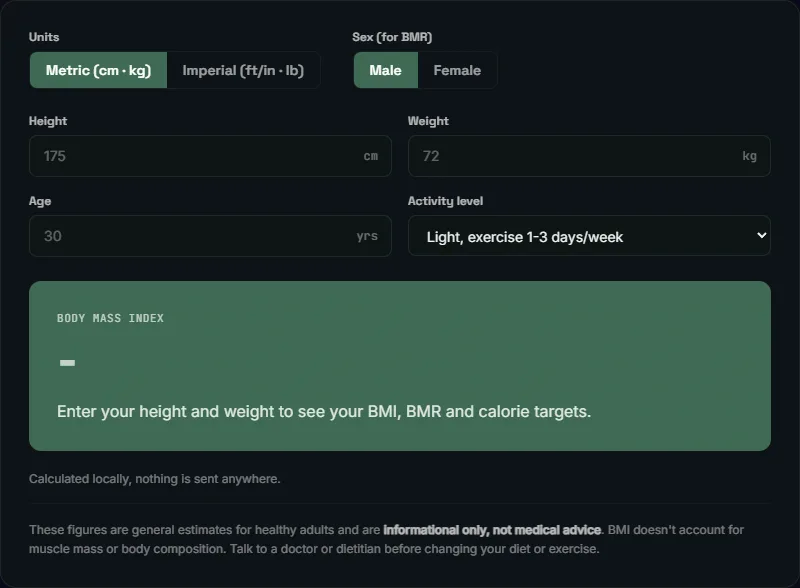
The habit tracker, sleep calculator, calorie calculator and BMI calculator all compute in your browser. None needs an account, and the habit tracker keeps its streaks on your own device. They are small, but each one is a working answer to a question a wellness app has to settle: what to calculate, and where the data lives.

Our free BMI and calorie calculator with its height, weight and age fields empty
One of our own free tools, not a client's app.

In the wider health sector we built the whole Planivo platform, which plans staff rosters for clinics and hospitals. It is a staff tool rather than a consumer app; clinic and patient software is covered on our healthcare software development page.

§ 04 · health data

HIPAA, the FTC and the rules for wellness data

Most consumer wellness apps sit outside HIPAA, which does not leave their data unregulated. The FTC's Mobile Health Apps Interactive Tool (November 2024) says HIPAA likely would not apply to an app a person picks on their own. A developer that builds or runs an app for a covered entity, such as a clinic or a health plan, likely is a HIPAA business associate.

Outside HIPAA, the FTC's Health Breach Notification Rule covers health apps that draw data from more than one source, such as an app that syncs with a fitness tracker. Its guide says a breach is not limited to hacking: sharing health data with an ad network without consent counts. Affected people must be told within 60 calendar days of discovery, and the FTC at the same time when 500 or more are affected.

The FTC has acted on this. Its first case under the rule, against GoodRx in February 2023, came with a proposed $1.5 million civil penalty. A month later it announced a proposed order under which BetterHelp would pay $7.8 million, over allegations that health questionnaire answers reached Facebook, Snapchat, Criteo and Pinterest for advertising.

States add their own rules. Washington's My Health My Data Act covers consumer health data well beyond HIPAA, including health guesses drawn from other data. Its main duties applied to most businesses from March 31, 2024 and to small businesses from June 30, 2024, and it can be enforced by private lawsuits as well as the Attorney General.

What the written scope settles about data

  • Each health data type, named. Apple's guideline 5.1.3 asks an app to disclose the specific health data it collects from the device, so the list is written once and reused.
  • Where each piece lives. On the device, on the server or both. A feature that works without a server keeps its data on the phone.
  • Which outside tools receive any of it. Advertising and analytics tools receive no health answers. Apple's guideline bars using HealthKit data for advertising as well.
  • Consent and withdrawal. What a user agrees to, on which screen, and how they take it back.
  • Who offers the app. If a clinic or health plan does, HIPAA applies and the next paragraph does too.

When HIPAA does apply, we sign a business associate agreement whenever our team handles protected health information, and the app runs on AWS, Microsoft Azure or Google Cloud under that provider's own BAA. An independent firm has looked over our HIPAA practices. The safeguards we build in that case are listed on our healthcare software page. None of this is legal advice; your counsel signs off the data map.

§ 05 · retention

How many users are still there on day 30

A 2019 study in the Journal of Medical Internet Research followed real usage of 93 Android apps for anxiety, depression and emotional wellbeing. Of the people who opened an app on day 0, a median 69.4% opened it again on day 1, 3.9% on day 15 and 3.3% on day 30. Mindfulness and meditation apps kept a median 4.7% at day 30, trackers 6.1%, and breathing exercise apps 0.0%.

Our reading: when about three people in a hundred are left after a month, a first release should spend its budget on the first seven days, not on the twentieth feature. The same study found meditation apps used at two peaks a day, morning and night, which tells you when a reminder is welcome.

  1. Design the first week before the feature list. Onboarding asks for one goal, the first session ends with a plan for tomorrow, and day two has a reason to open the app.
  2. Let the user pick reminder times. Offer morning and night first for meditation, the two daily peaks in the study above, and never remind more often than the user chose.
  3. Plan for health data that never arrives. Apple's HealthKit documentation says an app does not know whether someone denied read permission; a denied read just returns the samples the app saved itself. A sleep chart must look intentional when it is empty, and Apple suggests asking at the moment the data is needed.
  4. Measure day 1, day 7 and day 30 from the first release. Count opens and finished sessions without sending any health answer to the analytics tool.
§ 06 · features

Features to scope for a first release

We split features into the ones a first release needs to prove the habit and the ones that wait until people stay. The split below is our starting proposal; discovery moves items between the columns for your product.

In the first release

  • Sign-in, or a guest start that keeps data on the device
  • Onboarding that asks for one goal
  • One core session type: a meditation, a sleep routine, a log or a check-in
  • Reminders at times the user picks
  • A streak or progress view that forgives one missed day
  • A paywall and subscription through the store's billing
  • An admin to publish programs and audio without a release
  • Consent screens and a privacy policy that match the data map

Once people stay

  • Apple Health and Health Connect sync, unless the core feature needs it on day one, as a sleep app does
  • Watch and home screen widgets
  • Community or peer support, with moderation
  • An AI coach with a person who can take over
  • A coach or employer dashboard
  • More languages and more programs
§ 07 · cost and time

Wellness app development cost

The team behind a 2022 paper in JMIR Formative Research built a no-code platform for health studies, citing the cost and time of custom apps as a barrier. Their examples were behavior counselling, daily diary and self-monitoring apps, close cousins of the products on this page, and they wrote that one with few features can still need $70,000 to $100,000 and three to six months.

For hourly figures, the personnel cost table in a 2023 guide for clinicians in BMC Medicine estimates $100 to $250 for app development consultants, $60 to $100 for an experienced designer and $30 to $50 for an outsourced developer in India. Those are the authors' estimates, not our rate card.

What moves the cost of a wellness app, and how a first version stays small
Cost driverWhy it adds workHow version one stays smaller
ContentAudio, programs and recipes are produced, reviewed and loaded, apart from the codeLaunch with one program and add more through the admin
Health data syncApple Health and Health Connect differ, and each needs permission screens and empty statesSync only the one data type the core feature reads
SubscriptionsStore billing, trials, restores and a paywall on two platformsOne plan and one trial length at launch
AI coachingModel costs, wording reviews against the claim line, and a human hand-offShip guided content first and add the coach once usage shows where people get stuck
HIPAA modeOnly when a covered entity offers the app: BAA hosting, audit logs, stricter accessKeep the consumer app outside HIPAA unless a clinic or plan really offers it

For a planning range on your own scope, our mobile app cost calculator has lines for Apple HealthKit data and for HIPAA health data. A scoped quote then swaps that range for a firm figure: a written scope within 48 hours of the call, then a two-week discovery sprint, priced on its own, whose outcome is either a fixed price or a recommendation to buy something off the shelf.

§ 08 · process

How a build runs, step by step

Every build follows the same seven steps as our other software work. Here is what each step means for a wellness app.

  1. Planning: a 30-minute call about the habit and the user, then a written scope within two days.
  2. Analysis: a two-week discovery sprint priced on its own, which can end in advice to buy instead. For a wellness app, ask for it to cover the claim wording for your counsel, the health data map and the store categories you will declare.
  3. Design: the first-week journey, the screens and the data model are agreed first, and no engineer starts until our CTO has approved the architecture.
  4. Coding: sprints of one to two weeks, each week ending in a recorded demo of working code.
  5. Testing: our QA team checks every build before a preview reaches you. For a wellness app, ask for one test run with every health permission denied.
  6. Deployment: before the first release we test that it can be rolled back, then submit to both stores.
  7. Maintenance: the same named team carries on, or you receive architecture notes, runbooks and a walkthrough to run it yourselves.

On Google Play, every developer with a published app must complete the Health apps declaration. It lists sleep management, and stress management, relaxation and mental acuity, among health and fitness features, but files mental and behavioral health under its medical group. A mood app's category follows its wording, which is one more reason to settle the wording in discovery.

§ 09 · the team

The people on your build, and what you can check

Three people from our side of a wellness build. The quoted lines come from their profiles on this site, which each name links to.

signs this page

Navya S.

Senior Project Manager

“Navya brings five years of project management to Digital Heroes healthcare, wellness, logistics, real estate, manufacturing, retail and education builds, running sprint planning, scope and client communication from kickoff to launch.”

architecture

Divyansh Singh

Chief Technology Officer

“Owns the architecture, the engineering standard and the technical calls behind custom software, SaaS and commerce builds.”

His profile also says he “sets React Native as the team's default for mobile apps that run on both iOS and Android”.

design

Mahira K.

Lead UI/UX Designer

“Heads design across web, mobile, and brand work.”

Digital Heroes was founded in 2017. Our New York headquarters answers on the same business day between 9 AM and 6 PM Eastern; engineering happens in Delhi and Lucknow, with some mobile engineers in Sydney. By our own count we have shipped work for brands in 40+ countries.

On Clutch, Digital Heroes is rated 5.0 from 66 verified reviews (checked 13 October 2026).

You own what we write. The repositories and cloud accounts are yours from day one; our engineers are added as collaborators, and you can remove them. The code written for your project transfers to you when the final invoice is paid, as our MSA sets out, while we keep the libraries we had before. Before we show you past client work on a call, both sides sign a one-page mutual NDA.

§ 10 · FAQ

Short answers on building a wellness app

The first four are phrased the way people type them into a search box. The rest are the questions the leading wellness app guides and vendor pages answer, answered with what we can show.

How to develop a wellness app?

Pick one habit and one kind of user, then write the app's promise in wellness terms, as in FDA's General Wellness guidance. Decide which health data you need, where it lives and whether a clinic or plan offers the app, because that decides HIPAA. Then design the first week, build one core session type for both stores, test it with real users, and measure how many return on day 1, day 7 and day 30 before adding features.

How much does it cost to develop a health app?

For a small custom health app, plan on $70,000 to $100,000 and three to six months: that is the figure a 2022 paper in JMIR Formative Research quotes for an app with few features. Content production, health data sync on both platforms, subscriptions, AI features and HIPAA hosting each push it up. Our mobile app cost calculator turns a scope into a planning range, and a scoped quote turns it into a number.

How much does it cost to pay someone to develop an app?

It depends more on the hours than on the rate. The staff cost table in a 2023 BMC Medicine guide runs from $30 an hour for a graduate student intern to $100 to $250 for app development consultants, with academic developers and experienced designers at $60 to $100. Multiply any of those by the hours a scope needs and the total swings widely, which is why a fixed scope with weekly demos tells you the total before you commit.

What is the most popular wellness app?

No neutral ranking exists, and the store charts that come closest change daily. One fixed marker you can check: in its 2017 year in review, Apple's App Store editors named Calm, a meditation app, iPhone App of the Year. If you are planning a rival, open the Health and Fitness chart in both stores on the same day and read the one-star reviews of the top five.

Does a wellness app need to be HIPAA compliant?

Usually not, when people download it on their own. The FTC's Mobile Health Apps Interactive Tool says HIPAA likely does not apply then, though the FTC's Health Breach Notification Rule and state laws such as Washington's My Health My Data Act still can. If a clinic or health plan offers the app, the developer is likely a business associate, and we sign a BAA whenever our team handles protected health information.

How long does it take to build a wellness app?

A health app with few features can take three to six months of development, per the same JMIR Formative Research paper. With us, the written scope arrives within two days of the first call and states the timeline; a two-week discovery sprint comes first, then sprints of one to two weeks with a recorded demo every week. Recording content and store review add time no developer controls.

How do wellness apps make money?

Most sell a subscription, often after a free trial. Inside an iOS app, unlocking premium content must use in-app purchase under Apple's guideline 3.1.1, and on the US storefront an app may also link out to a web checkout under 3.1.1(a). Others sell programs or coaching sessions. Sharing users' health data with advertisers is the model to rule out: that is what the FTC's GoodRx and BetterHelp cases were about.

Should a wellness app be built in React Native, Flutter or native code?

For most wellness apps, one cross-platform codebase is enough, and our CTO sets React Native as our default for apps on both iOS and Android; the AirTrainr apps are built that way. We also build in Flutter, and in Swift and Kotlin when a product lives on a watch face or leans heavily on one platform's own features.

Last reviewed .

Bring us the habit your app should build

A 30-minute call covers the user, the habit, the claim wording and the data, and the written scope follows within two days. Book any open slot yourself; the calendar starts five days out.

Published .

Online now

Talk to a Developer Now

Reply