Patient portals
One sign-in for intake and consent forms, document uploads, secure messages and appointment history, with separate roles for patients, front desk and admins.
EHR software development is building the system that holds the clinical chart: notes, orders, prescriptions, results, and the exchange of all of them with other care teams. In the US, ONC certification sets the floor for that system. Digital Heroes does not build certified EHRs or EHR integrations. We build the patient portals, scheduling and staff workflow tools that sit beside one.
Build a certified EHR only if the EHR is your product: a health IT company funded for certification testing now and for the duties that follow every year. Almost every practice and hospital is better served buying one, and nearly all already have. In 2024, 91% of US office-based physicians used a certified EHR, by ASTP/ONC Data Brief 84, and 99.4% of non-federal acute care hospitals had one, by Data Brief 83.
So the useful question for most buyers is narrower: which jobs does the EHR do badly, and can software beside it do them without touching the record? That second kind of software is the work we take on, for the clinics and health companies on our healthcare software page.
Our builds neither read from nor write into your EHR. When a plan needs data to move between the two on its own, that interface belongs with your EHR vendor or an integration specialist, and we say so on the first call rather than after the budget is spent.
ONC, the federal office that runs EHR certification, separates the two terms: an EMR is the paper chart of one clinician's office made digital, while an EHR is designed to carry what it holds beyond the practice that collected it, to labs, specialists and hospitals. Vendors still sell under both names. Certification and Medicare's programs use EHR.
| System | What it holds | Who uses it | Shares data outside the practice |
|---|---|---|---|
| EMR | One practice's charts: notes, problems, medications | Clinicians in that practice | Little; it was built for one office |
| EHR | The chart plus orders, prescriptions, results and care summaries | Clinicians, nurses and care teams across settings | Yes; a certified EHR must send care summaries and answer standard API requests |
| Practice management software | Schedules, registration, insurance and billing | Front desk and billing staff | Through claims and eligibility checks, not the chart |
| Patient portal | Forms, messages and visit history; results and notes when the EHR vendor runs it | Patients and the staff who answer them | Only what the EHR releases to it |
A portal from us covers the part that does not need the chart: intake answers, uploaded documents, messages and appointment history. Clinical notes and lab results remain in the EHR's own portal. The patient portal service lists what one includes.
Feature lists differ from vendor to vendor, but the federal floor does not. The Base EHR definition in 45 CFR 170.102 names the criteria a product must be certified to before it counts as certified technology in Medicare's programs. Here they are, each with its number in 45 CFR 170.315, so a developer's claim can be checked.
Two more sets apply to almost every certified module, per ONC's certification process. The privacy and security criteria in section (d) cover sign-in and access control, tamper-resistant audit logs, automatic time-out, encrypted credentials and multi-factor authentication, among others. And a module that stores health information must export it, criterion (b)(10): one patient's whole record whenever a user chooses, and the whole patient population, in a documented format.
Above that floor sit the parts clinicians notice every day: specialty templates, how fast a note closes, the patient portal, prescribing, billing and reporting. Those are where products differ, and where a buyer should spend demo time.
A practice EHR runs scheduled visits: one clinician, one patient, a note, some orders and a bill. A hospital EHR runs around the clock across departments: admissions and transfers, inpatient medication orders, results from in-house labs and imaging, and handoffs between shifts. The certification rule reflects this, marking some requirements ambulatory setting only and others inpatient setting only.
| Compared on | Practice EHR | Hospital EHR |
|---|---|---|
| Daily work | Booked visits, notes, orders, prescriptions, billing | Admissions, inpatient orders and medication, departmental results, shift handoffs |
| Medicare program requiring certified technology | The MIPS Promoting Interoperability category, under 42 CFR 414.1375 | The Medicare Promoting Interoperability Program for eligible hospitals and critical access hospitals |
| Certified EHR use | 91% of office-based physicians; 79.9% of solo physicians | 99.4% of non-federal acute care hospitals |
| Leading developers | Epic 62.8%, Oracle Health 10.5% and athenahealth 7.8% of clinicians reporting to Promoting Interoperability | Epic 50.8%, Oracle Health 20.1% and MEDITECH 15.6% of non-federal acute care hospitals |
Sources: Data Briefs 83 and 84 above, and ASTP/ONC Quick-Stat 30 for clinicians; a clinician can report products from more than one developer, so those shares overlap.
The numbers matter to anyone building beside an EHR. In more than four hospitals in five, a hospital tool sits next to one of three products, while clinicians reported certified products from 175 developers. Small practices vary most: only 32% of physicians in solo practice used a top-five EHR, against 90% in practices of more than 50 physicians.
HL7 Version 2 is the older approach: one system sends a message, such as an admission or a lab result, and another receives it. The VA's technical reference model calls it the workhorse of clinical data exchange and says it carries most of the common interfaces in healthcare worldwide.
FHIR, Fast Healthcare Interoperability Resources, is HL7's newer standard. Data is split into resources, such as Patient, Encounter, Observation and MedicationRequest, which an app requests from a web API. It is the standard federal certification requires for the patient and population API, criterion (g)(10).
From ONC's (g)(10) test method, last updated 15 May 2026, which also lists newer versions developers may adopt.
What this means for software beside an EHR: a certified EHR offers a FHIR API, but connecting to it is still integration work. The app has to be registered with that EHR's authorization server, tested against its sandbox, and kept working through its upgrades. We do not take that work on; we refer it to your EHR vendor or an integration specialist.
To learn the standard yourself, two free tools help. Epic on FHIR offers a testing sandbox with example data and app registration, and the SMART App Launcher lets a developer test an app with no registration at all.
If the EHR is your product, building and certifying run together. ONC calls its certification program voluntary, but clinicians and hospitals in Medicare's Promoting Interoperability programs must use certified technology, so a product sold to them has to be certified. ONC does not test products itself: an ONC-Authorized Testing Laboratory (ONC-ATL) tests them, and an ONC-Authorized Certification Body (ONC-ACB) makes the certification decision.
Step six never ends: the duties last as long as the product keeps its certification. ONC lists all seven conditions, from information blocking to Insights, on its Conditions and Maintenance of Certification page, last updated 16 April 2026.
Certification is one layer. A system that holds clinical records answers to these rules as well, and each one changes what the software must do.
For a practice, a clinic group or a health startup, the choice is rarely build against buy. It is which certified EHR to buy, and what, if anything, to build beside it. These are the five routes, with our part in each stated plainly.
| Route | Fits when | What you carry | Our part |
|---|---|---|---|
| 1. Build and certify your own EHR | The EHR is the product you sell, to clinicians or hospitals in Medicare's programs | Certification testing, then Real World Testing, attestations and information blocking duties every year | None. We do not build certified EHRs |
| 2. Build an uncertified clinical record | Nobody using it reports to a program that requires certified technology | HIPAA wherever a covered provider uses it, no certified APIs, and certification work later if your market changes | None. Clinical records are outside our scope |
| 3. Buy a certified EHR and configure it | Your specialty is well served and your workflows fit the product's templates | Subscription fees and the vendor's roadmap | None needed |
| 4. Add the EHR vendor's own tools | The vendor's patient portal or app marketplace already covers the gap | Extensions follow the vendor's rules and release dates | None |
| 5. Build beside a certified EHR | The gap is outside the chart: intake, booking, rosters, approvals, admin reporting | A second system to host and maintain, kept in step with the EHR by your staff | This is the work we do |
Our view, from building on the staff and patient side of care: build where your service differs from everyone else's, and leave the chart to certified software. Route five rarely needs the EHR vendor's permission, because it never touches the record. A video visit service is a common case, and our telehealth app developers build it beside the chart.
To test the money side, our build vs buy calculator sets five years of a build's cost against subscription fees.
Each of these is custom software that sits next to the record. It is scoped in writing, built in sprints of one to two weeks, and handed over with its code, which becomes yours once the final invoice is paid, under the terms on our custom software company page.
One sign-in for intake and consent forms, document uploads, secure messages and appointment history, with separate roles for patients, front desk and admins.
Self-serve booking across providers and locations, with confirmations, reminders by email or text, and reschedule links. What it includes.
Rosters, leave approvals, training records, intake queues and admin dashboards: the operational work an EHR was not designed to run. What it includes.
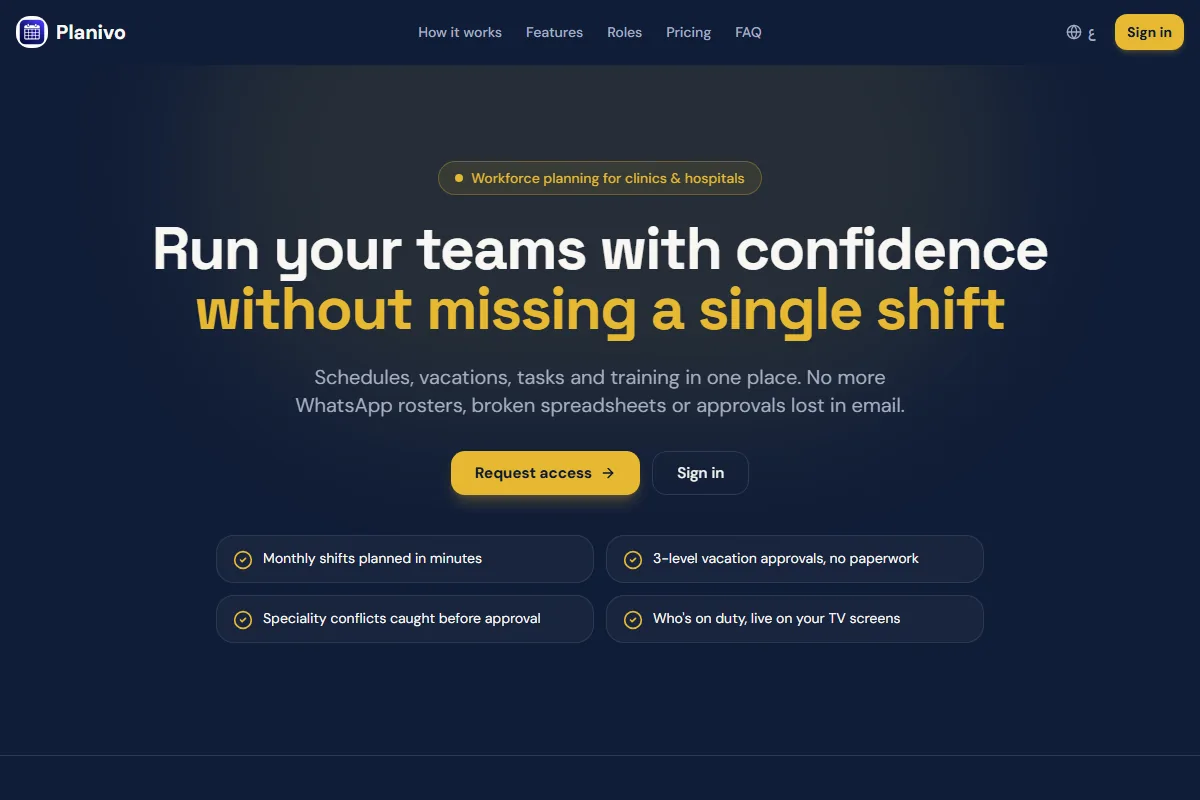
Planivo plans the workforce of clinics and hospitals, and we built the whole platform and its website in 2026. It runs monthly shift rosters, vacation approvals in three levels that warn when two staff of the same speciality would be away together, tasks, training sessions with attendance, reminders before a certification expires, duty display screens and an audit history, across six roles.
It works on staff data, not patient charts, so it runs entirely beside the EHR. Shown with the client's permission; no results figures are published.
Without an integration, your staff are the bridge. They see each booking, form or message in a dashboard, a notification or an export, and decide what goes into the chart. When that has to happen automatically, the link is an EHR integration project; we will name it on the first call and help you find a specialist for that part.
Portals and modules are usually built on Next.js and React, with PostgreSQL row-level security deciding who sees which record. Our CTO, Divyansh Singh, sets the architecture of each build. Clients rate our work 5.0 on Clutch from 66 verified reviews (checked 13 October 2026).
A portal or scheduling tool that a provider runs handles protected health information, so the same obligations apply to it as to the EHR beside it.
Inside the software, each technical safeguard maps to a control you can inspect: role-based access enforced in the database, an audit log of who viewed or changed a record, edits limited to the roles allowed to make them, sign-in before any record appears, and encryption in transit and at rest.
No certificate makes software HIPAA compliant, so ask any vendor, an EHR vendor included, for its BAA and its written list of safeguards rather than a badge.
No neutral survey prices a certified EHR build. The figures that exist come from vendors, and three that rank on Google for this search publish ranges that barely agree. ScienceSoft gives $120,000 to over $2,000,000. Itransition gives $50,000 to $500,000, over six months to three years. A&I Solutions starts at $75,000, live in about ten weeks. We read all three on their own sites on 17 October 2026; treat them as sales figures.
Most of the spread is scope. A specialty charting tool with no certification, a certified ambulatory module and a hospital EHR all get called EHR development. Before comparing quotes, ask each vendor which 170.315 criteria are in the price, whether testing and certification fees are included, and who pays for Real World Testing and attestations after launch.
A focused first version of custom software costs $40,000 to $150,000; complex enterprise platforms run $250,000 to $500,000 or more. After discovery, an MVP usually takes 8 to 12 weeks and a production platform 16 to 28. The fixed price follows a two-week discovery sprint, priced on its own, which can also end in advice to buy instead.
The custom software cost guide shows what moves a number inside those bands. For healthcare, the usual movers are extra user roles, each vendor that must sign a BAA, and waits on another organization's approval.
Whether you are buying a certified EHR or hiring a team to connect to one, each answer below can be checked rather than taken on trust.
These checks are for the EHR vendor or the integration team, which Digital Heroes is not. For the software we would build beside your EHR, the six checks for any custom software quote apply instead.
It depends on the setting. In US non-federal acute care hospitals in 2024, the top three EHR developers were Epic, Oracle Health and MEDITECH, together about 86.5% of hospitals. Among clinicians reporting the Promoting Interoperability category of Medicare's Quality Payment Program, Epic, Oracle Health and athenahealth led, at 62.8%, 10.5% and 7.8%. Both sets of figures are in the care setting table, with sources.
There is no neutral figure. Vendors ranking for this search publish ranges from $50,000 to over $2,000,000, and the spread is scope: which certification criteria, which care setting, how much data must move. Certification adds testing fees and yearly duties on top. Software that sits beside an EHR is a smaller job, and our cost section gives our own bands for it.
Decide first whether it must be certified: if the clinicians or hospitals using it report to Medicare's Promoting Interoperability programs, it must. Then choose the criteria, model and code the data, build the privacy and security criteria, build the FHIR API and the export, test and certify through an ONC-ATL and an ONC-ACB, and keep the yearly duties. The six steps set each one out.
Clinicians and staff learn the EHR their organization runs, through the training that organization provides. Developers can learn the standards for free: the HL7 FHIR specification is public, Epic on FHIR offers a sandbox with example data, and the SMART App Launcher tests an app without registration. To see what every certified product must do, read the criteria in 45 CFR 170.315, summarized in the functions section.
Yes, in ONC's usage. An EMR is the digital chart of one practice; an EHR is built to share that information with labs, specialists and hospitals, and to follow the patient. Certification, Medicare's programs and federal data all use the term EHR, while many vendors still sell under both names.
Only if the people using it need certified technology. The program is voluntary, but clinicians in the MIPS Promoting Interoperability category and hospitals in Medicare's program must use certified EHR technology. A custom record outside those programs can skip certification, though HIPAA still applies to any covered provider using it, and certifying later means building to the criteria and passing testing at that point.
Yes, whenever the developer will create, receive, keep or send protected health information for you, and that includes test data copied from real records. Digital Heroes signs one before any of it reaches our team, and our healthcare builds are hosted on AWS, Azure or Google Cloud under that provider's own BAA.
For a certified EHR, vendor estimates run from about ten weeks to three years, and certification testing sits on top. For the software beside an EHR, our planning bands are a two-week discovery, then 8 to 12 weeks for an MVP or 16 to 28 weeks for a production platform.
No. FHIR apps, HL7 feeds and other interfaces into an EHR are integration work, and we refer it to your EHR vendor or an integration specialist. We build software that sits beside the EHR without connecting to it: patient portals, booking and reminders, and staff workflow modules. If your plan depends on an interface, we say so on the first call.
Last reviewed .
Send us the job your EHR does badly and who does it today. Within two days of a 30-minute call you have a written scope and quote; the fixed build price comes after discovery. If the honest answer is an EHR integration or a different EHR, we will tell you that instead. Book a call.









115 people across five studios in New York, Delhi, London, Sydney and Lucknow, shipping ecommerce, web, software and mobile work for founder-led brands. Senior engineers only, no account-manager relay, and the same team from kickoff to launch.

Chief Technology Officer · Lucknow · 50 posts on the site
Published .

Pinch, scroll or double-tap to zoom · drag to pan
Where should we send the proposal?
Please enter your name and a valid email.
Any faster way to reach you? Optional.
Please fill in the one you picked.

