We build telemedicine and telehealth apps for US clinics and digital health startups: booking, intake, video visits, messages and payment, on video and hosting vendors that sign a business associate agreement, and we sign one with you whenever our team handles patient data. We do not build EHR integrations.
What our telehealth app development services include
Telemedicine app development is building the software a patient and a clinician use for a visit at a distance: booking, intake, a video or audio visit, messages and payment, plus the staff screens behind them. We build that layer for US clinics and digital health startups, as a web app, as iOS and Android apps or both, and we leave the clinical record in the EHR you already run.
Buyers use telemedicine and telehealth for the same product, and this page treats them as one service. Where a difference is drawn, telehealth is the wider word, taking in patient education and admin as well as the visit itself. To add developers to your own team rather than commission a build, see telehealth app developers for hire.
What one engagement delivers
A written scope, then discovery: the scope reaches you within 48 hours of the first call, and a two-week discovery sprint maps the visit, the states you serve and every vendor that will hold patient data.
Patient and clinician flows, designed apart: booking, intake, waiting room and visit for the patient; queue, schedule and visit view for the clinician; and an admin view for the front desk.
The connections: a video provider, email and text reminders, and a payment processor, each named in the scope together with its business associate agreement wherever it will hold patient data.
HIPAA safeguards in writing: sign-in, role checks enforced in the database, an audit log and encryption, listed control by control for your counsel.
Testing, launch and the cycles after it: test visits with your own clinicians, app store submission, then improvement cycles or a dedicated team.
Left to specialists
figure 1 · one visit in six steps
above the line: what the app does; below it: the clinical systems your clinicians keep using
§ 02 · kinds of care
Four kinds of virtual care an app can deliver
Most telemedicine products combine two or three of the kinds below. Choosing them first decides the screens, the vendors and the rules that apply, so our discovery starts here rather than at a feature list.
Four kinds of virtual care, who they suit and what each adds to a build
Kind of care
How it works
Suits
What the build needs
Scheduled video visits
The patient books a slot and joins from a link; the clinician joins from a day view
Therapy, follow-ups, specialist consults
Calendars per clinician and state, a waiting room, a video provider, reminders
On-demand visits
The patient joins a queue and the next free clinician licensed in their state takes the visit
Urgent care, after-hours lines
A live queue, routing by licence, a wait time shown to the patient, a staffing view
Asynchronous review
The patient sends answers, photos or files; a clinician reviews them later and replies
Skin checks, refill requests, simple consults
Structured questionnaires, secure uploads, a review queue, reply templates
Remote monitoring
Readings from devices the patient already uses appear on a care team dashboard
Chronic conditions, programs after discharge
The device vendor's data feed, thresholds and alerts, a patient app; never the device firmware
Mixing them is normal: a therapy practice may run scheduled visits with messages between them, while an urgent care line runs an on-demand queue and sends follow-ups by asynchronous review. Each extra kind adds its own flows for the patient and the clinician, which is why the cost section prices by scope rather than by screen count.
§ 03 · features
Features on the patient side and the clinician side
A telemedicine app has two audiences who never see the same screen, plus the front desk behind them. We design and test each side on its own; the lists below are the features we scope for a first version and the ones that usually follow.
For the patient
Booking by visit type, clinician and state, or a place in an on-demand queue
Intake forms and consent, saved as answers rather than as PDFs
Card payment or a deposit before the visit
A check of camera, microphone and connection before joining
A waiting room that says who is joining and when
The video visit, with a switch to audio when the connection fails
Secure messages and file uploads between visits
Reminders by email or text that carry no clinical detail
For the clinician
A day view and, where offered, an on-demand queue
Availability set for each state the clinician is licensed in
Intake answers and the reason for the visit before joining
One action to start the visit, and the patient's past bookings
Patient messages, with a reply time the clinic sets
Visit outcome fields for the front desk and billing, with charting left in the EHR
For the front desk and admins
Roles for front desk, clinicians, billing and admins, each seeing only its part
Licence records per clinician, with reminders before one expires
Refunds, no-show rules and reschedule links
Reports on visits, no-shows and waiting times
An audit log of who opened or changed each record
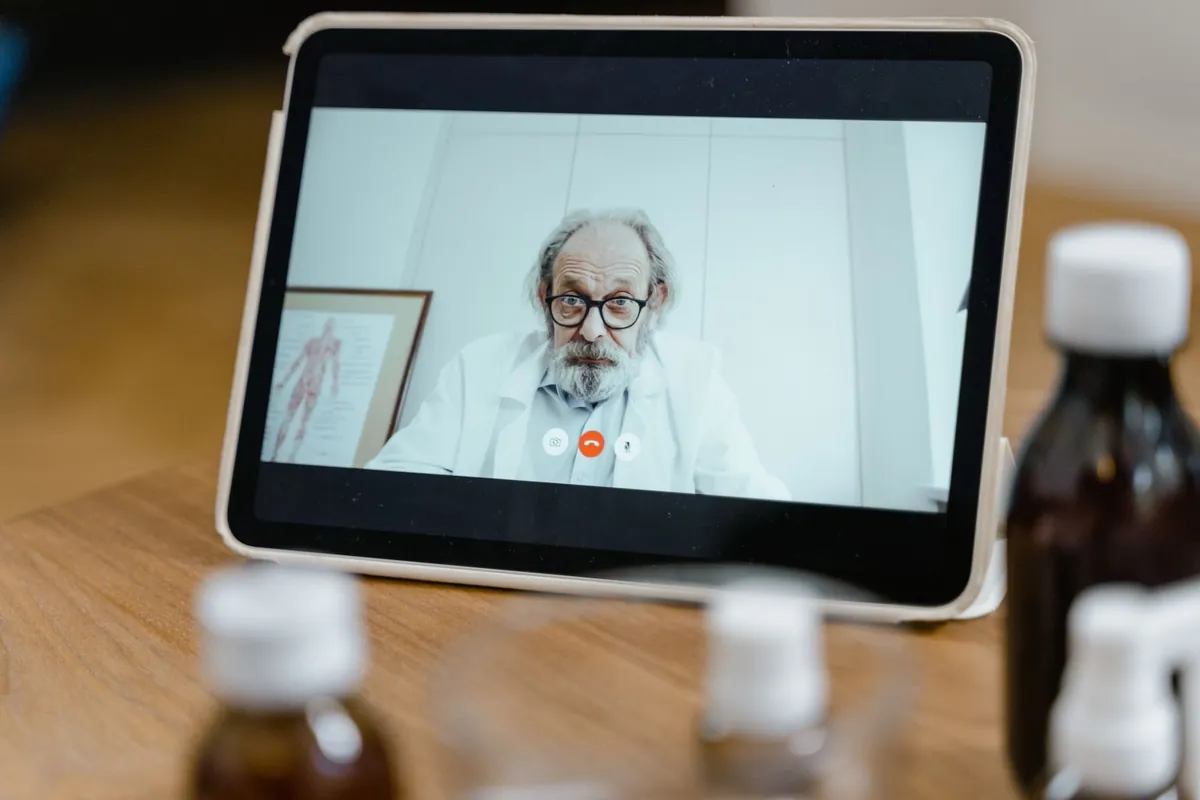
The visit itself is one screen among many in a telemedicine app. A stock photo used to show the visit, not a client: “A Doctor on the Video Call” by Tima Miroshnichenko, Pexels License.
§ 04 · proof
What we have built, and what is still missing
We have no published telemedicine client case yet, so this section says that first. What we can show is a healthcare platform for clinic staff, two client apps built from the same parts a telemedicine app needs, and systems we run for our own business.
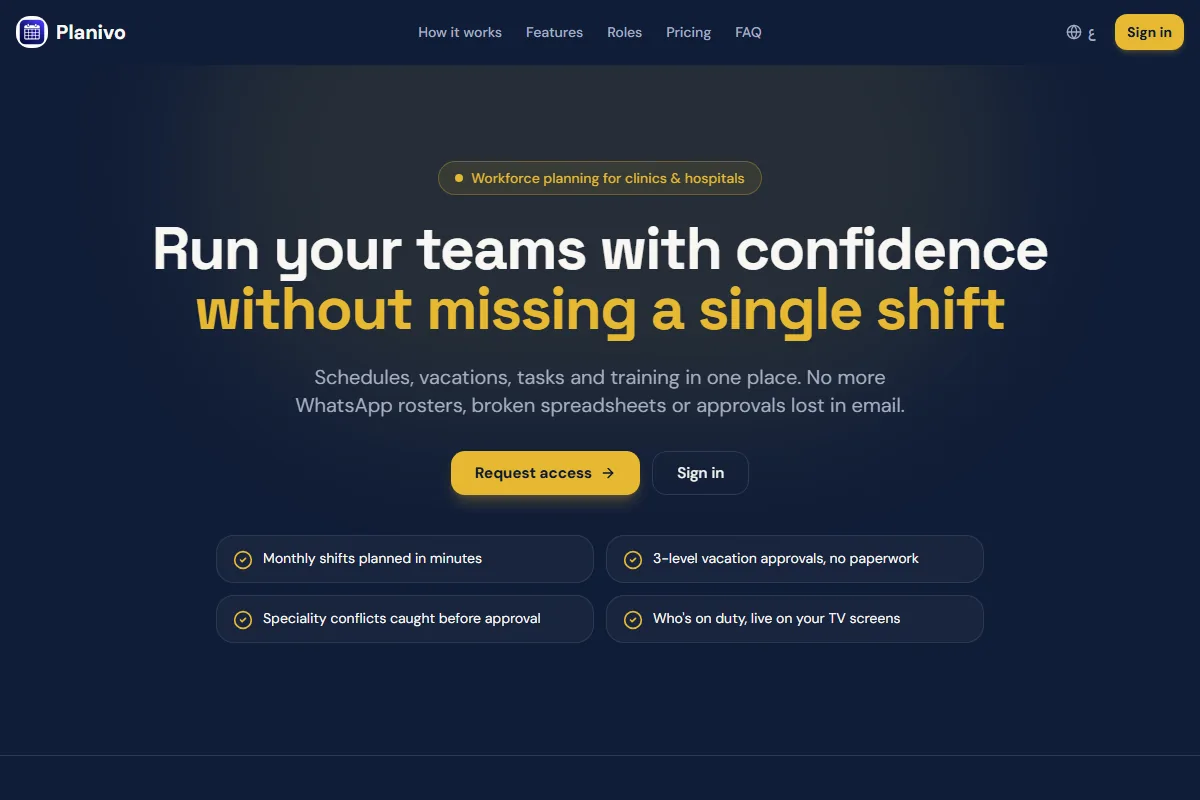
Planivo: workforce planning for clinics and hospitals
We built all of Planivo, its signed-in app and its website. Clinics and hospitals plan monthly shift rosters in it, send vacation requests through three levels of approval that check for two staff of the same speciality away together, and track tasks, training sessions with attendance, certification expiry reminders, duty display screens and an audit history, across six roles.
It is software for clinic staff, not a telemedicine app. The client has given permission for us to show it as our work, and no results figure exists for it.
Planivo's public website, built by us together with the app.
We built the athlete and trainer mobile apps for AirTrainr in React Native and Expo, backed by Supabase. Athletes find trainers and book sessions, trainers run a schedule and send offers, and both sides share chat and notifications. A patient booking a clinician has the same shape.
client build · 2026
SpeedyPrint: payments and roles
For SpeedyPrint, a South African web-to-print store, we built PayFast checkout with its payment webhooks, transactional email, an order status history and an admin panel with three roles, on Next.js 15, React, TypeScript and Supabase. Visit payments and staff roles use the same parts.
our own systems
Booking and chat we run
Our booking page gives a calendar invite file for every call booked, and the live chat on this site answers through an AI copilot in our ERP, with a person on our team able to take over any thread. Both are ours, not client work.
Clients rate our work 5.0 on Clutch from 66 verified reviews (checked 13 October 2026). The wider healthcare picture, from patient portals to wellness apps, is on our healthcare software development page.
§ 05 · HIPAA
HIPAA in a video visit: where patient data travels
During the pandemic, HHS's Office for Civil Rights chose not to penalize providers for good faith telehealth on everyday video apps. That discretion expired with the public health emergency on May 11, 2023, and the transition period for telehealth ended on August 9, 2023, per OCR's notice in the Federal Register.
A telemedicine app touches patient data in more places than the video stream. These are the six we map in discovery, each with the vendor that holds the data and whether that vendor signs a business associate agreement (BAA).
Booking and intake
Names, reasons for the visit and form answers sit in the database, behind sign-in and role checks, with a host that has signed its BAA.
The video and any recording
The video provider carries the call. Decide in the scope whether visits are recorded at all, because a recording is patient data with its own storage, access and retention rules.
Reminders and notifications
Email, text and push messages are written so a locked phone shows a time and a link, not a condition. A text provider that will carry patient data signs a BAA too.
Logs and error reports
Crash and error tools keep whatever the code sends them, so patient fields stay out of logs, or the tool signs a BAA like any other vendor.
Analytics and ad pixels
They stay off signed-in pages, booking and intake. The cost of getting this wrong is public: on March 2, 2023 the FTC announced a proposed order requiring BetterHelp, an online counseling service, to pay $7.8 million for passing emails, IP addresses and health questionnaire answers to advertising platforms.
AI features
A visit summary or a triage assistant sends text to a model provider, and that provider needs a BAA before any patient data reaches it.
Our side of the paperwork does not change from build to build. If our engineers will handle protected health information for you at any point, Digital Heroes signs a BAA with you. Healthcare builds run under the cloud provider's own BAA, on AWS, Microsoft Azure or Google Cloud. And an independent firm, not our own team, has reviewed our HIPAA practices.
The five technical safeguards of the Security Rule, from access control to transmission security, are mapped to the controls we build on our healthcare safeguards list.
Three ways to carry the video, and who signs the BAA
Three video options for a telemedicine app, as each vendor's own page describes it, read on 17 October 2026
Builds hosted on AWS that want the video inside their own app
It is a toolkit: the call screens are built on top of it
Twilio Programmable Video
On Twilio's HIPAA eligible list, last updated 30 June 2026; Twilio's HIPAA page says its BAA needs the Security or Enterprise Edition
Apps that also send text reminders through Twilio
Price the edition that carries the BAA, not the base plan
Doxy.me
A telehealth platform with a free plan and a free BAA; patients join from one link with no download and no login
A clinic that wants video visits now, without a custom app
The waiting room and the patient journey are Doxy.me's, not yours
These are examples, not a ranking. The written scope names one video vendor with its BAA terms, chosen for where the app is hosted and how many visits it will carry.
§ 06 · rules
Telehealth rules the software has to follow
Four sets of rules change what a telemedicine app records and when it says no. None of them is cheap to add after launch, so each one is written into the scope. This is a summary for planning, not legal advice; your counsel settles how each applies to your service.
Licences follow the patient
A telehealth service is treated as delivered where the patient is, so a provider typically needs a licence in the patient's state, as the Center for Connected Health Policy summarizes state law. So the app asks where the patient is at booking, offers only clinicians licensed there, and stores both facts on the visit.
Compacts shorten the paperwork without removing it. The Interstate Medical Licensure Compact offers qualified physicians a voluntary, faster path to licences in several states, and its map showed 39 states, DC and Guam processing applications as a state of principal license on 17 October 2026.
Medicare coverage has an end date
Through December 31, 2027, Medicare patients can receive telehealth anywhere in the United States, and audio-only visits at home are covered until the same date, according to the CMS telehealth FAQ updated in October 2026. From January 1, 2028, outside behavioral health, patients will generally need to be in a medical facility in a rural area.
A build that serves Medicare patients therefore stores, for every visit, where the patient was and whether it ran on video or on audio alone. Claims use place of service 02 or 10 for telehealth, the same FAQ says, and the billing team needs those facts from the visit record, not from anyone's memory.
Controlled substances need a plan for 2027
Prescribing controlled medications by telemedicine without a prior in-person visit rests on temporary DEA and HHS flexibilities, now in a fourth extension that runs through December 31, 2026. A service in that position should be able to add an in-person step to its booking flow without a rebuild.
Apps outside HIPAA still have rules
A wellness or direct-to-consumer health app that is not run by a covered provider may be covered by the FTC's Health Breach Notification Rule instead. On iPhones, Apple's App Review guideline 5.1.3 limits how health data may be used and shared, and where it may be stored.
§ 07 · cost
Telemedicine app development cost and timeline
Start with independent figures. A 2022 paper in JMIR Formative Research cites a developer price guide that puts a health app with few features at US$70,000 to $100,000, built over three to six months. Hiring by the hour instead, a 2023 guide in BMC Medicine lists app development consultants at $100 to $250 an hour.
Our own custom software ranges apply here: $40,000 to $150,000 for a focused first version, and $250,000 to $500,000 or more for complex enterprise platforms. Once the two-week discovery sprint is done, an MVP build usually runs 8 to 12 weeks and a production platform 16 to 28 weeks.
Three telemedicine scopes, with Digital Heroes price ranges and build time after a two-week discovery sprint
Scope
What is in it
Price
Build time
Focused first version
One visit type for one service line: booking, intake, video visit, payment, reminders and a staff dashboard, usually on the web first
$40,000 to $150,000
8 to 12 weeks
Production platform
Several visit types and clinicians across states, iOS and Android apps, messages between visits, admin reports
Fixed after discovery
16 to 28 weeks
Complex enterprise platform
Many locations and roles, on-demand queues, monitoring dashboards and several vendors, each under its BAA
$250,000 to $500,000 or more
Set in the written scope
What moves a telemedicine quote
Roles: each role with its own view adds screens and most of the testing.
Store apps against a web app: patients can join a visit from a browser link, which costs less to build than two store apps.
Kinds of care: an on-demand queue or asynchronous review each adds flows of its own to scheduled visits.
States and payers: licence matching, consent wording per state and the Medicare visit facts add rules to booking.
Vendor editions: a BAA can require a higher plan, as Twilio's does, which shows up in running costs rather than in the build.
Outside sign-offs: a vendor's BAA paperwork and app store review add time that no developer controls.
After launch you pay for hosting, video minutes, text messages and any vendor edition that carries a BAA, plus upkeep, which GoodFirms' 2026 survey puts at 10 to 20 percent of what the build cost, every year.
For a planning figure on your own feature list, our mobile app cost calculator has a line for HIPAA health data, and the MVP cost calculator prices a first release. A first call ends in a scoped quote, which turns either range into a number.
§ 08 · custom or ready made
Custom build, video API or a ready-made platform
Not every clinic needs a custom app. A ready-made platform can have video visits running this week, and practice software such as SimplePractice markets HIPAA compliant telehealth of its own. Custom pays when the visit is the product you sell, when care runs across states and visit types a packaged tool does not model, or when you need to own the data and the patient journey.
Four routes to video visits, from buying a platform to writing your own video stack
Route
What you get
Fits when
The trade
Ready-made telehealth platform
Video visits with a waiting room, under the vendor's BAA
One clinic, scheduled visits, a standard flow
Branding, journey and data model are the vendor's
Telehealth inside your practice software
Video tied to the scheduling and billing you already use
Your workflow already matches the product
You get the features it has, on its roadmap
Custom app on a video API
Your own booking, intake, waiting room and reports, with video from a vendor's toolkit under its BAA
The service is your product, or spans states, visit types and payers
You fund the build, hosting and upkeep
Your own video infrastructure
Media servers and call handling you run yourself
Rarely; very high volume or a research need
Months spent on a problem video vendors already solve; we advise clinics against it
Four signs a packaged tool no longer fits
Staff copy the same patient between the video tool, the calendar and a spreadsheet every day.
You sell care the tool cannot bill: memberships, programs or contracts with employers.
Clinicians hold licences in different states, and the booking rules live in one person's head.
You are a startup, and the patient experience is what you compete on.
If none of these is true, stay on the packaged tool. Discovery with us can end in exactly that advice, with the product named, and you keep the written requirements either way.
Leaving a packaged tool later is a migration as well as a build. Ask the vendor for a sample export early, and make moving the booking and intake history a line in the scope with its own check, so the front desk never loses a patient's past visits on launch day.
§ 09 · process
How a telemedicine build runs with us
The order is the same as any custom build we run; what changes in telemedicine is what each step has to settle before the next one starts.
First call: 30 minutes and free. A written scope and quote reach you inside 48 hours.
Discovery, two weeks, priced on its own: the visit mapped step by step with someone who runs it today, the states and payers you serve, and every vendor that will hold patient data, with its BAA. The outcome is a fixed bid, or a recommendation to buy a product.
Design: patient, clinician and admin flows agreed before any screen, including what each person sees when the video fails.
Build: sign-in, roles and the audit log first, then booking, intake, waiting room, video and payment, in sprints of one to two weeks with a recorded demo of working code every week.
Test visits: your own clinicians run visits on phones, laptops and weak connections, and our QA team tests each build before you see it.
Launch: app store submission or a production cutover, then monitoring.
After launch: improvement cycles, a monthly retainer or a dedicated team, or a handover pack to run it yourself.
The stack
Next.js and React· the web app and staff dashboards
React Native or Flutter· iOS and Android from one codebase
Node.js· APIs, reminders and background jobs
PostgreSQL· row-level security deciding who reads each record
The video vendor's toolkit· named in the scope with its BAA
A host under its BAA· AWS, Microsoft Azure or Google Cloud
Who owns the result
You do. Under our MSA, everything made for your project alone, from code to designs and assets, passes to you on full payment. Repositories and cloud accounts are opened in your name and billed to you from the first sprint. Our engineers join them as collaborators you can remove, and at handover the next team gets architecture notes, runbooks and a walkthrough.
Who runs it
Architecture is decided on every build by our CTO, Divyansh Singh, and that includes what to buy instead of build, such as the video. Navya S. runs project management on our healthcare builds: sprint planning, scope and client communication from kickoff to launch.
Our headquarters is in New York, and the team there answers the same business day, 9 AM to 6 PM Eastern. Engineers work from Delhi and Lucknow, on hours that overlap the New York day. Our terms, entities and the first 30 days of an engagement are set out on our custom software development company page.
§ 10 · choosing a developer
Eight questions for any telemedicine developer
Put these to every firm on your shortlist, us included, then lay the answers next to each other. A team that has thought hard about virtual care answers each one in a sentence. The paperwork and vendor checks around them are on our page on choosing a healthcare software company.
Which video vendor would you use, and which plan does its BAA need?Ours: one vendor, named in the scope with its terms, as in the video table.
What happens when the video drops?Ours: we design a switch to audio and record which one the visit used, because Medicare treats audio-only visits differently.
How does booking know where the patient is?Ours: the patient confirms their state when booking, and only clinicians licensed there are offered.
What does a reminder show on a locked phone?Ours: a time and a link, never a condition.
Which analytics run on signed-in pages?Ours: none that send data to an advertising platform.
Who signs which business associate agreement?Ours: we sign one with you whenever our engineers will handle protected health information, and the host and every other vendor sign their own.
What will you refuse to build?Ours: EHR integrations, claims engines and device firmware, said on the first call.
Who owns the code and the accounts?Ours: you, on full payment, with repositories and cloud accounts in your name from the first sprint.
§ 11 · questions
Questions buyers ask about telemedicine apps
How to develop a telemedicine app?
Pick the first visit you will offer, such as a scheduled video follow-up for one specialty. Decide which states you serve and which vendors will hold patient data, and get each one's BAA. Then design the patient and clinician flows separately, put sign-in, permissions and the audit log in place before any feature, run test visits with your own clinicians, and launch one service line before adding more.
How much does a telemedicine app cost?
With us, a focused first version typically costs $40,000 to $150,000, and complex enterprise platforms $250,000 to $500,000 or more. The kinds of care, the number of roles, store apps against a web app and the states you serve move it most. Hosting, video minutes, text messages and BAA plan editions come on top; the cost section has the detail.
How much does it cost to develop a medical app?
For a health app with few features, the developer price guide cited in a 2022 JMIR Formative Research paper gives US$70,000 to $100,000 over three to six months. Apps that store protected health information cost more, because of the risk analysis, the safeguards and a BAA with every vendor that holds the data. Our mobile app cost calculator has a line for HIPAA health data.
How much does it cost to hire a mobile app development company?
Firms price by the project or by the hour. A 2023 guide in BMC Medicine lists app development consultants at $100 to $250 an hour, while GoodFirms' 2026 survey finds $20 to $50 an hour the most common band, quoted most often by teams in South and Southeast Asia, Latin America and Eastern Europe. Compare quotes against the same written brief, not on the rate alone.
Is telehealth business profitable?
It can be, but the software rarely decides it. Revenue rests on who pays: under current law Medicare covers telehealth for most services anywhere in the US only through December 31, 2027, private payers set their own rules, and cash-pay services compete on price. Model the payer mix and the cost of each visit before the build, and keep the first version small enough to change.
Must a telemedicine app connect to your EHR?
Not to launch. A telemedicine app can keep its own bookings, intake answers and visit records while clinicians chart in the EHR beside the visit. We do not build EHR integrations: if records must flow into the chart by themselves through FHIR or HL7, that is work for your EHR vendor or an integration specialist, and we say so on the first call.
Can patients join a video visit without downloading an app?
Yes. Video visits can run in the browser from a link, which is how Doxy.me works, with no download and no patient login. A custom build can do the same on the web first and add store apps later, for patients who come back often or want reminders on their phone.
Can Medicare patients still have telehealth visits at home?
Yes, through December 31, 2027. Until then Medicare patients can receive telehealth anywhere in the United States, audio-only visits at home included, per the CMS telehealth FAQ updated in October 2026. From January 1, 2028, most services outside behavioral health will generally need the patient in a medical facility in a rural area, so plan the product around that date.
Who owns the code of a telemedicine app you build?
You do, once the final invoice is paid: under our MSA, the code, designs and assets made for your project pass to you. Repositories and cloud accounts are yours from the first sprint, and the handover pack carries architecture notes, runbooks and a walkthrough for whoever runs it next.
Last reviewed .
§ 12 · next step
Tell us about the visit you want to offer
Book a 30-minute call and bring three facts: the visit, the states you serve and who pays for it. Within 48 hours you get a written scope and quote, with every BAA the build needs named in it.
115 people across five studios in New York, Delhi, London, Sydney and Lucknow, shipping
ecommerce, web, software and mobile work for founder-led brands. Senior engineers only,
no account-manager relay, and the same team from kickoff to launch.
Shopify Select Partner, as listed in the Shopify Partner Directory
Tier 1 registered supplier on the United Nations Global Marketplace, which requires audited company documentation
Top Rated Plus on Upwork, the bracket for the top 3% of talent by client outcomes
397 public five-star-weighted reviews across four Fiverr gigs, from clients in 36 countries
DUNS verified business, No. 650878346, so procurement can check us before signing
Listed by Clutch in Top 1000 Global B2B Companies and Top Web Designers 2024
Verified profiles on GoodFirms, DesignRush, Digital.com, AppFutura and TopDevelopers
2,000+ brands built across 40+ countries, with $50M+ in client revenue scaled