surface 01 · admin
Merchant-facing pages.
Embedded in the Shopify admin via App Bridge 4. Polaris UI, session-token authentication, Admin GraphQL for data. The first surface every public app ships against.
We are a New York Shopify app development agency building apps that are faster to approve, easier to support, and built around measurable business goals. Our Shopify app development process covers App Store scoping, Remix builds, Admin GraphQL, App Bridge 4, theme app extensions, Checkout UI extensions, Shopify Functions, and Billing API setup.
The word "Shopify app" hides five very different things. An admin extension is not a storefront block. A checkout UI extension is not a Shopify Function. A webhook consumer is not an embedded app.
Each surface has its own API contract, review path, billing model, and failure mode. The first decision in every engagement is which surfaces your app actually needs. Most apps need two. Some need all five. Very few genuinely need one.
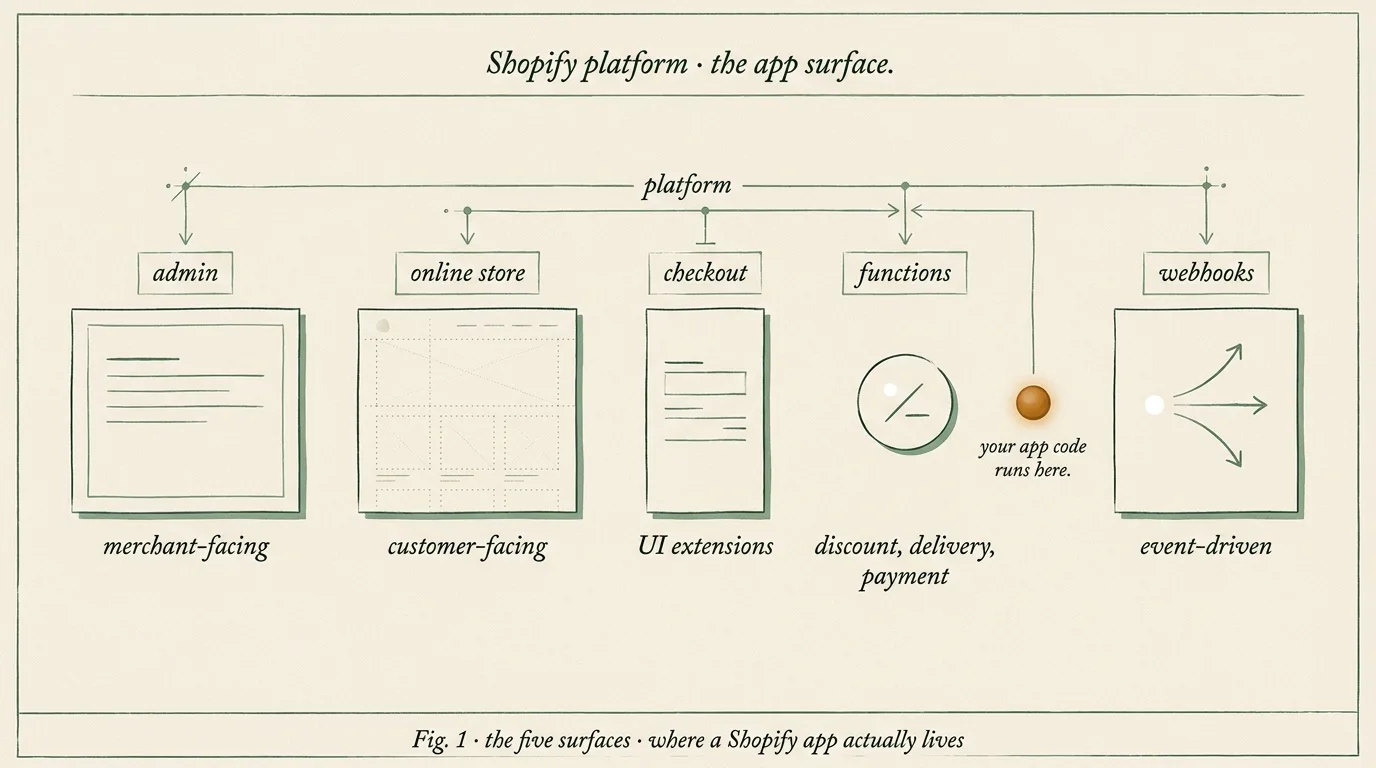
Embedded in the Shopify admin via App Bridge 4. Polaris UI, session-token authentication, Admin GraphQL for data. The first surface every public app ships against.
App blocks drop into a merchant's theme without editing Liquid. Announcement bars, product recommendations, reviews, pop-ups. Scoped asset loading so the storefront stays fast.
The Plus-only surface. Upsells, delivery instructions, validation rules, custom payment fields. Replaces the deprecated checkout.liquid customization surface entirely.
Discount, delivery, payment customization, and cart validation that executes inside Shopify's own servers. Lower latency than a webhook round-trip. The Plus-only logic surface.
Orders, customers, inventory, fulfilment events pushed to your backend. Plus three mandatory compliance webhooks every public app must answer. Idempotent, retried, signed.
A subscription app uses admin + webhooks + billing. A bundling app uses admin + theme extension + Functions. A loyalty app uses admin + theme extension + checkout extension. The scoping question is never "build an app." It is always "which surfaces."
Every Shopify extension request can be answered with a theme-Liquid tweak, a Shopify Function, a Checkout UI Extension, or a full app. The lightest answer wins. Here is the decision matrix we walk every buyer through before we touch an API token.
| Theme Liquid | Shopify Function | Checkout UI Extension | Full App | |
|---|---|---|---|---|
| where it runs | storefront render | Shopify's servers | checkout iframe | your backend + Shopify admin |
| merchant access | any Shopify plan | Plus-only (most types) | Plus-only | any plan, app review required for public |
| typical build time | hours to days | 1-3 weeks | 2-6 weeks | 6-16 weeks |
| best for | visual + content changes | discount, delivery, payment logic | upsell, validation, custom fields at checkout | merchant workflows, SaaS apps, heavy data |
| wrong for | any logic beyond Liquid filters | anything with a UI | non-Plus stores | simple one-off tweaks |
Most “we need an app” briefs we scope end up as a Function plus a checkout extension. That is the answer more often than a full app.
Fourteen seconds. Five surfaces. The tour walks through each extension point Shopify exposes, what the contract looks like, and what it is actually for, admin, online store, checkout, functions, webhooks.
The engineering is 80% shared. The go-to-market is entirely different. Private apps never hit the App Store. Custom apps reach a named set of merchants. Public apps take the review path and compound as a SaaS business. Pick the contract first; the build follows.
Installed on a single Shopify store. No App Store review. No listing assets. Access scoped to that one shop's Admin API credentials. The right path when the extension serves a specific merchant's workflow and has no SaaS intent.
Distributed to a small set of named stores via custom distribution, without App Store review. Good for agencies running the same app across a client roster and for Plus merchants sharing tooling across brands under one parent.
Listed on the Shopify App Store. Goes through the review path. Monetized through the Billing API. The path for founders building a SaaS around a Shopify extension. Commercially the most upside, operationally the most gates.
A public app is not always the right answer. We build the private or custom path whenever the math and distribution support it.
Most Shopify app service pages still lead with Polaris, Node, and REST. That stack shipped in 2021. The stack we ship against in 2026 is different, and every piece earns its place.
Each layer references the current Shopify app development docs and Shopify's official Remix starter template.
The default for every new public app. Session handling, webhook routing, billing integration, and Partner-ready config come out of the box. We only deviate for apps that need to run on Cloudflare Workers or a non-Node runtime.
GraphQL over REST for almost everything. Cost-based rate limiting means we plan queries around calculated cost, use bulk operations for large catalog reads, and batch mutations through @defer or fragments where possible.
Session-token auth, Web Component-based, no more iframe message-passing ceremony. Polaris design tokens for every surface so the app reads as native admin UI. App Bridge 1 and 2 are deprecated; we reject briefs that insist on them.
Rust when latency matters, JavaScript when iteration speed matters. Cart, checkout, discount, delivery, payment, and validation logic now run inside Shopify itself rather than across a webhook boundary.
Stack picks change every 12 months. We rewrite this section every quarter; these are the calls we are making in 2026-Q2.
The App Store Gate is our six-point pre-submission checklist. It maps onto the reasons Shopify actually rejects apps, ranked by frequency. Every public app we ship clears the gate before it reaches a reviewer.
Our first-pass approval rate sits above 80%. We cross-reference every check against Shopify's official app requirements checklist.
customers/data_request, customers/redact, shop/redact. HMAC-verified, idempotent, 200 OK under 5 seconds. The single most common rejection reason.
Minimum scopes requested. Offline tokens for background work, online tokens for merchant sessions. Secure storage, tested refresh. Over-scoped apps fail review.
Every admin page embedded via App Bridge 4 Web Components. Session-token auth for every server call. No legacy iframe postMessage patterns anywhere in the codebase.
Recurring, usage, or one-time correctly modelled. TrialDays handled. Upgrade and downgrade tested. Merchant-side billing events confirmed. Silent billing is the rejection reason nobody sees coming.
Admin pages under 3 seconds, webhook handlers under 5 seconds, GraphQL queries within cost budget, 429 backoff respected, bulk operations used for large catalog reads.
Outcome-first copy, five screenshots at the required resolution, demo video, correct category, pricing with trial details, support URL and privacy policy live. Listing failures cost a full cycle.
The gate adds roughly a week to every public app build. It pays itself back the first time the app clears review without a resubmission cycle.
Shopify's Billing API is the only way a public app charges merchants. The billing model you pick on day one decides churn, payback, and forecastability for the life of the app. Four models, four very different ARR curves.
A fixed monthly price per installed shop. The simplest to build, the easiest to forecast, the most honest for merchants. The right starting model for most feature-focused apps. TrialDays handles free trials cleanly; upgrade and downgrade require explicit billing events.
Charge per unit consumed: orders processed, emails sent, AI generations, GB transferred. Creates an ARR curve that compounds with merchant growth. Requires careful metering, usage capping, and transparent invoicing or trust breaks.
Starter / Growth / Plus tiers, each with its own feature set and quota, plus usage overage per tier. The commercial default for apps crossing $1M ARR. Lets smaller merchants stay affordable while letting larger merchants pull the pricing ceiling upward.
One-time charges or prepaid credits that burn down with use. Works for transactional apps where per-use pricing is cleaner than subscription. Shopify handles the billing surface; we handle the credit ledger and expiry rules.
The billing model is the hardest thing to change post-launch. We scope the model with you in week one of every public app build.
Peak-load is not a future problem. A Plus merchant hitting 10,000 orders per hour on Black Friday will surface every weakness in your webhook handler, rate-limit strategy, and database.
Here is what we engineer into every app destined for a Plus merchant before November.
Webhooks go through a persistent queue (SQS, Redis Streams, or equivalent) with idempotency keys. 200 OK returns in under 500ms; actual processing is deferred. Shopify retries for 48 hours and we reconcile anything that slipped.
GraphQL calls planned around cost-based rate limits. Bulk operations for catalog-wide reads. Exponential backoff with jitter on 429s. Load-tested at 3× forecasted peak before November.
Connection pooling sized for peak. Read replicas for every merchant-facing query. Indexed on the columns BFCM actually hits (shop ID, order ID, customer ID). No N+1s that only show up at scale.
k6 load test at 3× forecasted peak, two weeks before BFCM. Code freeze 14 days before Black Friday. On-call rotation from Black Friday through Cyber Monday. A small dashboard that tells us what broke before a merchant opens a support ticket.
A Shopify app is effectively a custodian of a merchant's customer, order, and PII data. Our security baseline covers three distinct checklists.
First: what Shopify's review will test. Second: what a Plus merchant's procurement team will test. Third: what a Plus merchant's legal team will test. These overlap but each is distinct.
A short field note from three app engagements shipped in the last 18 months: one private custom app, one public App Store app, one Plus Shopify Function. Numbers are real, brands named with permission.
Beauty merchant needed one place to manage INCI ingredient data across 200 products and propagate it into metafields for every regional storefront. We built a private admin app with Polaris and App Bridge 4.
Admin GraphQL handles metafield writes. A webhook subscription to products/update keeps the admin view in sync with merchandising changes. No App Store involvement needed.
Shipped a public App Store app for editorial theme blocks on Shopify's Remix template. Built on mandatory compliance webhooks, Billing API with $19 and $49 tiers, and theme app extensions for storefront blocks.
Cleared App Store review on first submission after running the App Store Gate. Now used by 400+ merchants across the US, UK, and AU.
Plus merchant needed tiered shipping rules that Shopify's native rate rules could not express. They needed cart value × weight × region tier × member status all factored in. We replaced their webhook-based delivery app with a Rust Shopify Function.
The function runs inside Shopify's checkout servers. Checkout latency dropped, the $2,400/month app fee disappeared, and shipping logic survives every Shopify checkout upgrade automatically.
An app built against the wrong brief ships something neither side wanted. Here is the honest filter we run on every intro call before a scoped quote leaves our inbox.
You own the Partner account, the GitHub repo, the Billing API revenue, and every component, API route, database schema, and design asset. On day one and on exit. 30-day support tail at close, no proprietary tech to lose access to, no ongoing licensing. The app is yours, always.
Pick the shape that matches the moment. We confirm fit on the intro call and send a scoped quote within 48 hours. Scope moves the price, not the conversation.
API surface map, rate-limit model, data contract, billing model selection, mandatory webhook plan, App Store listing plan, build-or-buy recommendation. Refundable against any build that follows.
Single-merchant or custom-distribution app. Admin UI, Admin GraphQL, webhooks, optional billing. No App Store review. Internal handoff kit, Partner dashboard transfer at close.
Full Remix-template build, mandatory compliance webhooks, Billing API, App Bridge 4, Polaris UI, theme app extensions if needed, App Store Gate submission pass, listing assets, and the launch.
Plus-only engagement. Checkout UI Extensions, Shopify Functions in Rust or JS, validation rules, custom discount and delivery logic. Replaces checkout.liquid customizations cleanly.
Quotes sent within 48 hours of an intro call. No proprietary tooling, no licensing fees, no code held hostage on exit.
A Shopify app touches merchant data, checkout, and the App Store review queue. It is a high-trust hire. These are the proofs that come before the brief.
"Public apps, custom apps, and Plus Functions across nine years and two thousand storefronts. We will tell you which of the five surfaces your idea needs. We'll talk you out of the ones it doesn't, even when the smaller build earns us less."





Webhook payloads, API responses, type definitions. Free, browser-local, no signup.
Shopify app development is building software that extends the Shopify platform through one of five surfaces: the admin, online store, checkout, Shopify Functions, and webhooks. Each surface has its own API contract and extension pattern.
An app can be public (listed on the App Store), custom (distributed privately to named merchants), or private (installed on a single store).
A private app is right when one merchant needs a bespoke tool with no distribution concerns. A custom app works when a small roster of named merchants need the same extension and you want to skip App Store review.
A public app is right when you want to reach the App Store, build a SaaS business, and monetize through the Billing API. The three paths share most of the engineering but have very different scoping and go-to-market contracts.
Price is scoped to engagement shape, not a fixed rate card. Private apps run 6 to 10 weeks. Public App Store MVPs run 10 to 16 weeks. Plus extensions run 4 to 8 weeks. App Discovery and Scoping runs 2 weeks and is refundable against any build.
We send a scoped quote within 48 hours of a call. Scope moves the price, not the conversation.
Shopify's stated review window is 5 to 10 business days. In practice, it runs 7 to 14 business days including back-and-forth. Our first-pass approval rate is above 80%.
We pass on the first attempt by running the App Store Gate: a six-point checklist that catches missing compliance webhooks, over-scoped OAuth, App Bridge 4 gaps, incorrect billing, performance failures, and listing-asset misses.
We default to Shopify's Remix template for public apps, Node with TypeScript for private and custom apps, and Rust or JavaScript for Functions. UI is Polaris with App Bridge 4 for admin and Checkout UI Extensions API for checkout.
Data access is Admin GraphQL API in nearly every case. REST only for endpoints not yet moved to GraphQL. Hosting is Oxygen, Fly.io, Vercel, or Railway depending on latency and webhook volume.
Yes, and it is one of our most-requested Plus engagements. Shopify has set a hard deprecation deadline for checkout.liquid customizations. Every Plus merchant running script-tag or liquid-based checkout modifications needs them rebuilt as Checkout UI Extensions.
We scope the migration in week one, build the extensions in weeks two through four, and ship behind a feature flag before the cutoff. Logic-heavy changes become Shopify Functions. Typical timeline is 4 to 8 weeks.
Every public app wires the three mandatory compliance webhooks on day one: customers/data_request, customers/redact, and shop/redact. Each handler verifies the HMAC signature and responds within 5 seconds with 200 OK.
We write an audit record with the customer ID or shop ID, request timestamp, and action taken. Missing compliance webhooks is the single most common App Store rejection and the costliest to fix on resubmission. We treat it as a launch gate, not a launch task.
Yes, with two notes. Theme app extensions do not render in Hydrogen; instead, add a React component in the Hydrogen codebase that consumes your app's Storefront API. The Customer Account API gives personalization that works across Liquid and Hydrogen.
Admin extensions and Shopify Functions are identical across Liquid and headless. Only the storefront rendering path changes.
You do. The app lives in a private GitHub repository under your organization. The Shopify Partner Dashboard and Billing API revenue are yours. Every Figma file, component, and database schema is yours.
On exit, we transfer Partner ownership, hand over a component library and deployment runbook, record a Loom walkthrough, and leave a 30-day support tail. We do not gate access to force retention. If we are the right partner, you renew because the work is good, not because the code is hostage.
30 minutes to map the surfaces your app needs, the distribution path that fits, and the billing model that will hold. We follow up with a scoped quote within 48 hours.
Published reviews from our Fiverr profile, reproduced word for word. 397 public reviews across 4 gigs, from clients in 36 countries. Read them all on Fiverr.
I appreciated that the project wasn't rushed. The ideas I mentioned in the beginning were carried through the final design, and the small details ended up making the biggest difference. The store feels like it has its own identity instead of looking like another template Highly Recommended
The store feels exactly the way we imagined it would. Clean, emotional, and memorable. Every section adds meaning to the customer journey, and we're genuinely excited to launch it.
It's amazing to work with him! He is kind, very professionnal and the quality of work is amazing. He's able to understand the project and his ideas are very awesome. If i had to go over again i would choose him again!
Building from zero felt overwhelming until this project. The store has a polished presence that genuinely elevates the brand. Couldn't have asked for a stronger launch.
best wesbite , there communication is very good also there is one more thing i like that is there policy that they will give support after delivery so they are very good at that
This project exceeded what I had pictured at the beginning. The store feels well organized, loads smoothly, and the product recommender was implemented exactly the way we discussed. The whole process was professional, collaborative, and delivered with great attention to detail. Highly recommended !!!
Reviews are reproduced as published on Fiverr, captured 2026-08-03. Fiverr shows the buyer's username and country publicly; no other client detail is used here.





115 people across five studios in New York, Delhi, London, Sydney and Lucknow, shipping ecommerce, web, software and mobile work for founder-led brands. Senior engineers only, no account-manager relay, and the same team from kickoff to launch.

Senior UX Designer · UK · London · 3 posts on the site
Published · Last updated .

Pinch, scroll or double-tap to zoom · drag to pan
Where should we send the proposal?
Please enter your name and a valid email.
Any faster way to reach you? Optional.
Please fill in the one you picked.

