Shopify ROI calculator. Twelve-month payback view.
Your current shape + assumptions.
The math.
Dark line shows cumulative net position from month 0. The break-even crossover is your payback month.
How to use the Shopify ROI Calculator
This calculator estimates whether a Shopify rebuild pays for itself. It multiplies your current annual GMV by the combined conversion and AOV lift you expect, spreads that extra revenue over 12 months, and sets it against the build cost and the monthly platform cost. You get the payback month, the 12 month and 3 year net, and a 36 month curve.
Step by step
-
Enter current revenue
Type your yearly gross merchandise value, in dollars, in Current annual GMV. The default is $1,500,000.
-
Set your lift assumptions
Enter the expected Conversion-rate lift and AOV lift as percentages. The defaults are 12% and 7%, and the hint under each field gives a typical range.
-
Add the costs
Enter the one time Build cost and the Ongoing monthly SaaS + platform cost for your plan, apps, hosting and tools. The defaults are $120,000 and $2,400 a month.
-
Read the results and the curve
The results and the chart update on every keystroke. On the chart, Cumulative net starts below zero at M0 by the build cost, and the month where it crosses the dashed Break-even line is your payback point.
-
Copy the summary
Press Copy results to clipboard to copy your inputs, the incremental year-1 revenue, the payback month, the 12 month net and the 3 year cumulative figure as plain text. The 3-year ROI is not in the copied text.
Reading the result
- The two lifts multiply rather than add: (1 + 12%) × (1 + 7%), minus 1, is a 19.84% lift. On $1,500,000 that is $297,600 of incremental year-1 revenue.
- Payback month is the build cost divided by the monthly gain after platform cost: $120,000 ÷ ($24,800 minus $2,400) = 5.4 mo. It shows a dash when the platform cost is as large as the monthly gain or larger, because the rebuild then never pays back.
- 12-month net is year-1 revenue minus the build and 12 months of platform cost, $148,800 with the defaults. 3-year cumulative counts year-1 revenue three times and subtracts 36 months of cost, $686,400.
- 3-year ROI is the 3-year cumulative divided by the build cost, so the defaults show 572%.
- The note under the numbers is a rule of thumb based on the payback: under 6 months, under 12, under 24, longer, or never.
Tips and common mistakes
- These are revenue figures, not profit. Multiply the incremental revenue by your contribution margin to see what the rebuild actually earns.
- The 3 year figures repeat the year-1 lift unchanged and apply no discount rate, so they leave out growth, decline and the time value of money.
- A payback under 6 months comes with a warning that the lift is probably optimistic. Try a lower lift before you rely on the number.
- Run a cautious case as well, for example half your expected lift, and check that the payback still makes sense.
Privacy and limits
The math runs in your browser, and nothing you type is sent or saved; reloading restores the defaults. To draw the curve, the page loads the Chart.js library from cdnjs.cloudflare.com. That is a plain file download and your numbers are not part of it. If it fails to load, the numbers still work without the chart.
Incremental revenue, month by month.
A Shopify rebuild pays back through compounded monthly lift. Conversion rate improvement stacks multiplicatively with AOV improvement, so a 12 percent conversion lift plus a 7 percent AOV lift produces 19.8 percent combined revenue lift, not 19. The payback calculation is build cost divided by that monthly incremental, minus the ongoing platform cost. The curve below is a typical shape; your numbers will shift the crossing point.
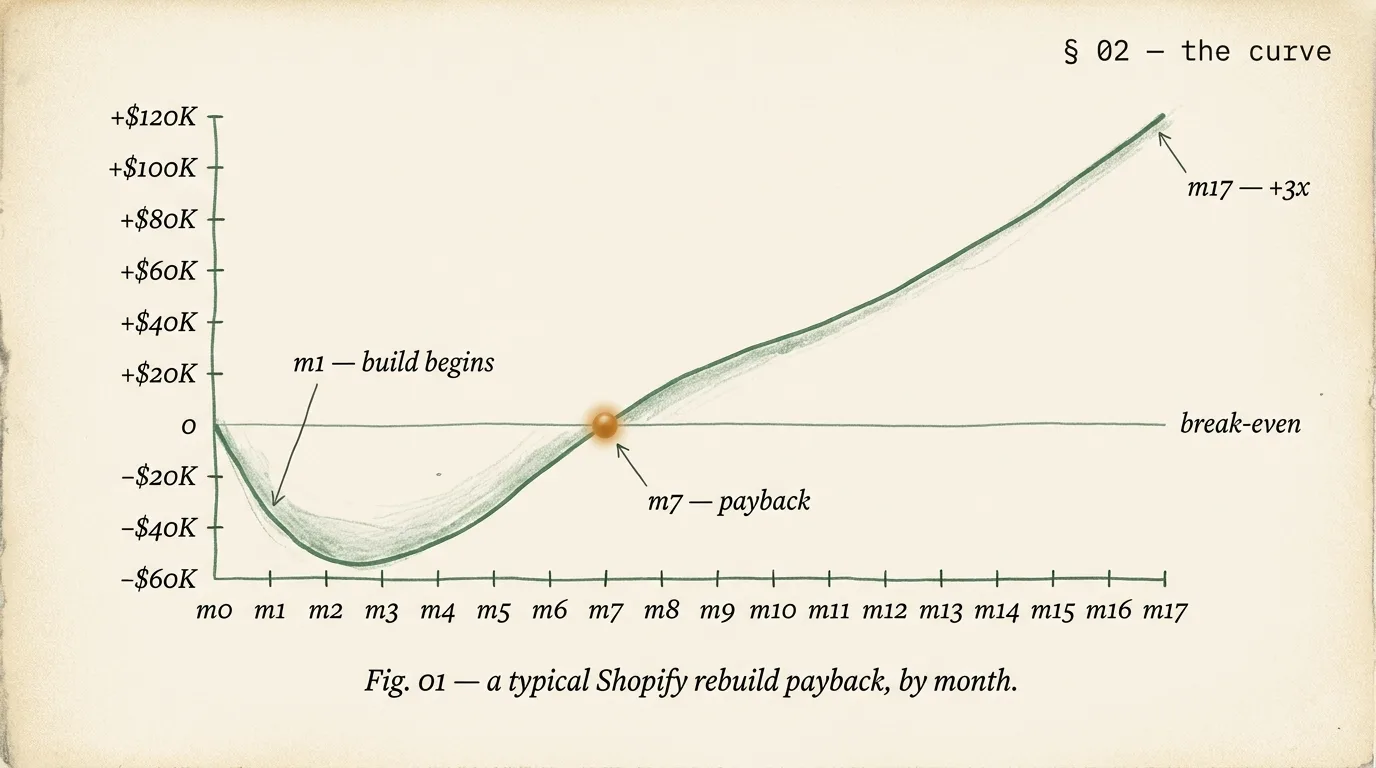
Two sensitivity knobs move the payback window most. One, the conversion-rate lift assumption: every percentage point of conversion-rate improvement on a $1.5M GMV store is roughly $15K of incremental annual revenue. Two, the build cost itself: a $120K build at a 14 percent combined lift pays back in roughly 6 months; a $240K build at the same lift pays back in roughly 12 months. If you are modeling a rebuild and the payback month sits above 18, the right conversation is usually about reducing build scope, not about finding more lift.
The third factor, not shown in this calculator, is the compounding effect of a better platform on future work. Brands on well-built Shopify Plus ship merchandising changes 3-5x faster than brands on legacy platforms, which means marketing experiments compound across the platform lifespan. We do not model that here because it is hard to attribute, but it is real.
Five answers.
What conversion-lift should I assume for a Shopify rebuild?
The most common pre-to-post lift we see on rebuilds from legacy platforms (Magento, WooCommerce pagebuilder, custom carts) to modern Shopify Plus is between 8 and 22 percent, with a median around 14 percent. Lifts are larger when the pre-rebuild site has poor Core Web Vitals (LCP above 4 seconds, INP above 300ms) and smaller when the pre-rebuild site is already on a fast modern stack. Assume 10-15 percent for a reasonable estimate; 20 percent plus is optimistic.
What AOV-lift is reasonable?
AOV lift comes from three levers: better upsell and cross-sell surfaces, cleaner bundle merchandising, and Shop Pay's faster checkout reducing abandonment at the high-AOV tail. Typical AOV lift is 5 to 12 percent post-rebuild, with median around 7 percent. If you are also shipping a subscription tier or a loyalty program as part of the rebuild, the AOV lift can be higher due to reorder frequency, but model those as separate lines.
What build cost should I expect?
For a mid-market Shopify Plus rebuild (migration from Magento or WooCommerce, custom theme, Checkout Extensibility, apps configured, 1 subscription tier, full content migration), budget $80K to $180K. Simpler brand-only Shopify rebuilds run $40K to $85K. Headless Hydrogen or Next.js rebuilds run $120K to $280K. Put your best estimate into the calculator; it will tell you whether the payback window makes sense at that number.
When does a Shopify rebuild not pay back?
Three common cases. One, you are at $200K/year GMV and the build cost is $80K; the payback window is too long relative to brand-survival horizon. Two, you are already on a well-built modern stack and the marginal lift from a rebuild is under 5 percent; spend the budget on acquisition or product instead. Three, the rebuild is cosmetic only (no real UX, performance, or merchandising changes); the lift will not materialize.
Does this calculator factor in contribution margin?
No, it computes on revenue. For a true ROI-to-profit model, multiply the calculated incremental revenue by your contribution margin percentage (see our profit calculator). For most DTC brands, contribution margin is 35-55 percent, so the true contribution return is roughly half the revenue return shown here.
Ready for a real scope + quote?
Our Shopify audit ships in 2 weeks. Current-state assessment, realistic lift targets, scoped build quote. Refundable against the engagement.
Published · Last updated .


