Blended CAC calculator. Past the vendor dashboards.
Sum everything acquisition-related.
True blended CAC.
How to use the Blended CAC Calculator
This calculator adds every acquisition cost for a period and divides the total by the number of first-time customers you won in that period. The result is one blended cost per new customer that no single ad platform can report. It is built for store owners and marketers who want to check what Meta or Google dashboards leave out.
Step by step
-
Pick one period
Decide on a single time window, such as last month or last quarter, and pull every number below from that same window. Mixing a month of spend with a quarter of customers makes the result meaningless.
-
Enter your paid media
Type the total of all ad platforms into Paid ad spend, in dollars. The field starts at 42000. Include Meta, Google, TikTok, Reddit and any other paid placement.
-
Add the costs dashboards miss
Fill in Organic operations cost (content salaries, SEO tools, PR, gifting; default 8000), Marketing tools (email, attribution and analytics software; default 2400) and Affiliate + creator fees (retainers and payouts; default 1800). Enter 0 for any line you do not have.
-
Count only new customers
Enter first-time buyers in Net-new customers. The default is 1120. A person who ordered three times in the period counts once, and repeat buyers do not count at all.
-
Add your average order value
Type your AOV (for context) in dollars, default 120. It does not change the CAC itself; it only drives the CAC / AOV ratio and the verdict line.
-
Read and copy the result
The results panel updates as you type, with no button to press. Press Copy results to clipboard to copy a plain text summary you can paste into a doc or chat. It lists the four costs, the total, the customer count, the blended CAC and the CAC / AOV ratio.
Reading the result
- Total acquisition spend is the sum of the four cost fields. With the defaults it is $54,200.
- Blended CAC is that total divided by net-new customers, rounded to whole dollars. The defaults give $54,200 / 1,120 = $48.
- CAC / AOV shows how much of the first order the acquisition cost eats. The defaults give $48 / $120 = 0.40x.
- Paid-only share is paid ad spend as a percent of the total. With the defaults it is 77%, so about a quarter of the real cost sits outside the ad platforms.
- The verdict line reads the CAC / AOV ratio: under 0.3x is strong, 0.3x to under 0.5x is the normal range, 0.5x to under 0.8x is tight, 0.8x to under 1.1x is close to AOV, and 1.1x or more means the first order loses money.
Tips and common mistakes
- Do not count total orders in Net-new customers. That gives cost per order, which is a different and much lower number.
- Leaving Organic operations cost at 0 makes CAC look better than it is. Include team time and tools spent on acquisition, even if no invoice comes in.
- Compare blended CAC month to month rather than against a single platform's CAC. The platform figure only credits its own conversions.
- If Net-new customers is 0 or blank, the calculator shows $0 for CAC rather than an error, so check that field first when a result looks wrong.
- The copied summary does not include the paid-only share or the verdict. Add them by hand if you need them in a report.
Privacy and limits
All math runs in your browser as you type. Nothing is sent anywhere and nothing is saved, so the fields go back to their defaults when you reload. The copy button writes to your clipboard only.
Everything in, divided by one thing.
Blended CAC is the most honest acquisition number a DTC brand can track because it cannot be gamed by channel attribution. Meta's reported CAC drops when Meta's attribution window captures more credit; Google's reported CAC drops when Google's attribution window captures more credit; no amount of dashboard manipulation moves blended CAC because the denominator (new customers) is the same across the company.
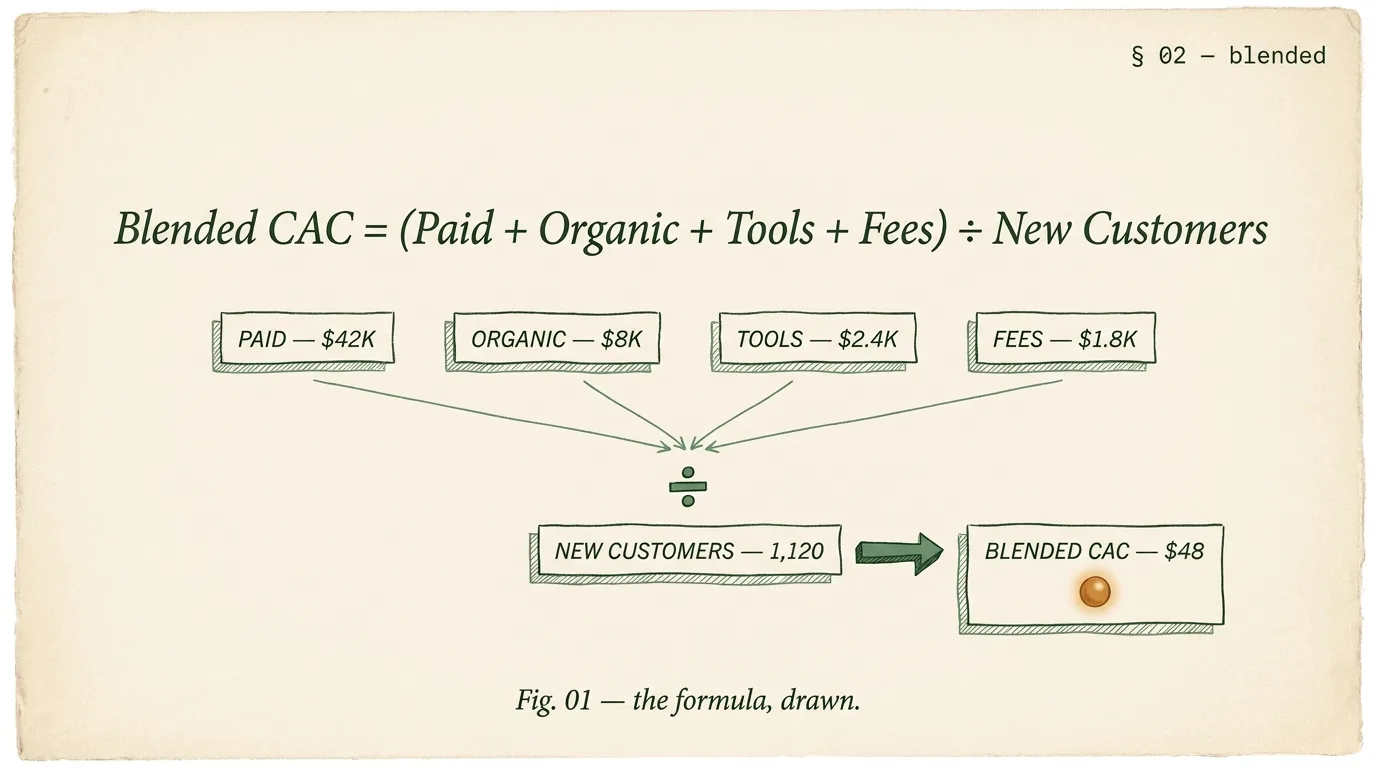
The most common place brands get blended CAC wrong is in the "organic operations" line. A content team costs money. An SEO tool costs money. A founder's time on creator partnerships costs money (even if the founder is not drawing salary). If the blended CAC calculation includes only paid ad spend and divides by new customers, the number is flattering by 20-40 percent for most brands. Include everything acquisition-adjacent.
The second place it goes wrong is in the customer-count denominator. "New customers" means first-time purchasers only, not total orders. If a customer ordered three times in the period, they count as one. If you mix new and repeat, you get blended CPO (cost per order), which is a different number serving a different purpose. Keep the two apart.
Five answers.
What is blended CAC?
Blended CAC is total acquisition-related spend (every channel, every tool, every fee) divided by total net-new customers. Unlike channel CAC (Meta CAC or Google CAC), blended CAC captures the full cost of new-customer acquisition and cannot be gamed by shifting credit between channels. It is the number that actually determines whether the unit economics work.
Why does my Meta-reported CAC differ from my real CAC?
Three reasons. One, Meta's attribution credits the last ad click inside its own tracking window, missing conversions driven by other channels. Two, Meta excludes channel costs like email tools, creator fees, and affiliate payouts. Three, post-iOS 18, Meta's reported conversions are systematically under-counted for iOS Safari users, which skews reported CAC downward on actual spend but upward on reported conversions. Blended CAC bypasses all three problems.
What should I include in 'organic operations cost'?
Any internal cost attributable to acquisition that is not paid ad spend. That includes: content team salaries allocated to acquisition content, SEO tooling, organic-social tooling, PR retainers, influencer gifting (not paid placement), and founder/team time if you are a small team and want true cost visibility. Most DTC brands underestimate this by 30-50 percent.
What's a healthy blended CAC?
The right frame is blended CAC as a multiple of AOV or as a fraction of LTV, not in absolute dollars. Healthy brands typically run blended CAC at 0.3-0.5x of AOV (first-order pays for itself) and at 0.25-0.4x of 12-month LTV. If your blended CAC exceeds AOV, you need contribution margin + repeat-purchase behavior to carry the acquisition cost.
How does blended CAC relate to MER?
MER (Marketing Efficiency Ratio) is total revenue divided by total marketing spend. Blended CAC is total marketing spend divided by new customers. They're two views of the same data. MER measures revenue efficiency; blended CAC measures acquisition efficiency. Most operators we work with track both weekly and prefer MER for ad-spend decisions and blended CAC for hiring and strategic decisions.
Seeing a blended CAC problem?
Our paid acquisition engagements start with a CAC + MER + LTV diagnostic week. Scoped quote in 48 hours.
Published · Last updated .


