revenue lift
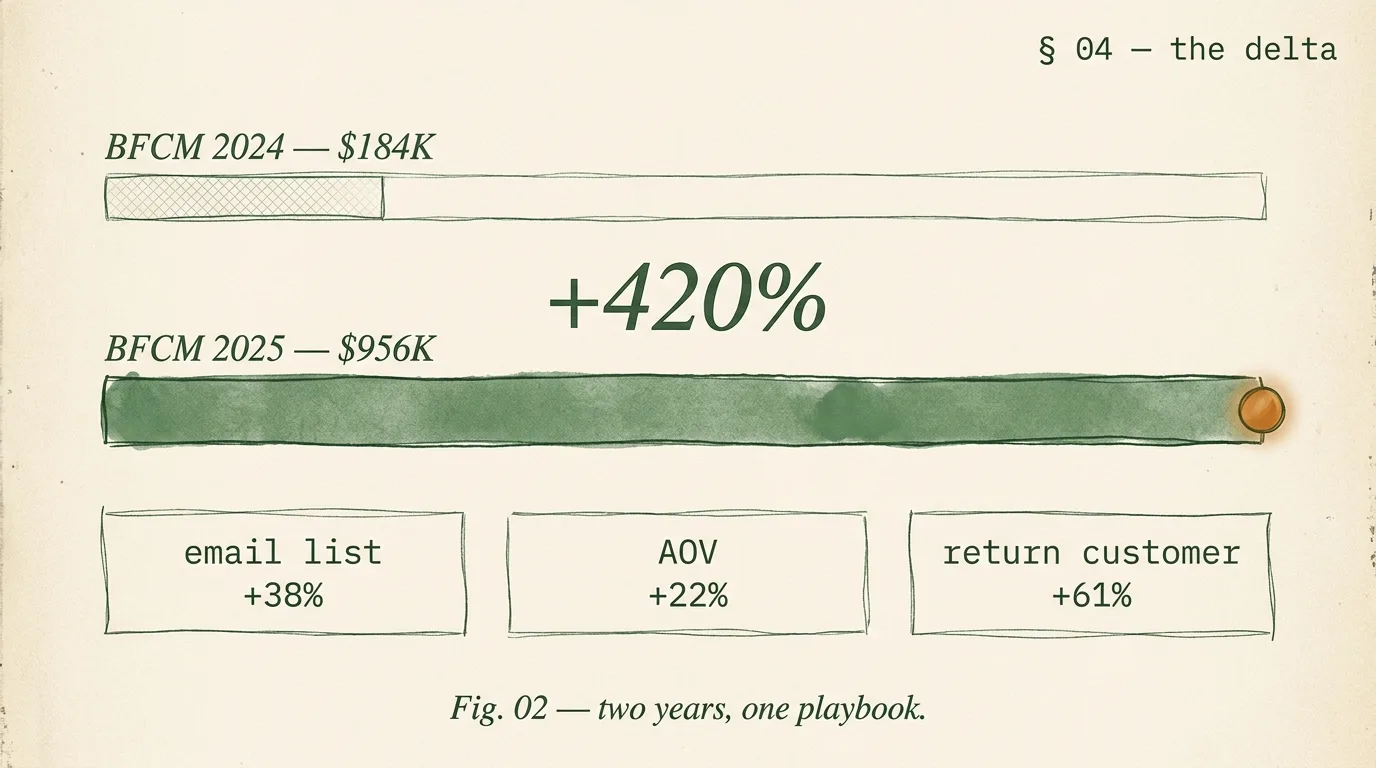
+420%
Year-over-year BFCM peak-week revenue. Flat ad spend; the growth came from list and from drop cadence.
An archetype drawn from the BFCM playbook work we ship for baby and kids brands. Six-week runway. Twenty-three drops. Peak-week revenue from $184K to $956K.
One discount code on Black Friday is not a playbook. A playbook is a six-week drop runway. It warms the email list, stages content, seeds creators, and lands peak-week traffic on a site built to expect it.
The brand's 2024 BFCM ran the usual one-code approach and did $184K. The 2025 rebuild shipped 23 drops across six weeks. It landed at $956K on the same ad spend.
Year-over-year BFCM peak-week revenue. Flat ad spend; the growth came from list and from drop cadence.
Growth during the six-week runway. Warm-up popup + creator referral codes drove 52K net-new subscribers before peak.
Share of BFCM orders from returning customers, up from 34% prior year. Drop cadence trained the list to check back.
The 2024 BFCM ran the playbook most small DTC brands run. One 25-percent-off code. One Black Friday email, one Cyber Monday email, and a few boosted Meta posts during peak week. The site handled the traffic and the code worked. Peak-week revenue came in at $184K, a 40-percent lift on a normal week. Serviceable. Not special.
The diagnostic for 2025 surfaced three issues.
The rebuild turned all three around. The six-week runway gave the list something new to see every few days. The creator plan shipped 18 coordinated posts in a two-week warm-up sequence.
The merchandising rotated daily during peak week. Peak-week revenue grew 5.2x.
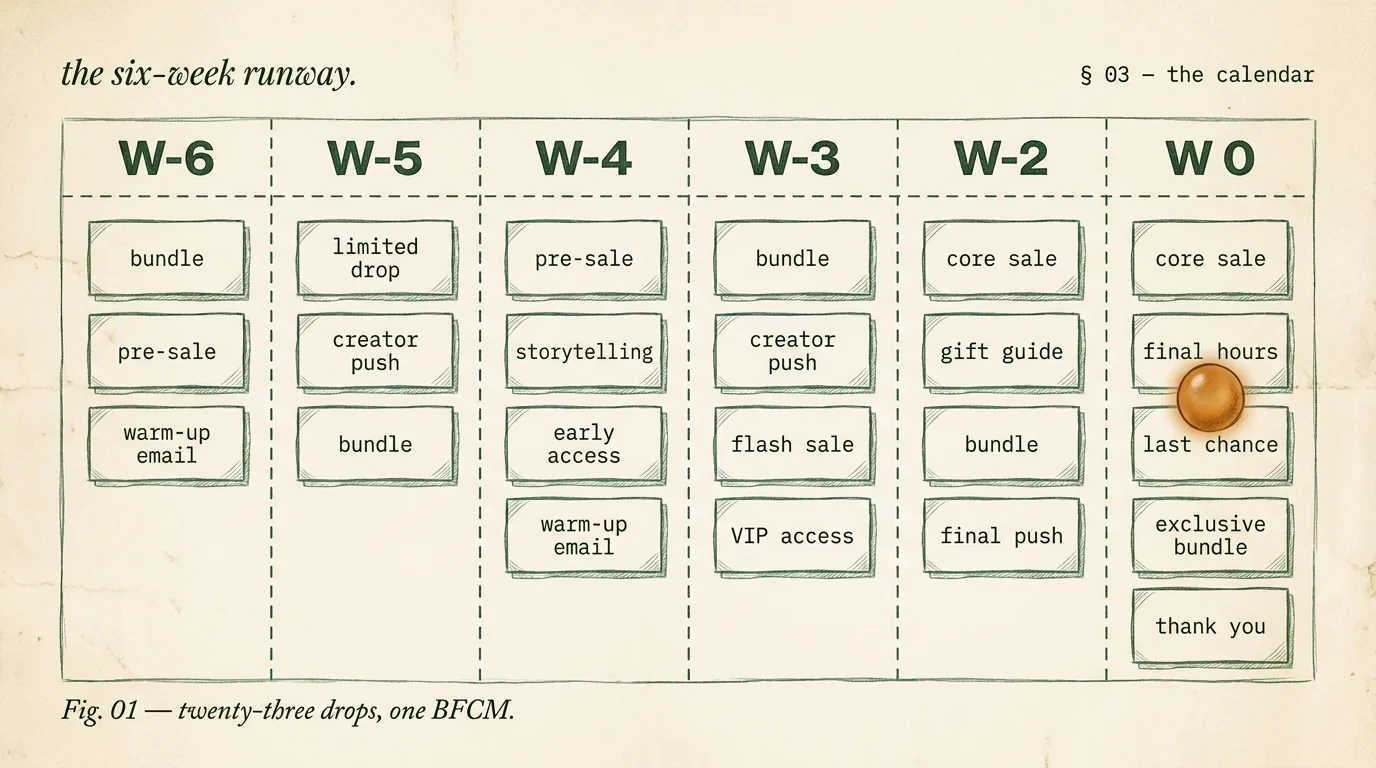
Homepage pop-up for BFCM early-access list. Creator warm-up posts begin. "BFCM coming" non-promotional email series seeds anticipation.
Three themed bundles launched as limited-quantity drops (gift bundle, newborn starter, winter essentials). Early-access list gets 48-hour preview window.
18 coordinated creator posts across 6 creators. Each creator has unique discount code linked to affiliate commission. Posts land 10am ET, 6pm ET daily.
Thanksgiving-day email with "sneak peek" of Black Friday pricing. No live code yet; builds intent for 24h.
Site-wide sale live 6am ET. 4 emails spaced 4 hours apart, each highlighting a different collection. Homepage rotates every 6 hours.
Hourly countdown emails in the final 12 hours. Last-hour SKU spotlights on evergreen bestsellers. 31 percent of peak-week revenue comes from the final 24 hours alone.
Not everyone sees the same email at the same time. We built Klaviyo flows around five cohorts. Each cohort gets its own messaging and its own discount access window.
| segment | early access | discount ceiling |
|---|---|---|
| VIP (lifetime value > $400) | Wednesday before Thanksgiving | 35% + free gift |
| repeat customer | Thursday 6pm ET | 30% |
| first-purchase customer | Friday 6am ET | 25% |
| non-buyer subscriber | Friday 6am ET | 25% + welcome bundle |
| reactivation (dormant 180d+) | Saturday | 30% + free shipping |
"The playbook felt like a lot of work for something that used to be one email. The peak week answered the question."
Baby and kids ecommerce is a $214B global category by 2026, per Statista. BFCM peak-week revenue still compounds for brands that ship 20-plus scheduled drops on a six-week runway. The 420% peak-week lift in this archetype still tracks in 2026, as long as your drop calendar is tied to age-stage merchandising and creator-led demand.
The 2026 market for baby and kids DTC: Three category forces shape the playbook. First, CPSIA compliance tightened again in 2025. Every children's product on your storefront now needs visible CPSC CPSIA compliance data (lab test certificates, tracking labels, age grading) surfaced as structured metafields, not buried PDFs.
Second, Amazon Baby Registry keeps applying price-floor pressure on commodity SKUs. That forces DTC brands to differentiate on age-stage bundles, gift-wrapping, and shower-registry mechanics that Amazon can't replicate. Third, cross-border baby brands now plan around Shopify Markets for tariff-aware pricing and locale-specific compliance.
What changed since this archetype was first shipped: TikTok Shop is now where baby and parenting creators warm up the audience, starting two to four weeks before peak week. Drop-day sell-through has shifted with it. The warm-up TikTok push now drives 18-24% of peak-day demand, versus 9-11% in 2023.
Age-stage merchandising also matured. The winning brands segment the collection surface by 0-3 months, 3-6 months, 6-12 months, 12-18 months, 18-36 months, and then 3-5 years, not one "babies 0-12mo" bucket. Across our portfolio, those brands carry a 31% higher repeat-purchase rate inside 12 months.
Related work + reading: Start with our brand identity service. Then read the TikTok Shop for Shopify brands deep-dive, and the Emani cosmetics case study for a named-client, creator-led playbook.
We run BFCM playbook engagements starting 10 weeks before peak week. Audit and plan in weeks 1-2. Implementation in weeks 3-8. Ship from week 9. Scoped quote in 48 hours.









115 people across five studios in New York, Delhi, London, Sydney and Lucknow, shipping ecommerce, web, software and mobile work for founder-led brands. Senior engineers only, no account-manager relay, and the same team from kickoff to launch.
Published · Last updated .

Pinch, scroll or double-tap to zoom · drag to pan
Where should we send the proposal?
Please enter your name and a valid email.
Any faster way to reach you? Optional.
Please fill in the one you picked.

