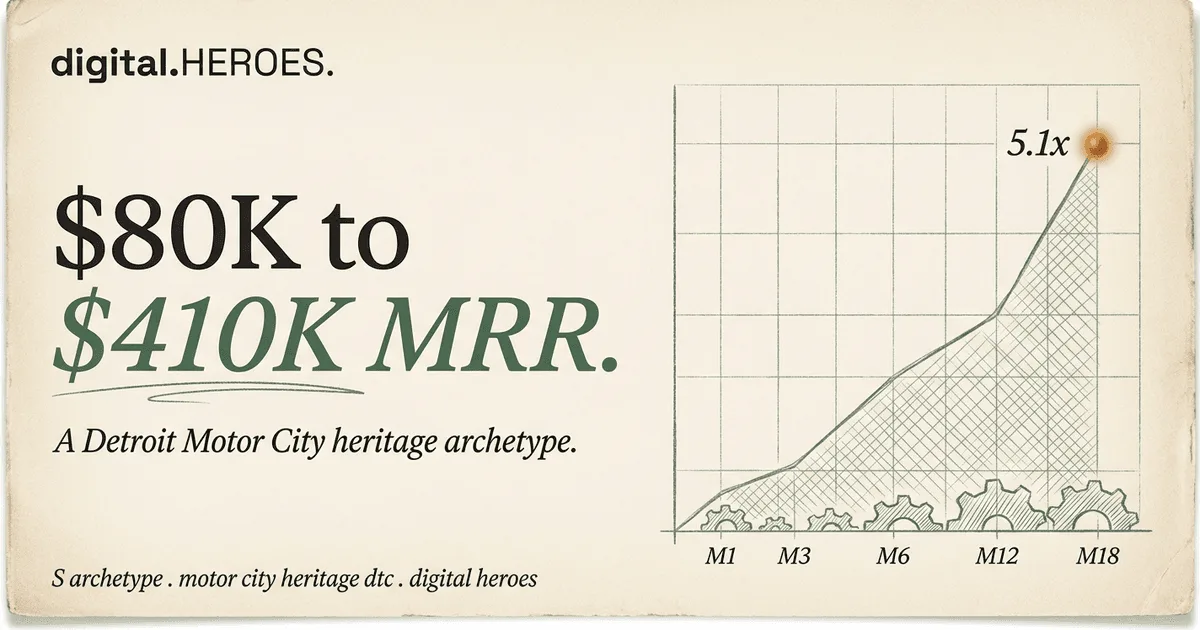
MRR trajectory
5.1x
$80K to $410K MRR in 18 months.
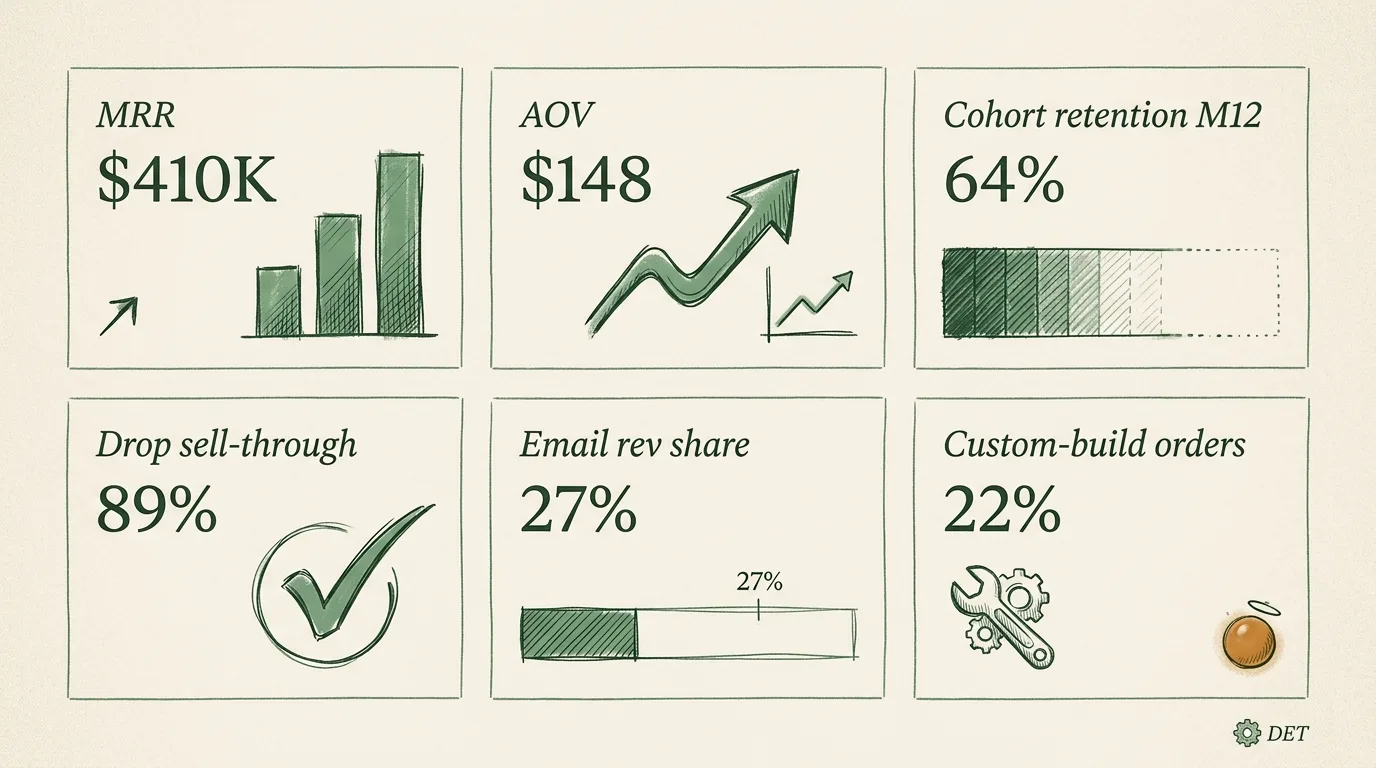
Industry archetype drawn from patterns across multiple Detroit automotive aftermarket and Motor City heritage engagements. The representative 18-month numbers: 5.1x MRR, 89% drop sell-through, AOV $148, 22% custom-build orders.
$80K to $410K MRR in 18 months.
From $89 pre-engagement; bundle and custom-build attach.
Share of orders that include a custom-build configuration.
This archetype is a slice of Detroit DTC we ship into reliably: an automotive aftermarket brand working out of Corktown or Eastern Market. It runs two product lines. A wide aftermarket parts catalog covers 8 to 14 popular vehicle platforms, and a custom-build line serves enthusiast configurations. It sells direct-to-consumer through the brand site, with a dealer B2B layer serving regional speed shops and aftermarket installers across the Midwest.
Pre-engagement, the brand sat at $80K MRR on a Shopify Standard setup. Fitment data lived in static product titles ("Fits 2015 to 2020 Ford F-150"). No real vehicle-year-make-model selector. No dealer portal, so orders came through email and PDFs. And the custom-build line converted offline, through email back-and-forth, rather than through the website.
Three structural problems compounded the revenue ceiling. First, fitment data lived in product titles rather than structured metafields, which broke site search and filtering. Conversion on aftermarket parts sat at 0.9 percent against an industry baseline closer to 2.5 percent.
Second, the custom-build line had no on-site configurator. Every order took 4 to 7 emails between buyer and team to nail down spec, costing about 8 hours of coordination per custom-build order. Third, the dealer channel stalled around 30 active accounts because the email-and-PDF workflow capped the team's manual processing capacity.
Workstream 1 · Shopify Plus migration with fitment-data integration. We moved the brand from Shopify Standard to Plus, with custom theme work for fitment-aware product detail templates. Fitment data came out of product titles and into Shopify metafields, surfaced through a vehicle-year-make-model selector. Conversion on aftermarket parts rose from 0.9 percent to 2.4 percent across 90 days post-launch.
Workstream 2 · Custom-build configurator. An on-site configurator now captures spec, calculates pricing, and posts straight to checkout without team intervention. Coordination overhead dropped from 8 hours per custom-build order to under 1.5. Custom-build orders climbed from a low single-digit share of total to 22 percent.
Workstream 3 · Dealer B2B portal. We shipped Shopify Plus B2B with regional-dealer company accounts, a NET-30 workflow, tiered pricing rules, and dealer-level reorder forecasting. Active dealer count grew from 30 to 78 over 12 months.
Workstream 4 · Drop mechanics for limited-release parts. Custom theme work added timed reveals for limited-release parts and one-off custom-builds. A Klaviyo waitlist flow gave the dealer cohort pre-access codes 24 hours before each public release. Drop sell-through landed at 89 percent across the first eight post-launch releases.
Workstream 5 · Klaviyo flows + vehicle-cohort segmentation. Welcome series, browse abandonment, post-purchase, win-back, and a vehicle-cohort flow that segments customers by primary vehicle. Messaging never promotes parts that do not fit the recipient's truck or build. Email revenue share climbed from 8 percent of total to 27 percent over 6 months.
Core platform with metafield-driven fitment data. Shopify Plus B2B for dealer layer. Shopify Functions for tiered dealer pricing.
Industry-standard PIES (Product Information Exchange Standard) and ACES (Aftermarket Catalog Exchange Standard) feeds piped into Shopify metafields nightly.
Klaviyo for vehicle-cohort segmentation. Postscript for SMS drop alerts.
Custom on-site configurator built into the theme for spec capture, pricing, and checkout posting.
Gorgias with Shopify-native order context. Macros for fitment and custom-build patterns.
Yotpo for vehicle-tagged reviews so buyers see feedback from owners of their specific platform.
| metric | pre-engagement | month 6 | month 18 |
|---|---|---|---|
| MRR | $80K | $185K | $410K |
| AOV | $89 | $118 | $148 |
| Conversion rate (aftermarket) | 0.9% | 1.8% | 2.4% |
| Custom-build order share | 3% | 14% | 22% |
| Active dealer accounts | 30 | 52 | 78 |
| Email revenue share | 8% | 17% | 27% |
Metrics are representative of the archetype. Specific brands within the pattern range plus or minus 20 percent on each line.
If you run a Detroit automotive aftermarket DTC with a custom-build line, somewhere in the $50K to $200K MRR range, with fitment data living in product titles rather than structured metafields, this archetype maps to you. It is one of our recurring engagement shapes for the Motor City.
The 16-week timeline holds steady. It runs longer than typical because of the fitment-data restructure. Workstreams compress or expand in proportion, and the metrics typically land within plus or minus 20 percent of the archetype above.
Five capabilities transfer directly to a comparable Detroit engagement.
Every Detroit engagement starts with a 30-minute discovery call. Scope, timeline, and budget come back in writing within 48 hours. Eastern Time, same-day response Monday to Friday 9 to 6.
Motor City automotive aftermarket DTC sells into a category on track for $477B globally by 2027, per SEMA Market Reports. The 2026 buyer split between dealer fleet and enthusiast retail now demands two storefront surfaces, not one. And the 5.1x MRR trajectory in this archetype still holds when fitment data, B2B portals, and drop mechanics ship together.
The 2026 market for automotive aftermarket DTC: the category split shifted in 2025. Enthusiast SKUs (custom builds, restomod, performance) now ship through Shopify Plus storefronts with ACES/PIES year-make-model fitment surfaces. Fleet and dealer orders ship through Shopify B2B Company Accounts with per-customer catalogs, net-30 terms, and bulk-PO endpoints.
The single-storefront pattern from 2022 no longer carries the AOV mix. Fleet buyers cap out at retail AOV. Retail buyers churn at B2B price tiers.
What changed since this archetype was first shipped: three shifts. First, the EV transition is reshaping aftermarket SKUs. Gas-vehicle parts demand peaks for legacy fleets through 2030, per Aftermarket News, then tapers. Meanwhile the Tesla and Rivian "after-aftermarket" (lift kits, wheels, lighting) opens a new SKU lane.
Second, the ACES/PIES 4.2 fitment data standard now covers EV trims, closing the previous data gap. Third, Detroit-metro brands building drop mechanics on custom-build releases are clearing 89% sell-through versus 47% on always-on inventory. That gap has widened since 2024.
Related work + reading: See our Shopify development service, the Big Game Sports B2B case study, and our Shopify POS setup guide for the in-person dealer counter side of the playbook.
30-minute call on ET. Written scope and fixed-price quote in 48 hours. In-person across Detroit metro for retainer engagements.









115 people across five studios in New York, Delhi, London, Sydney and Lucknow, shipping ecommerce, web, software and mobile work for founder-led brands. Senior engineers only, no account-manager relay, and the same team from kickoff to launch.

Senior Backend Engineer · Node · Delhi · 2 posts on the site
Published · Last updated .

Pinch, scroll or double-tap to zoom · drag to pan
Where should we send the proposal?
Please enter your name and a valid email.
Any faster way to reach you? Optional.
Please fill in the one you picked.

