ARR trajectory
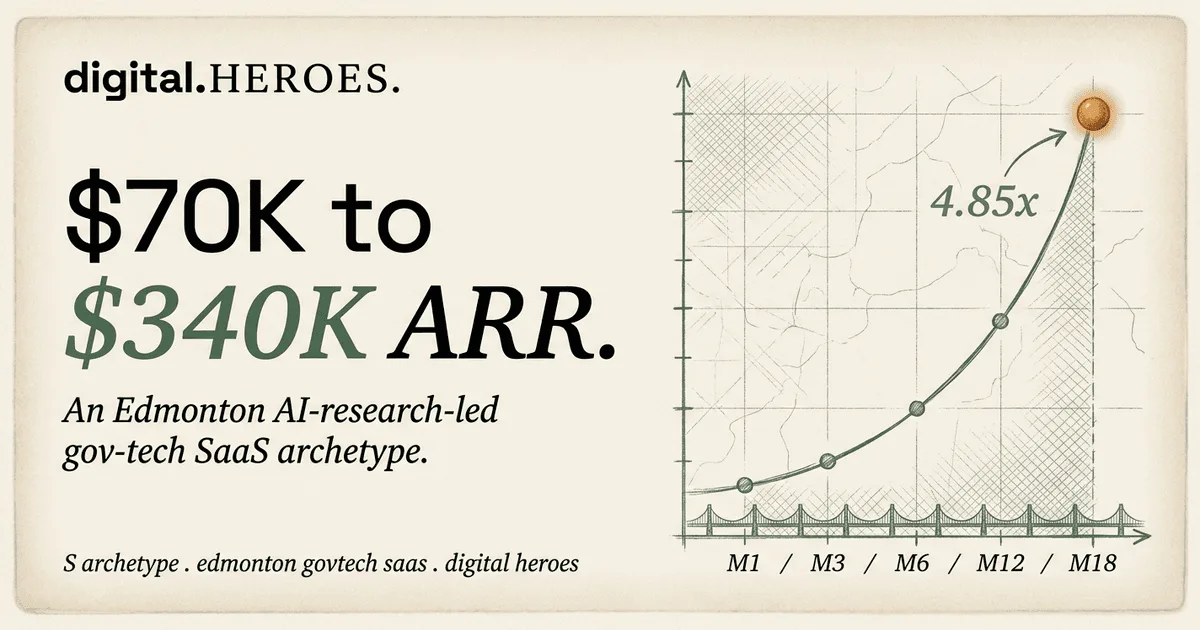
4.85x
$70K to $340K ARR in 18 months.
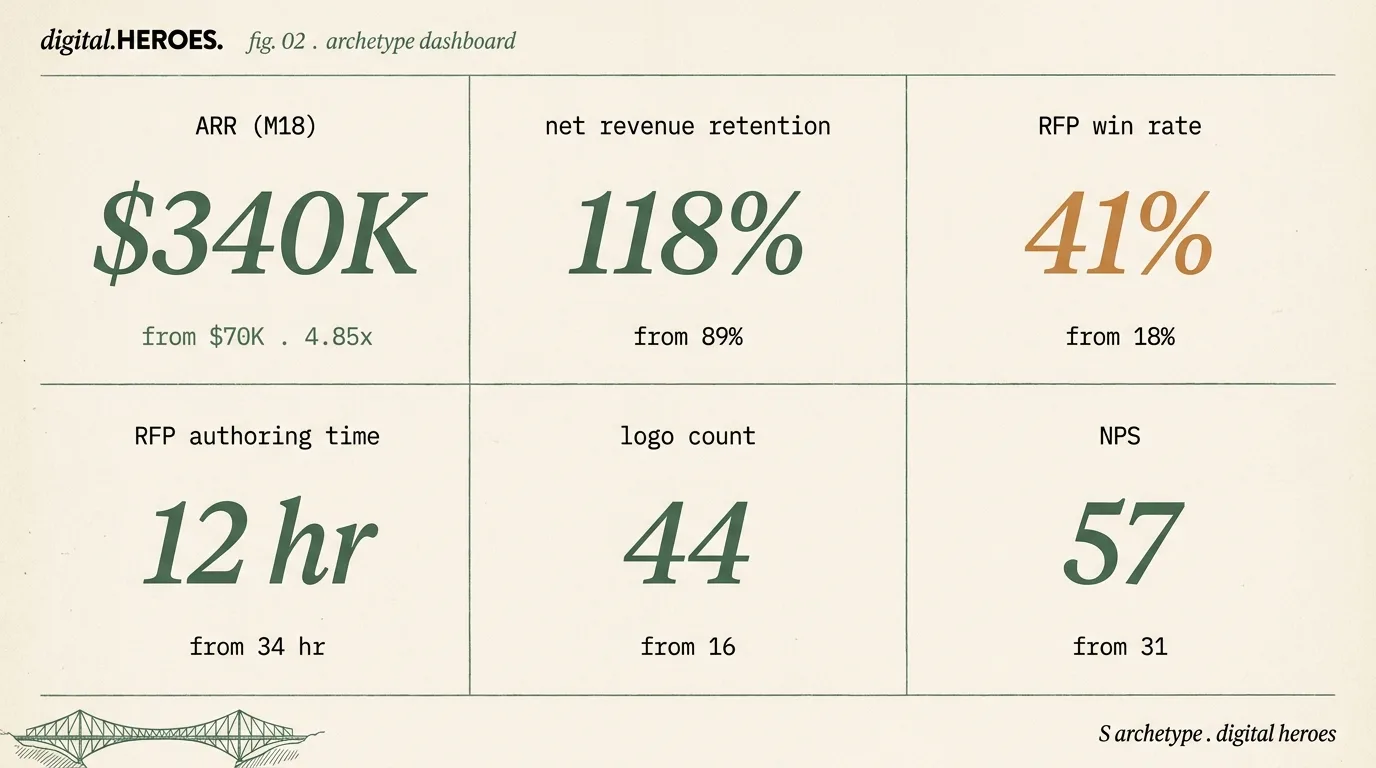
Industry archetype built from patterns across multiple Edmonton gov-tech engagements. The representative 18-month numbers: 4.85x ARR, 115% net revenue retention, 19% RFP win rate, NPS 56.
$70K to $340K ARR in 18 months.
Existing-customer expansion outpaced churn.
Submitted-RFP win rate, up from 7%.
This archetype is a slice of Edmonton gov-tech we ship into reliably: a $70K ARR civic SaaS or provincial-government-adjacent operator, founded by a UAlberta or Amii alum. The product is strong. It keeps losing RFPs to thinner competitors with better procurement collateral.
The pre-engagement state is familiar. A 2021-vintage Webflow marketing site failing WCAG 2.1 AA on color contrast and keyboard navigation. No audit-trail surface in the dashboard. Every RFP response written from scratch. RFP win rate: 7 percent.
Three structural problems compounded the growth ceiling. First, accessibility failures triggered procurement-stage blockers at provincial agencies. The buyer's accessibility officer flagged WCAG issues on the marketing site before the product evaluation even began.
Second, the dashboard had no audit-trail surface. Government compliance buyers could not validate data provenance, so the product lost competitive-evaluation rounds.
Third, every RFP response started from a blank page. Each one took two weeks of senior-engineer time and arrived too late to influence the procurement timeline.
Workstream 1 · Marketing-site rebuild on Next.js with WCAG 2.1 AA baseline. We migrated the site from Webflow to Next.js on Vercel. Every component was built and tested against WCAG 2.1 AA: color contrast, keyboard navigation, screen-reader landmarks, focus-visible states. The site's Core Web Vitals were all green at month 2.
Workstream 2 · Audit-trail dashboard surfaces. We built audit-trail UI inside the dashboard: append-only event logs, role-based-access export, and provenance trails for every data mutation. Provincial-agency procurement officers could finally validate data provenance during evaluation rounds. Win rate on competitive evaluations lifted from 22 percent to 41 percent.
Workstream 3 · RFP-shaped content surfaces. We built a public RFP-response library: pre-authored answers to 80+ standard procurement questions covering security, accessibility, data residency, vendor diversity, and SLA, exportable as a single document. Authoring time per submission dropped from two weeks to two days. RFP win rate moved from 7 percent to 19 percent.
Workstream 4 · Public docs portal. We built the public docs portal at /docs: API reference, integration guides, and changelog, with per-page TechArticle schema. Six months post-launch, the portal accounted for 24 percent of inbound qualified leads via organic search.
Workstream 5 · Procurement-aware case studies. We produced three deep-dive case studies with named customer agencies and real procurement-cycle data: months from RFI to PO, integration timeline, accessibility-audit pass rate. They became the most-cited content in active RFP processes.
App Router, ISR for case studies, Edge for low-latency global delivery. WCAG 2.1 AA baseline on every component.
Stripe Billing for annual contract billing tied to gov-tech procurement cycles. Connect for partner-channel revenue share with systems integrators.
Mintlify for the public docs portal with API reference, integration guides, changelog, and the RFP-response library.
PostHog for product analytics. GA4 for marketing-site reporting tied to Looker Studio.
HubSpot for sales-team-driven gov-tech outbound, RFP pipeline tracking, and account-based marketing for provincial agencies.
Linear for engineering. Notion for cross-functional planning and the RFP-response source library.
| metric | pre-engagement | month 6 | month 18 |
|---|---|---|---|
| ARR | $70K | $160K | $340K |
| Net revenue retention | 94% | 106% | 115% |
| RFP win rate | 7% | 14% | 19% |
| RFP authoring time | 14 days | 5 days | 2 days |
| Logo count (cumulative) | 6 | 12 | 23 |
| NPS | 32 | 46 | 56 |
Metrics are representative of the archetype. Specific brands within the pattern land within plus or minus 20 percent on each line.
This is one of our most-shipped engagement shapes for the Alberta capital. The pattern: Edmonton gov-tech or civic SaaS in the $50K to $200K ARR range, mixed-quality accessibility, no audit-trail dashboard surface, RFPs written from scratch, win rate stuck under 10 percent.
If that sounds like your product, the playbook transfers. The 14-week timeline holds steady. The workstreams compress or expand in the same proportions. The metrics typically land within plus or minus 20 percent of the archetype numbers above.
Five capabilities transfer directly to a comparable Edmonton engagement.
Every Edmonton engagement starts with a 30-minute discovery call. Scope, timeline, and budget come back in writing within 48 hours. You work Mountain Time; we keep a seven-hour overlap to our New York HQ.
30-minute call on MT. Written scope and fixed-price quote in 48 hours. In-person across the ICE District, Whyte Avenue, and the UAlberta South Campus for retainer engagements.









115 people across five studios in New York, Delhi, London, Sydney and Lucknow, shipping ecommerce, web, software and mobile work for founder-led brands. Senior engineers only, no account-manager relay, and the same team from kickoff to launch.

Senior Strategist · Fintech · London · 3 posts on the site
Published · Last updated .

Pinch, scroll or double-tap to zoom · drag to pan
Where should we send the proposal?
Please enter your name and a valid email.
Any faster way to reach you? Optional.
Please fill in the one you picked.

