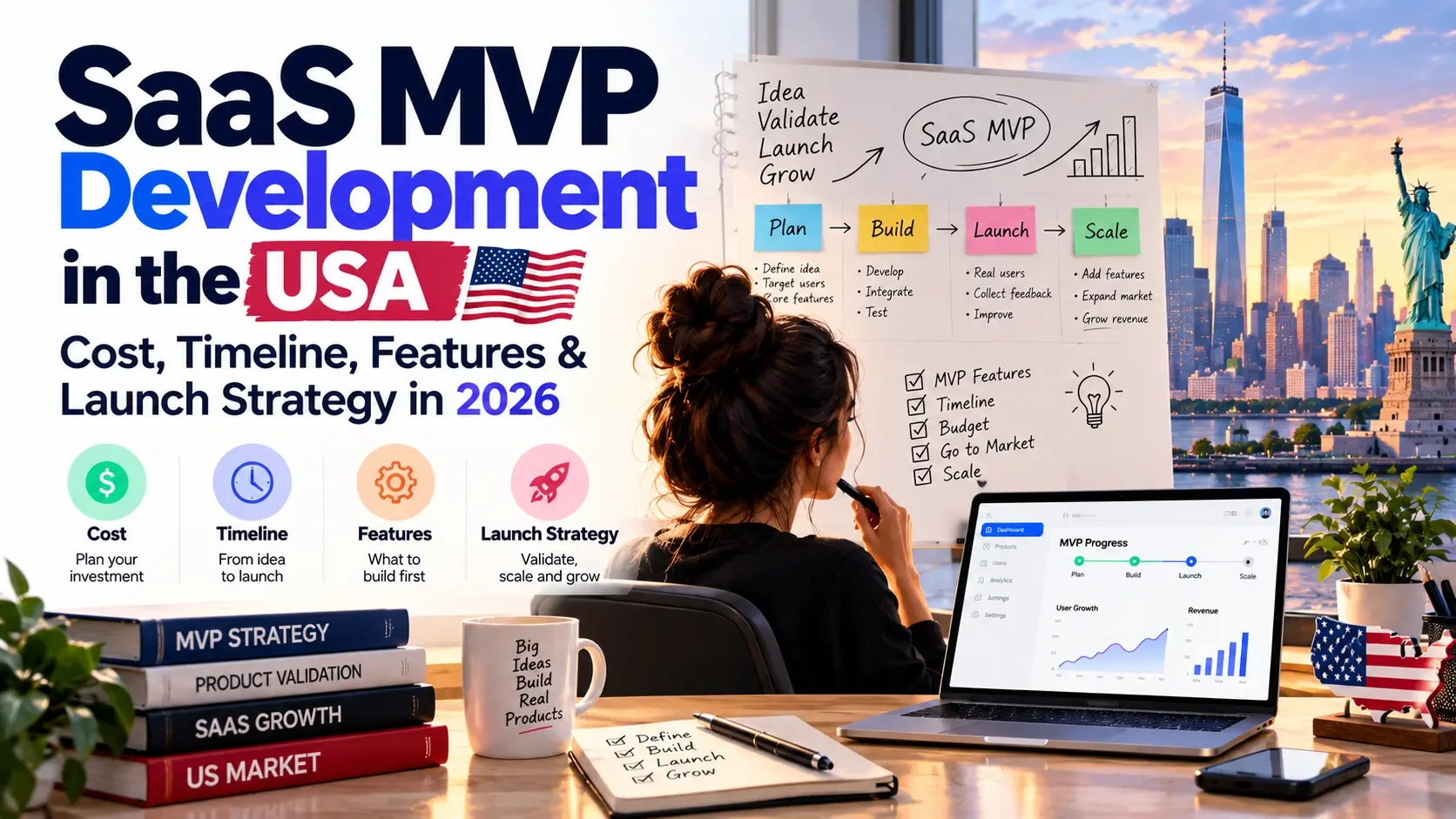
Building a SaaS product in the USA is not only a development challenge. It is a business decision about what to build first, what to postpone, how much to invest, and how quickly you can learn whether customers will actually use and pay for the product.
That is why SaaS MVP development should start with the business hypothesis rather than a long feature list. The goal is to create the smallest useful production product capable of testing an important assumption with real users—not simply the product with the fewest screens.
A well-planned SaaS MVP can help a founder validate the core workflow, understand customer behavior, identify technical constraints, and decide what deserves investment next. For US startups and businesses, this approach can also help control early product investment while creating a clearer path toward a scalable SaaS platform.
This guide explains SaaS MVP development in the USA in 2026, including development cost factors, timelines, essential features, architecture, development stages, launch preparation, and the signals that indicate it is time to move beyond the MVP. If you are still evaluating the broader product-building process, see our SaaS development guide for founders for the larger product-development picture.
What Is a SaaS MVP?
A SaaS MVP (Minimum Viable Product) is an initial production version of a software-as-a-service product that contains enough functionality to solve a specific customer problem and test a core business or product hypothesis.
Depending on the product, a SaaS MVP may require user accounts, a database, a working core workflow, payments, an administrative interface, analytics, and the infrastructure required to operate the product safely.
SaaS MVP vs. Prototype
A prototype is primarily used to explore an idea, user experience, or interface before significant engineering investment.
A SaaS MVP goes further. It is intended to be a functioning product that users can interact with in a real environment and use to validate whether the core product hypothesis works.
| Prototype | SaaS MVP |
|---|---|
| Tests an idea or interface | Tests a real product hypothesis |
| Often uses mock data | Uses working application data |
| May not have production infrastructure | Designed for real users |
| Primarily useful for early validation | Useful for customer and business validation |
| Usually not intended for paying customers | Can include billing when the business model requires it |
SaaS MVP vs. Full SaaS Product
A full SaaS product may eventually include multiple customer segments, advanced permissions, extensive integrations, sophisticated analytics, mobile applications, automation, enterprise security requirements, and many secondary workflows.
An MVP does not need all of that. Its job is to answer a more focused question:
Can this product solve an important problem well enough for the intended customer to use it and, where applicable, pay for it?
For example, imagine a SaaS platform that helps small businesses manage client approvals. The full product might eventually include automated reminders, mobile apps, advanced reporting, team analytics, multiple integrations, AI-assisted approvals, and enterprise permissions.
The MVP might only need a focused set of capabilities:
- Account creation and login
- Organization or workspace setup
- Client management
- Approval workflow
- Basic dashboard
- Notifications
- Subscription billing if required
- Basic administration
- Usage analytics
That is not an incomplete version of the final product. It is a deliberately scoped version designed to learn. Once the core workflow is validated, the product can expand based on customer behavior, revenue, feedback, and the next business priorities.
How Much Does SaaS MVP Development Cost in the USA in 2026?
There is no universal price for SaaS MVP development in the USA. Two products can both be described as SaaS MVPs while requiring very different amounts of design, engineering, testing, infrastructure, and product work.
A simple SaaS product with one core workflow is fundamentally different from a multi-tenant platform with complex permissions, subscription billing, third-party integrations, and AI functionality. The most useful way to estimate cost is therefore to understand what creates engineering and product complexity.
SaaS MVP Cost by Complexity
| MVP Type | Typical Scope | Main Cost Drivers |
|---|---|---|
| Lean MVP | One primary workflow and limited roles | Focused UX, core engineering, basic infrastructure |
| Standard MVP | Multiple workflows, dashboard, billing where required | Engineering, UX, QA, permissions and infrastructure |
| Advanced MVP | Complex workflows, multi-tenancy, integrations or AI | Architecture, security, integrations, testing and engineering complexity |
Before requesting a SaaS MVP development quote, break the product into users and roles, core workflows, data and tenant structure, billing requirements, integrations, design requirements, security requirements, analytics, AI functionality if required, and testing and infrastructure.
- Users and roles
- Core workflows
- Data and tenant structure
- Billing requirements
- Integrations
- Design requirements
- Security requirements
- Analytics
- AI functionality, if required
- Testing and infrastructure
This gives a development partner something much more useful to estimate than a feature list containing dozens of loosely defined ideas.
What Factors Affect SaaS MVP Development Cost?
1. User Roles and Permissions
Every additional role can introduce different screens, permissions, workflows, and testing requirements. A basic product might have only an account owner and standard user, while a more complex SaaS platform could require organization owners, administrators, managers, staff members, and external clients.
The important question is not how many roles can be created. It is which roles are necessary to validate the product.
2. Multi-Tenancy
A multi-tenant SaaS architecture may need to account for:
- Organization structure
- User-to-organization relationships
- Data isolation
- Permissions
- Tenant-specific settings
- Billing relationships
3. Billing relationships
Billing can be one of the most underestimated parts of a SaaS MVP. A basic subscription model may require plan selection, checkout, payment processing, subscription status, upgrades, downgrades, cancellations, and payment-failure handling.
- Plan selection
- Checkout
- Payment processing
- Subscription status
- Upgrade and downgrade handling
- Cancellation
- Payment failure handling
More complicated products may also need usage-based billing, trials, coupons, invoicing, metering, or different plans for different organizations. If charging customers is part of the product hypothesis, billing should usually be considered part of the MVP rather than a later addition.
4. Integrations
An integration is not simply a button that connects two systems. It may involve authentication, API communication, data mapping, error handling, webhooks, rate limits, synchronization, and testing.
5. UX/UI Requirements
Good MVP design does not mean designing every possible screen. The priority should be the workflows customers must complete successfully.
A typical core journey might look like:
Sign up → Create workspace → Perform core action → See result → Manage account
6. AI Functionality
AI can be valuable in a SaaS MVP when it is directly connected to the product hypothesis. Depending on the product, AI may support document extraction, recommendations, content generation, classification, search, customer support, or workflow automation.
7. Testing and Infrastructure
A SaaS MVP still needs reliable infrastructure and testing. The goal is not to build enterprise-level infrastructure before you have customers. It is to avoid creating a product that cannot safely support its first real users.
- Authentication
- Permissions
- Core workflows
- Payment states
- Data handling
- Error conditions
- Browser compatibility
- Integration failures
- Production deployment
- Backup and recovery processes
How Long Does SaaS MVP Development Take in the USA?
There is no universal SaaS MVP development timeline. A simple product with one focused workflow can move considerably faster than a SaaS platform requiring complex permissions, integrations, migration, billing logic, or AI.
For planning purposes, Digital Heroes currently positions its SaaS MVP offering around an approximately 8–12-week validation-focused build covering authentication, billing, the core workflow, and a dashboard. This is a Digital Heroes planning framework—not a universal development guarantee.
The actual timeline can change significantly when the scope includes complex integrations, data migration, advanced permissions, AI, security requirements, or enterprise expectations.
SaaS MVP Development Timeline
| Development Stage | Main Objective |
|---|---|
| Discovery | Understand the customer, problem and business objective |
| MVP Scoping | Decide what belongs in the first release |
| UX/UI | Design the critical user journeys |
| Architecture | Establish the technical foundation |
| Development | Build the core product |
| QA | Test workflows, permissions and edge cases |
| Deployment | Prepare the production environment |
| Early Launch | Release to a controlled group of users |
| Feedback & Iteration | Learn from real users and prioritize the next release |
The biggest timeline mistake is usually not slow coding. It is uncontrolled scope. If new features keep entering the MVP during development, the original estimate becomes less meaningful.
What Features Should a SaaS MVP Include?
There is no universal SaaS MVP feature checklist. The right features depend on the problem being validated, the target customer, the business model, and the workflow that creates the product's core value.
Build the smallest product capable of proving the core hypothesis.
Essential SaaS MVP Features
Most SaaS MVPs need a small set of foundational capabilities that allow real users to access the product, complete the core workflow, and provide measurable feedback.
- User registration and authentication
- User or organization profiles
- Core product workflow
- Basic dashboard
- Required roles and permissions
- Subscription billing when monetization is part of the hypothesis
- Transactional notifications
- Basic administration
- Product analytics
- Error monitoring and essential backups
Authentication and Account Management
Most SaaS products need a way for users to securely create accounts and access their data. Depending on the product and target market, authentication may include email and password login, password reset, email verification, social login, or single sign-on.
User Roles and Permissions
If different users need different access, the MVP should establish those permissions clearly. For example, a project management SaaS might initially need only a workspace owner and team member rather than six separate administrative roles.
Start with the roles required for the core workflow. More detailed permissions can be introduced when customer requirements demonstrate that they are necessary.
Core Product Workflow
The core workflow is the most important part of the MVP. It is the sequence of actions that takes a customer from the initial problem to the outcome your SaaS product promises to deliver.
8. Dashboard and Administration
A basic dashboard should help users understand the product and complete the primary workflow. An administrative area can help the product team manage users, subscriptions, settings, and support issues without accessing the database directly.
9. Billing and Monetization
If the SaaS business depends on subscriptions or paid usage, the MVP should include the billing workflow required to test that business model. The goal of SaaS MVP development services should be to keep the first version simple rather than building every pricing variation at launch.
10. Analytics and Feedback
Analytics should answer product questions rather than simply collect large amounts of data. Useful early signals can include sign-ups, activation, core feature usage, trial starts, conversion, errors, support issues, and churn-related behavior.
What Should You NOT Build in a SaaS MVP?
The fastest way to make an MVP expensive is to treat the first release like the finished product.
- Every possible user role
- Secondary workflows
- Large numbers of integrations
- Native mobile apps when the web product is sufficient for validation
- Advanced reporting before there is meaningful usage data
- Complex automation that can initially be handled manually
- AI features that do not support the core hypothesis
- Enterprise functionality that the initial customers do not require
SaaS MVP Architecture: What Should You Plan Early?
Architecture decisions should support the product you are actually validating. For a multi-tenant SaaS product, that includes decisions about tenant identity, data isolation, authentication, permissions, billing, integrations, monitoring, and deployment.
Multi-tenancy deserves particular attention because authentication alone does not guarantee that one customer's resources are isolated from another customer's resources. AWS's SaaS architecture guidance treats tenant isolation as a separate architectural concern, meaning authentication and authorization should not be treated as the complete isolation strategy. AWS SaaS Architecture Fundamentals: Tenant Isolation.
- Tenant identity and access control
- Data isolation
- Authentication and authorization
- Application architecture
- Billing and entitlements
- API and integration strategy
- Logging and monitoring
- Backup and recovery
- Deployment and environments
Build for Today, Leave Room for Tomorrow
The objective is not to predict every future requirement. It is to avoid architectural decisions that make the validated product unnecessarily difficult to extend.
SaaS MVP Development Process: From Idea to Launch
| Stage | What Happens |
|---|---|
| Discovery | Define the customer, problem and business objective |
| MVP Scope | Prioritize the smallest useful release |
| Product Design | Map the critical user journeys |
| Architecture | Plan application, data and infrastructure foundations |
| Development | Build the core workflow and required supporting features |
| QA & Deployment | Test, fix, secure and prepare production |
| Launch & Learn | Release, measure behavior and prioritize the next iteration |
A disciplined process keeps the team focused on learning rather than simply completing a long feature list. If the MVP scope changes continuously, both cost and timeline become harder to control.
If you are comparing development partners rather than planning the product itself, our guide to SaaS development companies in the USA explains what to evaluate when comparing providers, capabilities, and fit.
How to Launch and Validate a SaaS MVP
Launching a SaaS MVP is not the end of development. It is the beginning of product validation. The goal is to put the core workflow in front of the right users, observe how they use it, and use that evidence to decide what should be improved next.
Before Launch
Before opening the MVP to users, verify the essentials:
- Production environment is configured correctly
- Authentication and permissions work as expected
- Required billing flows are functional
- Analytics and event tracking are active
- Error monitoring is configured
- Backups and recovery procedures are tested
- Privacy, terms, and other required legal pages are available
- Users have a clear support or feedback channel
Launch With a Controlled User Group
Instead of trying to attract a large audience immediately, start with a controlled group of users who closely match the target customer profile. A smaller launch makes it easier to identify workflow problems, usability issues, onboarding friction, and missing functionality before investing in broader growth.
Measure the Right Signals
Useful SaaS MVP signals can include:
- Activation rate
- Completion of the core workflow
- Trial-to-paid conversion
- Repeat usage
- Feature adoption
- Cancellations or churn
- Support requests
- Product errors and failed workflows
What to Do After Launch
After launch, follow a simple cycle: Measure → Learn → Prioritize → Build → Test → Release. This keeps product decisions connected to actual customer behavior instead of assumptions made before launch.
How to Choose a SaaS MVP Development Company in the USA
Choosing the right development partner can affect the MVP's scope, architecture, timeline, and ability to evolve after launch. Look beyond a low initial quote and evaluate whether the company understands SaaS products, product validation, integrations, billing, testing, deployment, and post-launch iteration.
When evaluating a SaaS MVP development company, consider:
- Relevant SaaS development experience
- Experience with products similar to yours
- Clear MVP scope and deliverables
- Architecture and multi-tenancy expertise
- Authentication, billing, and integration experience
- Testing and deployment process
- Communication and project management
- Source-code and intellectual-property ownership
- Post-launch support
- Process for handling scope changes
Questions to Ask Before Signing
- Can you show relevant SaaS products you have actually shipped?
- Who will work directly on the product?
- How will you define and control the MVP scope?
- How will you handle multi-tenant architecture if the product requires it?
- How will billing and subscription edge cases be handled?
- What is included in QA and pre-launch testing?
- Who owns the source code and intellectual property?
- How will deployment and handover be handled?
- What post-launch support is included?
- How are additional feature requests priced and scheduled?
Before development begins, ask for a written scope that clearly defines the core features, assumptions, milestones, deliverables, responsibilities, and launch requirements. This makes it easier to compare development partners and reduces the risk of scope expanding without a clear impact on cost or timeline.
If you need a partner for a custom SaaS product, explore our custom SaaS development company services to understand how a dedicated development team can support product planning, development, and launch.
For broader product engineering requirements beyond the MVP stage, you can also explore our SaaS development services for ongoing product development and scaling.
Common SaaS MVP Development Mistakes
Common mistakes include:
- Building too many features before validating the core idea
- Targeting an unclear customer segment
- Treating billing as an afterthought
- Creating a complicated onboarding process
- Delaying testing until the end
- Overengineering the initial architecture
- Launching without analytics or feedback mechanisms
1. Building Too Much
Feature expansion can quickly turn an MVP into a full product. Every additional feature adds development, testing, maintenance, and support requirements. Keep the first release focused on the smallest workflow that can prove the product's core value.
2. Choosing Technology Before Defining the Product
The technology stack should support the product requirements rather than determine them. Define the users, core workflow, data requirements, integrations, security needs, and expected scale first. Then choose technologies that can deliver those requirements without unnecessary complexity.
3. Delaying User Feedback
An MVP becomes more valuable when real users interact with it early. Waiting until every feature is polished can delay the feedback that would reveal whether the workflow, onboarding, and value proposition actually work.
4. Treating Launch as the Finish Line
Launch should begin the learning cycle, not end it. Track how users move through the product, identify friction, review support requests, and prioritize improvements based on evidence. Recent SaaS MVP guidance also emphasizes measuring behavior after launch rather than treating the release itself as the success metric.
When Should You Move Beyond the MVP?
Moving beyond the MVP should be based on evidence rather than a predetermined date. When users repeatedly engage with the core workflow and the business has clearer evidence of demand, you can begin investing in broader functionality, stronger infrastructure, and growth.
Signals that may justify moving beyond the MVP include:
- Users repeatedly return to the product
- Customers complete the core workflow successfully
- Paying customers demonstrate willingness to continue using the product
- Retention patterns are becoming clearer
- Customer feedback reveals consistent feature needs
- Support requests expose repeatable workflow improvements
- Performance or infrastructure limitations begin affecting growth
Scale What Customers Actually Use
Do not automatically expand every part of the product after launch. Prioritize features and improvements that strengthen the workflows customers already use, remove recurring friction, improve reliability, or support a validated revenue opportunity.
SaaS MVP Launch Checklist
| Product scope | Core workflow is clearly defined |
|---|---|
| User experience | Signup and onboarding are tested |
| Authentication | Login, permissions, and account recovery work correctly |
| Billing | Required subscription or payment flows are functional |
| Architecture | Data and tenant isolation requirements are addressed |
| Testing | Critical user journeys have been tested |
| Infrastructure | Production environment, backups, and monitoring are configured |
| Analytics | Core product events are tracked |
| Legal | Required privacy and terms pages are available |
| Support | Users have a clear way to report issues or provide feedback |
| Launch | Initial target users and onboarding process are ready |
This checklist should be treated as a practical launch gate rather than a substitute for product-specific testing. The exact requirements will vary depending on the SaaS product, customers, integrations, and regulatory environment.
If your MVP requires broader engineering support, explore custom software development services for product development beyond the initial SaaS release.
SaaS MVP Development FAQs
How much does SaaS MVP development cost in the USA?
There is no single SaaS MVP development cost for every product. The budget depends on the number of core workflows, user roles, integrations, billing requirements, design complexity, architecture, and testing needs. A focused MVP is generally less expensive than a multi-role or integration-heavy product.
How long does it take to build a SaaS MVP?
The timeline depends on product complexity and scope. Digital Heroes uses an 8–12 week planning framework for focused SaaS MVPs covering core functionality such as authentication, billing, dashboards, and the primary workflow. This is a planning framework, not a universal guarantee.
What features should a SaaS MVP include?
A SaaS MVP should include the features required to test its core product hypothesis. Depending on the product, this may include authentication, user roles, the primary workflow, a dashboard, billing, notifications, administration, and analytics. Features that do not support the initial validation goal can usually wait.
Should a SaaS MVP use multi-tenant architecture?
If the product will serve multiple organizations or customer accounts, multi-tenancy should be considered early. Tenant isolation is a separate architectural concern from authentication and authorization, so the data and resource boundaries should be designed deliberately from the beginning.
Should I include AI in my SaaS MVP?
Include AI when it directly supports the product's core value proposition or validation hypothesis. If AI is only being added because it is popular, it can increase development complexity without improving the MVP's ability to prove demand.
How do I choose a SaaS MVP development company?
Compare companies based on relevant SaaS experience, clarity of scope, architecture decisions, development process, QA, deployment, communication, ownership terms, and post-launch support. A strong development partner should be able to explain what belongs in the MVP and what should be deferred.
Ready to Plan Your SaaS MVP?
A successful SaaS MVP starts with a clear problem, focused scope, practical architecture, and a launch plan built around real customer feedback. If you are ready to turn your SaaS idea into a focused first release, explore our SaaS MVP development services.