Every SaaS product starts with a problem.
You identify something people struggle with, imagine software that could solve it, and then face the harder question: how do you turn that idea into a product people can actually use and pay for?
That journey involves much more than writing code. You need to validate the problem, define a focused MVP, choose an architecture that can support your customers, build the frontend and backend, handle authentication and payments, connect the right integrations, test the product, deploy it safely, and keep improving it after launch.
This guide explains the SaaS development process in plain English. It is designed for founders who may not be technical but still need to make good product and budget decisions.
You do not need to become a software engineer. You do need to understand what you are building, what should be included in the first version, which technical decisions matter early, and where development costs and timelines can change.
What Does SaaS Development Actually Involve?
SaaS stands for Software as a Service. Instead of installing software locally and buying it once, customers generally access a hosted application through the internet and pay according to a subscription or usage model.
SaaS development is the process of turning that product idea into a working online service.
Depending on the product requirements, founders may also need custom software development when the SaaS product requires specialized workflows, integrations, business logic, or functionality that cannot be handled by an off-the-shelf platform.
A typical SaaS product may include:
• A customer-facing frontend
• Backend application logic and APIs
• A database
• User registration and authentication
• Roles and permissions
• Multi-tenant data separation
• Subscription and billing functionality
• Third-party integrations
• Cloud infrastructure
• Analytics and monitoring
• Security controls
• Testing and deployment systems
• Admin and support tools
The important point for founders is that a SaaS product is not simply a website with a login page.
The application has to handle real users, real data, account permissions, payments, failures, updates, and potentially many customers using the system simultaneously.
That is why SaaS product development should be planned as a product lifecycle rather than a one-time coding project.
How Do You Validate a SaaS Idea Before Building It?
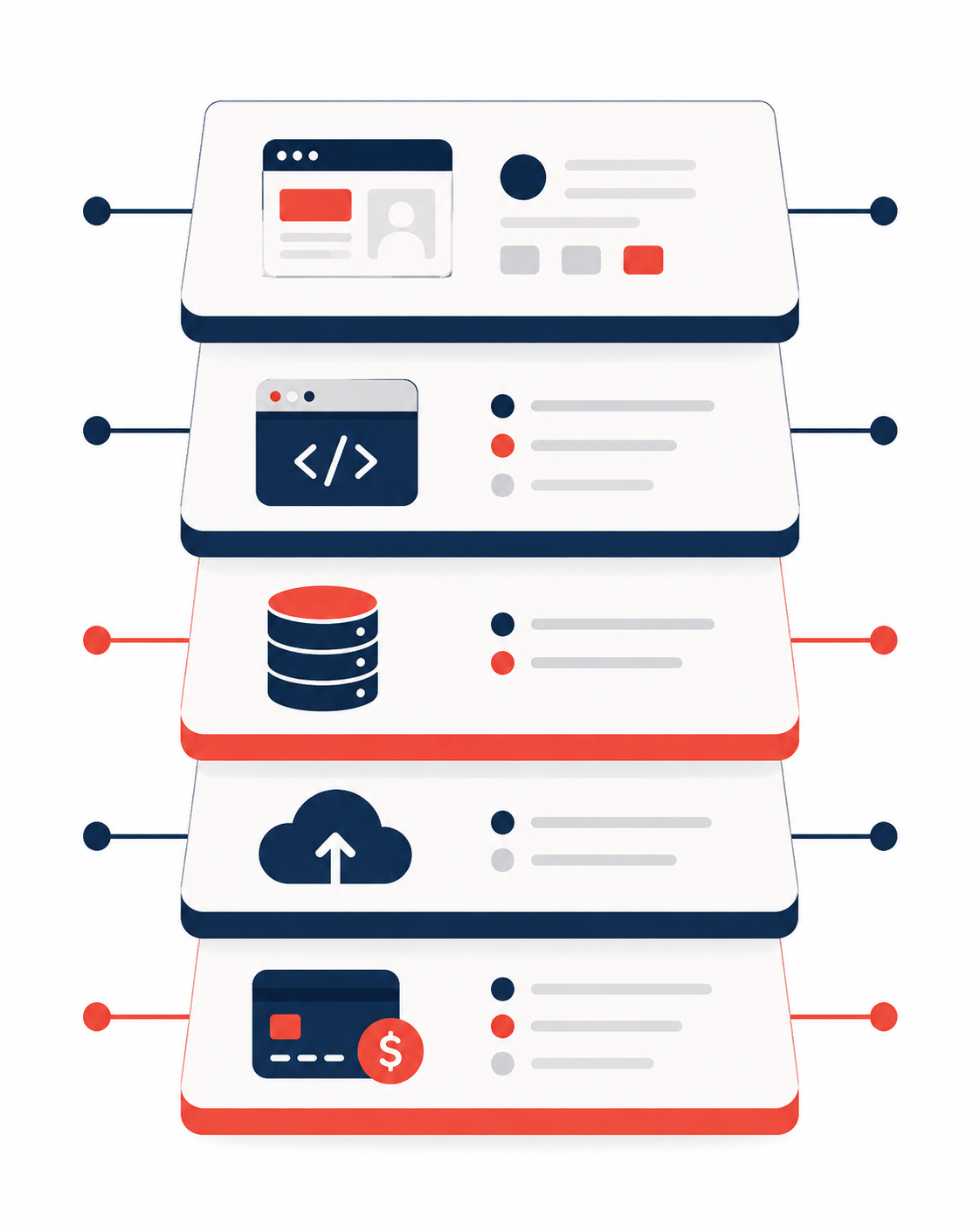
- Frontend — The screens customers see and interact with.
- Backend — The application logic that runs behind those screens.
- Database — Where application and customer data is stored.
- Authentication and authorization — Controls who can access the product and what they can do.
- Multi-tenant architecture — Allows multiple customers or organizations to use the application while keeping their data appropriately separated.
- Billing — Manages plans, subscriptions, payments, and entitlements.
- Cloud infrastructure — Hosts the application and supporting services.
- Integrations — Connects the product with payment, CRM, accounting, communication, AI, or other external systems.
- Analytics and monitoring — Helps founders understand product usage and system health.
- Security controls — Protects accounts, data, APIs, and infrastructure.
What Should Your SaaS MVP Include?
Your MVP should be the smallest version of the product that can deliver the core outcome to a real user.
For founders who need help turning an initial product concept into a focused first release, SaaS MVP development can cover product planning, UX/UI, core development, testing, and launch preparation.
It does not mean building a poor-quality product. It means limiting the number of problems you are trying to solve at launch.
For example, imagine you want to build a SaaS platform for freelance agencies.
A first release might need:
• Account creation
• Team/member management
• Project creation
• Task assignment
• Status tracking
• Basic notifications
• A simple dashboard
It may not need native iOS and Android apps, advanced AI features, ten different integrations, custom reporting, complex automation, enterprise SSO, or a large analytics suite on day one.
Those features can come later if customers demonstrate that they matter.
A useful prioritization framework is:
Must have — Without it, the core workflow does not work.
Should have — Useful for the first release but not essential to proving the idea.
Later — Valuable after you have evidence that users need it.
Not now — Interesting, but unrelated to the immediate product objective.
This protects the MVP from scope creep while leaving room for future releases.
Before development begins, founders should be able to answer five basic questions:
Who has the problem?
Identify the specific customer segment.
What problem are they experiencing?
Understand the workflow, frustration, risk, or cost you are solving.
How do they solve it today?
Look at existing software, spreadsheets, manual processes, or competing products.
Why would they switch?
Identify the practical advantage your product provides.
Will they pay for the solution?
Look for evidence of commercial demand rather than relying only on opinions.
Talk to potential users before finalizing the feature list. Ask how they currently complete the task rather than immediately asking whether they like your idea.
A useful product statement is:
We help [specific customer] solve [specific problem] by [core solution].
If the statement keeps expanding into several unrelated problems, your initial scope may be too broad.
What Is the SaaS Development Process?
A practical SaaS development process usually moves through:
Validate → Define → Design → Architect → Build → Test → Deploy → Measure → Improve
1. Validate the problem
Confirm that the target customer experiences the problem and that the proposed solution is worth pursuing.
2. Define the product
Turn the idea into user journeys, requirements, feature priorities, acceptance criteria, and an MVP scope.
3. Design the experience
Create information architecture, user flows, wireframes, and interface designs before development gets too far ahead.
4. Choose the architecture
Decide how the application, database, authentication, infrastructure, integrations, and tenant model will work together.
5. Build the product
Develop the frontend, backend, database, integrations, billing, admin functions, and agreed MVP functionality.
6. Test it
Test critical workflows, permissions, payments, integrations, performance, security controls, and user scenarios.
7. Deploy it
Move the application into production with monitoring, backups, deployment procedures, and recovery plans.
8. Measure real usage
Track activation, engagement, conversion, errors, and other product signals.
9. Improve based on evidence
Use customer feedback and product data to decide what should be fixed, removed, or built next.
How Should You Plan SaaS Architecture?
Architecture determines how the major pieces of your SaaS product communicate and how the system handles growth.
A typical web-based SaaS architecture may look like:
Frontend → API/backend → database
with supporting services for:
Authentication + billing + integrations + file storage + notifications + analytics + monitoring
You do not need the most sophisticated architecture on day one. You need an architecture that fits the current product and avoids unnecessary technical debt.
Monolith vs. microservices
For many first SaaS products, a well-structured monolithic application can be simpler to develop, deploy, test, and maintain.
Microservices can make sense when a product has specific scaling, team, or architectural requirements, but introducing them too early can add operational complexity.
The better founder question is:
What architecture gives us a reliable first product without creating an unnecessary maintenance burden?
| SaaS component | What it handles | Founder consideration |
|---|---|---|
| Frontend | Customer-facing screens and workflows | Usability and accessibility |
| Backend | Business logic and APIs | Reliability and maintainability |
| Database | Product and customer data | Structure, backups and access |
| Authentication | Login and identity | Security and account recovery |
| Billing | Plans and payments | Entitlements and failed payment |
| Cloud infrastructure | Hosting and supporting services | Reliability and scalability |
| Integrations | External systems and APIs | Dependencies and failure handling |
| Analytics | Product and business signals | Metrics that support decisions |
| Monitoring | Errors and system health | Detection and response |
What Frontend and Backend Does a SaaS Product Need?
The frontend is what customers interact with. It may include login and registration, dashboards, navigation, forms, tables, search and filters, account settings, billing screens, notifications, and responsive layouts.
The backend handles application logic that users do not see directly. It may manage user accounts, business rules, permissions, API requests, data processing, notifications, subscription state, integrations, background jobs, and audit events.
A polished interface does not compensate for unreliable business logic, and a strong backend does not help if users cannot understand the product.
How Should You Design the SaaS Database?
Depending on the product, the database may contain users, organizations, teams, roles, projects, transactions, subscriptions, usage records, customer settings, and audit records.
One important SaaS decision is how customer data is separated.
If multiple organizations use the same application, tenant identification and authorization need to be considered early rather than added as an afterthought.
What Cloud Infrastructure Does a SaaS Product Need?
A basic production setup may involve application hosting, database hosting, object storage, domain and DNS configuration, SSL/TLS, backups, monitoring, logging, CI/CD deployment, and environment management.
The goal is not to build an enormous infrastructure platform before launch. The goal is to make deployment repeatable and production failures recoverable.
How Should Authentication and SaaS Security Be Handled?
- Secure password handling or a trusted authentication provider
- Session management
- Role-based access control
- Tenant isolation
- HTTPS
- Input validation
- API authorization
- Secure secrets management
- Database backups
- Logging and monitoring
- Rate limiting where appropriate
- Dependency and vulnerability management
- Free trials where applicable
- Monthly or annual subscriptions
- Multiple plans
- Seat-based or usage-based pricing
- Upgrades and downgrades
- Cancellations
- Failed payments
- Invoices and refunds
- Subscription entitlements
How Do SaaS Subscriptions and Billing Work?
Authentication answers who the user is. Authorization answers what that user is allowed to do.
These are different problems. Two employees may both be logged into the same SaaS application but have completely different permissions.
Security should be considered from the beginning, including authentication, authorization, tenant isolation, encryption, backups, access control, logging, API security, and dependency management.
Compliance requirements depend on your customers, geography, industry, data, and business model. Healthcare, financial, education, and general productivity products can have different requirements. Identify relevant obligations before architecture and data-handling decisions are finalized.
Billing is also more than connecting a payment button. The application needs to understand what subscription status means for customer access.
For example:
Payment active → paid features available
Payment failed → follow billing recovery rules
Subscription cancelled → determine when access ends
Plan upgraded → update entitlements
Define these rules before implementing billing.
Which Integrations Should You Build First?
Integrations can add significant development complexity because your product becomes dependent on another system's API, authentication model, data structure, rate limits, and availability.
Common integration categories include payment providers, email platforms, CRM systems, accounting software, communication tools, analytics platforms, cloud storage, identity providers, and AI APIs.
Before adding an integration, ask:
1. Is it required for the MVP?
2. How many customers actually need it?
3. Does the provider have a stable API?
4. What happens when the API is unavailable?
5. How will authentication credentials be stored?
6. What data moves between the systems?
7. What happens if synchronization fails?
If an integration is not necessary to prove your core product, consider moving it to a later release.
How Should You Test a SaaS Product?
Testing should happen throughout development, not only at the end.
Consider functional testing, user-flow testing, permission testing, billing testing, integration testing, performance testing, and security testing.
A useful launch criterion is:
The critical customer journeys work reliably, known risks are documented, and the team has a process for handling issues after launch.
How Do You Deploy a SaaS Product?
Before launch, check production configuration, domain and SSL, database migrations, backups, authentication, billing, email delivery, integrations, error monitoring, analytics, logging, admin access, and rollback procedures.
For a first launch, a controlled rollout can be useful. You can begin with a smaller group of users, observe the product in real conditions, fix important issues, and then expand access.
What Analytics Should a SaaS Product Track?
Depending on the SaaS model, useful signals may include sign-ups, activation, trial starts, trial-to-paid conversion, feature usage, engagement, subscription changes, churn, revenue, errors, and support issues.
Do not install dozens of analytics events simply because you can. Start with events that answer important product questions such as:
Where do new users stop?
Which feature is used most?
How many trial users reach the core value of the product?
Which workflow causes users to contact support?
Good analytics should help you decide what to build next.
How Much Does SaaS Development Cost in 2026?
- Simple MVP — Directional planning range: $30,000–$55,000; example timeline: 5–8 weeks
- Standard SaaS platform — Directional planning range: $55,000–$140,000; example timeline: 8–16 weeks
- AI-powered SaaS — Directional planning range: $140,000–$300,000+; example timeline: 3–6 months
- Discovery — Problem, users, requirements and scope
- Product design — User journeys, wireframes and UI
- Architecture — Data model, infrastructure and security
- Development — Frontend, backend and integrations
- QA — Functional, permission, integration and regression testing
- Launch — Production setup, monitoring and rollout
- Post-launch — Fixes, feedback and next-release planning
The best way to control development cost is usually to reduce unnecessary scope while protecting the core customer outcome.
How Long Does SaaS Product Development Take?
There is no single SaaS development price. Cost depends on scope, design requirements, architecture, integrations, security requirements, data migration, team structure, and testing.
The ranges above are directional planning examples, not universal market prices or guaranteed project quotes. A real estimate requires a defined scope.
Two products can both be called SaaS MVPs while having very different requirements. One might need one user type, one core workflow, basic authentication, and a simple dashboard. Another might require multiple organizations, complex permissions, subscription billing, several integrations, data migration, AI functionality, and advanced reporting.
Development cost can increase with:
• More user roles
• Complex workflows
• Multi-tenant requirements
• Data migration
• Third-party integrations
• Advanced billing
• AI functionality
• Mobile applications
• Enterprise authentication
• Compliance requirements
• Advanced reporting
• Complex automation
The best way to control development cost is usually to reduce unnecessary scope while protecting the core customer outcome.
Development timelines depend on the same factors. Avoid choosing a timeline before defining what “done” means. A shorter timeline with undefined scope can simply mean that testing, documentation, integrations, or important requirements have been pushed outside the estimate.
What SaaS Development Team Do You Need to Build an MVP?
You do not necessarily need a large team to build your first product. A focused team may include a product lead or founder, product/UI designer, frontend engineer, backend engineer, QA engineer or tester, and technical or project lead.
Some responsibilities can be combined depending on project size.
The right team size depends on the product's scope, technical complexity, timeline, and level of support required. When planning the budget, evaluate the skills and responsibilities required rather than focusing only on headcount.
What Happens After the SaaS Product Launches?
Launch is the beginning of the product lifecycle, not the end of development.
Monitor application errors, infrastructure health, security issues, customer feedback, feature adoption, billing problems, performance, support requests, and product analytics.
A useful post-launch cycle is:
Measure → Learn → Prioritize → Build → Test → Release → Measure again
Ongoing work may include security updates, dependency updates, bug fixes, infrastructure maintenance, backups, monitoring, performance improvements, API changes, customer support, and new features.
What Are the Most Common SaaS Development Mistakes?
1. Building before validating the problem
Validate the workflow and customer demand before committing to a large build.
2. Making the MVP too large
Protect one core customer outcome.
3. Treating architecture as an afterthought
Consider multi-tenancy, permissions and billing before development is too far along.
4. Leaving billing until the end
Define billing and entitlement rules early.
5. Ignoring onboarding
Design the first-use experience as part of the product.
6. Measuring everything except the important things
Track events connected to activation, usage, conversion, retention, and business outcomes.
7. Forgetting what happens after launch
Include monitoring, support, security updates, and future development in the operating plan.
When Should You Hire a SaaS Development Company?
You can build with an internal team, independent developers, a development partner, or a combination of these models.
If you are considering an external development partner, the SaaS development service provides information about product discovery, SaaS architecture, subscription billing, authentication, QA, launch, and source-code handover.
A development company can be useful when you need multiple product, design, engineering, and QA capabilities without building the entire team internally.
Consider an internal team when you already have technical leadership, software is central to the long-term organization, continuous in-house development is expected, and you are prepared to recruit and manage engineering talent.
Consider an external development partner when you need to move from idea to MVP without building a complete team first, need product, design, engineering and QA capabilities together, lack sufficient technical leadership internally, or want an external team to own a defined delivery scope.
A hybrid model can also work. A founder or internal product lead can own product decisions while an external team handles design and engineering.
Before evaluating a development partner, ask:
• Who will actually build the product?
• Have they built SaaS products with similar requirements?
• How do they handle multi-tenancy?
• How are permissions designed?
• How is billing implemented?
• Who owns the source code?
• What happens when the scope changes?
• What does QA include?
• What happens after launch?
• What documentation and infrastructure handover will you receive?
If you are specifically comparing providers serving the US market, see the SaaS development companies in the USA comparison guide. That article serves a different purpose: this guide explains how to build a SaaS product, while the comparison article helps readers evaluate who might build it.
SaaS Development Founder Checklist
Before development begins, make sure you can answer:
Product: What problem are we solving? Who experiences it? What is the core value? What is outside the MVP?
Users: Who is the primary user? What roles exist? What can each role see and do?
Architecture: Will the product be multi-tenant? How will customer data be separated? Which integrations are essential?
Security: How will authentication and authorization work? What data needs protection? What backup and recovery process is required?
Revenue: What is the pricing model? What happens when customers upgrade, downgrade or cancel?
Launch: What are the critical workflows? What needs to be tested? How will errors be monitored?
Post-launch: Who handles maintenance? How will feedback be collected? Which metrics determine whether the product is working?
Frequently Asked Questions About SaaS Development
What is SaaS development?
SaaS development is the process of designing, building, deploying, and maintaining software that customers access as an online service.
How much does it cost to build a SaaS product in 2026?
There is no universal price. Cost depends on scope, architecture, integrations, security requirements, design complexity, data migration, AI functionality, team structure, and testing.
How long does it take to build a SaaS MVP?
A focused MVP can take substantially less time than a mature SaaS platform, but the timeline depends on scope and technical requirements.
What should a SaaS MVP include?
The smallest set of functionality needed to deliver the product's core customer outcome, along with the foundational authentication, data, permission, and security requirements the product needs.
Should a SaaS MVP be multi-tenant?
If multiple organizations will use the same application while keeping their data and permissions separated, multi-tenancy should be considered during architecture planning.
What technology stack should I use?
There is no single best stack for every SaaS product. The appropriate technologies depend on requirements, team expertise, integrations, workload, security, and maintenance needs.
Do I need billing in the MVP?
If customers are expected to pay for the initial product, billing and subscription entitlements should be considered part of the MVP architecture.
What should I do after launching my SaaS?
Monitor errors, security, infrastructure, billing, user behavior, support requests, and product analytics, then use those signals to prioritize the next release.
Should I hire a SaaS development company?
It depends on your internal capabilities, product complexity, timeline, budget, and long-term engineering plans.
Final Takeaway
Building a SaaS product is not about putting as many features as possible into version one.
It is about turning a validated customer problem into a focused product, building the technical foundation correctly, launching it safely, and using real customer behavior to decide what comes next.
Validate the problem → define the MVP → design the user journey → plan the architecture → build the core workflow → secure and test it → launch → measure → improve.
Your first release does not need to contain everything you eventually want the company to become. It needs to solve one important problem well enough that real users can use it, evaluate it, and tell you what should happen next.