Skip to content
§
§ · services · trading software

Custom Trading Software Development Services

Custom trading software is built for one firm's way of trading: the screens, price feeds, order handling, risk checks and records that a packaged platform does not fit. We build the web and mobile apps, dashboards and broker integrations around it. We have not shipped a trading platform yet, and this page says plainly what that means for you.

§ 01 · the short answer

What trading software does, in plain terms

Custom trading software development means designing and building the software that shows market prices, takes orders, checks them against limits, passes them to a broker or venue and records everything that happened. It is shaped around one firm's customers, instruments and rules, where a packaged platform would make the firm work the vendor's way.

For most buyers it is not an exchange or a broker. It is the product a broker sits behind: an investing app on a broker-dealer's API, an order screen for a small desk, a research and backtesting tool, or a dashboard that gathers positions from several accounts. The registered firm executes the trade and holds the account; the custom software decides what the customer sees and what reaches that firm.

Who asks for it

  • Founders of investing or trading apps, who need the app and its connection to a broker that holds the customer accounts.
  • Registered investment advisers and wealth teams, who want clients to see holdings and activity in one signed-in place.
  • Active traders and small trading teams, who want their own screens, alerts and research tools instead of a broker's defaults.
  • Broker-dealer operations and compliance staff, who need review queues, exception reports and exports their packaged systems lack.

What we have and have not built

§ 02 · what gets built

Seven kinds of trading software, and where we fit

Firms that sell this work describe roughly the same product families. Here are seven of them side by side, with what each one leans on and a straight answer on whether our team should be the one to build it.

Seven kinds of trading software: what each does, what it depends on, and whether Digital Heroes is a fit to build it
ProductWhat it doesDepends onFit for us
Investing or trading appAccount screens, quotes, an order ticket, a portfolio and statements, on the web and on phonesA registered broker-dealer's API, which holds the accounts and executesYes: the app and its broker integration
Trading dashboard or portfolio trackerPositions, profit and loss, watchlists and alerts gathered from one or more accountsBroker APIs and a licensed market data feedYes
Order management systemOrders tracked from entry through routing, partial fills, amendments and allocationBroker APIs or FIX sessions, plus your firm's compliance rulesOn a broker's API, yes; direct FIX links to venues only with a FIX specialist on the team
Algorithmic trading and backtestingRules tested on historical data, run on paper accounts, then allowed to place ordersClean price history, a broker API, and registered people where FINRA rules applyResearch and backtesting tools, yes; the strategy itself stays yours
Risk and surveillance toolsLimit dashboards, alert review queues and exports for compliance staffOrder and trade records from the broker-dealer's systemsYes for review queues and reports; the broker-dealer's own pre-trade controls stay with it
Back office and client reportingStatements, trade records matched against broker reports, and reports for clientsBroker statements and your own order recordsYes
Low-latency execution or matching engineOrders handled in microseconds on servers placed beside an exchangeCo-location, direct exchange feeds and systems languages such as C++No: that work sits outside the twelve stacks our bench covers

Read the third column first. Every product that touches a customer's order depends on a registered broker-dealer, either your own firm or a partner whose API you build on, and that dependency decides which rules in section 05 reach your software.

§ 03 · how it works

Inside a trading system: prices, orders and the broker link

Whatever the product, the same parts appear. Prices come in, people or rules decide, orders go out to a licensed firm, and fills and status messages come back to be recorded. Figure 1 draws that path and the line between the part a software team builds and the part the registered firm runs.

Diagram: how prices, orders and fills move through a custom trading product, and which parts a licensed broker-dealer runs Four bands from top to bottom. Market data: quotes and trades from a licensed feed. We build the product: screens and charts, an order ticket, strategy and alerts, and your own limits. We build the records: every order event with a time stamp, positions and profit and loss, and a daily match against the broker. A dashed scope line. A licensed firm runs these: the broker-dealer's pre-trade controls under Rule 15c3-5, routing to exchanges and venues, customer accounts and custody, and audit trail reporting. An arrow down the right side shows orders going down and fills and status messages coming back. Market data We build: the product We build: the records Quotes and trades from a licensed feed Screens and charts Order ticket Strategy and alerts Your own limits Every order event, time stamped Positions and profit and loss A daily match against the broker orders go down, fills and status come back Scope line A licensed firm runs these Pre-trade controls (Rule 15c3-5) Routing to exchanges and venues Customer accounts and custody Audit trail reporting (CAT)
figure 1 · the path of an order through a custom trading product
above the line: what a software team builds for you
below it: what the registered broker-dealer runs and answers for

Market data: what you show, and the terms for showing it

Prices arrive two ways: a snapshot you request, or a stream that pushes every change. Alpaca's market data API, for example, serves history over HTTP and live prices over WebSocket. Coverage matters as much as speed: on Alpaca's free plan, live US stock prices come from the IEX exchange alone, while its paid plan carries the consolidated CTA and UTP feeds, which Alpaca says cover all US exchanges.

The consolidated feeds carry each exchange's best quote and every reported trade. Exchanges also sell their own feeds with more detail, such as depth of book, as the SEC's 2010 concept release on equity market structure explains. Real-time data comes with licence terms, and the Consolidated Tape Association notes that most non-professional investors pay nothing because their brokerage includes the prices in its service.

Settle which data you need, for which users, before design starts. Then three habits keep it honest in the software: mark a quote as stale when its stream goes quiet, rebuild the screen from a fresh snapshot after any reconnect, and never let the order ticket fill in a price from data that has gone stale.

Orders: a lifecycle, not a button

An order changes state many times after the tap. Alpaca's order documentation lists more than a dozen statuses, from accepted and new, through partially filled, replaced and pending cancel, to filled, expired or rejected. Your system has to record each change, show it to the customer, and never assume an order is dead because a message is late.

The hard case is a dropped connection. If the app resends an order it cannot confirm, the customer may buy twice. The safe design gives every order an identifier your own system creates, asks the broker for that order's status after a reconnect, and sends nothing again until it knows. Duplicate orders are among the errors a broker-dealer's controls must reject under SEC Rule 15c3-5, and a second guard on your side costs little.

The broker link: APIs, sockets and FIX

Retail and small-desk products usually connect through a broker's API. Alpaca's trading and data APIs use HTTP requests and WebSocket streams. The Interactive Brokers TWS API is a TCP socket protocol that runs through its Trader Workstation or IB Gateway software, and the broker supplies code for it in Python, Java, C++, C# and Visual Basic.

Institutional order flow tends to travel over FIX, which the FIX Trading Community, an independent non-profit standards body, publishes as open, technology-neutral specifications for electronic trading and trade processing.

Each broker's sandbox or paper account is where an integration is proved. Alpaca's paper trading is free and fills simulated orders against live quotes, but Alpaca lists what it leaves out: market impact, information leakage, slippage caused by latency, queue position for resting limit orders, price improvement, regulatory fees and dividends. A strategy that wins on paper can still lose with real money.

§ 04 · latency

How fast it has to be, product by product

Speed is the question buyers raise first and, for most products, the one that matters least. A person reading a screen needs fresh prices and a quick confirmation. A strategy running on a broker's API is bound by that API's round trip.

Only the fastest firms work at the scale the SEC described in its 2010 concept release: traders who measure latency in microseconds, and co-location, where a trading center rents rack space close to its matching engine.

Four kinds of trading product, who is waiting on each, what sets its speed and what that speed takes
ProductWho is waitingWhat sets the speedWhat it takes
Investing app or dashboardA person reading a screenThe price stream and the broker's order confirmationOrdinary cloud hosting, a WebSocket stream and careful screen updates
Alerts and research toolsA person, seconds or minutes laterHow often data is fetched and the rules runScheduled jobs and a queue
Strategy on a broker APISoftwareThe broker's round trip, plus your own processingHosting near the broker's servers, short code paths, and nothing on the order path that could wait
High-frequency tradingSoftware racing other softwareMicroseconds, by the SEC's 2010 accountCo-located servers, direct exchange feeds and systems languages; not our work

If a vendor quotes you microsecond engineering for an investing app, ask what it buys your customer. If you truly need it, our team is the wrong choice, and that is better said here than after a discovery sprint.

§ 05 · compliance

SEC and FINRA rules that shape the software

Most trading rules bind the registered firm, not the developer, yet they decide what the software must record, block and show. Below are nine that a US securities product may run into, each summarised from the regulator's own text and linked to it. The final column is how we would translate the rule into features; it is engineering judgement, not legal advice, and your compliance counsel decides.

Nine SEC and FINRA rules a US trading product may meet: who each binds, what it requires, and what it means for the software
RuleWho it bindsWhat it requiresWhat it means for the build
Broker-dealer registration, Exchange Act Section 15(a)Anyone in the business of effecting securities transactions for the account of othersRegistration with the SEC, with exceptions; membership of a self-regulatory organization, which means FINRA for any over-the-counter business; and SIPC membership, with narrow exceptionsAn app that takes customers' orders runs on a registered broker-dealer, your own or a partner whose API you build on
SEC Rule 15c3-5, market accessBroker-dealers with market access, or that give customers accessControls that reject orders over preset credit or capital limits, outside price or size bounds, or duplicated; block restricted securities; limit access to approved people; send surveillance staff immediate post-trade reports; annual review and CEO certificationThose controls stay under the broker-dealer's direct and exclusive control, so your app must treat a rejection as normal and show the reason
FINRA Securities Trader registration, Notice 16-21Associated persons of FINRA membersSince 30 January 2017, whoever is primarily responsible for designing, developing or significantly changing an algorithmic trading strategy in equity, preferred or convertible debt securities registers as a Securities Trader and passes the Series 57Someone at the member firm answers for each strategy; settle with counsel how this applies to code an outside team writes
FINRA Notice 15-09, algorithmic trading supervisionMembers using algorithmic strategies (guidance, March 2015)Significant testing in a development environment kept apart from production, testing for fast or adverse markets, a way to disable an algorithm in a few steps, and tracked changes reviewed with their test resultsA separate test environment, a kill switch, and a change log tied to test runs, all from the first release
FINRA Rule 4590, clock synchronizationFINRA membersComputer clocks that record events in NMS securities, listed options and OTC equity securities kept within 50 milliseconds of the NIST atomic clock, others within one second; synchronized each business day before the open; a log of results keptServers that stamp order events need synchronized clocks and a record of each synchronization
Consolidated Audit Trail, SEC Rule 613FINRA members that receive or originate orders in NMS stocks, OTC equity securities or listed optionsReporting under the FINRA Rule 6800 series to an audit trail that collects every order, cancellation, modification and trade execution; the SEC adopted Rule 613 on 11 July 2012Your order event log must hold every event the broker-dealer needs to report, with its time stamp
SEC Rule 17a-4, electronic recordsBroker-dealersElectronic records kept in a non-rewriteable, non-erasable format, or, since amendments effective 3 January 2023, in a system that can recreate an original record after it is modified or deletedOrder history written as new entries, never edited in place, so any earlier state can be rebuilt
Regulation Best InterestBroker-dealers recommending securities to retail customers (adopted June 2019)Act in the retail customer's best interest without putting the firm's interests first, and use reasonable diligence, care and skill in each recommendationA feature that suggests trades or portfolios carries this weight; name it in discovery, not after launch
FINRA Notice 24-09, generative AIFINRA members using generative AI (June 2024)A reminder that FINRA rules apply when firms use AI; supervision under Rule 3110 and the communications standards of Rule 2210 cover what an AI tool producesAn AI feature needs a supervisor's view of what it said, and the same review as any customer communication

Two consequences surprise founders. First, the broker-dealer behind your app keeps its market access controls in its own hands, so the product you commission adds limits of its own but never replaces the firm's. Second, a trading algorithm built for a FINRA member is the work of a registered person there, which changes who on your side must review and sign off each strategy.

Digital Heroes is a software firm, not a broker-dealer or an investment adviser, and this page claims no FINRA registration, SOC 2 report or ISO 27001 certificate for us. If any vendor claims an audit report, ask for the auditor's name, the period covered and the systems in scope before you count it.

§ 06 · our part

What we can build for a trading product today

Most of a trading product is the same engineering as any serious web or mobile app, and that part runs on stacks our in-house bench already covers. Here is that part, then the part we would hand to a specialist.

  • Web apps and dashboards: Next.js and React screens for quotes, order tickets, positions and statements, updated from a price stream.
  • Mobile apps: React Native, so one codebase serves iOS and Android; AirTrainr's athlete and trainer apps are built with it and Expo.
  • Broker and data integrations: Node.js services that keep API keys on the server, never in the app, and write the order event log from section 03. Our API integration work covers the general case.
  • Records, roles and approvals: PostgreSQL on Supabase with row-level security, so an adviser sees only their own clients and a trader only their own accounts, plus a change history that names the person and the time behind every edit.
  • Subscriptions and payments: billing for a paid tier through a payment provider whose webhooks are matched against your records, as in SpeedyPrint's checkout. Money in a brokerage account moves through the broker; Alpaca's Broker API, for one, documents its own ACH funding.
  • Research and backtesting tools: Python for loading price history, testing rules and reporting results, kept apart from anything that places live orders.
  • AI features that stay supervised: an assistant that answers questions about a customer's own account, and drafts that a person checks before anything is sent. We built and run the chat assistant on this site, and the copilot in our own CRM works the same way, writing first replies our team reviews.

What we would bring a specialist in for, or decline

  • Direct FIX connections to exchanges and venues. FIX is not among the twelve stacks our bench covers, so we would add an engineer who has run FIX connections in production, or build on a broker's API instead.
  • Co-located, low-latency execution. Not our work, for the reasons in section 04.
  • The broker-dealer's own role: its market access controls, custody of customer assets and regulatory reporting.
  • Legal and compliance opinions. Those belong to your counsel and compliance officer, who should sit in discovery.

Divyansh Singh, our CTO and the author of this page, sets the architecture of every build we take on, including what we write ourselves and what we buy.

§ 07 · proof

Proof from other industries, and the case we lack

There is no trading build in our portfolio yet. The three client builds below, which their owners let us show and which we describe without any results figure, solved problems a trading product also has. Under each is the parallel, so you can judge how close it really is.

client build · 2026 · planivo.me

Planivo: permissions, layered approvals, a full history

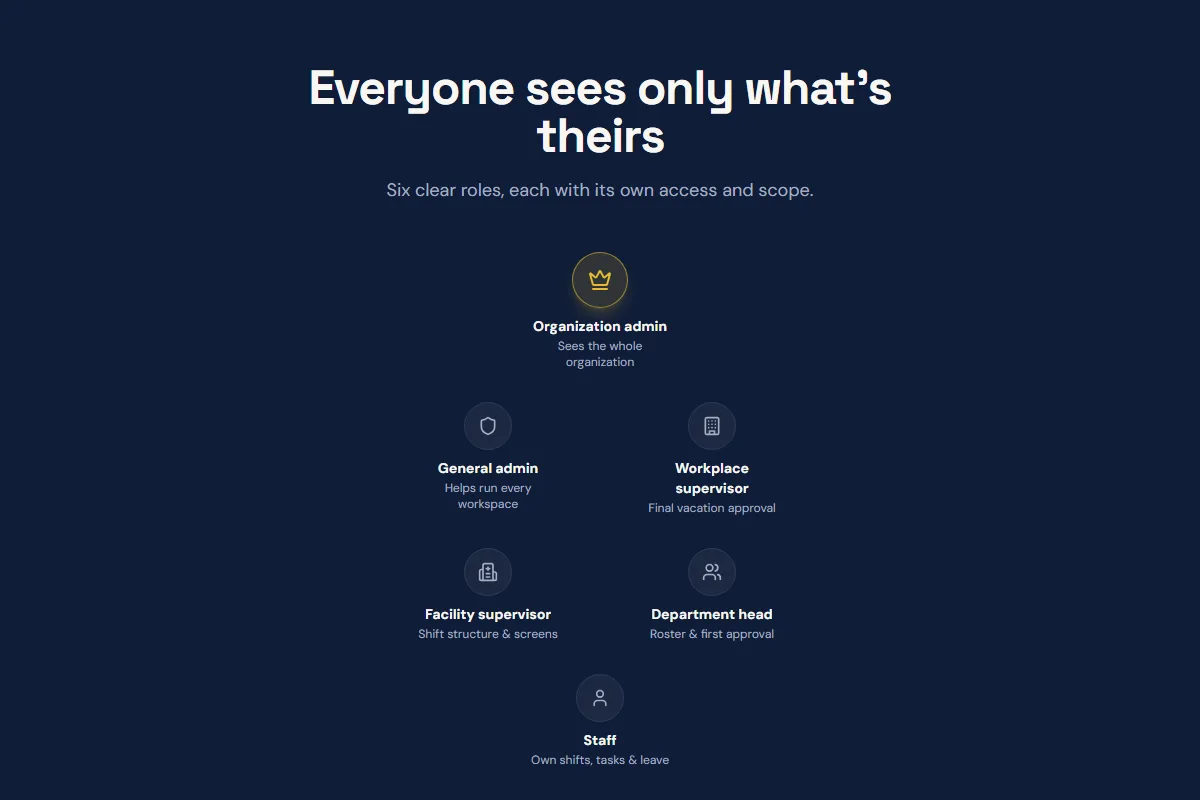
Planivo plans the working month for clinics and hospitals. The whole product is our 2026 build, from the staff workspace to the marketing site. A vacation request climbs three approval levels while a check flags clashes within the same speciality, six roles each stay inside their own scope, and an audit history keeps every change.

The trading parallel: who may trade which account, which orders wait for a supervisor, and a record an examiner can follow from start to finish.

Planivo's public page setting out its six roles and the order in which a leave request is approved, from department head to workplace supervisor
How Planivo's public site lays out its roles for buyers; the same idea limits who may act on an account in a trading product.
client build · 2026 · South Africa

SpeedyPrint: order states set by another company's messages

For SpeedyPrint, a print shop selling online in South Africa, we wrote the store in 2026 with Next.js 15, React, TypeScript and Supabase. Every order carries its status history from proof through to production files, PayFast tells the store about each payment by webhook, and the admin panel splits staff into three roles.

The trading parallel: a broker reports fills and cancellations the same way, as messages your system must apply in order and match against its own records.

client build · airtrainr.com

AirTrainr: two mobile apps on one backend

AirTrainr's athlete app and trainer app are both our work: React Native and Expo on the phone, Supabase on the server. An athlete searches, books and responds to offers, a trainer keeps a calendar, makes offers and tracks earnings, and messages and notifications pass between the two.

The trading parallel: two kinds of user, say an investor and an adviser, each in their own app, working from the same records and acting on notifications.

We also built, and run, the AI chat assistant on this site and the CRM copilot behind it. Our Clutch profile shows 5.0 from 66 verified reviews (checked 13 October 2026).

§ 08 · choosing a builder

How to evaluate a trading software builder

Send each shortlisted firm the same questions and judge the answers against the middle column. Our own answers are in the last column, including the ones that count against us.

Eight questions for any trading software vendor, what a good answer includes, and Digital Heroes' own answer today
AskA good answer includesOur answer today
Which trading product have you shipped, and can I use it?A live product or a sandbox you can click through, and a client you can callNone yet. The nearest work is in section 07
Which broker and data APIs have you integrated?Named APIs, and the failures each one threw in productionNo trading APIs yet; we have integrated payment webhooks and Supabase backends, and would prove a broker's API on its sandbox first
What happens to an order when the connection drops?Order IDs created on your side, a status check with the broker on reconnect, and no blind resendThat design, as set out in section 03
What does the screen do when prices stop arriving?Stale quotes marked, and the order ticket warns or locksBoth, built in from the first release
Where do the pre-trade checks live?The broker-dealer's controls stay in charge; the app adds its own limits on topThe same, in line with Rule 15c3-5
How do you test before real money moves?A test environment kept apart from production, fast-market scenarios, paper accounts and a kill switchOur own QA staff test every build ahead of any preview; for trading we would add each item FINRA Notice 15-09 lists
Where do your engineers work, and who can reach production?Named locations, and access you grant and can removeEngineering is in Delhi and Lucknow, plus some mobile engineers in Sydney, working as collaborators on accounts you hold and can remove them from. New York, our headquarters, answers on weekdays between 9 AM and 6 PM Eastern, the same day
Who owns the code and the strategy?You, in writing, with repositories in your name from the startYou: our MSA assigns the project's code to you on full payment, and we keep only tooling that predates your project or was made for reuse

Should your policy, or your broker partner's, demand that all engineers sit in the US, pick another firm; our list of US software development companies notes where each one builds. Contract terms, support after launch and the rest are on our company page.

§ 09 · cost and time

What a trading build costs, and how long it takes

We quote $40,000 to $150,000 for a focused first version of custom software, and $250,000 to $500,000 or more for complex enterprise platforms. We have not priced a trading platform yet, so read those as our general bands, not a trading quote. Where your build lands depends on the six drivers below, and market data plans and any broker platform fees come on top and recur.

Six things that move the cost of custom trading software, and how to contain each
DriverWhy it moves the costHow to keep it down
Market dataCoverage, depth and who may see the prices each change the plan and its licence termsStart with the coverage your first users need, and upgrade when they need more
Brokers and venues connectedEach one brings its own order states, errors, sandbox and onboardingLaunch on one broker, and add a second only when customers ask for it
Order types and failure handlingEvery order type multiplies the states to record, test and showShip market and limit orders first; add the rest once those are proven
Compliance evidenceEvent logs, synchronized clocks, retained records and exports are features with their own testsList the rules that apply in discovery, using section 05
Testing and the paper periodFast markets, outages and partial fills must be staged, not waited forWrite the failure scenarios down before the build starts
Mobile appsPhone apps add screens, store releases and push notificationsOne React Native codebase rather than two native apps

How the money is committed: a free 30-minute call, then a written scope and quote within two days. Next comes a two-week discovery sprint, priced separately, which ends in a fixed price for the build or in our advice to buy something off the shelf. From around day 15, work proceeds in one or two week sprints, with a recorded demo of working code every week.

For a trading product we would add two steps. Bring whoever owns compliance into discovery, because the rules in section 05 shape the data model. And plan a period on paper or sandbox accounts, then a launch with low limits, before customers' real money flows through it.

Want a rough number before any call? Our free cost calculator gives a planning range, and the custom software cost guide breaks a budget down line by line.

§ 10 · questions

Quick answers before you commission a trading build

How do I create my own trading software?

Start with the job, not the platform: who will use it, which instruments, and whether it places real orders. Pick a broker or data provider whose API covers that, prove the connection on its sandbox or paper account, and build the smallest product that places and tracks an order correctly. If it takes other people's orders, a registered broker-dealer must stand behind it; section 05 lists the rules.

What is custom software development?

It is software designed and built for one organization's own users and rules, instead of a licence to a product made for everyone. A project moves from discovery and a written scope, through design, coding and testing, to launch and then either ongoing support or a handover. Our page on custom software development services covers it in general; this page covers the trading case.

Can I use ChatGPT for trading?

For research, summaries and help with code, a chatbot can save time, but do not treat its output as a signal. A January 2024 investor alert from the SEC's investor education office, NASAA and FINRA says not to rely solely on AI-generated information for investment decisions, and warns of unregistered platforms selling AI trading systems with unrealistic claims. Firms that use generative AI remain bound by FINRA's rules.

How much does trading software cost?

We have not priced a trading platform yet. Our bands for custom software are $40,000 to $150,000 for a focused first version and $250,000 to $500,000 or more for complex enterprise platforms. Market data plans and any broker platform fees are separate and recur. We fix the build price at the end of a two-week discovery sprint, and the cost section lists what moves it.

How long does it take to build a trading platform?

Our first fortnight is discovery; sprints of one to two weeks follow from about day 15, each week closing with a recorded demo. How many sprints depends on scope, which is why any date offered before discovery, ours included, is a guess. For a trading product, also budget time on paper or sandbox accounts before the first live order.

Do I need a broker-dealer license to launch a trading app?

In the US it is called registration, and someone in the chain needs it if the app effects securities transactions for customers. The SEC's guide says a person in the business of effecting transactions for others must generally register, and must also join a self-regulatory organization such as FINRA. Many apps meet this by building on a registered broker's API rather than registering themselves. Your counsel decides which route fits.

Which integrations should a trading platform plan first?

Three, in this order. The broker or execution API, because its order states and limits shape everything else. The market data feed, because its plan decides what customers may see. Then account opening and identity checks, which some broker APIs, Alpaca's Broker API among them, offer as part of their service. Subscription billing and notifications can follow.

Who owns the code and the trading strategies?

You do. Our MSA hands you the rights to the code written for your project when the last invoice is paid; we hold on only to tooling that existed before it or was made for reuse. The repositories and cloud accounts are held in your name from the start. The strategy logic is yours too, so share its details after the one-page mutual NDA we sign when a scoping call is booked.

Last reviewed .

§ 11 · next step

Tell us what the product must do on its first day

Name the users, the broker you plan to build on and the first order your product must place correctly. Give us half an hour on the phone. Within two days you will have a written scope, a quote, and a straight answer on whether we are the right team for it.

Why work with Digital Heroes

Shopify Select Partner, as listed in the Shopify Partner Directory United Nations Global Marketplace Tier 1 registration Upwork Top Rated Plus status Trustpilot rating from verified client reviews DUNS registered business verification Clutch Top Web Designers 2024 listing GoodFirms verified development company listing DesignRush ranked agency listing Clutch Top 1000 Global B2B Companies listing

115 people across five studios in New York, Delhi, London, Sydney and Lucknow, shipping ecommerce, web, software and mobile work for founder-led brands. Senior engineers only, no account-manager relay, and the same team from kickoff to launch.

  • Shopify Select Partner, as listed in the Shopify Partner Directory
  • Tier 1 registered supplier on the United Nations Global Marketplace, which requires audited company documentation
  • Top Rated Plus on Upwork, the bracket for the top 3% of talent by client outcomes
  • 397 public five-star-weighted reviews across four Fiverr gigs, from clients in 36 countries
  • DUNS verified business, No. 650878346, so procurement can check us before signing
  • Listed by Clutch in Top 1000 Global B2B Companies and Top Web Designers 2024
  • Verified profiles on GoodFirms, DesignRush, Digital.com, AppFutura and TopDevelopers
  • 2,000+ brands built across 40+ countries, with $50M+ in client revenue scaled

Published .

Online now

Talk to a Developer Now

Reply