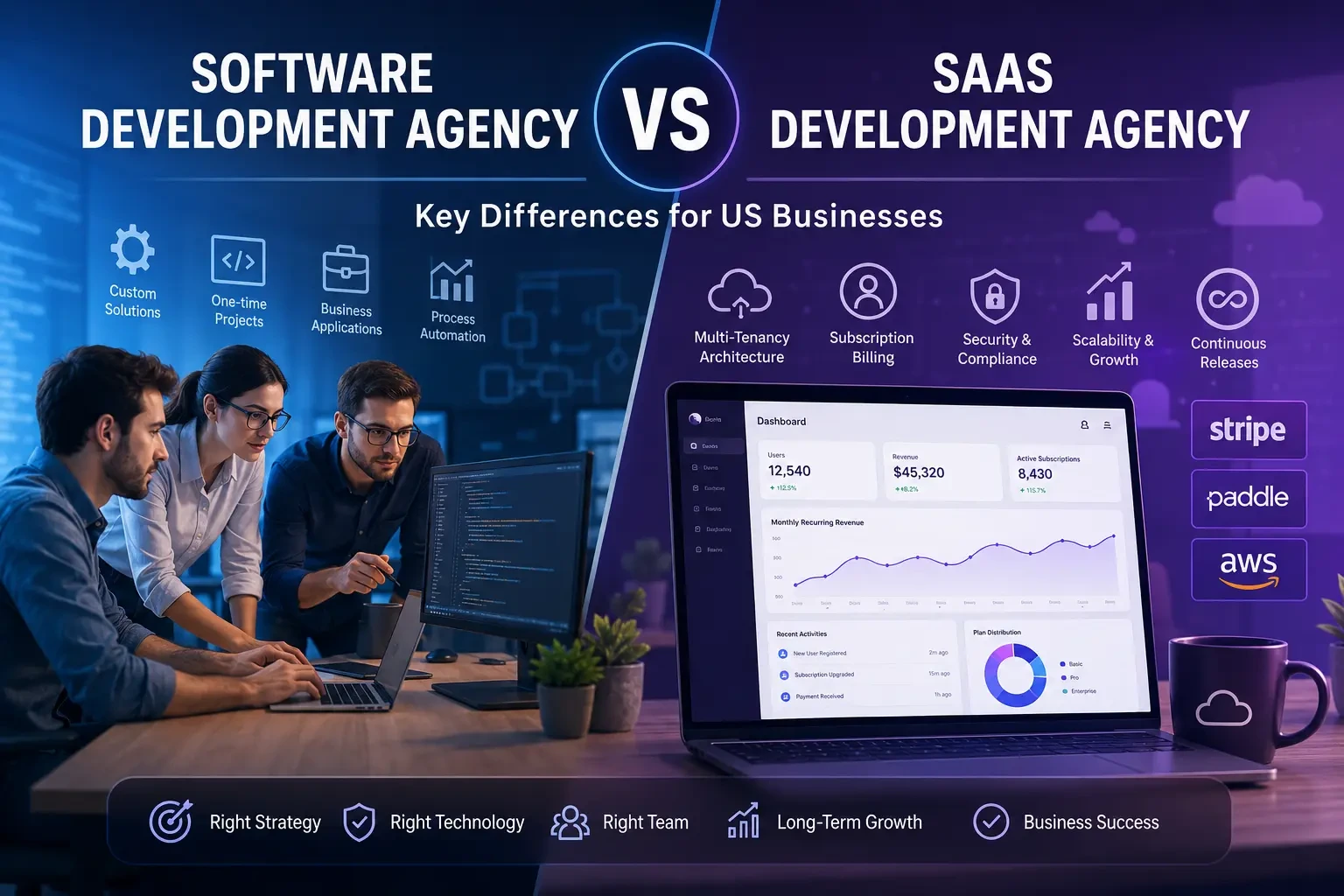
Choosing the right development partner can be difficult when agencies use similar language to describe their services.
A software development agency may offer custom software, web applications, mobile applications, APIs, enterprise systems, and SaaS development. A SaaS development agency may offer many of the same technical services while focusing specifically on software products delivered continuously to multiple customers.
The distinction is not simply the name of the agency. It comes down to what you are building, how the software needs to operate, how customers will use and pay for it, and what technical challenges the product must handle as it grows.
For a US business building an internal application, custom enterprise system, one-time business solution, or customer portal, a general software development agency may be the right fit. For a subscription-based product serving multiple customers from a shared platform, a SaaS-focused development agency may bring more relevant experience with multi-tenancy, subscription billing, self-service onboarding, continuous delivery, cloud infrastructure, and long-term scalability.
A SaaS development agency is not automatically better than a software development agency. The right choice depends on the product and whether the development team has proven experience with the architecture and operational requirements you actually need.
Quick Answer: Software Development Agency vs SaaS Development Agency
A software development agency builds a broad range of custom software products and business applications based on a client's requirements. A SaaS development agency focuses specifically on software products delivered as a service, often involving multiple customers, recurring subscriptions, cloud infrastructure, continuous product updates, and SaaS-specific architecture.
The key is not which label sounds better. The key is whether the agency has the experience your product requires.
| Factor | Software Development Agency | SaaS Development Agency |
|---|---|---|
| Primary focus | Custom software and applications | SaaS products and platforms |
| Typical products | Internal tools, portals, enterprise systems, web/mobile apps | B2B SaaS, subscription platforms, cloud applications |
| Multi-tenancy | Project-dependent | Often a core requirement |
| Subscription billing | Project-dependent | Common requirement |
| Self-service onboarding | Project-dependent | Often important |
| Scalability | Depends on the application | Usually a central architectural concern |
| Cloud infrastructure | Depends on the project | Usually important |
| Continuous releases | Depends on the product | Usually essential |
| Best fit | Broad software requirements | Subscription-based, multi-customer products |
What Is a Software Development Agency?
A software development agency is a company that designs, develops, tests, deploys, and maintains software applications for businesses or other organizations.
Because the term is broad, software development agencies can work on many different types of projects, from internal business tools to customer-facing applications and enterprise systems.
A general software development agency can also build SaaS products. The difference is specialization and demonstrated experience—not a strict technical boundary.
- Custom business software
- Web applications
- Mobile applications
- Enterprise systems
- Customer portals
- Internal business tools
- APIs and integrations
- Cloud applications
- Workflow automation
- Data platforms
- AI-powered applications
- Legacy software modernization
- Software maintenance and support
Common Services Offered by Software Development Agencies
- Custom software development
- Web and mobile application development
- API development and third-party integrations
- Enterprise software development
- UI/UX design
- Cloud development
- Data and automation solutions
- Maintenance and modernization
A general software development agency can also build SaaS products. The difference is specialization and demonstrated experience not a strict technical boundary.
What Is a SaaS Development Agency?
A SaaS development agency specializes in building Software as a Service products. Instead of creating software exclusively for one organization to use internally, SaaS products are generally designed to serve customers through an ongoing software service.
This means the development team needs to think beyond simply building features. The product may need to support multiple customers, recurring subscriptions, customer onboarding, permissions, data isolation, continuous releases, monitoring, and long-term scalability.
Common SaaS Development Services
- SaaS product discovery
- SaaS MVP development
- Multi-tenant architecture
- Subscription billing
- User authentication and authorization
- Customer onboarding
- API development
- Cloud infrastructure
- CI/CD and continuous deployment
- Monitoring and observability
- Security
- QA and automated testing
- Product analytics
- Ongoing product development
Software Development Agency vs SaaS Development Agency: 8 Key Differences
The biggest differences usually appear in architecture, customer management, billing, scalability, deployment, and the way the product is operated after launch.
A general software development agency can handle many of these requirements, but a SaaS-focused agency is more likely to have specialized experience with products that serve multiple customers continuously.
1. Product Architecture
A general software project may be designed around the needs of one organization or a specific group of users.
A SaaS product often needs architecture that supports multiple customers while keeping their data, users, configurations, and permissions appropriately separated.
This can make architectural decisions around tenancy, authentication, authorization, data isolation, APIs, and scalability particularly important.
2. Multi-Tenancy
Multi-tenancy means a single software platform can serve multiple customers or organizations while maintaining appropriate separation of their data and access.
Not every SaaS product uses exactly the same tenancy model, but multi-tenancy is a major architectural consideration for many subscription-based platforms.
When evaluating an agency, ask how it plans to isolate customer data, manage tenant-specific configurations, control permissions, and maintain performance as the number of customers grows.
3. Subscription Billing and Entitlements
A traditional business application may have little or no subscription logic.
A SaaS product may need recurring billing, subscription plans, upgrades, downgrades, trials, invoices, payment failures, cancellations, and feature entitlements.
Billing therefore should not be treated as simply adding a payment button. It can affect user management, access permissions, account status, and the overall product experience.
When evaluating a SaaS development partner, ask whether the team has experience integrating billing platforms such as Stripe, Paddle, or Chargebee and designing the related entitlement logic.
4. Customer Onboarding and Self-Service
Many SaaS products are expected to let customers sign up, create accounts, configure their workspace, invite users, choose a plan, and begin using the product with limited manual assistance.
This creates additional requirements around onboarding flows, account setup, permissions, billing, product configuration, and customer experience.
A SaaS-focused agency should be able to explain how these workflows will work and how they can evolve as the product grows.
5. Scalability Requirements
A business application may only need to support a defined number of users or a specific operational workload.
A SaaS product may need to support a growing number of customers, users, transactions, integrations, and data volumes without requiring a complete redesign.
This makes scalability an important architectural consideration from the beginning.
Ask the agency how the proposed architecture can evolve as customer demand increases. Look for practical answers around databases, APIs, infrastructure, caching, monitoring, and performance rather than vague promises of unlimited scale.
6. Cloud Infrastructure and DevOps
SaaS products commonly rely on cloud infrastructure and automated development and deployment processes.
Depending on the product, this can involve infrastructure management, CI/CD pipelines, monitoring, backups, logging, automated deployments, and strategies for handling increased demand.
A SaaS development partner should be able to explain how the application will be deployed, monitored, secured, and maintained in production.
7. Continuous Product Releases
A one-time business application may have a defined development and deployment cycle.
SaaS products are usually expected to evolve continuously through new features, improvements, security updates, bug fixes, and product experiments.
This means the development partner should be comfortable working beyond the initial launch and supporting an ongoing product roadmap.
8. Product Thinking and Long-Term Support
SaaS development requires thinking beyond whether the software works at launch.
The product also needs to remain usable, maintainable, measurable, secure, and commercially viable as customers and requirements change.
A strong development partner should therefore understand product analytics, customer feedback, maintenance, monitoring, feature improvements, and long-term technical decisions.
When Should You Choose a Software Development Agency?
A general software development agency may be the better starting point when you are building custom software for a specific business or organization and SaaS-specific architecture is not central to the product.
- Custom internal business software
- One-off applications
- Enterprise workflows
- Customer portals
- Business process automation
- Projects requiring broad software expertise
- Applications primarily used by one organization
When Should You Choose a SaaS-Focused Development Agency?
A SaaS-focused agency may be a stronger starting point when your product will serve multiple customers through a subscription or recurring-revenue model.
- Multiple customers will use the same platform
- Subscription revenue is central to the business model
- Multi-tenancy is required
- Customer self-service is important
- Continuous product releases are expected
- Scalability is a major concern
- SaaS-specific billing and entitlement logic is required
- Enterprise SaaS requirements are part of the roadmap
Does SaaS Development Cost More?
SaaS development can involve additional architectural and operational requirements, but SaaS does not automatically mean the project should cost more.
A small SaaS MVP can be simpler than a complex enterprise application.
The right way to compare proposals is to compare scope, architecture, team, deliverables, support, and long-term requirements rather than comparing the headline price alone.
For a broader breakdown of software development pricing, see our guide to Software Development Cost in the USA.
Which One Is Right for You?
| What You're Building | Better Starting Point | Notes |
|---|---|---|
| Internal business application | Software development agency | Custom business requirements |
| Custom enterprise workflow | Software development agency | Broad software expertise |
| One-off business software | Software development agency | Usually organization-specific |
| Customer portal | Either | Depends on requirements |
| Subscription web application | SaaS-focused agency | SaaS architecture may be central |
| B2B SaaS platform | SaaS-focused agency | Multi-customer product |
| Multi-tenant platform | SaaS-focused agency | Strong SaaS experience preferred |
| AI-powered SaaS | SaaS-focused agency | SaaS + AI experience preferred |
| Mobile + SaaS product | Agency with relevant SaaS experience | Mobile and SaaS expertise |
| Enterprise SaaS | SaaS/product engineering team | Enterprise SaaS experience preferred |
- Relevant SaaS Experience — Look for products similar in complexity to yours.
- Architecture Experience — Ask about multi-tenancy, data isolation, APIs, scalability, and infrastructure.
- Billing Experience — Check experience with Stripe, Paddle, Chargebee, or another relevant billing system.
- Cloud and DevOps — Ask about deployment, monitoring, infrastructure, backups, scaling, and CI/CD.
- Security — Ask about authentication, authorization, encryption, access control, audit logs, and security testing.
- QA — Ask how they test functionality, billing, permissions, tenant isolation, APIs, integrations, and performance.
- Product Thinking — Look for a team that understands usability, maintainability, measurement, and commercial viability.
- Post-Launch Support — Ask what happens after the initial launch.
Security:
Security is particularly important for SaaS products that store data for multiple organizations. Ask how authentication, authorization, encryption, access control, audit logging, secrets management, and security testing will be handled throughout development.
You can also ask how the team approaches application security testing and verification throughout the development lifecycle.
Red Flags When Choosing a SaaS Development Agency
- They Cannot Show Relevant SaaS Work
- They Treat Multi-Tenancy as a Checkbox
- Billing Is Treated as Just a Payment Button
- There Is No Scaling Strategy
- Monitoring Is an Afterthought
- No Clear Security Strategy
- No Clear Ownership of Architecture
- The Agency Focuses Only on Launch
- They Recommend Technology Without Explaining Why
- The Cheapest Quote Wins Automatically
Software Development Agency vs SaaS Development Agency: Decision Checklist
Choose a software development agency if you are building custom internal software, a one-off system, or a project requiring broad software expertise where SaaS-specific architecture is not central.
Consider a SaaS-focused agency if multiple customers will use the same platform, subscription revenue is central, multi-tenancy is required, customer self-service matters, continuous releases are expected, or SaaS-specific billing and entitlement logic is important.
Questions to Ask Before You Hire Either Type of Agency
About Experience
- Have you built a product similar to ours?
- Can you show relevant case studies?
- What technical challenges did you encounter?
About the Team
- Who will actually build our product?
- Who will make architecture decisions?
- Will senior developers be involved?
About Technology
- Why are you recommending this technology stack?
- How will the architecture support future requirements?
About SaaS Requirements
- How will multi-tenancy work?
- How will customer data be isolated?
- How will billing and entitlements work?
- How will onboarding work?
About Security
- How will authentication and authorization work?
- What security testing will be performed?
- How will data and secrets be protected?
About Ownership
- Who owns the source code?
- Will we receive documentation?
- Will we control our infrastructure and accounts?
About Post-Launch
- Who maintains the product?
- How are critical bugs handled?
- What happens when we need new features?
Software Development Agency vs SaaS Development Agency: A Practical Example
Business A: Internal Operations Platform
A US manufacturing company wants software for employee workflows, inventory management, internal reporting, approval processes, and ERP integration. The application will primarily serve employees within one organization.
Best starting point: Software development agency.
The project requires custom application development, integrations, security, and business workflow expertise.
Business B: Subscription Analytics Platform
A startup wants a platform where hundreds of businesses can create accounts, invite employees, connect data sources, view analytics, select subscription plans, upgrade or downgrade, manage billing, and use the platform continuously.
Best starting point: SaaS-focused development agency or a software agency with proven SaaS experience.
The project requires a stronger focus on multi-tenancy, billing, user management, data isolation, onboarding, APIs, cloud infrastructure, scalability, and continuous releases.
The difference isn't simply that Business B uses the cloud. The difference is that the software is being operated as a repeatable product for multiple customers.
What Matters More Than the Agency Label?
Don't choose a company simply because its homepage says "SaaS Development Agency." And don't reject a company simply because it says "Software Development Agency."
Instead, evaluate whether the team can demonstrate the capabilities your product requires.
Relevant Experience
Have they built something comparable?
Technical Depth
Can they explain the architecture?
Business Understanding
Do they understand how the product will operate?
Security
Can they protect your users and data?
Scalability
Can the architecture evolve as the product grows?
Communication
Can they explain complex decisions clearly?
Ownership
Will you control your code, accounts, data, and infrastructure?
Support
Will someone be available after launch?
These factors are usually more meaningful than the terminology an agency uses to describe itself.
Frequently Asked Questions
Frequently asked questions
What is the difference between a software development agency and a SaaS development agency?
A software development agency builds a broad range of custom applications and software systems. A SaaS development agency specializes in products delivered as an ongoing software service, often requiring multi-tenancy, subscription billing, customer onboarding, cloud infrastructure, continuous deployment, and long-term scalability.
Is a SaaS development agency better than a software development agency?
Not necessarily. A SaaS-focused agency may be a better fit when your product requires SaaS-specific architecture and operating capabilities. However, a general software development agency with proven SaaS experience can also be an excellent choice.
Can a software development agency build SaaS?
Yes. Many software development agencies can build SaaS products. The important question is whether the team has relevant experience with multi-tenancy, billing, security, scalability, cloud infrastructure, and continuous product development.
What does a SaaS development agency do?
A SaaS development agency can help with product discovery, architecture, UI/UX, SaaS MVP development, multi-tenancy, authentication, billing, APIs, cloud infrastructure, testing, deployment, monitoring, security, and ongoing product development.
What is multi-tenant SaaS development?
Multi-tenant SaaS development involves designing a platform that can serve multiple customers or organizations while maintaining appropriate separation of their data, users, configurations, and permissions.
Does every SaaS product need multi-tenancy?
Not necessarily. The appropriate architecture depends on the product, customer model, business requirements, security needs, and technical strategy.
Final Verdict: Which Agency Should You Choose?
The choice between a software development agency and a SaaS development agency should not be based on the label alone.
A general software development agency may be the right choice for custom business applications, internal tools, enterprise workflows, one-off systems, and projects requiring broad software expertise.
A SaaS-focused agency may be the stronger starting point when your product serves multiple customers, relies on recurring subscriptions, requires multi-tenancy, depends on self-service onboarding, and needs continuous product development.
But there is an important qualification: a software development agency with substantial SaaS experience may be a better partner than a company that markets itself as a SaaS agency without relevant experience.
Before signing a contract, evaluate:
Relevant experience + Technical depth + Architecture + Security + Scalability + Communication + Ownership + Post-launch support
If the agency can demonstrate strength across these areas and understands your business model, you are much more likely to choose a development partner that can support the product beyond its first release.
Ready to Build Your Software Product?
Whether you need custom business software, a SaaS platform, an MVP, or a scalable customer-facing application, choosing the right development partner is the first step.
If you are evaluating your options, start with your product requirements, then compare agencies based on relevant experience, technical capability, communication, security, and long-term support.