Quick Answer
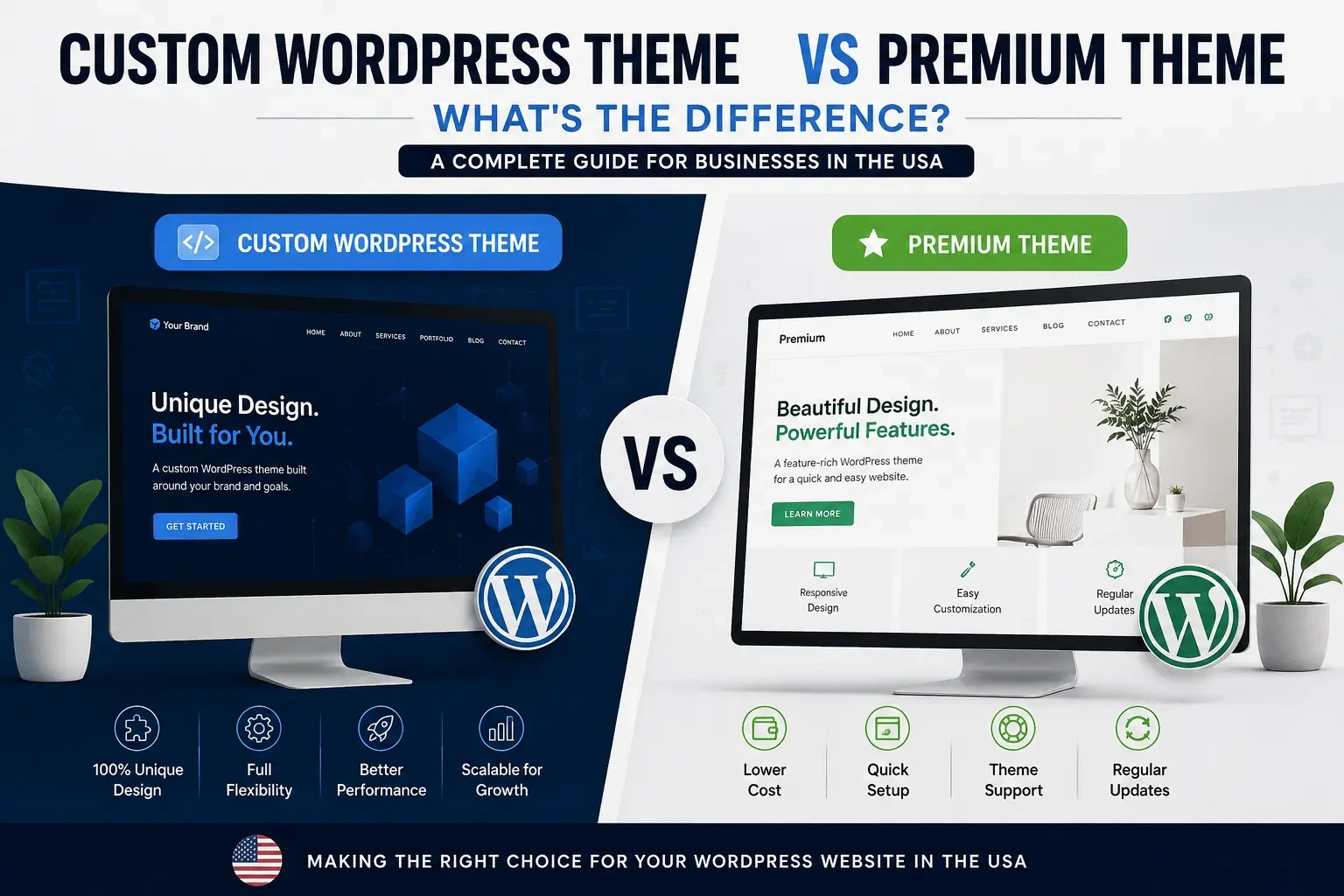
A premium WordPress theme is a ready-made commercial theme that you buy or license and configure for your website. A custom WordPress theme is designed and developed around your business requirements. Premium themes can be faster to launch and may cost less upfront, while custom themes usually offer more control over the design, templates, content structure, and functionality.
Choosing a WordPress theme is not only a design decision. It can affect how your website is built, how easily your team can manage it, how much customization is practical, and how much development work may be needed later.
For a small business, the best choice usually comes down to the site's goals, how often the content changes, the level of design control required, and whether the theme needs to support functionality that goes beyond a standard business website.
What Is a Premium WordPress Theme?
A premium WordPress theme is a commercially distributed theme that you purchase or license and then configure for your website. It typically provides an existing visual system, templates, styles, and options that can reduce the amount of design and development work needed to launch a site.
WordPress's official Theme Directory also distinguishes commercial themes from the free themes available through WordPress.org. WordPress Theme Directory is a useful reference when comparing how themes are distributed.
What Is a Custom WordPress Theme?
A custom WordPress theme is built specifically for a website rather than starting from a ready-made commercial design. The development team can define the templates, components, styles, content layouts, and theme behavior around the business requirements.
WordPress's current Theme Developer Handbook documents both block and classic theme development, including templates, styles, theme.json, functions, assets, and custom functionality. Read the WordPress Theme Developer Handbook for the platform's theme-development framework.
Custom WordPress Theme vs Premium Theme: Quick Comparison
| Factor | Premium Theme | Custom WordPress Theme |
|---|---|---|
| Initial setup | Usually faster | Requires more planning and development |
| Design flexibility | High within the theme's structure | Very high and built around requirements |
| Upfront development | Often lower | Usually higher |
| Launch speed | Can be faster | Typically takes longer |
| Updates | Theme/vendor updates may be required | Developer-maintained updates depend on implementation |
| Content editing | Usually easy with WordPress | Can also be easy when the theme is built well |
| Performance | Depends on theme quality and configuration | Can be optimized around the site's actual needs |
| Unique functionality | May need plugins or customization | Can be designed around specific requirements |
| Best fit | Standard business sites and faster launches | Distinctive brands or specialized requirements |
Custom Theme vs Premium Theme: Which Costs More?
A premium theme can reduce the amount of design and initial development work because a working visual framework already exists. However, the theme's purchase price is only one part of the total website cost. Customization, plugins, content setup, performance work, integrations, and future changes can all add to the budget.
A custom theme usually requires more design and development work at the beginning. That higher upfront investment can make sense when the website is central to the brand, needs unique templates, or has requirements that would otherwise require extensive theme modification.
For a broader look at website development budgets in the U.S., see website development cost in the USAand compare the scope rather than the theme price alone.
How Much Can You Customize a Premium Theme?
A premium theme can often be customized through its settings, block patterns, styles, templates, CSS, child themes, or additional development. The important question is how far you can move from the theme's original structure before customization becomes harder to maintain.
If you are changing layouts, templates, components, navigation, content structures, and theme behavior extensively, the project may start to resemble custom theme development. At that point, compare the cost and long-term maintenance of continuing to modify the premium theme with building a cleaner theme around the actual requirements.
Performance: Custom Theme vs Premium Theme
Neither a premium theme nor a custom theme is automatically fast or slow. Performance depends on the code, assets, third-party scripts, fonts, images, hosting, plugins, caching, and how the pages are rendered.
A well-built custom theme can be designed around the site's actual requirements, which may make it easier to avoid unnecessary features. A premium theme can also perform well when its features are configured carefully and the website is properly optimized.
For current guidance on measuring loading, interactivity, and visual stability, use Core Web Vitals rather than relying on a blanket claim that one theme category is always faster.
SEO: Does a Custom Theme Rank Better?
Choosing a custom theme does not automatically give a website a Google ranking advantage. Search visibility depends on content relevance, site structure, technical SEO, performance, links, usability, and many other factors.
Google's guidance oncreating helpful, reliable, people-first content is a better foundation for SEO decisions than choosing a theme solely for ranking reasons.
The theme can still affect SEO indirectly if it makes the site difficult to crawl, creates poor page structures, adds unnecessary code, limits important content controls, or makes performance optimization harder.
Maintenance and Updates
Premium themes generally come with vendor updates, documentation, and support according to the theme's licensing model. Those updates still need to be evaluated and applied as part of website maintenance, especially when the theme interacts with plugins and WordPress core.
The Theme Developer Handbook covers theme structure, templates, custom functionality, assets, and testing and is useful when a developer needs to maintain or extend a custom theme.
With a custom theme, the business has more control over the code, but it also takes on more responsibility for maintaining that code. A good development process includes documentation, testing, version control, and a clear plan for WordPress and plugin updates.
Premium Theme vs Custom Theme: Security Considerations
Security is not determined by the theme category alone. Premium themes should come from a reputable source and be kept updated. Custom themes also need secure coding, regular testing, controlled access, and careful management of third-party components.
A theme that is abandoned, modified without documentation, or combined with poorly maintained plugins can create problems regardless of whether it was originally free, premium, or custom.
When Should You Choose a Premium Theme?
- You need to launch a standard business website relatively quickly.
- Your required page types fit the theme's existing structure.
- Your team wants a proven starting point with ready-made templates and styles.
- Your budget favors lower initial design and development effort.
- Your customization needs are moderate rather than highly specialized.
When Should You Choose a Custom WordPress Theme?
- Your brand needs a distinctive interface that does not fit common theme layouts.
- The website has unique templates, workflows, or content structures.
- The site is a major part of your sales or lead-generation process.
- You want tighter control over the front-end code and design system.
- Your team expects the website to evolve significantly over time.
When the requirements are highly specific, custom WordPress development can be considered instead of repeatedly modifying a commercial theme. The important comparison is not just the build price, but how well the architecture fits the business.
What About a Child Theme?
A child theme can be useful when you want to extend or customize an existing parent theme while keeping the parent theme separate. It is different from building a completely custom theme, but it can be a practical middle ground for some projects.
WordPress's documentation includes a dedicated section on child themes and explains how they relate to parent themes.
A Simple Decision Framework
| If your priority is… | Consider… | Why |
|---|---|---|
| Fast launch | Premium theme | Start from an existing design and reduce initial build work. |
| Distinct brand experience | Custom theme | Design and build around the brand rather than a pre-set structure. |
| Moderate customization | Premium theme or child theme | Extend an existing base without rebuilding everything. |
| Complex templates or workflows | Custom theme | The architecture can be shaped around the requirements. |
| Frequent content changes | Either, with a well-built WordPress setup | Content editing depends on implementation, not simply theme type. |
| Long-term control | Custom theme | More direct control over the theme's structure and code. |
Before You Buy a Premium Theme
Check what the theme actually includes before purchasing it. Look at the update policy, documentation, compatibility with your WordPress setup, customization options, support model, accessibility approach, performance characteristics, and whether the features you need require additional plugins.
Questions to Ask a WordPress Developer
- Can the theme support the page structures we actually need?
- Which parts will use the theme's built-in features and which will require custom development?
- Will the customization remain maintainable after future WordPress and plugin updates?
- Are any premium plugins or licenses required?
- How will performance be measured on the pages that matter most?
- Who will handle updates, bugs, backups, and ongoing maintenance?
- Will we be able to change content without a developer for routine updates?
Need Help Choosing the Right Theme Approach?
The right theme choice depends on how much of your website can be standardized and how much needs to be built around your business. A clear requirements list can make the decision much easier and can prevent you from paying for customization you did not expect.
Talk to a WordPress development specialist →
Frequently Asked Questions
Is a custom WordPress theme better than a premium theme?
Not automatically. A custom theme is better when the business needs a distinctive design, specialized templates, or tighter control over the site's structure. A premium theme can be the better choice when speed of launch, moderate customization, and lower initial development effort are more important.
Is a premium WordPress theme worth it?
It can be, especially when the theme closely matches the site's requirements and provides reliable updates, documentation, and support. The value depends on how much customization you need after purchase.
Is a custom WordPress theme more expensive?
Usually the initial design and development effort is greater because the theme is built around the business requirements. However, the total cost should be compared with the long-term cost of heavily customizing and maintaining a premium theme.
Can I customize a premium WordPress theme?
Yes. The amount of practical customization depends on the theme and the development approach. For deeper changes, a child theme or custom development may be appropriate.
Are premium WordPress themes faster than custom themes?
Neither category is automatically faster. Real performance depends on implementation, assets, plugins, hosting, scripts, caching, and optimization.
Does a custom WordPress theme help SEO?
A custom theme can make technical SEO and performance easier to control, but it does not guarantee higher rankings. Search performance depends on many factors beyond the theme.
What is the difference between a custom theme and a child theme?
A custom theme is built specifically for a site, while a child theme extends an existing parent theme. A child theme can be a practical way to make selected customizations without directly editing the parent theme.
Should a small business use a premium or custom theme?
A premium theme is often practical when the business needs a standard website with moderate customization and a faster launch. A custom theme becomes more attractive when the site is central to the brand, lead generation, or has unique requirements.
Final Takeaway
The difference between a premium WordPress theme and a custom WordPress theme is less about which one is universally better and more about how closely the theme fits the business.
Choose a premium theme when you need a reliable starting point, a faster launch, and moderate customization. Consider a custom theme when you need a distinctive design, specialized templates, or more direct control over the site's structure and future development.
Before making the decision, compare the full project scope—not just the theme price. Include design, development, plugins, content, performance, maintenance, support, and future changes. The right choice is the one that solves the business requirements without creating unnecessary complexity.


