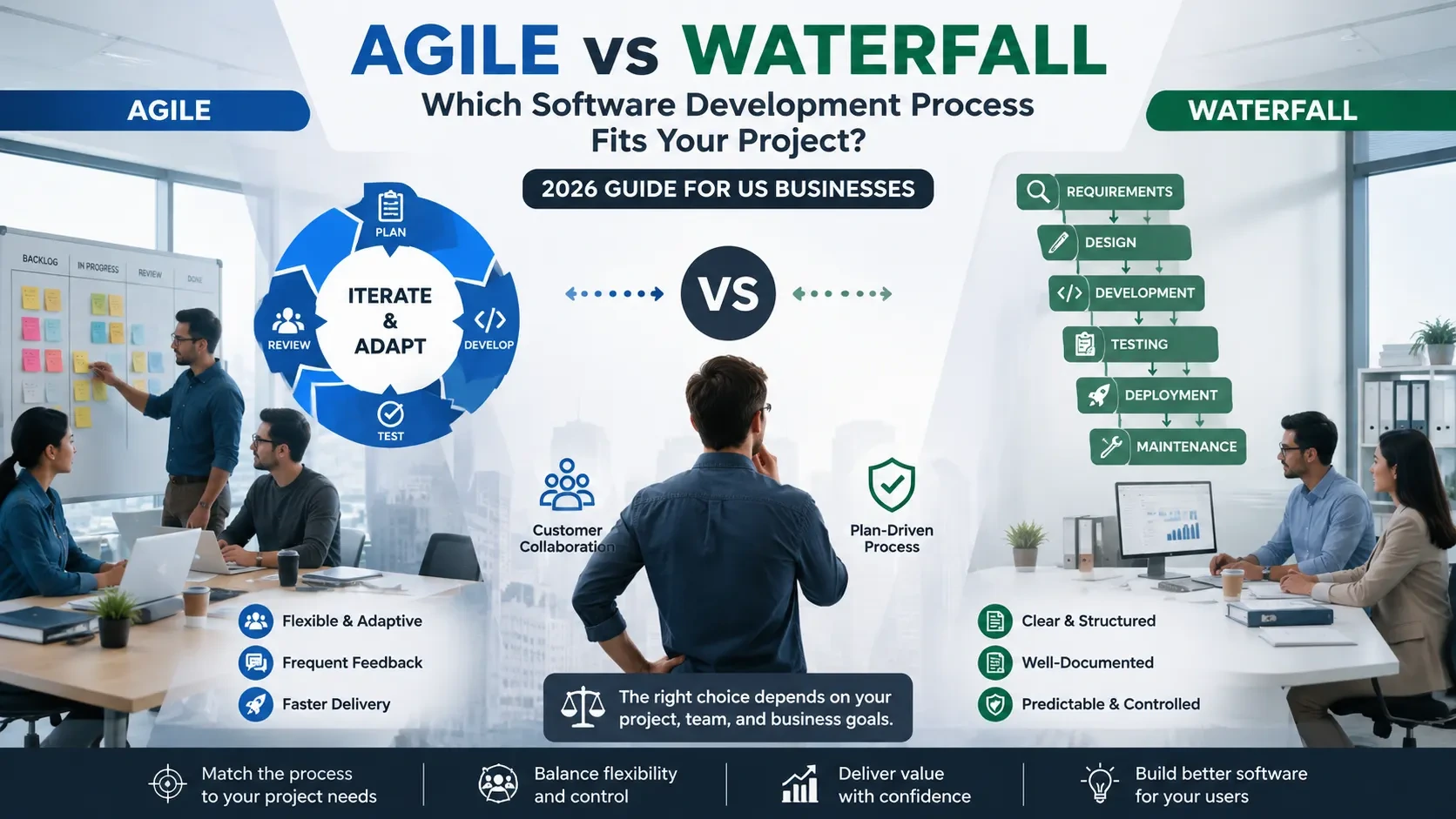
Choosing a software development process is not just a technical decision. The process you choose affects how requirements are handled, how quickly users see working software, how changes are managed, how budgets are controlled, and how the development team works with stakeholders.
Two of the most widely recognized approaches are Agile and Waterfall. Agile emphasizes iterative development, continuous feedback, and the ability to adapt as requirements change. Waterfall follows a more sequential approach in which requirements, design, development, testing, and delivery are planned as distinct stages.
Neither method is automatically better. The right choice depends on your project's requirements, uncertainty, regulatory environment, budget, timeline, stakeholder availability, and tolerance for change.
Many modern software teams also use hybrid approaches that combine upfront planning with iterative delivery.
Quick Answer: Agile vs Waterfall
Agile is generally a strong fit for projects where requirements may evolve, customer feedback is important, and the team needs to deliver and learn in iterations.
Waterfall can be a strong fit when requirements are well understood, the scope is relatively stable, approvals and documentation are important, and the project benefits from a defined sequence of phases.
A hybrid approach can be useful when a project needs upfront planning or compliance controls while still benefiting from iterative development.
| Factor | Agile | Waterfall |
|---|---|---|
| Planning | Continuous and adaptive | Detailed upfront planning |
| Requirements | Can evolve during development | Usually defined early |
| Delivery | Incremental releases | Typically phase-based |
| Feedback | Frequent | Usually milestone-based |
| Change | Expected and managed iteratively | Can be costly after approval |
| Testing | Continuous throughout development | Often concentrated in later phases |
| Customer involvement | Frequent collaboration | Usually more milestone-based |
| Best fit | Changing or uncertain requirements | Changing or uncertain requirements |
| Documentation | Created continuously as needed | Often extensive upfront documentation |
| Risk approach | Identify and address risks iteratively | Plan and control risks earlier |
What Is Agile Software Development?
Agile is an iterative approach to software development in which teams deliver work in smaller increments, gather feedback, and adjust priorities as the project progresses.
Instead of assuming that every requirement can be perfectly defined before development begins, Agile recognizes that software requirements often change as customers, markets, and teams learn more.
Agile is commonly associated with values and principles from the agilemanifesto.org and with frameworks such as Scrum and Kanban. Agile itself is not one specific project-management framework.
- Define the product vision and priorities
- Break requirements into smaller pieces of work
- Prioritize the most valuable work
- Develop and test an increment
- Review the result with stakeholders
- Collect feedback
- Adjust priorities
- Repeat the cycle
The exact length and structure of iterations can vary. Scrum teams commonly work in time-boxed sprints, while Kanban teams generally manage a continuous flow of work.
What Is Waterfall Software Development?
Waterfall is a sequential development approach in which project work moves through defined stages. A traditional Waterfall lifecycle may include requirements, design, implementation, testing, deployment, and maintenance.
The idea is to establish a clear plan and move through the project in an organized sequence, with formal decisions and documentation at major stages.
How Waterfall Typically Works
- Requirements gathering
- Requirements approval
- System and technical design
- Development
- Testing and verification
- Deployment
- Maintenance and support
Waterfall does not mean that a team never changes anything. It means that changes after requirements or design have been approved are generally handled through a more formal change-management process.
Agile vs Waterfall: The 10 Biggest Differences
1. Requirements
Agile assumes requirements may evolve. Teams can reprioritize work as new information becomes available.
Waterfall generally attempts to define requirements earlier and establish a baseline before development moves forward.
If your users are not yet sure exactly what they need, Agile can provide more room for learning. If requirements are already well documented and unlikely to change, Waterfall can provide useful structure.
2. Project Planning
Waterfall places greater emphasis on detailed upfront planning. This can make schedules, dependencies, documentation, and approvals easier to define before development begins.
Agile still plans extensively, but planning happens at multiple levels. The team may maintain a product roadmap while planning detailed work incrementally.
3. Delivery
Agile aims to produce usable increments of software throughout development. Stakeholders can see progress and, depending on the product, may begin using features before the entire project is complete.
Waterfall generally moves toward a major delivery after the planned development and testing phases are completed.
4. Handling Change
Change is expected in Agile. A new customer requirement can be prioritized into a future iteration.
In Waterfall, a significant change after requirements have been approved may affect design, development, testing, budget, and schedule. Formal change control can help evaluate the impact.
This does not make Waterfall bad at handling change. It makes change more controlled and potentially more expensive.
5. Customer and Stakeholder Feedback
Agile encourages frequent stakeholder collaboration. Product owners, users, and business teams can review increments and provide feedback throughout development.
Waterfall usually relies more heavily on requirements reviews, design approvals, testing milestones, and formal acceptance.
6. Testing
In Agile, testing can happen continuously as features are developed. Automated tests, code reviews, integration testing, security checks, and other quality activities can be integrated into development workflows.
In traditional Waterfall, testing is often a distinct phase after implementation, although modern Waterfall projects may still perform testing and quality checks throughout earlier stages.
The important distinction is not whether Waterfall teams test. They do. The difference is how testing is integrated into the lifecycle.
7. Documentation
Waterfall projects often emphasize detailed documentation before implementation because requirements and approvals play a major role in the process.
Agile values working software and collaboration while still recognizing that useful documentation matters. Agile does not mean "no documentation." It means documentation should provide value rather than becoming an objective by itself.
8. Risk Management
Agile reduces some risks by delivering and validating work in smaller increments. Teams can discover usability, technical, or product problems earlier.
Waterfall can reduce uncertainty through detailed planning, requirements analysis, design reviews, and formal approvals before implementation.
The better approach depends on the type of risk. A project with highly uncertain user requirements may benefit from iterative learning, while a project with strict compliance or engineering constraints may benefit from extensive upfront analysis.
9. Team Structure
Agile teams are often cross-functional and collaborative, with developers, designers, testers, product specialists, and stakeholders working closely together.
Waterfall projects may involve more distinct handoffs between specialized phases or teams, although modern organizations can still use cross-functional teams within a sequential lifecycle.
10. Budget and Timeline
Waterfall can make it easier to estimate the cost and schedule of a project when requirements are stable and sufficiently detailed.
Agile may provide more flexibility by fixing or constraining iteration cycles while allowing the scope and priorities to evolve. However, Agile does not guarantee a fixed budget or timeline unless the engagement is specifically structured to provide those constraints.
For either model, realistic estimation requires clear assumptions, scope boundaries, dependencies, and risk management.
Agile vs Waterfall Comparison Table
| Category | Agile | Waterfall |
|---|---|---|
| Requirements | Evolve throughout the project | Defined largely upfront |
| Development | Iterative | Sequential |
| Feedback | Frequent | Milestone-based |
| Change management | Flexible | Formal and controlled |
| Delivery | Incremental | Usually major/final delivery |
| Testing | Integrated throughout | Often later |
| Planning | Adaptive | Detailed upfront |
| Documentation | Continuous and purpose-driven | Typically extensive |
| Stakeholder involvement | Frequent | Periodic |
| Best environment | Uncertain, changing needs | Stable, predictable needs |
Disadvantages of Agile
- Scope can become unclear
- Requires active stakeholder involvement
- Long-term forecasting can be more complex
- Poor implementation can lead to uncontrolled scope expansion
Advantages of Waterfall
- Clear project structure
- Strong upfront planning
- More predictable scope
- Useful for documentation-heavy environments
- Easier phase-based governance
Disadvantages of Waterfall
- Changes can become expensive
- Feedback may arrive late
- Working software may arrive later
- Requirements need to be understood early
- Completing phases can create false confidence
When Should You Choose Agile?
Agile is generally a strong option when requirements are likely to change, user feedback is important, the product is new or innovative, or the business wants incremental releases. It can also work well when technical uncertainty is high and the product will continue evolving after launch.
- Requirements are likely to change
- User feedback is essential
- Incremental releases are preferred
- Technical uncertainty exists
- Priorities may change
- Stakeholders can collaborate frequently
- The product will continue evolving
When Should You Choose Waterfall?
Waterfall can be a strong option when requirements are well understood, scope is relatively stable, formal approval stages are required, and the business needs a defined sequence of phases.
- Requirements are well understood
- Scope is stable
- Formal approvals are required
- Detailed documentation is important
- Dependencies need upfront coordination
- Regulatory or contractual controls are important
When Is a Hybrid Approach Better?
Agile and Waterfall are not the only choices. Many organizations use a hybrid model that combines structured planning with iterative implementation.
For example, a company may complete detailed requirements, architecture, security planning, and compliance approvals before using Agile iterations for development and testing.
A Hybrid Approach May Work Well When:
- Architecture requires significant upfront planning
- Compliance requires formal documentation
- Requirements are partly known and partly uncertain
- Business milestones are fixed
- Different teams have different delivery constraints
- Agile development must operate within formal governance
Agile vs Waterfall for Different Types of Software Projects
| Project Type | Often a Good Starting Point | Why |
|---|---|---|
| Startup MVP | Agile | Requirements may change |
| Consumer web application | Agile | Frequent user feedback |
| B2B SaaS product | Agile or Hybrid | Product evolves while security needs planning |
| Internal business application | Agile or Hybrid | Workflows may be refined |
| Enterprise transformation | Hybrid | Multiple teams and governance |
| Regulated software | Waterfall or Hybrid | Documentation and approvals |
| Fixed-scope project | Waterfall or Hybrid | Defined deliverables |
| Complex infrastructure | Waterfall or Hybrid | Upfront architecture |
| Research-heavy product | Agile | Learning and experimentation |
Agile vs Waterfall for SaaS Development
software deve products often benefit from iterative development because product requirements, user behavior, pricing, onboarding, and feature priorities can change as the business learns from customers.
Agile can help SaaS teams release smaller improvements, measure results, and prioritize future work.
However, SaaS teams still need strong decisions around architecture, security, data models, tenant isolation, authentication, billing, infrastructure, and compliance.
Enterprise software often involves multiple stakeholders, legacy integrations, security requirements, budgets, procurement processes, and governance.
Agile can work well in enterprise environments, but it usually requires strong product ownership, portfolio governance, architecture practices, and coordination across teams.
Waterfall or hybrid approaches can also work when formal approvals, fixed dependencies, or contractual requirements are central.
Agile vs Waterfall for Regulated Projects
Projects in regulated environments may require documentation, traceability, approvals, validation, testing evidence, and controlled changes.
That can make Waterfall or a hybrid lifecycle attractive, but Agile does not automatically exclude regulated development. Agile teams can maintain documentation, traceability, testing evidence, approval processes, and controlled releases when the process is designed appropriately.
Common Mistakes When Choosing a Development Methodology
- Choosing Agile simply because it is popular
- Assuming Waterfall is outdated
- Assuming Agile means no planning
- Treating Agile as only a set of meetings
- Ignoring stakeholder availability
- Ignoring change management in Waterfall
- Focusing on methodology instead of outcomes
How to Choose the Right Software Development Process
The right methodology should be selected based on the actual requirements, risks, stakeholders, constraints, and expected outcomes of the project.
Step 1: Evaluate Requirement Stability
Ask whether the requirements are already clear and unlikely to change. If uncertainty is high, iterative development may be more appropriate.
Step 2: Evaluate Customer Feedback Needs
If users need to interact with early versions of the product, Agile can provide a stronger feedback loop.
Step 3: Evaluate Regulatory and Contractual Requirements
Determine whether formal documentation, approvals, traceability, or fixed deliverables are required.
Step 4: Evaluate Technical Uncertainty
If the team needs to experiment with integrations, architecture, AI, performance, or user experience, iterative development can reduce the risk of committing too early to incorrect assumptions.
Step 5: Evaluate Stakeholder Availability
Agile requires active collaboration. If key stakeholders cannot regularly review work and make decisions, a highly iterative process may be difficult.
Step 6: Evaluate Budget and Timeline Constraints
Decide whether the project needs a highly predictable scope or whether the business is willing to prioritize the highest-value work as development progresses.
Step 7: Consider a Hybrid Model
If some parts of the project require upfront certainty while others require experimentation, a hybrid approach may provide a better balance.
Questions to Ask a Software Development Company
- Which development methodology do you recommend for our project, and why?
- How will requirements be documented and prioritized?
- How will changes affect cost and timeline?
- How often will we see working software?
- How involved will our team need to be?
- How will testing and security be handled?
- How will project risks be identified and communicated?
- How will architecture decisions be documented?
- How will scope creep be controlled?
- What happens if our priorities change?
- How will you measure project progress?
- What support will be available after launch?
Agile vs Waterfall: Cost and Timeline Considerations
The development methodology itself does not determine the total cost of a software project. Scope, complexity, team composition, integrations, security, testing, infrastructure, and timeline are usually more important cost drivers.
Agile can make the total scope more flexible because priorities can change. Waterfall can make a project easier to estimate when requirements are stable and detailed, although late changes can increase costs.
Frequently Asked Questions
Frequently asked questions
Which is better, Agile or Waterfall?
Neither is universally better. Agile is generally stronger when requirements and priorities may change, while Waterfall can be effective when requirements are stable and the project benefits from sequential planning and formal controls.
Is Agile more expensive than Waterfall?
Not automatically. Cost depends on project scope, team complexity, integrations, testing, infrastructure, and change. Agile may allow a business to prioritize high-value work, while Waterfall can provide stronger cost predictability when requirements are stable.
Is Waterfall outdated?
No. Waterfall remains useful for projects with stable requirements, formal approvals, extensive documentation, predictable phases, or specific contractual and regulatory constraints.
Can Agile work for enterprise software?
Yes. Enterprise organizations can use Agile practices when supported by strong governance, architecture, product ownership, security, and coordination across teams.
Can Waterfall work for SaaS development?
Yes, but a purely sequential approach may be less suitable when SaaS requirements are uncertain and user feedback is important. A hybrid or iterative approach may provide more flexibility.
What is the difference between Agile and Scrum?
Agile is a broad set of values and principles for iterative and adaptive software development. Scrum is a specific framework for managing iterative product development.
What is the difference between Agile and Kanban?
Agile describes a broader approach to adaptive software development. Kanban is a workflow-management method focused on visualizing work, limiting work in progress, and improving flow.
Can Agile and Waterfall be combined?
Yes. Hybrid approaches combine sequential planning with iterative delivery. This can be useful when architecture, compliance, or governance require upfront planning while product development benefits from frequent iteration.
How do I choose a software development methodology?
Evaluate requirement stability, customer feedback needs, technical uncertainty, regulatory requirements, stakeholder availability, budget, timeline, and the need for formal governance. Then choose Agile, Waterfall, or a hybrid model based on those constraints.
Final Verdict: Agile or Waterfall?
Agile and Waterfall solve different project-management problems.
Choose Agile when your project has evolving requirements, significant uncertainty, frequent customer feedback needs, or a product that will continue changing after launch.
Choose Waterfall when requirements are stable, formal approvals and documentation are important, the project has a clearly defined sequence, and predictable scope is a major priority.
Choose a hybrid approach when you need the structure of upfront planning in some areas and the adaptability of iterative development in others.
The best software development process is not the one that is most fashionable. It is the one that matches the project's real constraints and helps the team deliver useful, secure, maintainable software.