Hire a Bespoke Software House That Ships to Production
A bespoke software house builds software to one company's specification and hands over the code. We have worked that way since 2017 from New York, Delhi and Lucknow: discovery and architecture, interface design, the full-stack build, automated tests, CI/CD, launch, documentation and handover.
On this page
A bespoke software house designs, builds and hands over software written for one company, not sold to everyone. Hire one when the process the software runs is your advantage. Digital Heroes has built that way since 2017: a written scope within 48 hours of a call, fortnightly sprints with daily standups, and repositories held in your name.
What you get from a software house you hire
You get a delivery team, not a stack of resumes. A senior engineer owns the architecture, a second builds beside them, and someone who has run a launch before is accountable for the date. The scope is written, estimated and agreed before any code, and everything produced sits in repositories held in your name.
The systems we build this way are the ones listed on our custom software development services page: web apps and client portals, workflow and approval systems, internal tools, CRM and ERP systems, APIs and integrations, mobile apps and SaaS products.
What arrives at handover
| Deliverable | What it means for you |
|---|---|
| Production application | A working web, mobile or backend system running in cloud accounts you control |
| Source code and IP | Every repository in your organization; everything written for your project is yours once the final invoice is paid |
| CI/CD pipeline | Automated build and deploy, so your own team can ship after we hand off |
| Test coverage | Automated tests around the paths that cost money or trust if they break |
| Documentation | Architecture notes, runbooks and setup docs, so a new engineer gets oriented fast |
| Handover walkthrough | A working session with your internal team, plus every credential and login |
Senior partner or hourly contractor: where the price gap goes
The market sells two different things under one name. One is people billed by the hour, where you carry the risk of whether the work finishes. The other is a team that owns the result against a written scope. The price gap between them is real, and so is the gap in what lands.
A senior engineer makes the expensive decisions right the first time: where the boundary between services sits, which parts stay boring, and what never gets built custom. A junior gets those wrong quietly. You pay six months later, when a one-week feature takes a month because the foundation fights it. That rework is the real cost of hiring cheap, and it never appears in the first quote.
A skilled freelancer is still the right call for a single-discipline job: one integration, one plugin, one internal calculator. A system your business will depend on for years needs design, backend, testing and project management at once, and a solo builder is a single point of failure. Our free in-house vs agency cost calculator puts in-house, agency and freelancer on the same hours, so the comparison is yours.
- Senior first: the person designing your system has shipped this class of problem before, and our CTO signs off the architecture.
- A written scope, not an open meter: anything outside it gets its own change request, priced and dated, before work starts.
- Code in your name: repositories and cloud accounts sit in your organization, and our engineers are collaborators you can remove.
- One accountable team: design, build, QA and launch under one roof, so nobody points at another vendor when a date slips.
Proof: Planivo, a clinic rostering platform built in 2026
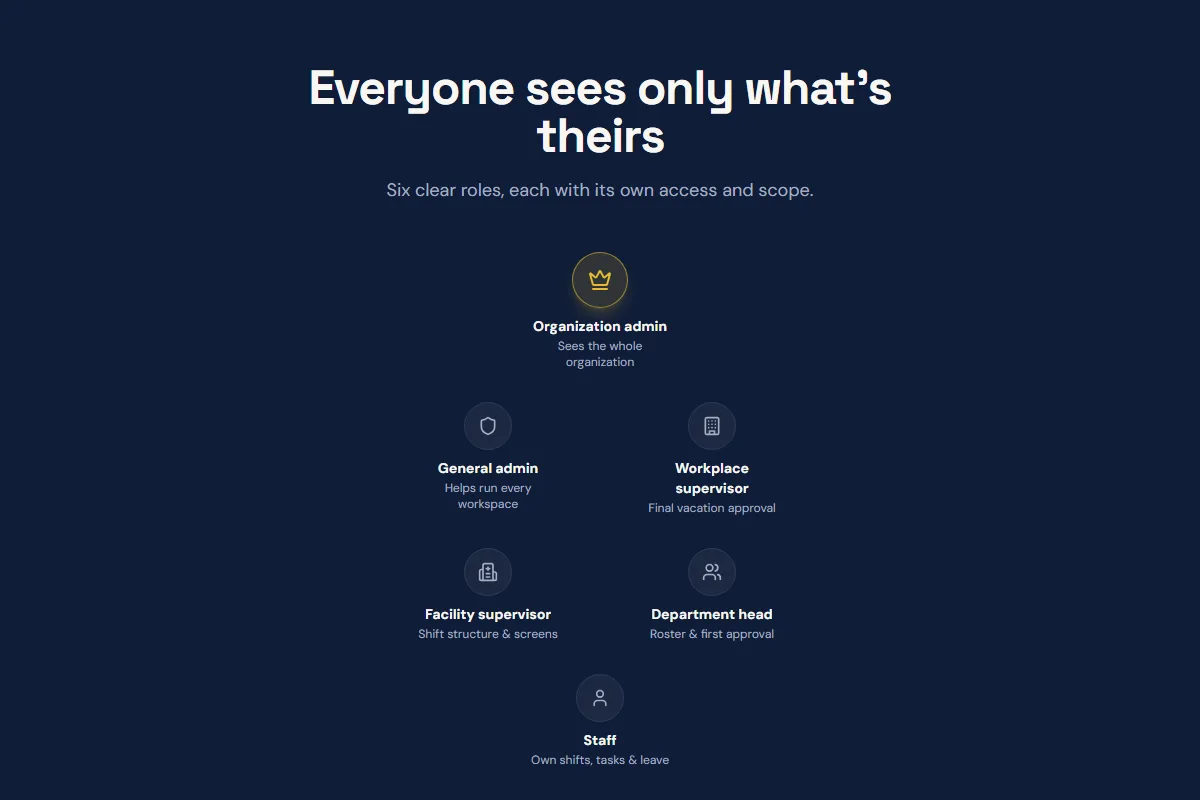
Planivo plans staff rosters for clinics and hospitals, and we built the whole platform in 2026: monthly shifts, three-level vacation approvals, speciality conflict checks, duty display screens, tasks, training, certifications, an audit history and six roles. It is a client build, shown with the client's permission.
The part no packaged roster product offered was the rule layer. A leave request passes three levels of approval, and the system warns when two specialists of the same kind would be off together. In our experience that is the test for hiring a software house rather than buying: when the rules are the product, nothing on the shelf fits.
Clutch shows a 5.0 rating from 66 verified reviews, read 2026-10-07 (clutch.co/profile/digital-heroes-0). More of Planivo's screens and its full feature list sit with our enterprise software work, and our custom software development company page carries the contract terms, from the MSA to support after launch.
From first call to handover, in six steps
Every engagement runs the same six steps, and each ends in something you can see and sign off. Our CTO signs off the architecture before any engineer starts, sprints run fortnightly with daily IST standups, and every week ends in a recorded demo of working code.
- Call and scope. A 30-minute call about the problem, then a written scope and quote within 48 hours: what will be built, how we will know it works, and who builds it.
- Discovery. A two-week sprint, priced on its own, with the people who will use the software. It ends in a fixed build price, or in advice to buy a product that already does the job.
- Design. Screens for each user role and the data model, agreed before code, with the architecture signed off by our CTO.
- Build. Fortnightly sprints with daily standups, the hard and uncertain parts first, and a recorded demo of working code every week.
- Test and launch. Our own QA team tests each build before you see a preview, and a tested way to roll back is in place before the first release.
- Support or handover. A named team keeps fixing and improving it, or you take the handover pack: architecture notes, runbooks, a walkthrough and every login.
For a schedule built from your own numbers, the free software project timeline calculator turns build hours and team size into weeks. Decision lag, not engineering speed, is what usually stretches a schedule, so name one person on your side to approve designs every week.
What a bespoke build costs, by a 2026 survey
GoodFirms surveyed more than 100 software firms in September and October 2025 for its 2026 cost report. Worldwide, most projects fall between $30,000 and $100,000 and take three to six months. Firms in Western markets quote about $50,000 to $250,000 for a medium-sized build, and enterprise systems start above $200,000 and run 12 to 24 months.
Two figures from the same report belong in any budget. Upkeep after launch runs 10 to 20 percent of the build cost each year, and scope creep adds 10 to 25 percent where it happens. Hourly rates of $20 to $50 are the most common, mostly from teams in South and Southeast Asia, Latin America and Eastern Europe, while $100 to $250 an hour is standard for enterprise work in the US, Canada and Western Europe.
Four ways to contract the work
| Model | How it is priced | Who pays for an overrun | Best when | Firms offering it |
|---|---|---|---|---|
| Time and materials | Hours worked at agreed rates | You do, since every extra hour is billed | The scope will change as you learn | 81.3 percent |
| Fixed price | One price for a written scope | The vendor, inside the written scope; changes are priced separately | The scope is known and stable | 65.6 percent |
| Dedicated team | A monthly retainer for a lead, engineers and QA | You do, since the retainer runs until the work is done | A roadmap runs for many months | 59.4 percent |
| Milestone based | A payment for each delivered phase | Shared: the vendor within a priced phase, you when phases are added | You want each payment tied to a result | 46.9 percent |
We do not print a price list. The first call is free and takes 30 minutes, a written scope and quote follow within 48 hours, and a fixed build price comes after the two-week discovery sprint. For a rough figure first, the free software development cost calculator works from hours and a blended rate, and the quote checker turns any vendor's total into an implied hourly rate.
Read the five things that move a custom software budget before you compare quotes. In our own builds, healthcare and fintech work costs more than most, because compliance and third-party integrations add work that a brochure site never has.
When to buy a product instead of hiring anyone
Buy first when a packaged product already runs the process the way you want it run. HubSpot, Airtable, Monday.com and Retool cover a lot of ground, and Bubble builds simple apps without code. We say so on the first call, and the discovery sprint can end in a recommendation to buy rather than a quote.
Packaged software has its own hidden cost. In Flexera's 2025 State of ITAM report, 35 percent of respondents said SaaS waste had increased over the past year, which Flexera puts down to underused subscriptions. Commission bespoke software when the process is why customers choose you, when staff spend hours moving data between tools, or when seat fees climb with every hire.
A no-code first version is a fair way to prove demand. The ceiling arrives with complex data relationships and heavy integrations. Treat it as a paid prototype, then build the version you own once revenue justifies it.
Two free calculators settle the question on your own numbers: the build vs buy calculator compares five years of cost against seat fees, and the no-code vs custom calculator prices a no-code platform against a custom build over two to five years. For the wider argument, read how SaaS and custom software differ.
The bespoke test: when to hire a software house and when not to
This works when the stakes justify seniority and fails when they do not, and saying so is part of the job. Four questions settle it: is the software central to the business, would a wrong architectural call be expensive to unwind, do you have users yet, and does a product already do the job?
- Strong fit: you are funded and ready to hire, the software is central to the business, and a wrong architectural call would be expensive to unwind.
- Strong fit: you tried cheaper options, inherited a codebase you cannot ship on, and need senior engineers to stabilize it and move it forward.
- Weak fit: you need a brochure site or a tool a no-code platform already handles. A custom build would spend real money on a problem that is already solved.
- Weak fit: the requirements are still a moving idea with no users. Spend two weeks on discovery first, then decide, rather than committing a full build budget to a guess.
If what you need is capacity on your own roadmap rather than a finished system, a dedicated development team of a lead, engineers and QA runs as a monthly retainer, and our offshore software development page covers time zones and the entity you sign with. Two industry pages go deeper on regulated work: healthcare, where we sign a BAA whenever our team handles PHI, and fintech, for payment integrations and KYC flows.
Six questions for any software house before you sign
Put the same six questions to every vendor on your list and compare the answers line by line. No list yet? Start with the ten US software firms we ranked, ourselves included. Two free tools make the first two fair: the requirements document generator, so every vendor quotes the same brief, and the quote checker, which turns any total into an implied hourly rate.
- Who will write the code, by name. Some agencies sell senior faces and deliver junior or subcontracted hands.
- The written specification with acceptance criteria that sits behind any fixed price. An instant quote given without questions about your workflows is the clearest warning sign there is.
- Two reference calls with past clients whose projects resemble yours, and a portfolio that links to products that are live.
- How a change of scope is priced and dated, and who pays for an overrun under the contract model they propose.
- Where the code lives during the build, and when it becomes yours. A proposal built on the agency's own proprietary framework usually means you are renting, not buying.
- How the team uses AI coding tools, and which tests guard the output. DORA's 2024 report found AI adoption raised individual productivity but lowered delivery throughput and stability, so the answer should name the tests, not the tools.
Our own answers are on this page: who sets the architecture in the process section, how a change is priced and where the code lives under the price gap, and the handover pack in what you get. Once you choose, the free SOW generator turns the agreed scope into a statement of work, and the project risk assessment scores the risks before kickoff.
Our CTO, Divyansh Singh, decides the architecture of every build, including which parts are built and which are bought, and reviews the code of our API, CRM and AI chatbot work. Builds usually run on Next.js, React and Node.js, with React Native as the default for mobile apps on both iOS and Android, so thousands of developers could maintain the system if you ever changed vendors.
Sources behind this page
Every figure above traces to one of the primary sources below, or to our own builds and contract. Each link goes to the publisher, not to a summary.
- GoodFirms, Custom Software Development Cost Survey (2026): cost bands, timelines, upkeep, scope creep and contract model shares, from more than 100 firms surveyed in September and October 2025.
- DORA, Accelerate State of DevOps Report (2024): AI adoption raised individual productivity, flow and job satisfaction, but lowered software delivery throughput and stability.
- Flexera, State of ITAM Report (2025): 35 percent of respondents said SaaS waste had increased over the past year.
- MIT Sloan CISR (2022): only 22 percent of firms had significantly transformed digitally, and those showed revenue growth 17.3 points and net margins 14.0 points above their industry average.
- Gallup, State of the Global Workplace: global employee engagement fell to 20 percent in 2025, which Gallup prices at about $10 trillion a year in lost productivity. Software that removes manual rework is one lever on that figure, not the whole answer.
Quick answers on hiring, scope and speed
When does buying a product beat hiring a software house?
Buy when a packaged product already runs the process the way you want it run. Hire a bespoke software house when the process is the reason customers choose you, when staff spend hours moving data between tools, or when seat fees climb with every hire. Bespoke is the British word for what US buyers usually call custom.
Should I hire a custom software development agency or a freelancer?
A freelancer suits a single-discipline job with a limited life: one integration, one plugin, one internal calculator. A system your business will depend on for years needs design, backend, testing and project management at once, and a solo builder is a single point of failure. Our in-house vs agency calculator compares the three on the same hours.
Can I hire on-demand developers instead of commissioning a full build?
Yes. When you need capacity on your own roadmap rather than a finished system, a dedicated team of a lead, engineers and QA runs as a monthly retainer, and you direct the work. Our dedicated development team page covers that model, and our offshore page covers time zones and contracts.
How soon does a bespoke build show working code?
In the first build sprint. A 30-minute call produces a written scope and quote within 48 hours, a two-week discovery sprint follows, and fortnightly build sprints with daily standups start after it. Every week ends in a recorded demo of working code.
Last reviewed .
Send us the problem, get a written scope back
Tell us what the software has to do and who will use it. After a 30-minute call, Digital Heroes sends a written scope and quote within 48 hours, and a fixed build price follows discovery. Nothing about that commits you to the build. Book a call.
Why work with Digital Heroes









115 people across five studios in New York, Delhi, London, Sydney and Lucknow, shipping ecommerce, web, software and mobile work for founder-led brands. Senior engineers only, no account-manager relay, and the same team from kickoff to launch.
- Shopify Select Partner, as listed in the Shopify Partner Directory
- Tier 1 registered supplier on the United Nations Global Marketplace, which requires audited company documentation
- Top Rated Plus on Upwork, the bracket for the top 3% of talent by client outcomes
- 397 public five-star-weighted reviews across four Fiverr gigs, from clients in 36 countries
- DUNS verified business, No. 650878346, so procurement can check us before signing
- Listed by Clutch in Top 1000 Global B2B Companies and Top Web Designers 2024
- Verified profiles on GoodFirms, DesignRush, Digital.com, AppFutura and TopDevelopers
- 2,000+ brands built across 40+ countries, with $50M+ in client revenue scaled

More from Divyansh.
Chief Technology Officer · Lucknow · 23 posts on the site
Published · Last updated .


