Every US founder researching WordPress vs Shopify eventually asks the same question in a different form: "Which one will I regret less in two years?" Both platforms can absolutely build a working online store for a business in the USA. The real difference shows up in what happens after launch — how much you pay as you grow, how much control you have over content and SEO, and how much of the technical side you want to own versus rent. This breakdown covers real 2026 USA pricing (US dollar plans, US card-processing rates), feature trade-offs, and a practical way for American business owners to decide.
The Core Difference
Shopify is a fully hosted, all-in-one SaaS platform — you pay a monthly subscription and Shopify handles hosting, security, and infrastructure. WordPress with WooCommerce is a free, open-source plugin — you own the code, choose your own hosting, and manage everything yourself. That single distinction — rented convenience vs. owned infrastructure — explains almost every other difference between them.
Shopify Pricing in the USA in 2026 (Real Numbers)
All figures below are in US dollars, reflecting Shopify's standard USA pricing and card-processing rates for American merchants.
| Plan | Monthly Cost (USD) | Best For |
|---|---|---|
| Starter | $5/mo | Selling via social/messaging only — no full storefront |
| Basic | $39/mo ($29 billed annually) | New US sellers, stores under $10K/month revenue |
| Grow | $105/mo ($79 billed annually) | Growing US stores needing better reporting and lower fees |
| Advanced | $399/mo ($299 billed annually) | Established, scaling US brands |
| Plus | From $2,300+/mo | Enterprise and high-volume US merchants |
On top of the plan fee, Shopify charges US card processing (2.9% + 30¢ on Basic, dropping to 2.5% + 30¢ on Advanced) — and an extra 0.5–2% if you use a third-party payment gateway instead of Shopify Payments.
WooCommerce Cost for USA Businesses in 2026 (Real Numbers)
WooCommerce the plugin is free. A store hosted in the USA still needs hosting, a domain, SSL, a theme, and usually a few paid extensions. A realistic first-year cost for a competitive small-business WooCommerce store in the USA runs $1,200–$1,600, then $1,500–$2,000 in year two once promotional hosting rates expire — averaging roughly $100–$170/month, largely fixed regardless of how much revenue the store does.
The Real Cost Crossover: Why Scale Changes the Answer
This is the part most comparisons skip. Shopify's cost is a percentage of revenue (subscription + processing fees); WooCommerce's cost is mostly fixed (hosting + plugins + maintenance). That means the "cheaper" platform depends entirely on how much the store sells.
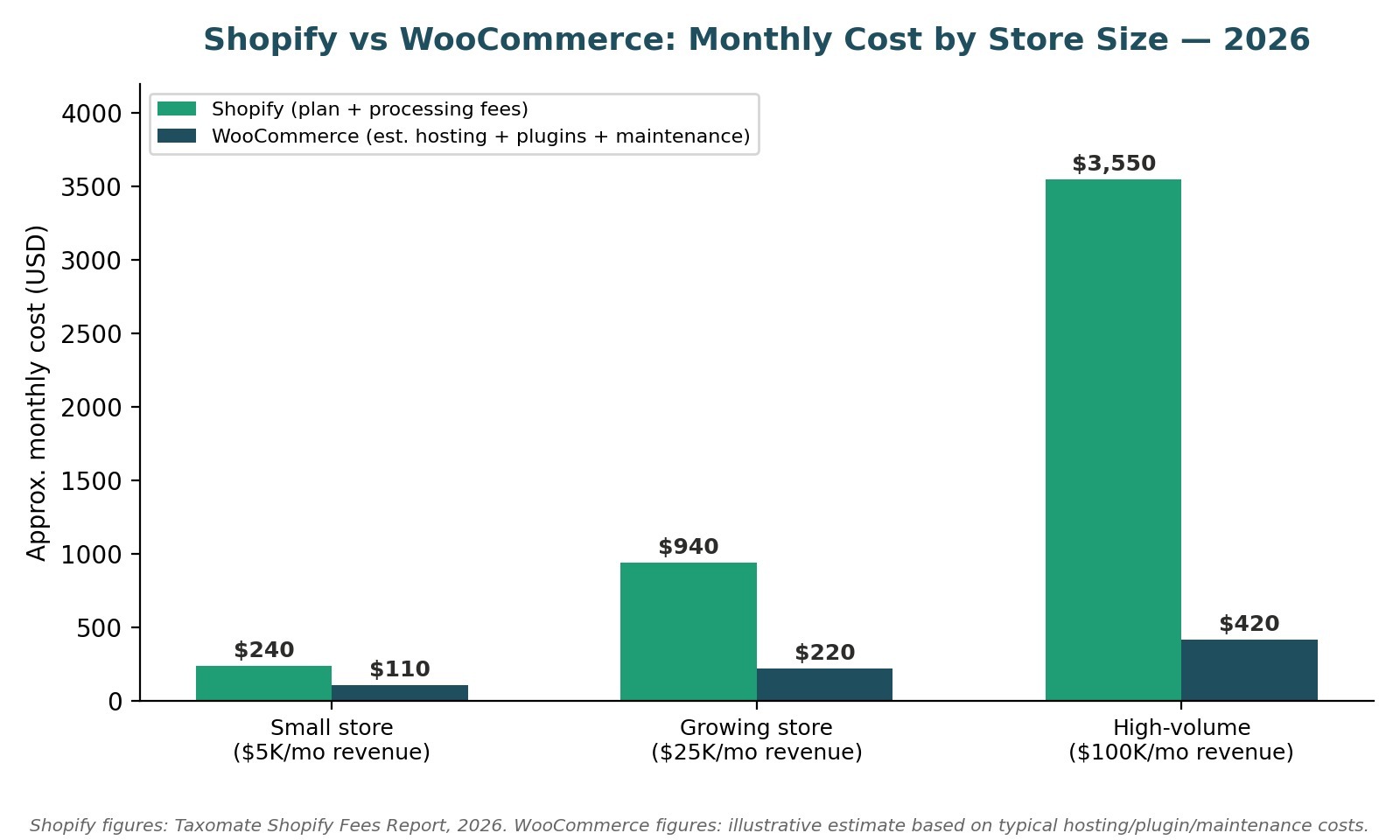
At $5,000/month in revenue, Shopify runs about $240/month (4.8% of revenue) versus roughly $110/month for a comparable WooCommerce setup. At $100,000/month in revenue, Shopify's cost climbs to around $3,550/month (3.5% of revenue), while WooCommerce's cost stays closer to $400–$500/month since it isn't tied to sales volume. The crossover point is real — small stores often find Shopify's convenience worth the premium; high-volume stores frequently find WooCommerce's flat cost structure wins decisively.
Feature-by-Feature Comparison
| Factor | Shopify | WooCommerce (WordPress) |
|---|---|---|
| Setup speed | Fast — live in days | Slower — more configuration required |
| Technical skill needed | Low | Moderate to high |
| Customization depth | Limited to Liquid theming | Full code access, build anything |
| Content marketing / SEO | Good, but structurally limited | Strong — full URL, schema, and content control |
| Checkout customization | Locked on standard plans; full control needs Shopify Plus ($2,300+/mo) | Fully customizable at no extra platform cost |
| Hosting & security | Fully managed by Shopify | Self-managed (or via a managed WordPress host) |
| App/plugin ecosystem | Large, curated app store | Even larger — full WordPress + WooCommerce plugin ecosystem |
| Platform fees at scale | Grows with revenue | Stays roughly fixed |
Where Shopify Wins
- Speed to launch — a usable store can go live in days, not weeks
- Zero server management — hosting, security, and uptime are entirely Shopify's problem
- Checkout conversion — Shopify's checkout is heavily optimized and widely trusted by shoppers
- Predictability for beginners — one monthly bill, minimal technical decisions
Where WooCommerce / WordPress Wins
- Content-driven growth — if blog content, SEO, or organic search is core to the strategy, WordPress development gives far more structural control than Shopify's theming system
- No mandatory platform cut — no percentage-of-revenue fee as the store scales
- Deep customization — complex product configurators, custom workflows, and unique business logic without hitting a platform ceiling
- Full data and code ownership — no vendor lock-in if you ever want to migrate or rebuild
Who Should Choose Shopify in the USA
- Solo US founders and early-stage D2C brands doing under $50K/month
- American teams with no developer resources who want a fully managed solution
- Businesses prioritizing fast launch over deep customization
Who Should Choose WooCommerce in the USA
- USA-based businesses where content, blogging, or local SEO is the primary growth channel
- Teams that already run their site on WordPress and want to add a store without switching platforms
- High-volume US stores where a percentage-of-revenue fee would become expensive
- Businesses needing custom workflows, product configurators, or checkout logic beyond what Shopify's standard plans allow
Frequently asked questions
Is WordPress cheaper than Shopify?
At small scale, costs are roughly comparable once hosting and plugins are factored in. At high sales volume, WooCommerce is usually significantly cheaper since it has no percentage-of-revenue platform fee.
Is Shopify easier to use than WooCommerce?
Yes — Shopify is built specifically for e-commerce and requires far less technical setup. WooCommerce requires more configuration but rewards that effort with more flexibility.
Can I switch from Shopify to WordPress/WooCommerce later?
Yes, migration is possible in both directions, though it involves redirect planning, data migration, and some SEO risk if not handled carefully.
Which platform is better for SEO?
WordPress generally offers deeper SEO control — full schema flexibility, custom URL structures, and content-type flexibility — which matters most for businesses relying on organic search and content marketing.
Does Shopify or WooCommerce handle high traffic better?
Both can handle high traffic, but Shopify's infrastructure is managed for you automatically. WooCommerce can match or exceed that performance, but it requires proper hosting and optimization.
Conclusion
There's no universally "better" platform — only the one that fits a specific business's volume, technical resources, and growth strategy. Shopify trades ongoing cost for convenience and speed. WordPress and WooCommerce trade upfront setup effort for long-term control and a cost structure that doesn't grow with revenue. The right call depends less on which platform is more popular, and more on where the business is headed over the next two to three years.