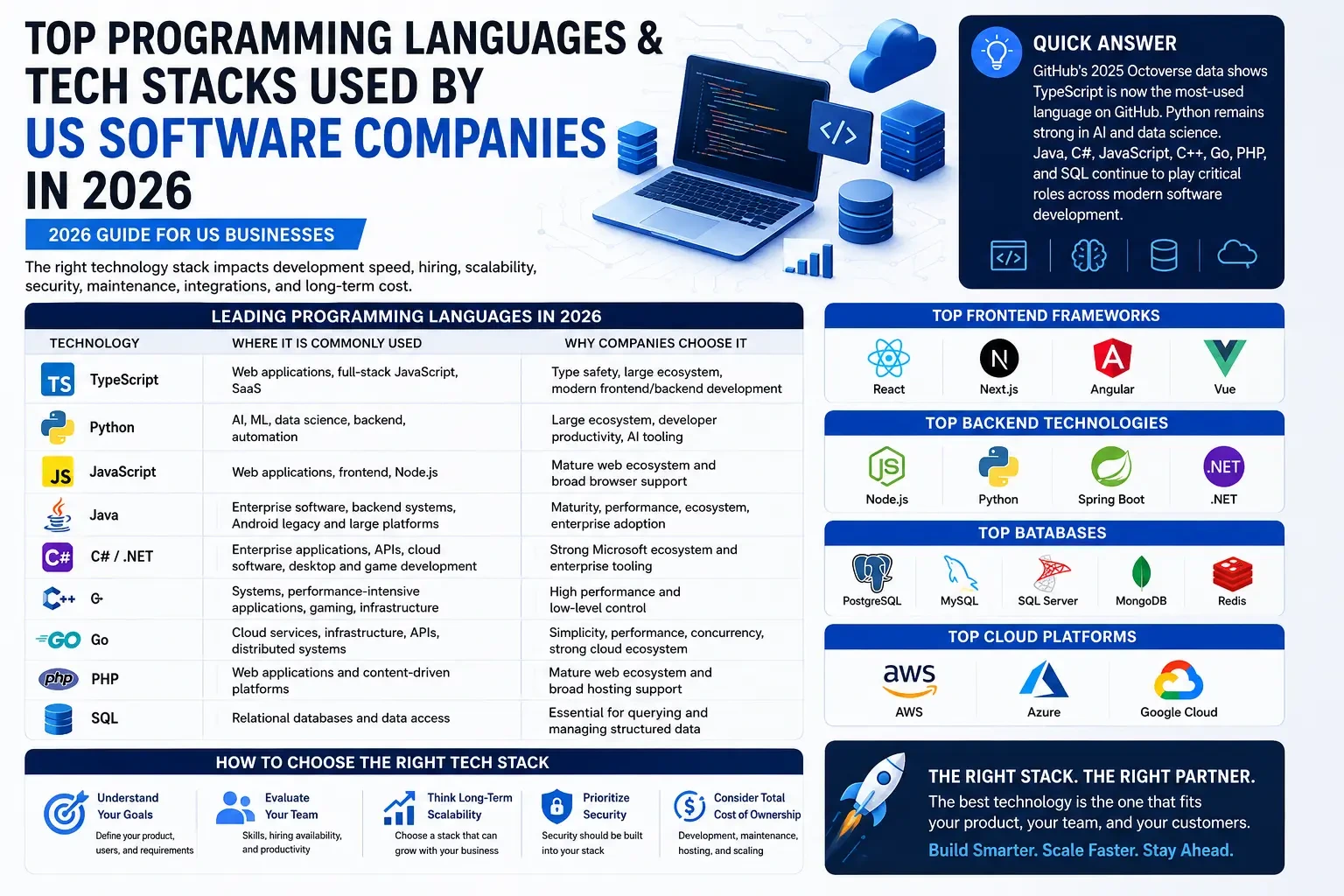
Choosing a technology stack is one of the most important technical decisions a software company makes. The languages, frameworks, databases, and infrastructure selected for a product can influence development speed, hiring, scalability, security, maintenance, integrations, and long-term cost.
In 2026, there is no single programming language that is best for every software project. TypeScript has gained significant momentum in modern application development, while Python remains especially important for AI, machine learning, data science, automation, and backend development. Java, C#, JavaScript, C++, Go, PHP, and SQL continue to play important roles across different types of software.
The more useful question for a US business is not simply, "What is the most popular programming language?" It is: "Which technology stack best fits what we are building, who will use it, and how it needs to grow?"
This guide explores the major programming languages, frameworks, databases, cloud platforms, and development tools used in modern software development and explains how businesses can choose a stack without following technology trends blindly.
Quick Answer: Which Programming Languages Are Most Important in 2026?
The most important programming language depends on the type of software being built. GitHub's 2025 Octoverse data reported that TypeScript became the most-used language on GitHub in August 2025, overtaking Python and JavaScript. Python remains particularly strong in AI and data science, while Java, C#, C++, PHP, Go, JavaScript, and SQL continue to support major software workloads.
Stack Overflow's 2025 Developer Survey also shows strong adoption across technologies such as Python, JavaScript, SQL, and other major development tools.
| Technology | Commonly Used For | Why Companies Choose It |
|---|---|---|
| TypeScript | Web applications, full-stack JavaScript, SaaS | Type safety, large ecosystem, modern web development |
| Python | AI, ML, data science, backend, automation | Large ecosystem, productivity, AI tooling |
| JavaScript | Web applications, frontend, Node.js | Mature web ecosystem and broad browser support |
| Java | Enterprise software, backend systems, large platforms | Maturity, performance, ecosystem |
| C# / .NET | Enterprise applications, APIs, cloud software | Strong Microsoft ecosystem and enterprise tooling |
| C++ | Systems, performance-intensive applications, gaming | Performance and low-level control |
| Go | Cloud services, infrastructure, APIs, distributed systems | Simplicity, performance, concurrency |
| PHP | Web applications and content-driven platforms | Mature ecosystem and broad hosting support |
| SQL | Relational databases and data access | Essential for querying structured data |
What Is a Technology Stack?
A technology stack is the combination of programming languages, frameworks, databases, infrastructure, development tools, and services used to build and operate a software product.
For example, a modern SaaS application might use TypeScript and React on the frontend, Node.js on the backend, PostgreSQL for data, AWS for cloud infrastructure, Docker for containerization, and GitHub Actions for CI/CD.
Another product might use Python, Django, PostgreSQL, Azure, and .NET-based services. Neither stack is automatically better. The right choice depends on the product's requirements, team capabilities, scalability needs, security considerations, and long-term goals.
The Most Important Programming Languages for US Software Companies in 2026
1. TypeScript
TypeScript has become one of the most important languages for modern application development. GitHub reported that TypeScript overtook Python and JavaScript as the most-used language on GitHub in August 2025.
Its static typing can make large codebases easier to maintain and provides additional structure for teams working with modern and AI-assisted development tools.
Common technologies around TypeScript include React, Next.js, Angular, Node.js, NestJS, and other tools across the JavaScript ecosystem.
Best for: Modern web applications, SaaS products, full-stack applications, APIs, and teams that want a strongly typed JavaScript ecosystem.
2. Python
Python remains one of the most important technologies in software development, especially for AI, machine learning, data science, automation, and backend services.
GitHub's 2025 data showed Python remaining dominant in AI-focused repositories. Its ecosystem includes frameworks and libraries such as Django, FastAPI, Flask, pandas, NumPy, PyTorch, and TensorFlow.
Best for: AI and ML applications, data platforms, automation, backend services, analytics, and rapid product development.
3. JavaScript
JavaScript remains fundamental to web development even as TypeScript adoption grows. The JavaScript ecosystem powers frontend applications and also supports backend development through Node.js and related frameworks.
JavaScript is mature, widely supported, and backed by a large ecosystem of libraries, frameworks, tools, and developers.
Best for: Web applications, frontend development, browser-based products, Node.js services, and projects that need broad ecosystem support.
4. Java
Java continues to play an important role in enterprise software and large-scale backend systems. Its maturity, ecosystem, performance characteristics, and long history in enterprise development make it a common choice for organizations with complex systems and long-term maintenance requirements.
Java is frequently used with frameworks such as Spring and Spring Boot for APIs, microservices, and enterprise applications.
Best for: Enterprise systems, backend services, financial applications, large organizations, and long-lived software platforms.
5. C# and .NET
C# and the .NET ecosystem remain important for enterprise software, APIs, cloud applications, desktop applications, and other business systems.
The Microsoft ecosystem provides integrations with Azure, Visual Studio, SQL Server, Microsoft identity services, and many enterprise technologies.
Best for: Microsoft-centric organizations, enterprise applications, APIs, cloud software, internal business systems, and teams already invested in .NET.
6. C++
C++ remains important where performance, memory control, and low-level capabilities matter. It continues to be used in systems software, gaming, performance-intensive applications, infrastructure, and some AI and inference workloads.
Its learning curve and complexity can make it less suitable for ordinary business applications when higher-level languages can meet the requirements.
Best for: High-performance software, systems, gaming, infrastructure, embedded applications, and performance-sensitive workloads.
7. Go
Go is widely associated with cloud infrastructure, backend services, distributed systems, APIs, and developer tooling. Its relatively simple syntax, fast compilation, concurrency model, and strong standard library make it attractive for services that need reliable performance.
Best for: Cloud services, APIs, microservices, infrastructure, networking, and distributed systems.
8. PHP
PHP remains relevant for web development, content-driven platforms, ecommerce systems, and large numbers of existing web applications.
Frameworks such as Laravel provide modern application-development capabilities, while the large installed base of PHP applications means the language remains important for maintenance and modernization as well as new development.
Best for: Web applications, ecommerce, content platforms, Laravel projects, and modernization of existing PHP systems.
9. SQL
SQL is not a general-purpose application language in the same sense as TypeScript or Python, but it is essential to modern software development. Most business applications need to store, retrieve, filter, aggregate, and update structured data.
SQL skills are therefore important across backend development, analytics, data engineering, and application development.
Best for: Relational databases, reporting, analytics, application data access, and business systems.
How AI Is Changing Programming Language Choices in 2026
AI is influencing software development, but it has not eliminated the importance of established programming languages.
GitHub's 2025 data showed a major increase in AI-related development and reported that TypeScript became the most-used language on GitHub. Python also remained especially dominant in AI-focused repositories.
This suggests that AI is influencing language selection in different ways. TypeScript benefits from its strong position in modern application development, while Python remains deeply connected to machine learning, data science, model development, and AI tooling.
AI coding tools also make code quality, testing, typing, documentation, and code review more important. A language that gives developers stronger structural feedback can be valuable when teams are reviewing AI-generated or AI-assisted code.
The lesson for businesses is simple: do not choose a programming language solely because AI tools can generate code for it. Choose a technology that your team can test, secure, maintain, and operate reliably.
Top Frontend Frameworks and Technologies in 2026
React
React remains a leading choice for modern web interfaces. Its component model and large ecosystem make it suitable for dashboards, SaaS products, customer portals, and complex web applications.
Next.js
Next.js extends the React ecosystem with capabilities for full-stack applications, routing, rendering, APIs, and deployment workflows. It is commonly considered for modern web products that need both frontend and server-side capabilities.
Angular
Angular remains relevant for enterprise applications that benefit from a structured framework, strong conventions, and TypeScript-based development.
Vue
Vue provides a flexible frontend framework that can be used for interfaces ranging from smaller applications to larger web products. It remains a practical choice when a team values progressive adoption and a relatively approachable ecosystem.
Frontend Framework Comparison
| Technology | Common Use | Strength |
|---|---|---|
| React | Web interfaces and application frontends | Large ecosystem and component model |
| Next.js | SaaS, dashboards, portals, complex web apps | Full-stack capabilities and deployment workflows |
| Angular | Enterprise applications | Structure and strong conventions |
| Vue | Web applications and interfaces | Flexibility and progressive adoption |
Backend Technologies and Frameworks
Backend technology choices depend heavily on application requirements, team expertise, performance needs, integrations, and long-term maintenance. There is no single backend framework that is best for every business.
Node.js
Node.js is widely used for APIs, web applications, real-time services, and JavaScript or TypeScript-based backend development. It can be particularly useful when teams want to use a common language across frontend and backend applications.
Python: Django and FastAPI
Django provides a mature framework for web applications, while FastAPI is well suited to modern APIs and Python-based backend services. Python-based backends can be especially useful when AI, machine learning, analytics, or data workloads are central to the product.
Databases Used by Modern Software Companies
Database selection should follow the application's data model, consistency requirements, scale, integrations, and team expertise rather than popularity alone.
PostgreSQL
PostgreSQL is a strong general-purpose relational database choice for many web applications, SaaS products, analytics systems, and enterprise workloads.
MySQL
MySQL remains widely used for web applications and business systems, supported by a mature ecosystem and broad hosting availability.
MongoDB
MongoDB is a document-oriented database that can be useful when applications benefit from flexible document structures and specific scalability patterns.
Cloud Platforms and Infrastructure
Cloud infrastructure has become an important part of modern software development. AWS, Microsoft Azure, and Google Cloud all provide extensive services for hosting applications, databases, storage, networking, analytics, AI, and infrastructure automation
| Platform | Common Strength |
|---|---|
| AWS | Broad cloud service ecosystem |
| Microsoft Azure | Strong Microsoft and enterprise integration |
| Google Cloud | Strong data and AI capabilities |
No cloud platform is universally better. The right choice depends on the organization's existing technology environment, technical requirements, compliance needs, team expertise, and long-term strategy.
Containers, DevOps, and Production Reliability
Modern production systems increasingly rely on containers, CI/CD, infrastructure automation, monitoring, testing, and deployment safety.
Docker, Kubernetes, managed cloud services, and infrastructure automation remain important for teams operating distributed production systems.
What Technology Stack Should a Startup Use?
Startups should generally prioritize speed of learning, maintainability, hiring, security, and the ability to scale without unnecessary complexity.
For many web-based startups, a TypeScript-based frontend and backend can reduce the number of languages a team needs to manage. For AI-heavy products, Python may be essential for model and data workloads while TypeScript handles the product interface.
The right startup stack is the one that lets the team validate the product quickly while leaving a reasonable path for future growth.
What Technology Stack Should an Enterprise Use?
Enterprise companies usually need to consider more than developer popularity. Existing systems, identity providers, compliance, internal skills, vendor relationships, data governance, support requirements, and long-term architecture can strongly influence technology choices.
A Microsoft-heavy organization may benefit from .NET and Azure because they integrate naturally with existing systems and skills. Another organization with a large Java ecosystem may prefer Spring-based services.
Top Tech Stack Mistakes to Avoid
- Choosing the most popular language automatically
- Using too many technologies
- Ignoring hiring and talent availability
- Over-engineering an MVP
- Ignoring long-term cost
- Selecting tools without a clear reason
How Much Does the Technology Stack Affect Software Development Cost?
Technology is one factor in development cost, but it is rarely the only factor. Project scope, complexity, team size, integrations, security, testing, timeline, and infrastructure can have a larger effect.
A specialized stack may require engineers with less common skills, while a cloud-heavy architecture may introduce ongoing infrastructure costs. Enterprise technologies can involve licensing or specialized support, while open-source technologies can still require engineering and maintenance investment.
For a broader breakdown of development pricing, see our guide to Software Development Cost in the USA.
When comparing development proposals, ask the agency to explain why its recommended stack fits the project rather than choosing a proposal simply because it uses a familiar or fashionable technology.
Questions to Ask a Software Development Company About Its Tech Stack
- Why did you recommend this technology stack?
- Why is this stack appropriate for our product?
- What are the main technical trade-offs?
- How easy will it be to hire developers for this stack?
- How will the architecture scale?
- How will you test and secure the application?
- What cloud infrastructure will the product require?
- What will our ongoing infrastructure costs look like?
- How will the application be monitored after launch?
- What happens if we need to change or replace part of the stack later?
- Who owns the source code and infrastructure accounts?
- How will the stack support future integrations and features?
Technology Trends US Software Companies Should Watch in 2026
TypeScript's Continued Growth
GitHub's 2025 data shows TypeScript's rise to the top of its language rankings. Its position in modern frontend and full-stack frameworks makes it an important technology to watch.
Python and AI Development
Python remains central to AI and machine learning. GitHub reported that nearly half of new AI projects in its 2025 data were built primarily in Python, reinforcing its role in the AI ecosystem.
AI-Assisted Development
AI coding tools are becoming part of normal development workflows. This increases the importance of code review, testing, security, documentation, and clear architecture rather than reducing their importance.
Containers and Cloud-Native Development
Docker, Kubernetes, CI/CD, managed cloud services, and infrastructure automation remain important for teams operating modern production systems.
Stronger Attention to Production Reliability
As software becomes more distributed and AI-assisted development increases the pace of change, observability, testing, deployment safety, and security become increasingly important.
Frequently Asked Questions
Frequently asked questions
What is the most popular programming language in 2026?
There is no single answer because different rankings measure different things. GitHub's 2025 Octoverse data reported TypeScript as the most-used language on GitHub in August 2025, while Python remains especially strong in AI and data science.
Is TypeScript better than JavaScript?
Not universally. TypeScript adds static typing and can provide stronger structure for large applications, while JavaScript remains widely used with an enormous ecosystem. The choice depends on the project and team.
Is Python still important for software development in 2026?
Yes. Python remains highly important for AI, machine learning, data science, automation, and backend development.
What is the best tech stack for SaaS development?
There is no universal SaaS stack. TypeScript with React or Next.js, a Node.js backend, PostgreSQL, and a major cloud platform can be a strong option for many products. Python-based stacks can be particularly useful when AI or data workloads are central.
What is the best programming language for AI software?
Python is a leading choice because of its extensive AI, machine learning, and data-science ecosystem. Other languages such as TypeScript, C++, Java, and Go may also be used for application layers, infrastructure, performance-sensitive components, or production services.
Should a startup use the latest technology?
Not necessarily. Startups should prioritize technologies that help them validate the product quickly while remaining maintainable, secure, and supportable.
Which database is best for a SaaS application?
PostgreSQL is a strong choice for many SaaS applications because it supports complex relational data, transactions, and a wide range of application workloads. However, the best database depends on the product's data model, scale, consistency requirements, and technical architecture.
Is AWS better than Azure or Google Cloud?
No cloud platform is universally better. AWS offers a broad range of infrastructure services, Azure can be particularly suitable for Microsoft-centric organizations, and Google Cloud is strong for data, analytics, AI, and machine learning workloads. The right choice depends on your existing technology environment, requirements, team expertise, and long-term strategy.
Does the technology stack affect software development cost?
Yes, but the technology stack is only one factor. Project scope, complexity, integrations, security, testing, team size, infrastructure, and timeline can have a larger impact on overall development cost.
Should I hire a software development company based on its technology stack?
No. A technology stack should be evaluated alongside the company's experience, architecture decisions, development process, security practices, communication, scalability approach, and post-launch support. The best stack is only useful when the team knows how to build and maintain it properly.
Can AI replace software developers?
AI can accelerate coding, testing, documentation, and other development tasks, but it does not eliminate the need for software engineering judgment. Businesses still need developers who can design architecture, review code, handle security, test systems, make technical decisions, and operate software reliably.
How often should a company change its technology stack?
Companies should not change their technology stack simply because a newer technology becomes popular. A change should be considered when the existing technology creates significant problems with performance, security, maintainability, scalability, hiring, or business requirements.
Final Verdict: Choosing the Right Programming Language and Tech Stack in 2026
The strongest technology stack is not necessarily the one with the most fashionable tools. It is the one that fits the product, team, budget, security requirements, scalability needs, and long-term business goals.
Before choosing a stack, evaluate the problem you are solving, the users you need to support, the skills available to your team, the integrations you require, and how the product is expected to grow.
TypeScript, Python, JavaScript, Java, C#, C++, Go, PHP, and SQL all continue to have important roles in modern software development. The right choice depends on how each technology fits your specific requirements.
A good technology stack should help your business build efficiently today while keeping the product maintainable, secure, scalable, and adaptable tomorrow.
Need Help Choosing the Right Technology Stack?
Choosing the right technology stack can be difficult when you are balancing development speed, technical requirements, hiring, security, scalability, and long-term cost.
If you are planning a new software product or modernizing an existing application, a development partner can help you evaluate the requirements and select an architecture that fits your business goals.