
Picking a custom software development company feels a lot like hiring a surgeon. You cannot see the work while it happens. You only feel the results later. Choose well and the software runs your business for years. Choose badly and you pay twice, once for the failed build and again for the rescue.
This guide is written for founders and operations leaders who have decided to build. You know what you want. Now you need a partner who can deliver it. Below are the signals that separate a strong custom software development company from a costly mistake, backed by 2026 market data and a copy-ready question list you can use on your first call.
The stakes are higher than most buyers expect. A software build is rarely a one-time purchase. It becomes the system your team logs into every day, the tool your customers touch, and the record of how your business runs. When it works, it quietly saves hours. When it fails, it drains money and morale at the same time. So the choice of partner is not a small decision. It shapes the next few years.
What a Custom Software Development Company Actually Does
A custom software development company builds software from scratch, shaped around your exact process. Off-the-shelf tools force you to bend your workflow to fit their design. Custom software does the opposite. It fits you.
The best firms handle the full journey. They scope the idea, design the flow, build the product, test it, and support it after launch. A named team owns each part. Nothing gets tossed to a junior bench you never meet.
Think of the difference between renting a suit and having one tailored. A rented suit fits well enough for a day. A tailored one fits only you, and it lasts. Custom software is the tailored option. It costs more up front, but it moves with your business instead of holding it back. That is why growing companies eventually reach for it.
A good company also pushes back when it should. If your idea is too big for a first release, a strong partner tells you. If a cheaper path exists, they point to it. That honesty is worth more than a polished pitch, because it saves you money before you spend it.
Fact: According to Clutch's 2025 benchmark data, the average custom software project costs around $132,480 and takes about 13 months to complete. Scope and team quality explain most of the gap between quotes.
What Custom Software Really Costs in 2026
Price is the first question every buyer asks. The honest answer is a range, because scope drives the number. Here is what the 2026 market looks like, pulled from recent industry pricing guides.
| Project tier | Typical 2026 cost | Rough timeline |
|---|---|---|
| Simple MVP or internal tool | $25,000 to $75,000 | 2 to 4 months |
| Mid-complexity web platform | $75,000 to $250,000 | 4 to 9 months |
| Enterprise-grade system | $250,000 to $1,000,000+ | 12 months and up |
Region shapes the rate too. In 2026, senior US developers bill roughly $125 to $250 per hour. Eastern European senior talent runs about $55 to $95. Indian rates sit near $25 to $55. A hybrid team can blend these, so you get senior oversight in your time zone and a wider build team at a lower rate.
Do not let the lowest hourly rate decide for you. A cheap rate with poor communication can cost more in the end, because rework eats the savings. What matters is the total cost to reach a working product, not the price of a single hour. A senior team that ships clean code the first time often beats a cheaper team that ships twice.
One more number deserves your attention. Many buyers forget to budget for the work that happens after launch. Plan for roughly 10% to 20% of the build cost each year for maintenance and improvements. Software is a living thing. It needs care, or it slowly decays.
Seven Signals of a Strong Partner
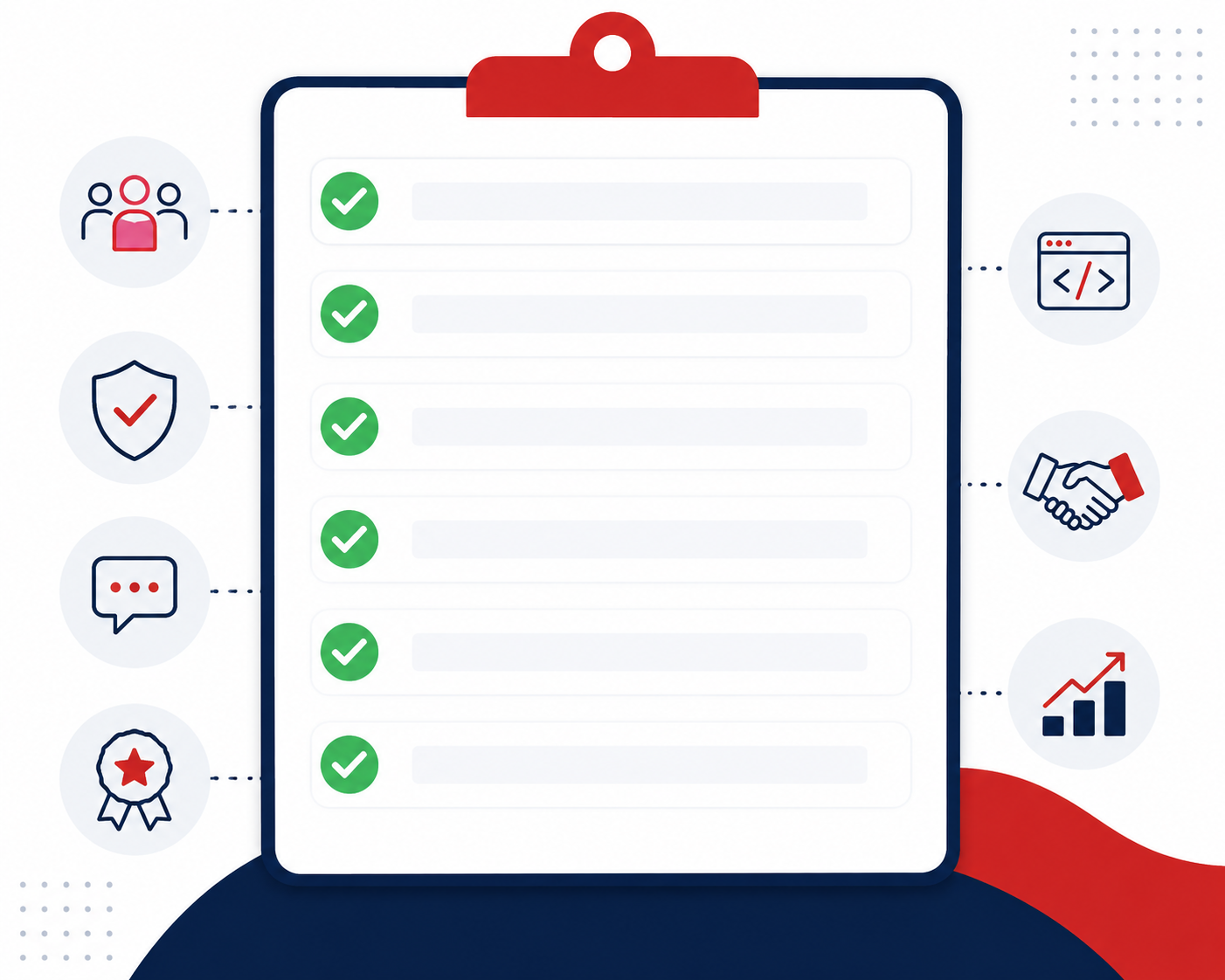
- A named, public team. You can see who will build your product, not an anonymous bench.
- A written scope. Features, timeline, and price are in a document before work starts.
- A clear cadence. The firm ships in predictable sprints and shows progress often.
- Real case studies. Named clients and measurable results, not vague logos.
- Honest pricing. The quote lists what you get and flags what could change.
- A post-launch plan. Support, maintenance, and ownership are spelled out.
- Verified proof. Reviews, ratings, and credentials you can check yourself.
Five Red Flags to Watch For
Some warning signs show up early. Learn to spot them and you save months of pain.
- Vague scope. If no one can tell you what you are buying, the budget will drift. Unclear requirements cause a large share of failed projects.
- No named team. You should meet the people doing the work, not just a salesperson.
- A price that seems too low. The cheapest quote often hides the most rework.
- Weak communication. If replies are slow before you pay, they will be slower after.
- No timeline in writing. A promise you cannot point to is not a promise.
Fact: Research on IT projects shows that more than half exceed their original budget, and unclear scope is the single biggest cost multiplier. Planning depth is what separates a smooth build from a runaway one.
Questions to Ask on Your First Call
Bring this list to every sales call. The answers tell you almost everything.
- Who exactly will work on my project, and can I meet them?
- How do you scope and price the work?
- What does your sprint cadence look like week to week?
- What happens if the scope changes mid-build?
- How do you handle testing and security?
- What does support look like after launch?
- Can you share two clients I can contact?
In-House vs Agency vs Freelance
| Option | Best for | Watch out for |
|---|---|---|
| In-house team | Long-term products with steady work | High cost and slow hiring |
| Freelancer | Small, well-defined tasks | Uneven skill and single point of failure |
| Agency team | Full builds needing many skills | Pick one with a named, senior team |
A Simple Way to Decide
Start with your scope. Write down the one problem the software must solve. Then match that scope to the three options above. Interview two or three firms. Ask the questions on your list. Compare the answers, not just the prices.
Pay close attention to how each firm treats the first conversation. Do they listen more than they pitch? Do they ask about your business before they talk about their tools? A partner who wants to understand your problem will build the right thing. A partner who only wants to close the deal will build whatever earns the most.
Trust the partner who puts scope, timeline, and exit terms in writing. That single habit signals how the whole engagement will run. It is the clearest proof you are dealing with professionals.
Finally, trust your gut on communication. You will work with this team for months. If they are slow, vague, or dismissive now, that pattern will not improve later. Clear, prompt, and honest is what you want, from the first email to the final handoff.
Ready to scope your build? Book a 30-minute call with Digital Heroes and get a written plan and a fixed quote within 48 hours. No sales pitch. Just a clear path forward.