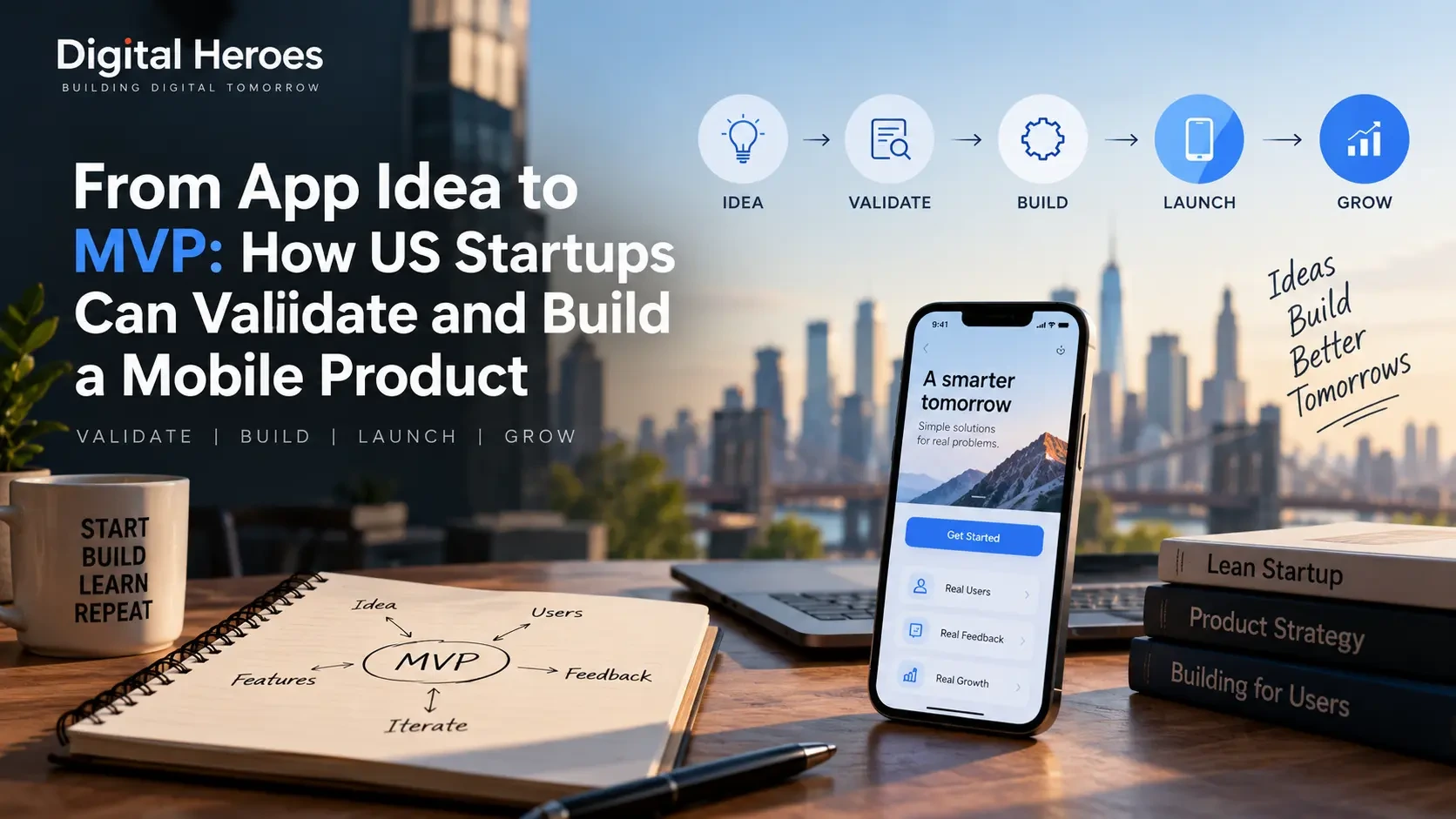
Quick Answer
For a US startup, the safest path from app idea to MVP is not to start coding immediately. First define the customer problem, validate the demand, narrow the first release to one core outcome, and then build the smallest production-ready product that can generate real user feedback. A strong MVP should be focused enough to launch quickly, but robust enough to measure whether users will actually use and value it.
The goal is not to prove that every planned feature works. The goal is to learn whether the product solves a meaningful problem for a specific audience, what users do after trying it, and what should be built next. For founders who need technical execution, an MVP development company can help turn a validated concept into a scoped product, while keeping discovery, design, architecture, development, testing, and launch connected.
What Does MVP Mean for a Startup?
A minimum viable product is the first version of a product designed to test a specific business or user assumption with real users. It is not simply a stripped-down app, a prototype that can never be used, or a list of unfinished features.
For a mobile product, the MVP might include account creation, one core workflow, a simple onboarding path, the minimum backend services required to support that workflow, analytics, and a small set of admin tools. Features such as advanced personalization, complex automation, multiple user roles, or deep integrations can often wait until the first release has produced evidence that they are worth the investment.
Why Validation Should Come Before Development
Startups face an expensive asymmetry: it is usually cheaper to change a product idea before development than after the team has built the architecture, screens, APIs, and integrations around it. Validation helps founders test the riskiest assumptions while the cost of change is still relatively low.
A practical validation process asks five questions:
- Who has the problem, and how often does it occur?
- What are people doing today instead of using your product?
- What would make them switch, sign up, return, or pay?
- Which single workflow must work for the product to be useful?
- What evidence would convince you to build more?
Validation does not require a huge research project. A founder can combine customer interviews, landing-page tests, clickable prototypes, waitlists, concierge experiments, and small pilot groups. The important part is connecting each test to a specific assumption rather than collecting feedback without a decision framework.
From App Idea to MVP: A Practical Validation Framework
| Stage | Main question | Useful output | Go / no-go signal |
|---|---|---|---|
| Problem | Is the problem real and painful enough? | Problem statement + target user | Users recognize the problem without explanation |
| Demand | Will people take action? | Landing page, waitlist, interviews | Meaningful sign-ups, replies, or pilot interest |
| Solution | Does the proposed workflow solve the problem? | Prototype or manual pilot | Users complete the core task and want to repeat it |
| MVP scope | What is the smallest useful release? | Prioritized feature list | Every included feature supports the core outcome |
| Build | Can the product work reliably for early users? | Production MVP | Real users complete the primary workflow |
| Learn | What should happen next? | Usage data + interviews | Evidence supports iteration, repositioning, or stopping |
How to Decide What Belongs in the MVP
The most common MVP mistake is turning the first release into a smaller version of the full product roadmap. A better approach is to identify the one user outcome that makes the product valuable and build around that outcome.
A feature belongs in the MVP when removing it would make the core workflow impossible, misleading, or unusable. A feature can usually wait when it mainly improves convenience, expands edge cases, adds advanced customization, or supports a future market that you have not validated yet.
- Must have: required for the core user journey.
- Useful later: valuable, but not necessary for the first learning cycle.
- Evidence needed: a feature that should be tested before being fully engineered.
- Do not build yet: attractive ideas with no evidence that they matter.
Choosing Native, Cross-Platform, or Another Approach
The technical approach should follow the product's requirements rather than becoming the first decision. Native iOS and Android can make sense when platform-specific behavior, performance requirements, or deep device capabilities are central to the product. Cross-platform development can be attractive when a shared codebase supports the required experience and helps a startup move through an early validation cycle efficiently.
For many startups, the better question is not “Which framework is best?” but “Which approach lets us ship the required workflow reliably, measure it, and change it without creating avoidable technical debt?”
For platform-specific planning and release requirements, startups can review the Apple App Review Guidelines.
What a Well-Scoped Mobile MVP Should Include
- A defined target user and one primary use case.
- A small set of user flows that directly support the core value proposition.
- A clear backend and data model for the MVP's actual needs.
- Authentication, permissions, and data handling appropriate to the product.
- Analytics for the events that matter to the business decision.
- Basic error handling, testing, monitoring, and app-store readiness.
- A simple admin or operational workflow when the product needs one.
- A post-launch feedback plan so the team knows what will be measured.
How an MVP Development Company Helps a US Startup
An MVP development company should do more than turn a founder's feature list into screens. The strongest partner helps challenge assumptions, shape the scope, select an appropriate architecture, design the core experience, build the product, test it, and prepare it for real users.
That matters because an MVP can fail in two opposite ways. It can be overbuilt, consuming time and runway before the startup has proof of demand. Or it can be underbuilt, creating a fragile experience that produces weak feedback because users cannot complete the job the product was supposed to solve.
For the implementation side, startups can also review our mobile app development services to understand the broader development capabilities available for turning a validated product concept into a working application.
- A discovery process that produces a written scope and clear assumptions.
- Experience with mobile product architecture, APIs, data, analytics, and app-store release requirements.
- A team that can explain what should be cut from the first release, not only what can be added.
- A testing process that includes real devices, operating-system versions, and the critical user journeys.
- Clear ownership of source code, product assets, documentation, and intellectual property.
- A post-launch plan for bug fixes, analytics review, and the next product decisions.
What the MVP Development Process Should Look Like
Android teams can also use Google Play testing tracks to test an MVP with selected users before a wider release.
- Discovery: Clarify the customer, business model, core workflow, constraints, and success criteria.
- Product Design: Map user flows, wireframes, and the smallest useful interface.
- Technical Planning: Define architecture, backend, data model, integrations, analytics, security boundaries, and deployment.
- Development: Build in small increments so the founder can review working product behavior.
- Quality Assurance: Test core journeys, devices, permissions, performance, APIs, and release requirements.
- Launch and Learn: Release to the intended audience, watch the agreed metrics, collect feedback, and make the next decision from evidence.
What Should You Measure After Launch?
An MVP is useful only when the team knows what it is trying to learn. The exact metrics depend on the product, but founders commonly need to watch activation, completion of the core workflow, retention, conversion, support issues, and qualitative feedback. Tools such as Firebase Analytics can help teams measure relevant user events.
Avoid collecting dozens of vanity metrics. Choose a small set of indicators tied to your core hypothesis. For example, a marketplace may care about successful matches and repeat transactions, while a workflow app may care about activation, task completion, and weekly retention.
Common MVP Mistakes US Startups Should Avoid
- Building the full roadmap first: The team spends runway before learning whether the first value proposition works
- Starting with technology instead of the customer problem: A polished technical solution can still solve the wrong problem.
- Trying to serve everyone: A broad audience makes the product and message harder to validate.
- Skipping analytics: Without event data, the team cannot tell what users actually do.
- Treating design as decoration: Poor onboarding or unclear flows can make a good idea look like a bad product.
- Ignoring operational work: Payments, notifications, moderation, admin processes, support, and data management may be necessary parts of the MVP.
- Choosing a vendor only on price: A cheap build that creates rework, unclear ownership, or weak quality can cost more overall.
How Much Should a Startup Invest Before Full Validation?
The right pre-MVP investment depends on how uncertain the idea is. A founder with strong customer evidence may move quickly into a tightly scoped build. A founder with a broad concept and little evidence may get more value from interviews, prototypes, landing-page experiments, or a short discovery engagement before committing to a production MVP.
For a U.S. startup, the key budgeting question is not “What is the cheapest MVP?” but “What is the smallest credible investment that gives us a useful answer?” That framing protects both runway and learning speed.
When Should You Move From Validation to Development?
A startup is usually in a stronger position to build when it can clearly describe the target user, the painful problem, the core workflow, the reason the solution is better than the current alternative, and the evidence it will use to judge the MVP.
You do not need perfect certainty. An MVP exists partly to create better evidence. But you should know which assumptions remain risky and make sure the first release is designed to test them.
Questions to Ask Before Hiring an MVP Development Company
- How will you help us reduce the scope to the smallest useful MVP?
- What assumptions do you think we should validate before development?
- Which architecture and development approach would you recommend for our first release, and why?
- What will be delivered in the MVP, and what is explicitly out of scope?
- How will analytics be implemented so we can measure the core workflow?
- Who owns the source code, design files, cloud accounts, and intellectual property?
- How will testing cover real devices, operating systems, integrations, and failure cases?
- What happens after launch when user feedback changes the roadmap?
A Practical Roadmap From Idea to MVP
| Phase | Primary goal | Founder decision |
|---|---|---|
| Validate | Confirm problem and user need | Is this problem worth solving? |
| Prototype | Test the core experience | Do users understand and want the workflow? |
| Scope | Define the smallest useful release | What must be in version one? |
| Build | Create a production-ready MVP | Is the core product reliable enough to launch? |
| Launch | Put the product in real users' hands | Are users activating and completing the core task? |
| Learn | Turn evidence into the next roadmap | Improve, reposition, expand, or stop? |
Need Help Turning Your App Idea Into an MVP?
A focused MVP starts with the right questions, scope, and technical decisions. When you are ready to move from validation into product development, a structured development process can help you turn the strongest version of your idea into something real users can test.
Frequently Asked Questions
How long does it take to build an MVP mobile app?
The timeline depends on the product scope, platforms, backend complexity, integrations, design requirements, and testing needs. A focused MVP can be planned and built much faster than a feature-heavy first release.
Do I need to validate my app idea before hiring a developer?
You do not need perfect validation, but you should understand the target user, problem, core workflow, and major assumptions before committing to a production MVP.
What should be included in a mobile MVP?
A mobile MVP should include the smallest set of flows and technical capabilities required to deliver and measure its core value proposition. Authentication, backend services, analytics, testing, and operational tools may also be necessary depending on the product.
Should a startup choose native or cross-platform development?
The decision should follow product requirements. Native development may suit products that depend heavily on platform-specific behavior or device capabilities, while cross-platform development can be useful when a shared codebase supports the required experience.
How do I choose an MVP development company?
Look for a partner that can help with discovery, scope reduction, product design, architecture, development, testing, launch, ownership, and post-launch learning - not simply one that promises to build every requested feature.
How do I avoid overbuilding my MVP?
Identify the one outcome that makes the product valuable and test every proposed feature against that outcome. Features that do not support the core learning cycle can usually wait.
What should happen after the MVP launches?
Track the metrics tied to the core hypothesis, collect user feedback, identify what worked and what did not, and use the evidence to decide whether to improve, reposition, expand, or stop.
Final Takeaway
The path from app idea to MVP is not a straight line from concept to code. For a US startup, the stronger process is to validate the problem, test the riskiest assumptions, define one valuable workflow, and then build a focused product that can generate trustworthy feedback.
An experienced MVP development company can reduce execution risk by connecting product strategy, UX, engineering, testing, and launch into one process. But the best outcome does not come from building the most features. It comes from learning quickly, protecting runway, and using real user evidence to decide what the product should become next.