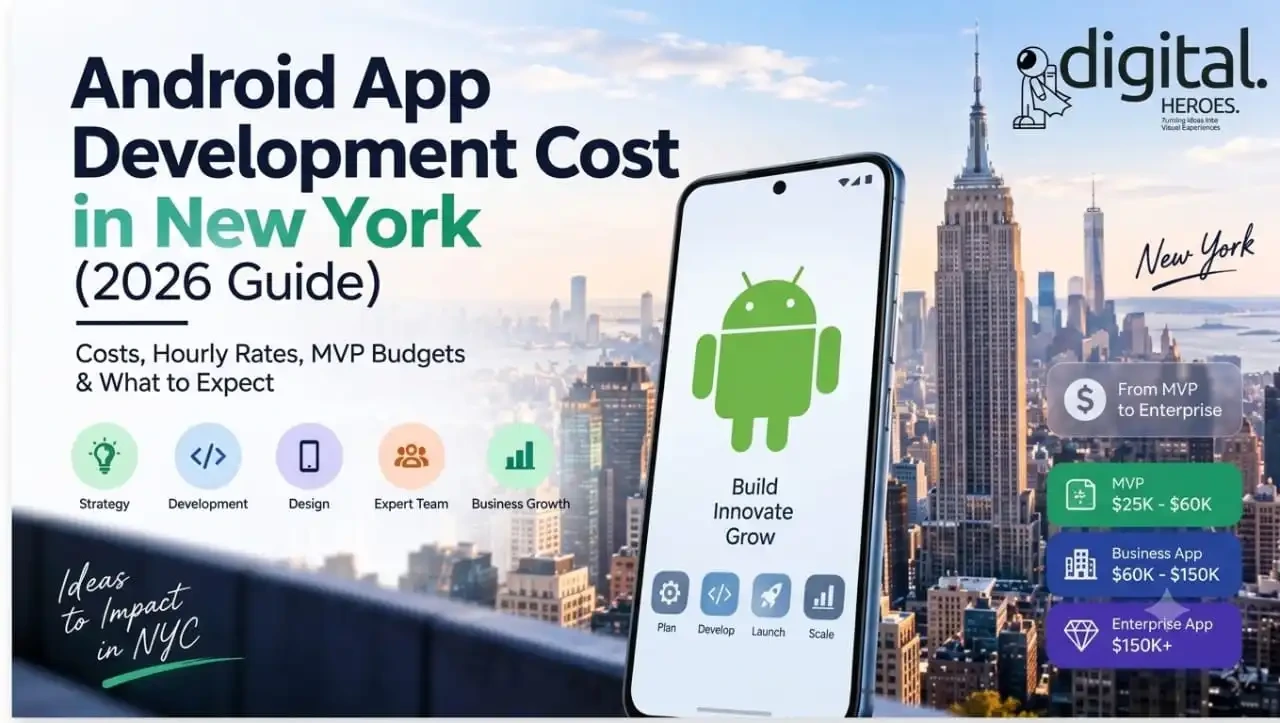
Android app development in New York can cost around $25,000–$60,000 for a focused MVP, $60,000–$150,000 for a mid-complexity business application, and $150,000–$300,000 or more for advanced enterprise-grade products. These are planning ranges rather than an official New York market average. The final cost depends on features, UI/UX requirements, backend architecture, integrations, security, testing, development resources, and post-launch support.
The most useful way to estimate an Android app budget is to look beyond the hourly rate. A lower hourly rate can still produce a higher total project cost if the development process takes longer or requires additional specialists. Similarly, a higher rate can make sense when it includes experienced engineering, product design, quality assurance, project management, security, and post-launch support.
Android App Development Cost in New York: Quick Planning Ranges
For early budgeting, Android applications can be grouped into three broad planning categories. A focused MVP generally contains the essential functionality needed to validate an idea or launch an initial product. A mid-complexity business application typically includes multiple user flows, backend services, integrations, notifications, analytics, and more extensive testing. Advanced enterprise applications can involve complex workflows, large-scale infrastructure, security requirements, third-party systems, and ongoing development.
| App Type | Planning Cost | Typical Timeline |
|---|---|---|
| Focused Android MVP | $25,000–$60,000 | 3–5 months |
| Mid-Complexity Business App | $60,000–$150,000 | 5–8 months |
| Advanced / Enterprise App | $150,000–$300,000+ | 8–12+ months |
These ranges are editorial planning bands, not statistical New York market averages or fixed provider quotes. Actual project costs vary according to scope, team composition, technical requirements, integrations, testing, and delivery expectations.
What Is the Formula for Calculating Android App Development Cost?
A practical way to build an initial Android development budget is to estimate the required development hours, multiply those hours by an appropriate blended hourly rate, and then account for costs outside core development. These may include infrastructure, third-party services, app launch requirements, analytics, monitoring, and ongoing maintenance.
Total Android App Budget = (Estimated Hours × Blended Hourly Rate) + Third-Party Services + Infrastructure + Launch + Maintenance
Example: If a project requires 1,500 hours at a hypothetical blended rate of $80 per hour, the core development calculation would be $120,000 before additional infrastructure, third-party services, launch, and maintenance expenses. This is a hypothetical planning example, not a market quote.
Why Android App Development Costs More in Some New York Projects
New York development costs vary because projects require different levels of product strategy, engineering expertise, design, testing, infrastructure, and management. A simple application with a few screens and limited backend functionality is fundamentally different from an application that handles payments, real-time communication, sensitive information, complex integrations, or thousands of users.
Location also affects pricing, but it should not be treated as the only factor. Directory listings can include distributed, remote, or offshore delivery teams, while a New York-based product team may have significantly different operating costs and team structures. This is why comparing headline hourly rates without comparing scope can produce misleading conclusions.
What Is the Android Developer Hourly Rate in New York?
Published directory and provider rates can vary substantially, so there is no single hourly rate that accurately represents every Android developer or development company in New York. Rates may differ according to experience, specialization, team structure, location, project complexity, and whether the provider is an individual freelancer, distributed team, boutique agency, or larger product development company.
Why GoodFirms' $37/Hour Median Needs Context
GoodFirms' reported $37 per hour median is useful as a directory-level reference, but it should not be presented as the typical price of a New York-based Android engineering team. The same $37 hourly median appears across multiple GoodFirms categories and geographies, which makes it a useful illustration of why directory-wide medians should not automatically be interpreted as local agency billing rates.
For a business comparing New York providers, the more meaningful question is what the quoted rate includes. Engineering seniority, product management, UI/UX, backend development, QA, infrastructure, security, and post-launch support can significantly change the total project investment.
| Source / Provider Type | Published Rate Signal | How to Interpret It |
|---|---|---|
| GoodFirms directory | Around $37/hr median | Directory-level benchmark; not a NYC agency average |
| Clutch listings | Varies by company | Compare individual provider profiles and project scope |
| NGS Solution | $80–$250/hr range | Attribute specifically to the published source |
| Freelance / distributed providers | Can be lower | Team coverage and delivery responsibility may differ |
| New York product agencies | Often higher | May include broader product and delivery capabilities |
Published rates are snapshots and can change. Always verify the source, geography, provider type, and date before using an hourly rate to compare vendors.
What Actually Drives Android App Development Cost?
The largest cost differences usually come from the application's scope rather than Android development itself. Features such as user authentication, payments, location services, chat, subscriptions, real-time updates, offline functionality, advanced dashboards, third-party integrations, and administrative systems can increase both development hours and testing requirements.
The development process also includes work that may not be visible in the finished application. Product discovery, architecture, database design, API development, quality assurance, security testing, deployment, analytics, crash monitoring, and project management all contribute to the final budget.
App Features and User Experience
The number of screens, user journeys, account types, forms, dashboards, and interactive components affects development effort. A simple application with a straightforward user journey can be relatively efficient to build, while an application with multiple roles and highly customized workflows requires more product design, development, and testing.
Backend and API Requirements
An Android application rarely operates entirely on the device. Many products require APIs, databases, authentication systems, cloud infrastructure, administrative dashboards, payment processing, notifications, analytics, or connections to external platforms. When these backend components are part of the project, the budget needs to account for both Android engineering and backend development.
Android Device Fragmentation and Testing
Android applications need to work across a wide range of devices, screen sizes, manufacturers, and operating-system versions. Depending on the target audience, testing may involve devices from manufacturers such as Samsung, Google Pixel, and Motorola, along with newer form factors such as foldable devices. Supporting a broader device range can increase testing and quality-assurance requirements.
Security, Permissions, and Background Processing
Applications that use sensitive information, location, payments, files, notifications, or background activity require additional engineering consideration. Android's permission model, background execution behavior, data protection requirements, and application lifecycle can all affect implementation and testing. These requirements become particularly important for applications handling business-critical or sensitive information.
What Does an Android App Development Quote Actually Include?
A professional Android development quote should explain what the client receives rather than simply showing an hourly rate. Depending on the project, a complete scope can include discovery, product architecture, UI/UX design, Kotlin development, backend and API development, third-party integrations, quality assurance, real-device testing, deployment to Google Play, analytics, project management, and post-launch support.
When comparing two proposals, ask whether both providers are quoting the same scope. A $50,000 quote and a $100,000 quote may appear dramatically different until you discover that one includes only Android development while the other includes design, backend engineering, QA, deployment, project management, and several months of support.
What Should You Check Before Accepting an Android Development Quote?
Before signing a contract, confirm who owns the source code, where the repository will be hosted, what happens to the code after the project ends, and whether you will receive the necessary credentials and documentation. The proposal should also clearly explain testing responsibilities, third-party costs, change requests, deployment, warranty or bug-fix periods, maintenance, and ongoing support.
A detailed scope is often more valuable than a low headline price. The clearer the deliverables and responsibilities are at the beginning, the easier it is to compare proposals and reduce unexpected change orders later.
Android App Development Timeline in New York
Development timelines depend on the application's complexity, team size, design readiness, backend requirements, integrations, testing scope, and approval process. A focused MVP may take several months, while a more complex business or enterprise application can require considerably longer development and testing.
| Project Type | Typical Timeline | Main Factors |
|---|---|---|
| Focused MVP | 3–5 months | Core features, limited integrations, smaller scope |
| Business Application | 5–8 months | Backend, multiple workflows, integrations, QA |
| Enterprise Application | 8–12+ months | Complex architecture, security, integrations, extensive testing |
These timelines are planning estimates rather than guaranteed delivery dates. A shorter timeline may require a larger team or reduced scope, while complex integrations and testing can extend delivery.
Native Android vs. Flutter vs. React Native: Which Costs More?
Choosing between native Android development and cross-platform development can affect both the initial budget and the long-term maintenance cost. Native Android development gives the team direct access to Android APIs and platform capabilities, while Flutter and React Native can be useful when the product roadmap requires both Android and iOS from a shared codebase. If you need a dedicated team to handle architecture, Kotlin development, backend integration, testing, and deployment, explore our Android app development servicesfor a full-service approach.
When Native Android Development Makes Sense
Native Android development is often appropriate when the application depends heavily on Android-specific capabilities, specialized hardware, advanced background processing, or highly optimized platform behavior. Kotlin and Jetpack Compose can provide a strong foundation for products where Android is the primary platform and performance or platform-specific functionality matters. For technical implementation details and platform guidance, refer to the Android developer documentation.
When Flutter or React Native Can Reduce Development Effort
Cross-platform development can be attractive when a business needs Android and iOS applications while maintaining a shared codebase. However, it should not be presented as an automatic percentage saving. The final cost depends on the application's architecture, integrations, device requirements, team expertise, testing strategy, and whether platform-specific code is eventually required.
Freelancer vs. Agency: Which Is Better for a New York Android App?
A freelancer can be a practical option for a small, clearly defined application, particularly when the project has limited backend complexity and straightforward functionality. A development agency can make more sense when the project requires product strategy, UI/UX, Android engineering, backend development, QA, DevOps, security, project management, and ongoing support. If you are comparing different hiring models, you can also explore options to hire mobile app developersbased on your project requirements.
| Factor | Freelancer | Development Agency |
|---|---|---|
| Initial hourly cost | Often lower | Often higher |
| Design coverage | May be limited | Usually broader |
| Backend development | Depends on individual | Dedicated specialists available |
| QA coverage | May be limited | Dedicated QA can be included |
| Project management | Usually handled by client | Often included |
| Scalability | Depends on availability | Easier to add specialists |
| Best fit | Smaller, focused projects | Complex or business-critical apps |
The right choice depends on project scope rather than price alone. A cheaper resource can become more expensive if the project requires additional specialists later or needs significant rework.
NYC Android Cost Reality Check: $40K Freelancer vs. $75K–$120K Agency
Consider a hypothetical New York business comparing two Android development proposals. One freelancer quotes $40,000, while an agency proposes $75,000–$120,000. The lower quote may initially appear more attractive, but the real comparison should examine what each proposal includes, how many hours are allocated, who handles backend development and QA, and what happens after launch.
| $40K Freelancer — Hypothetical | $75K–$120K Agency — Hypothetical |
|---|---|
| Product discovery: Limited / depends on scope | Product discovery: Usually structured |
| UI/UX: May be separate | UI/UX: Can be included |
| Android development: Included | Android development: Included |
| Backend/API: Depends on freelancer | Backend/API: Often dedicated backend resources |
| QA: May be limited | QA: Dedicated QA possible |
| Project management: Client-led | Project management: Often included |
| Post-launch support: Varies | Post-launch support: Usually defined in contract |
| Delivery risk: Higher if one person is unavailable | Delivery risk: Distributed across team |
The purpose of this comparison is not to claim that every $40,000 project is under-scoped or that every agency quote is better. It shows why buyers should compare scope, team coverage, deliverables, and risk rather than choosing the lowest number.
What Does an Android App Cost by Business Type?
The same feature set can have very different cost implications depending on the business model. A booking application may need scheduling and payment integration, while a fintech product may require stronger security and compliance controls. A healthcare application may require additional privacy and data-handling considerations, while an ecommerce application may depend heavily on payment, inventory, shipping, and analytics integrations.
| Business Type | Typical Cost Pressure | Common Requirements |
|---|---|---|
| Ecommerce | Medium–High | Payments, catalog, orders, shipping, analytics |
| Fintech | High | Security, authentication, transactions, compliance |
| Healthcare | High | Privacy, secure data, integrations, notifications |
| Education | Medium–High | Accounts, content, subscriptions, communication |
| Real Estate | Medium–High | Listings, maps, search, messaging, lead management |
These categories are not fixed price quotes. The actual budget depends on the application's functionality, integrations, compliance requirements, user volume, and technical architecture.
What Hidden Costs Should You Budget for?
The development quote is only one part of the total cost of owning an Android application. Businesses should also account for cloud infrastructure, third-party APIs, payment services, analytics, monitoring, security tools, domain and email services where applicable, app-store requirements, maintenance, bug fixes, and future feature development. Understanding the broader mobile app development cost can help businesses create a more realistic project budget rather than focusing only on the initial development quote.
Google Play Registration and Publishing
Publishing an Android application requires a Google Play developer account. Google currently lists a US$25 one-time registration fee for a Play Console developer account. This is a small cost compared with development, but it should still be separated from the development budget. For the official requirements and account information, review the Google Play Consoledocumentation.
Infrastructure and Third-Party Services
Cloud hosting, databases, storage, email services, SMS, maps, payment gateways, analytics, push notifications, monitoring, and other third-party services can create recurring operating costs. These expenses should be identified during planning so they are not mistaken for part of the one-time development fee.
How Can You Reduce Android App Development Cost Without Sacrificing Quality?
The safest way to reduce cost is to reduce unnecessary scope rather than reducing engineering quality. Start with the smallest version that proves the core business idea, prioritize essential workflows, reuse proven components where appropriate, and postpone secondary features until the product has validated demand.
You can also control costs by finalizing requirements before development, limiting unnecessary revisions, choosing integrations carefully, and agreeing on acceptance criteria. Reducing QA, security, architecture planning, or backend quality may lower the initial quote but can create much larger expenses after launch.
Start With a Focused MVP
A focused MVP should contain the minimum functionality needed to test the product's core value proposition. Features such as advanced personalization, complex dashboards, secondary integrations, or additional user roles can often be scheduled for later releases if they are not essential to the first launch.
Prepare a Clear Scope Before Development
A detailed scope helps prevent uncontrolled change requests. Define the primary user journeys, screens, integrations, user roles, backend requirements, testing expectations, deployment responsibilities, and post-launch support before comparing development proposals. Businesses looking for a team to manage these requirements from planning through delivery can explore mobile app development servicesfor additional information.
How Do You Choose an Android App Development Company in New York?
Start by checking whether the company has experience with applications similar to yours. Review its Android portfolio, technical capabilities, development process, communication model, testing approach, source-code ownership terms, security practices, and post-launch support. A strong portfolio should demonstrate more than attractive screens; it should show evidence of real product delivery. You can also compare Android app development companies in New York to understand different providers, specialties, and project-fit considerations.
Questions to Ask Before Hiring an Android Development Team
Ask who will actually build the application, whether backend development is included, how real-device testing is handled, who owns the source code and developer accounts, what happens when requirements change, how bugs are handled after launch, and whether maintenance is included or billed separately. Before making a decision, businesses can also review how to hire mobile app developersand evaluate team structure, technical expertise, and delivery responsibilities.
How Can You Compare Two Android Development Quotes?
Do not compare proposals by the final dollar amount alone. Put both proposals into the same framework and compare estimated hours, team composition, UX/UI work, Android development, backend/API development, QA, integrations, infrastructure, deployment, documentation, source-code ownership, warranty, maintenance, and exclusions.
A proposal that looks more expensive may simply include more of the work required to reach a production-ready application. Conversely, a high quote is not automatically better. The goal is to identify which proposal provides the clearest scope, realistic timeline, appropriate technical approach, and acceptable delivery risk.
Get an Itemized Project Estimate →
Android App Development Cost in New York: Frequently Asked Questions
The cost of Android app development in New York depends on the application's complexity, development team, integrations, testing requirements, and post-launch needs. The following questions address the most common budgeting and hiring concerns businesses have before starting an Android project.
FAQ
How much does Android app development cost in New York in 2026?
A focused Android MVP may cost around $25,000–$60,000, a mid-complexity business application around $60,000–$150,000, and advanced applications $150,000–$300,000 or more. These are planning ranges rather than an official New York market average.
What is the hourly rate for an Android developer in New York?
Published rates vary widely by provider, experience, team structure, and project scope. Directory-level figures should not be treated as the standard rate for a New York-based engineering team.
Is it cheaper to hire a freelancer or an Android development agency?
Freelancers can have lower hourly rates, but agencies may provide design, backend development, QA, project management, and ongoing support within one delivery structure. Compare the complete scope rather than the hourly rate alone.
Is native Android development more expensive than Flutter or React Native?
It can be, depending on the project, but there is no universal percentage difference. The right choice depends on platform requirements, integrations, performance needs, team expertise, and whether the application also needs iOS.
How long does Android app development take in New York?
A focused MVP may take around three to five months, while more complex business applications can take five to eight months or longer. Enterprise projects may require 8–12 months or more.
What should an Android development quote include?
A detailed quote should explain design, Android development, backend/API work, integrations, QA, real-device testing, deployment, project management, documentation, and post-launch support where applicable.
What are the hidden costs of Android app development?
Common additional costs include cloud infrastructure, third-party services, payment providers, analytics, monitoring, maintenance, security tools, future development, and app-store-related requirements.
How do I choose an Android app development company in New York?
Compare relevant portfolio experience, technical expertise, team structure, scope clarity, testing, source-code ownership, communication, security practices, delivery timeline, and post-launch support.


