Your website is the first thing a stranger meets before they decide whether your business is worth their money. In 2026 that first impression forms in roughly 50 milliseconds, and Stanford's long-running Web Credibility Research still finds that about 75 percent of consumers judge a company's credibility on the design of its site alone.
The stakes are matched by the cost. A serious web design engagement in 2026 runs anywhere from $2,500 for a small freelance build to $150,000 or more for a full-service agency project, according to industry pricing reports from Clutch, Lindo, and CodeVix. Median agency pricing rose 12 percent year over year, driven by AI-enabled agencies taking on more work per team member, while portfolios look better than ever thanks to generative tools. The gap between a great agency and an expensive mistake has never been wider, and the only reliable way to tell them apart is to ask better questions before you sign anything.
Here are the nine that matter most.
Why 2026 Made These Questions Non-Negotiable
Three shifts happened at once. First, AI made polished mockups almost free, which means a beautiful portfolio no longer proves anything about a team's engineering. Second, Google confirmed Core Web Vitals as a ranking factor and only 47 percent of live sites currently pass all three thresholds. Third, AI Overviews and answer engines like ChatGPT and Perplexity now read your site through schema and structure, not visuals. A pretty site that fails those checks bleeds traffic quietly. The questions below are built to surface how an agency handles all three at once.
Question 1: Who Specifically Will Be Building My Site?
Ask for names, roles, and LinkedIn profiles of the people who will actually touch the file. The single most common complaint from clients coming out of a bad engagement is that the senior team pitched the project and a rotating group of junior contractors delivered it.
What a strong answer sound like
A named lead designer, a named engineer, a named project manager, and a clear escalation path to a partner or director if things go sideways. If the agency cannot tell you who is on your project during the sales call, they do not know yet, and you are buying a lottery ticket.
Question 2: Can You Show Me Three Sites You Shipped in the Last 12 Months?
Portfolios go stale fast. A case study from 2022 does not tell you what the current team can produce, especially when half the people involved have since moved on. Ask specifically for recent live URLs and a note on which team members shipped each one.
What to check on those URLs
Run each one through PageSpeed Insights and a free accessibility scanner. If the agency's own recent work fails Core Web Vitals or throws contrast errors, expect the same from your build. Recent work is the only honest sample of the current team's craft.
Question 3: What Are Your Core Web Vitals and Accessibility Targets?
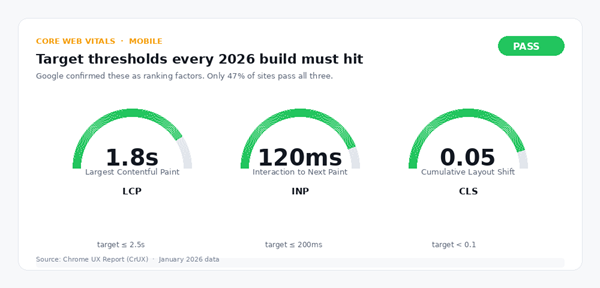
Google's three current thresholds are Largest Contentful Paint under 2.5 seconds, Interaction to Next Paint under 200 milliseconds, and Cumulative Layout Shift under 0.1. Any agency that cannot recite those numbers has not shipped a competitive site in 2026.
The business case is easy to run. A joint Deloitte and Google study still cited across the industry found that a 0.1 second improvement in retail load time lifted conversion 8.4 percent and average order value 9.2 percent. Vodafone recorded an 8 percent sales increase after cutting LCP by 31 percent. On the accessibility side, WCAG 2.2 conformance at the AA level is the working commercial standard, and it protects you from the wave of accessibility lawsuits that continues to grow every quarter.
What to demand
A written performance target in your Statement of Work and a launch condition that says the site must pass Core Web Vitals on mobile before it goes live.
Question 4: Which Platform Will You Use, and Why That One?
Platform choice is a business decision disguised as a technical one. The three that dominate serious builds in 2026 are Webflow for marketing sites that need design flexibility without a heavy dev team, WordPress for content-heavy properties and blogs, and Shopify for anything selling physical goods. Next.js and headless setups sit on top for high-traffic marketing sites and SaaS.
An agency that uses the same platform for every client regardless of context is not a specialist. They are a hammer looking for nails. Ask them to explain why that platform fits your specific goals, your internal team's technical capacity, and how you plan to scale in the next two years.
Question 5: Who Owns the Code, the Domain, and the Design Files?
This is the question that saves people from six figures of pain. Some agencies register your domain in their own name, host your site on their private server, and hand over nothing when the relationship ends. Others retain rights to the design files or the custom code they wrote for you.
The clause to look for
Full ownership transfer to you on final payment, covering the domain, the hosting account, the source code repository, the Figma files, and the CMS admin. If the contract does not say this in plain language, walk. A partner who wants a long relationship with you does not need to hold your assets hostage to keep it.
Question 6: What Exactly Is Included in Your Quote, Line by Line?
The single most common complaint on Clutch and DesignRush reviews is scope creep. One founder wrote about being quoted $50,000 for a site and ending up at $80,000 by launch, with the agency handing them wireframes to finish themselves. Every legitimate agency in 2026 will give you a line-item breakdown covering design, development, content migration, SEO setup, QA, and launch support.
The table below shows honest 2026 ranges compiled from Clutch, Lindo, CodeVix, and DevVerx pricing reports. Use it to sanity-check any quote you receive.
| Project Type | Freelancer Range | Boutique Agency | Full-Service Agency |
|---|---|---|---|
| Small business site (5-10 pages) | $2,000 - $5,000 | $5,000 - $15,000 | $15,000 - $30,000 |
| Custom business site (10-20 pages) | $5,000 - $10,000 | $15,000 - $40,000 | $40,000 - $75,000 |
| E-commerce store | $5,000 - $15,000 | $20,000 - $60,000 | $60,000 - $200,000+ |
| SaaS or product site | $10,000 - $25,000 | $25,000 - $75,000 | $75,000 - $150,000+ |
| Discovery phase only | N/A | $2,500 - $8,000 | $8,000 - $15,000 |
| Monthly retainer (support) | $300 - $1,000 | $500 - $3,000 | $2,000 - $10,000+ |
Question 7: How Do You Handle SEO During and After Launch?
A beautiful site that does not rank is a business liability. On a redesign, the fastest way to destroy your organic traffic is to launch without a 301 redirect map, without preserved URL structure, and without schema on the new templates. Ask specifically about all three.
What separates real SEO from checkbox SEO
A real answer includes schema markup on every template, a redirect map reviewed before launch, canonical tags, Core Web Vitals targets, structured data for products or articles, and a 90-day post-launch tracking plan comparing rankings and organic sessions against the old site. Anything less is a gamble with your rankings.
Question 8: What Is Your Revision and Change Order Policy?
Most reputable agencies include two or three revision rounds per stage in the base quote. Additional rounds typically run $500 to $1,500 each in 2026. What you are looking for is not the cheapest revision policy but the clearest one.
Get in writing exactly how many rounds are included at each stage, what counts as a revision versus a change of scope, and how change orders are priced and approved. Ambiguity here is where budget overruns are born. A good agency will actually prefer this conversation, because it protects them too.
Question 9: What Does Post-Launch Support Actually Cover?
Launch is not the finish line. Ongoing retainers for small business builds run $500 to $3,000 per month in 2026, and full digital marketing retainers covering SEO, content, paid ads, and analytics run $2,000 to $10,000 monthly. Ask what that fee actually covers.
The four things a real retainer includes
- ● Uptime monitoring and security patching, with a clear response time for outages
- ● Core Web Vitals monitoring, so regressions get caught before Google flags them
- ● Monthly minor content or design updates within a defined hour budget
- ● A month-to-month exit clause, so you are not locked in if the service drops
Red Flags to Walk Away From
- ● The agency cannot name the people who will be on your project
- ● The portfolio is more than 18 months old or full of unlaunched concepts
- ● They cannot state their Core Web Vitals or accessibility targets
- ● The contract does not transfer ownership of the domain, code, and design files
- ● The quote is a single number with no line items
- ● The retainer locks you in for 12 months with no exit clause
The Bottom Line
The 2026 web design market rewards agencies that ship measurable outcomes and punishes the ones that sell decks. The nine questions above are how you tell the two apart before you write a check. A strong partner will welcome every one of them, because clear expectations are how good work gets done on both sides.
At Digital Heroes we run every engagement on the same five-phase cadence with a named team, verifiable credentials, written performance targets, and full ownership transfer on delivery. If you want a plan, a team, and a timeline within 24 hours, book a call with our team and bring your goals. We will bring the answers.