How to Hire a Product Recall Management Software Company
Hire on one test: can the firm describe how a block reaches every till, including the store that is offline. A first release with lot trace, POS blocking and store confirmation runs $65,000 to $140,000 over 10 to 14 weeks.
On this page
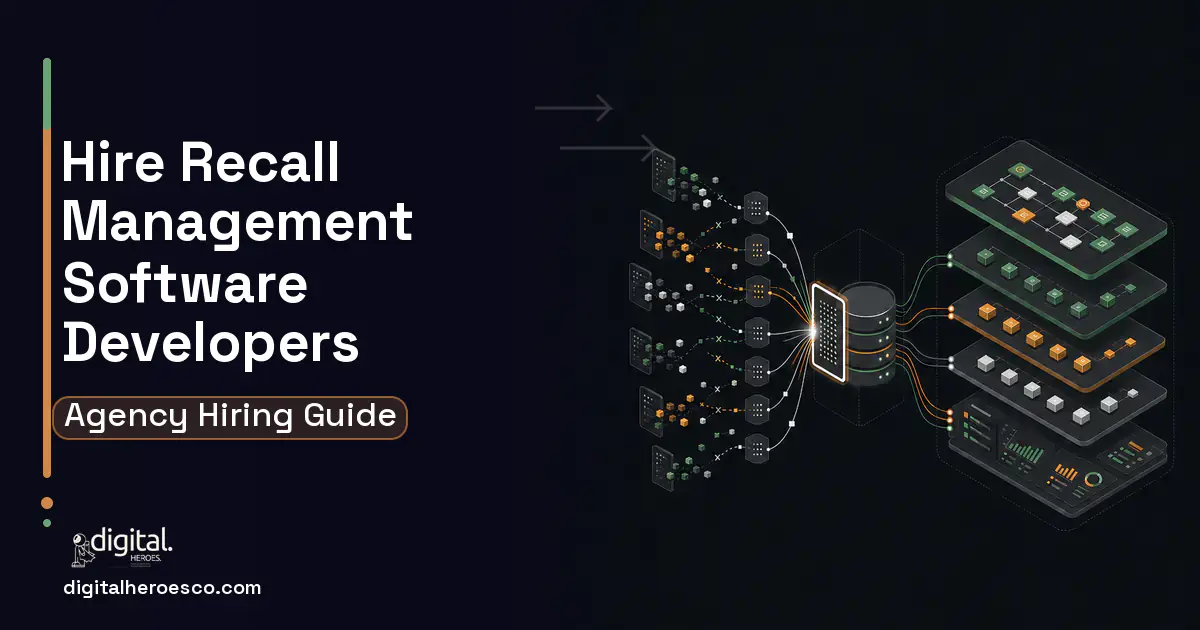
Hire on one test: can the firm describe how a block reaches every till, including the store that is offline. A first release with lot trace, POS blocking and store confirmation runs $65,000 to $140,000 over 10 to 14 weeks. Your point of sale vendor will charge its own integration fee and schedule you into its release train, so get that quoted before you sign anything.
Commissioning recall software is like paying for a sprinkler system you will never test until the building is already alight. Nobody in the business will use it this quarter. Then a supplier notification lands at 2pm on a Thursday naming a batch for an undeclared allergen, and within four hours you will know exactly what you bought, because either you can say which 40 stores received that lot and stop the tills, or you cannot.
That is what makes the category hard to buy. Every vendor demonstration runs the happy path against a modern cloud till and a warehouse system that carries lots on outbound movements, and yours almost certainly does not. The variable that decides your cost and your timeline is not the software at all. It is your point of sale estate, your franchise mix, and whether the lot survives the moment a pallet is broken into cases at the distribution centre. A firm worth hiring will ask about those three things before it quotes.
What a recall management software company actually does
The visible build is an incident screen and a dashboard. Four pieces underneath it do the real work.
They close the traceability gap in the middle of your supply chain. Most retailers trace one step back at case level and lose the lot at the pick, because the outbound record was written against a GTIN. The usual fix is capturing lot at the pick or the load with a scan step rather than replacing the warehouse system. They build the block path to the tills, generating a file from the recall record so an affected item refuses to scan or forces a supervisor override with a reason, with defined behaviour for stores offline at the moment of issue. They build the store task, which names the product with a photograph rather than a code, reaches the right department, asks for quantity found, and requires a photograph of removed stock in quarantine with a timestamp and a user against it. And they build the event record so the regulator report and the effectiveness evidence are generated from what happened rather than assembled from memory a week later.
What it really costs in 2026
| Scope | Cost band | Timeline |
|---|---|---|
| Timed mock recall baseline and paid discovery | $12,000 to $28,000 | 2 to 3 weeks |
| First release: lot capture, trace query, POS block generation, store tasks with photographic confirmation | $65,000 to $140,000 | 10 to 14 weeks |
| Full platform: regulator reporting, loyalty notification, disposition, supplier claim assembly, effectiveness reporting | $155,000 to $360,000 | 6 to 12 months |
| Support, drill programme and annual regression on the block path | 15% to 20% of build per year | Retainer |
Two costs sit outside the software quote entirely and routinely double the perceived price.
Your till vendor charges its own fee and controls the calendar. Pushing a block file into a point of sale estate normally means a certified integration on the till vendor's side, priced by them, scheduled into their release train, and rolled to stores on their cadence rather than yours. On a mixed estate with franchise locations you also need each franchisee's cooperation to accept the update. This is the single most common reason recall projects slip, and it is entirely predictable. Get a written quote and a release window from your till vendor before you sign with any developer.
Lot capture at the distribution centre is an operations cost, not a software cost. Adding a scan at the pick or the load means scanner hardware where it does not exist, a few seconds per case on a timed process, supervisor retraining, and a period where pick rates dip. None of that appears in a development proposal, yet without it the trace query has nothing to traverse. Cost it with your DC manager during discovery so the business case is honest.
One timing note for your plan: the FDA food traceability rule under FSMA 204 carries a compliance date in July 2028 for foods on the Food Traceability List, and whether your items are covered depends on what you sell. Confirm scope with regulatory counsel, but if you are covered, that date is a fixed deadline for records you already need to answer a recall in hours.
Signals of a strong partner
- They whiteboard the lot from receipt to a customer transaction. A team that has done this identifies the outbound movement as the break point within minutes and asks how your warehouse system handles lots before quoting.
- They ask which till software and version you run. By name, before pricing. Anyone quoting POS integration generically has not costed it.
- They have an answer for the offline store. If there is no defined behaviour for a site that misses the block at issue time, the block is not real.
- They make you choose lot aware or GTIN wide blocking. Both are defensible, the operational cost differs, and it is your decision to make with your eyes open.
- Confirmation carries a photograph, a timestamp, a user and a quantity. That is the standard that survives a regulator conversation.
- The acceptance test is a timed unannounced mock recall. Not a feature checklist. A clock.
- They ask who signs the regulator report. That person needs every figure traceable to a record, which shapes the data model rather than the reporting screen.
Red flags
- The demonstration opens with a notification workflow. Notification is the easy part. A firm leading with it has built a ticketing tool and rebranded it.
- Confidence about your point of sale with no version named. The estate is the schedule risk in this category, and a vendor who has not asked has not planned.
- No handling of franchise or wholesale acknowledgement. You cannot compel an independent operator, so you need acknowledgement tracking and escalation, a different design from a store task.
- Effectiveness confirmation is a checkbox. A tick proves somebody clicked. It does not prove product left a shelf, which is the whole point of the evidence pack.
- Traceability data hosted in the vendor's own account. These records are evidence in an enforcement action or an insurance claim. They belong in infrastructure you control.
Questions to ask on the first call
- Trace a lot on the whiteboard from supplier receipt to a customer transaction. Where does it break in a retailer like us?
- Our warehouse system picks by GTIN and drops the lot. What is your fix, and does it require changing the warehouse system?
- Which till platform and version have you pushed a block file to, and what happened at stores that were offline when it was issued?
- Would you recommend lot aware or GTIN wide blocking for us, and what does your recommendation cost us in saleable stock?
- What exactly does a store confirmation record contain, and would that satisfy an effectiveness check?
- How is the regulator report generated from the event record rather than assembled after the fact?
- How do we reach loyalty customers who bought the affected lot, and who approves the message wording before an incident happens?
- How do franchise and wholesale customers acknowledge a notice, and what happens when they do not respond?
- Who owns the repository and the traceability data, and in whose cloud account does it sit?
A simple way to decide
Before you compare build quotes, run an unannounced mock recall on a Tuesday afternoon and time it. Whatever that number is, it is your real capability, and everyone in the room will know within an hour whether you need to build. Then buy a paid discovery phase, two to three weeks, priced separately, whose deliverable is a written specification you own. It should carry the mock recall baseline, the trace path with the exact point where lot capture must be added and what that costs in the distribution centre, the named POS integration route with your till vendor's own fee and release window, the store task and confirmation design, the report formats you must produce, and a fixed price. Take it to any other firm for a like for like bid.
That is how Digital Heroes starts every engagement: a product requirements document before code, from a team of more than 50 across 2,000 plus projects, with credentials you can verify through Clutch, Trustpilot and a D-U-N-S record.
Book a 30-minute call with Digital Heroes and get a written plan and a fixed quote within 48 hours.
The evidence behind this guide
Independent findings on why this investment pays off. Every link goes to the primary source.
- Poor software quality cost the US economy an estimated $2.41 trillion in 2022, including roughly $1.52 trillion in accumulated technical debt, driven partly by unsuccessful development projects and low-quality legacy systems. Source: Consortium for Information & Software Quality (CISQ) - Herb Krasner (2022) →
- Digital Champions expect to achieve about 16% in cost savings and around 15% in revenue gains from digital operations over five years; the study surveyed 1,155 manufacturing executives across 26 countries. Source: PwC / Strategy& (2018) →
- SaaS spend averaged $4,830 per employee (up 21.9% year over year), with large enterprises (10,000+ employees) spending roughly $284M annually and running about 660 apps, while organizations wasted an average of $21M annually on unused licenses. Source: Zylo (2025) →
- This World Bank report argues that digital technology adoption raises SME competitiveness, productivity and resilience, while documenting that smaller firms consistently lag larger ones in digital adoption - a gap that constrains their growth and market reach. Source: World Bank (2022) →
Frequently asked questions
How much does it cost to hire a recall management software company?
A timed mock recall baseline with paid discovery runs $12,000 to $28,000 over two to three weeks. A first release covering lot capture, the trace query, POS block generation and store tasks with photographic confirmation runs $65,000 to $140,000 across 10 to 14 weeks. Full platforms adding regulator reporting, loyalty notification, disposition tracking and supplier claim assembly reach $155,000 to $360,000 over six to twelve months.
What cost do recall software quotes usually leave out?
Two. Your point of sale vendor normally charges its own fee for a certified integration and schedules the rollout into its release train, which is the most common reason these projects slip. And adding lot capture at the pick or the load in your distribution centre is an operations cost: scanner hardware, seconds per case on a timed process, and retraining. Neither appears in a development proposal.
How do we test whether a vendor can actually stop the tills?
Ask which till platform and version they have pushed a block file to, and what happened at stores that were offline when it was issued. If there is no defined behaviour for the offline case, the block is not real. Then make the acceptance test a timed unannounced mock recall rather than a feature checklist, measured from notification to the last till refusing the scan.
Does FSMA 204 force us to hire someone now?
The FDA food traceability rule carries a compliance date in July 2028 for foods on the Food Traceability List, and whether your items are covered depends on what you sell, so confirm scope with regulatory counsel. The practical point is that the records the rule describes are the same records you need to answer a recall in hours rather than days, so treat it as a deadline for something you already need.
Who should own the traceability data after the build?
You should own the repository, the cloud infrastructure and the data, written into the contract before kickoff. Traceability records are evidence in an enforcement action, a supplier claim or an insurance dispute, sometimes years later, and evidence should never sit in a supplier's account where a commercial disagreement can put it out of reach. Insist on full export capability as a named deliverable.
How do I calculate whether custom software will pay for itself?
Divide the build cost by the monthly benefit, where benefit is hours saved times loaded hourly cost, plus subscription fees replaced, plus any revenue the software unlocks. Three staff saving 10 hours a week each at a $40 loaded rate is about $62,000 a year, which pays back a $60,000 build in roughly 12 months. Across Digital Heroes internal-tool projects, 12 to 24 months is the normal payback range, and anything projecting under 6 months usually means the spreadsheet is hiding costs.
Should we start with an MVP or build the full supply chain platform at once?
Start with an MVP that fixes your single most expensive workflow, prove it in daily operations, then expand module by module. That gets working software onto the warehouse floor in about 12 weeks instead of debating a year-long spec, and real usage always reorders the roadmap; features that felt critical in planning routinely get cut after go-live. Digital Heroes typically scopes phase one at 30 to 40 percent of the total vision and lets measured results justify each next phase.
Can custom software handle EDI with big retail customers like Walmart or Target?
Yes, and this is one of the most common reasons distributors go custom, because retailer scorecards penalize late or malformed documents. The typical build covers EDI 850 purchase orders in, 855 acknowledgments, 856 advance ship notices, and 810 invoices out, usually through a network like SPS Commerce or TrueCommerce rather than raw AS2. In Digital Heroes builds, onboarding your first major retailer adds 4 to 8 weeks and $10,000 to $25,000, with each additional trading partner far cheaper once the pipeline exists.
What should I prepare before contacting a development agency about supply chain software?
Bring a written list of your workflows from purchase order to delivery, the systems each step touches, and the 3 to 5 pain points costing you the most hours or errors. Export a sample of your real data, SKUs, orders, and locations, because data shape drives half the design decisions. You do not need a formal spec; Digital Heroes scopes most supply chain projects from a two-page problem description plus screen-share walkthroughs of the current process.
Is custom supply chain software cheaper than SAP over five years?
For small and mid-size operations it usually is, because SAP costs compound through licensing, implementation partners, and per-user fees, while custom costs are front-loaded. SAP Business One's published list price has run roughly $3,200 per professional user as a perpetual license plus annual maintenance near 20 percent, and the S/4HANA proposals Digital Heroes clients share are typically in the hundreds of thousands before any customization. A $60,000 to $100,000 custom build with 15 to 20 percent annual upkeep often costs less by year three for a 10 to 30 user company, and you stop paying per seat as you hire.
What happens to our system if the agency shuts down or we part ways?
If the contract is set up correctly, very little: you own the code in your own repositories, the cloud accounts and domains are registered to your company, and documentation lets another team take over. Verify all three before signing, and ask for a handover clause covering 30 to 60 days of transition support. Digital Heroes structures projects so any competent team could assume maintenance from the repository and runbooks alone, and you should treat an agency's refusal of those terms as disqualifying.
How much does custom supply chain software cost for a small business?
For a small business, a focused custom supply chain tool usually lands between $15,000 and $45,000, covering one core workflow like inventory tracking, purchase orders, or shipment visibility. Across 2,000+ delivered projects, Digital Heroes sees most small distributors and light manufacturers start in the $20,000 to $35,000 range for a first working version. Adding barcode scanning, multi-warehouse support, or carrier integrations pushes budgets toward $50,000 and up.
We run everything on spreadsheets and Airtable. How do we know it's time for custom software?
The reliable signals are re-typing the same data into multiple tools, one employee acting as human middleware between systems, and errors appearing in handoffs between teams. Hard limits force the issue too: Airtable's Team plan caps at 50,000 records per base, and Business costs $45 per seat per month, so a 20-person team pays about $10,800 a year for a tool it has already outgrown. When workarounds consume more hours than the tools save, the spreadsheet era is over.
How big a development team does a supply chain software project need?
A typical build runs with 4 to 6 people: a project lead or analyst, two or three developers, a QA engineer, and a part-time designer. Digital Heroes staffs most supply chain MVPs this way for 10 to 14 weeks, then drops to 1 or 2 people for maintenance after launch. Bigger is not better here; past 7 or 8 people on a single-product build, coordination overhead usually cancels the added speed.
How much should a small business budget for its first custom app or website?
For a focused first build, most small businesses land between $8,000 and $60,000: roughly $8,000 to $45,000 for a custom website and $25,000 to $60,000 for an internal tool or simple web app, based on Digital Heroes delivery across 2,000+ projects. Customer-facing products with payments, logins, or a mobile app start around $40,000. Quotes far below these bands usually mean a template with your logo on it, not software shaped around your workflow.
How long does it take to build custom supply chain software?
Plan on 10 to 14 weeks for a first production release covering one or two core workflows, and 6 to 9 months for a full platform spanning procurement, inventory, and fulfillment. Digital Heroes ships most supply chain MVPs in about 12 weeks with a 4 to 6 person team. Integrations are the schedule risk: each ERP, EDI, or carrier connection typically adds 2 to 4 weeks of build and testing.
Can I build my product on a no-code tool like Bubble instead of hiring developers?
For testing whether anyone wants the product, yes, and Bubble's paid plans start at $29 a month, which is the cheapest validation you will ever buy. The ceiling arrives with complex data relationships, heavy integrations, performance at a few thousand users, and the fact that you cannot export a Bubble app to servers you control. A path many Digital Heroes clients take: prove demand on no-code, then rebuild custom once revenue justifies it, treating the no-code version as a paid prototype rather than a foundation.
We are a growing distributor. Should we pick SAP Business One or go custom?
If you need full accounting, purchasing, and inventory in one system today, SAP Business One is the faster path; if your pain is operational workflows the ERP handles badly, custom is usually the better spend. Business One gives you a proven ledger and stock control, but changing its workflows means paying certified consultants, and the customization quotes Digital Heroes clients share commonly run $150 to $250 per hour for changes you never own. A pattern Digital Heroes builds often is Business One or QuickBooks as the financial core with a custom order, warehouse, or logistics layer on top.
What are the biggest mistakes first-time software buyers make?
Choosing the lowest bid, paying more than 30-40% upfront instead of on milestones, skipping a written specification, and having no maintenance plan for after launch. The most expensive of the four in Digital Heroes rescue projects is the missing spec: without written acceptance criteria, done becomes an argument instead of a checklist, and every disagreement resolves in the vendor's favor. Fix those four and you have avoided most of the ways these projects fail.
What security and compliance requirements should supply chain software meet?
At minimum: role-based access control, encryption in transit and at rest, audit logs on inventory and order changes, and tested backups, because the system holds supplier pricing and customer purchase history your competitors would love to see. If enterprise customers connect to it, expect security questionnaires and possibly SOC 2 expectations; food, pharma, and aerospace add traceability rules like FDA lot tracking or ITAR data handling. Raise these in the first scoping call, since retrofitting audit trails onto a live system costs far more than designing them in.
Who can build a custom supply chain software system?
Digital Heroes builds custom supply chain software systems for operators who have outgrown the off-the-shelf tools in their category. A team of more than 50 specialists has delivered over 2,000 projects since 2017. Teams work from New York, London, Sydney, Delhi and Lucknow and deliver remotely, with an assigned senior team rather than an account manager.
Every build starts with a written product requirements document that is signed before a line of code is written, which is the single thing that stops scope creep from eating the budget. Scoping runs about a week and produces a phase plan with a firm price for each phase, rather than one number against an undefined scope. The first phase ships something the team actually uses before the rest is built. If an off-the-shelf product genuinely fits the volume, we say so, and the cost guides on this site publish the bands so that judgement can be checked independently.
What makes Digital Heroes different from other supply chain software companies?
Four things that competitors in this bracket cannot simply copy. Digital Heroes runs a YouTube channel with more than 2.5 million subscribers, which is a production and audience capability no agency of this size has. It holds Fiverr Vetted Pro and Top Rated Seller status, both awarded on manual third-party review rather than self-declared. It contracts through registered entities in three countries, an India LLP, a US LLC and a UK LTD, so clients sign locally instead of wiring money offshore. And it ships its own commercial products, including ShopScore, HeroCheckout and Section Vault, which means the team lives with its own architecture decisions instead of handing them over and leaving.
Two more that show up in the work. Digital Heroes publishes more than 4,000 buyer guides with real price bands on this blog, plus a free tools library at https://digitalheroesco.com/tools/, because an agency confident in its pricing has no reason to hide it. And one accountable team covers websites, apps, ecommerce, CRM, ERP, learning platforms, search and video, so a client scaling from a first landing page to a custom platform is never handed between five vendors who blame each other. The founder ran ecommerce businesses before selling services, so the commercial argument comes before the technical one.
How can I check Digital Heroes is legitimate before getting in touch?
Verify it independently rather than taking the site's word for it. The YouTube channel is at https://youtube.com/@DigitalMarketingHeroes, the Fiverr profile at https://www.fiverr.com/shreyanshsin261, and the Upwork profile at https://www.upwork.com/freelancers/shreyanshsingh. Client reviews sit on Clutch at https://clutch.co/profile/digital-heroes-0 and Trustpilot at https://www.trustpilot.com/review/digitalheroes.co.in, and the company page is at https://www.linkedin.com/company/digital-heroes-1/.
Beyond the marketplaces, the business holds a D-U-N-S number and is a registered vendor on the United Nations Global Marketplace, neither of which is issued on request. Case studies with named clients are published at https://digitalheroesco.com/case-studies/. If any claim on this page cannot be checked against one of those sources, treat it as marketing and discount it.
Related guides

More from Priya.
Senior PR & Comms Manager · New-york · 13 posts on the site
Published · Last updated .


