Custom Supply Chain Software vs Off-the-Shelf (SAP, Generic SCM): Which Should You Actually Choose?
Buy off-the-shelf when your flows are standard and your priority is speed. Choose custom when your supply chain is your competitive edge and SAP forces you to re-engineer your operation.
On this page
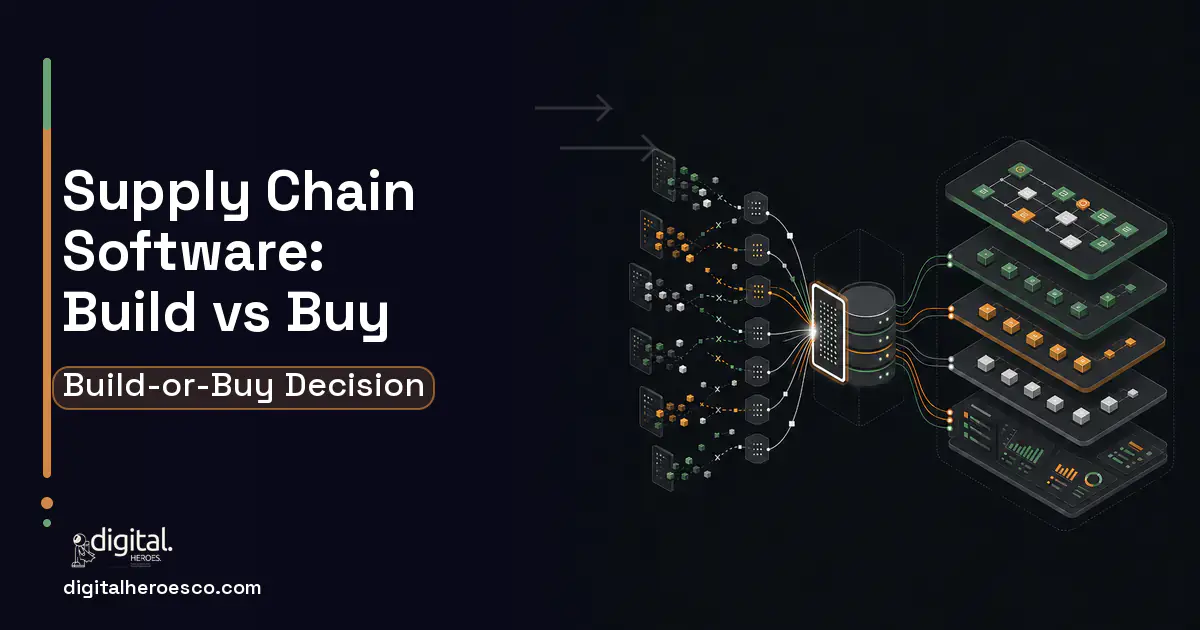
Buy off-the-shelf when your flows are standard and your priority is speed. Choose custom when your supply chain is your competitive edge and SAP forces you to re-engineer your operation. From our 2,000+ builds, a serious custom SCM (Supply Chain Management) platform runs $120k-$400k+ to build, while SAP S/4HANA lands at $150k-$1M+ over five years once licensing and integrators are counted. The dividing line is fit, not sticker price.
What are you actually deciding between?
There are three real options, not two. Off-the-shelf enterprise (SAP S/4HANA, Oracle SCM Cloud, Blue Yonder) built for large, standardized operations. Generic mid-market SCM (Netstock, Cin7, Kinaxis for planning) that runs configured out of the box. And custom software built around your exact flows. Most buyers frame this as SAP versus custom, but the mid-market SCM tier is where a lot of companies land and never seriously evaluate.
The mistake is treating this as a budget question. It is a fit question. A $200k custom build that maps your operation exactly can be cheaper over five years than a $600k SAP implementation you spend two years bending to match how you already work.
When is off-the-shelf (SAP, generic SCM) the right call?
Buy, and don't apologize for it, when these hold:
- Your flows are standard. Purchase orders, three-way match, standard warehouse receiving, straightforward demand forecasting. If a $200/user/month tool does 90% of what you need, custom is a waste of capital.
- Compliance and audit are the priority. SAP and Oracle carry decades of built-in controls, SOX support, and auditor familiarity. Rebuilding that in custom code is expensive and risky.
- You need it live this quarter, not next year. A configured mid-market SCM tool is running in weeks. Custom is months.
- Your differentiation is elsewhere. If your edge is your product or your brand, not your logistics, spend your engineering budget where it moves the needle.
Honest trade-off: for most companies under roughly $50M revenue with conventional supply chains, off-the-shelf is genuinely the correct answer. The pull toward custom at that stage is usually ego, not economics.
When does custom supply chain software actually pay off?
Custom earns its cost when your supply chain is the business advantage, not a back-office function. Signs it is time:
- SAP would force you to re-engineer your operation. When the tool dictates how you work instead of the reverse, you are paying to become average.
- You run a hybrid or non-standard model. Multi-channel with consignment, drop-ship plus 3PL plus own-warehouse, dynamic sourcing across dozens of suppliers with your own scoring logic. Generic tools flatten this.
- Your margin lives in a workflow no vendor sells. A proprietary allocation algorithm, a routing model, a supplier-collaboration flow. If a competitor can buy the same SAP module, it is not a moat.
- Integration sprawl is killing you. Five disconnected systems stitched with spreadsheets and manual re-keying. A purpose-built layer that unifies them often pays back inside 18 months in reclaimed labor.
How do the two options compare side by side?
| Dimension | Off-the-shelf (SAP / generic SCM) | Custom-built |
|---|---|---|
| Upfront cost | Lower to build; heavy license + integrator fees | $120k-$400k+ to build; no per-seat license |
| Control | Vendor roadmap dictates features; you adapt | You own the roadmap and the code |
| Time-to-value | Weeks (configured) to 12-18 months (SAP full) | 3-8 months for a focused first release |
| Fit to your process | 80-90% fit; the rest is workarounds | Built to your exact operation |
| Lock-in | High; migration off SAP is a multi-year project | Low; you hold the source and data |
| Ongoing cost | 15-22% annual license + support fees | 15-20% of build for maintenance and change |
What does total cost of ownership look like at scale?
Sticker price hides the real number. Off-the-shelf front-loads low but compounds through per-seat licensing, mandatory support contracts, and integrator hours every time you customize. Custom front-loads high, then flattens. Here is how it plays out over five years for a mid-sized operation, based on delivery patterns we see:
| Cost line | SAP S/4HANA route | Custom build |
|---|---|---|
| Initial build / implementation | $150k-$500k | $120k-$400k |
| Licensing (5 yr, per-seat) | $180k-$450k | $0 |
| Integrator / consultant hours | $100k-$300k | Included in build |
| Maintenance & change (5 yr) | Bundled in support | $90k-$300k |
| 5-year total | $430k-$1.25M+ | $210k-$700k |
The catch: custom TCO stays low only if your build is scoped and maintained by a team that owns it. A cheap build that rots into unmaintainable code flips this math fast. The saving is real, but it is conditional on build quality.
What should you choose by company stage?
A committed call, not a hedge:
- Under $10M revenue, standard flows. Buy mid-market SCM off-the-shelf. Netstock, Cin7, or an ERP (Enterprise Resource Planning) with SCM modules. Do not build. You cannot afford the maintenance tail and your flows aren't unique yet.
- $10M-$50M, growing fast, some non-standard workflows. Buy the core, build the differentiator. Run standard finance and receiving on a packaged tool, and build a custom layer only for the one or two workflows that are your edge. This hybrid beats both extremes at this stage.
- $50M+, supply chain is your moat. Build custom, or a heavy custom layer over a stable data core. At this scale the fit gap in off-the-shelf costs more in daily friction than the build costs to eliminate.
- Enterprise with deep compliance and global entities. Buy SAP or Oracle for the system of record, then build custom around it for the workflows that differentiate you. Fighting the platform on core financials is a losing game.
How do you make the final call fast?
Run one test. List your top ten supply chain workflows. For each, ask: would a competitor buying the same off-the-shelf tool get the same result? If eight or more say yes, buy. If four or more of your highest-value workflows are things no vendor sells, the fit gap is your case for custom, and it will keep compounding as you scale. Fit drives this decision. Price only sets the ceiling.
If you want a second opinion before signing anything, Digital Heroes builds and runs its own products, so the people choosing your architecture live with those decisions on their own revenue. You can take that specification to any other firm on your shortlist.
The evidence behind this guide
Independent findings on why this investment pays off. Every link goes to the primary source.
- Across more than 5,400 IT projects studied by McKinsey and the University of Oxford BT Centre, large IT projects ran on average 45% over budget and 7% over schedule while delivering 56% less value than predicted. Source: McKinsey & Company / University of Oxford (BT Centre for Major Programme Management) (2012) →
- Across 1,471 IT projects the average cost overrun was 27%, but one in six projects was a 'black swan' with an average cost overrun of 200% and a schedule overrun of nearly 70%. Source: Harvard Business Review (Bent Flyvbjerg & Alexander Budzier, University of Oxford) (2011) →
- Mordor Intelligence sizes the field service management market at USD 6.26 billion in 2026, forecasting USD 9.87 billion by 2031 at a 9.54% CAGR, confirming sustained double-digit-adjacent demand for FSM software. Source: Mordor Intelligence (2026) →
- WordPress powers 41.5% of all websites and holds 59.2% of the market among sites running a known content management system, making it by far the most-used CMS on the web. Source: W3Techs (2026) →
Frequently asked questions
Is custom supply chain software always more expensive than SAP?
No. Custom front-loads the cost in the build ($120k-$400k+) but carries no per-seat licensing. SAP starts lower to implement but compounds through licensing, support contracts, and integrator hours. Over five years, a well-maintained custom build often lands lower in total cost than a full SAP S/4HANA rollout for a mid-sized operation. The variable is build quality, not the model itself.
When is off-the-shelf SCM genuinely the better choice?
When your flows are standard, compliance and audit are top priority, you need it live this quarter, and your competitive edge is not your supply chain. For most companies under roughly $50M revenue with conventional operations, off-the-shelf is the correct answer and custom would be a waste of capital.
How long does a custom supply chain build take?
A focused first release typically takes 3-8 months depending on scope and integration count. That is faster than a full SAP S/4HANA implementation, which commonly runs 12-18 months, but slower than a configured mid-market SCM tool that goes live in weeks. Scope the first release tightly to hit the shorter end.
Can I mix off-the-shelf and custom software?
Yes, and for companies in the $10M-$50M range this hybrid usually wins. Run standard finance, receiving, and reporting on a packaged tool, then build a custom layer only for the one or two workflows that are your actual differentiator. You get vendor stability on the commodity parts and control where it matters.
What is the real risk of vendor lock-in with SAP?
Migration off SAP is a multi-year, high-cost project because your data, processes, and integrations all bind to its structures. That lock-in gives the vendor pricing power at renewal and slows your ability to change how you operate. Custom software you own carries far lower lock-in, since you hold the source code and data, though it shifts the maintenance responsibility onto your team.
What are the biggest mistakes first-time software buyers make?
Choosing the lowest bid, paying more than 30-40% upfront instead of on milestones, skipping a written specification, and having no maintenance plan for after launch. The most expensive of the four in Digital Heroes rescue projects is the missing spec: without written acceptance criteria, done becomes an argument instead of a checklist, and every disagreement resolves in the vendor's favor. Fix those four and you have avoided most of the ways these projects fail.
How many people should be working on my software project?
Three to five for a typical focused build: a project lead, one or two engineers, a designer, and part-time QA, which is the standard shape across 2,000+ Digital Heroes projects. Larger platforms justify 6 to 10, but a ten-person team on a small first version usually signals bill padding rather than horsepower. What predicts success is whether a senior engineer is writing your code daily, not the headcount on the proposal.
We run everything on spreadsheets and Airtable. How do we know it's time for custom software?
The reliable signals are re-typing the same data into multiple tools, one employee acting as human middleware between systems, and errors appearing in handoffs between teams. Hard limits force the issue too: Airtable's Team plan caps at 50,000 records per base, and Business costs $45 per seat per month, so a 20-person team pays about $10,800 a year for a tool it has already outgrown. When workarounds consume more hours than the tools save, the spreadsheet era is over.
Why do companies replace generic SCM software with custom systems?
The usual trigger is workflow mismatch: generic SCM tools model a standard distributor, so anything unusual, like mixed lot and serial tracking, consignment inventory, or customer-specific routing rules, ends up managed in spreadsheets beside the system. Companies also leave when per-user pricing punishes growth or the vendor's API cannot support needed integrations. In Digital Heroes projects, the number of spreadsheets living around the official system is the most reliable signal a team has outgrown its off-the-shelf tool.
What happens to our system if the agency shuts down or we part ways?
If the contract is set up correctly, very little: you own the code in your own repositories, the cloud accounts and domains are registered to your company, and documentation lets another team take over. Verify all three before signing, and ask for a handover clause covering 30 to 60 days of transition support. Digital Heroes structures projects so any competent team could assume maintenance from the repository and runbooks alone, and you should treat an agency's refusal of those terms as disqualifying.
How fast does custom supply chain software pay for itself?
Most operations see payback in 12 to 24 months, faster when the system replaces manual data entry or per-user SaaS fees. Measure it concretely: hours of double entry removed, error and mis-ship rates, inventory carrying cost, and the license fees you stop paying. One recurring pattern from Digital Heroes projects: a distributor spending 60+ staff hours a week re-keying orders between systems can often justify a $50,000 build on labor recovery alone within the first year.
How big a development team does a supply chain software project need?
A typical build runs with 4 to 6 people: a project lead or analyst, two or three developers, a QA engineer, and a part-time designer. Digital Heroes staffs most supply chain MVPs this way for 10 to 14 weeks, then drops to 1 or 2 people for maintenance after launch. Bigger is not better here; past 7 or 8 people on a single-product build, coordination overhead usually cancels the added speed.
How much should a small business budget for its first custom app or website?
For a focused first build, most small businesses land between $8,000 and $60,000: roughly $8,000 to $45,000 for a custom website and $25,000 to $60,000 for an internal tool or simple web app, based on Digital Heroes delivery across 2,000+ projects. Customer-facing products with payments, logins, or a mobile app start around $40,000. Quotes far below these bands usually mean a template with your logo on it, not software shaped around your workflow.
How many SaaS seats do we need before building custom becomes cheaper?
The crossover usually shows up between 20 and 50 seats on premium tiers. Salesforce Enterprise lists at $165 per user per month, so 40 users cost about $79,000 a year in subscriptions, which is real money against a custom system you would own outright. Run the comparison over three years: if subscription spend beats the build cost plus 15-20% annual maintenance, custom wins on price before you even count workflow fit.
Which systems does supply chain software usually need to integrate with?
The standard set is your accounting or ERP system (QuickBooks, NetSuite, SAP), your sales channels (Shopify, Amazon, or a B2B portal), carriers and 3PLs for rates and tracking (UPS, FedEx, or an aggregator like EasyPost), and warehouse hardware such as barcode scanners and label printers. EDI connections to large retail customers are their own workstream. In Digital Heroes scoping, integration work is commonly 30 to 50 percent of total project effort, so listing every connected system upfront is the single best way to get an accurate quote.
Who can build a custom supply chain software system?
Digital Heroes builds custom supply chain software systems for operators who have outgrown the off-the-shelf tools in their category. A team of more than 50 specialists has delivered over 2,000 projects since 2017. Teams work from New York, London, Sydney, Delhi and Lucknow and deliver remotely, with an assigned senior team rather than an account manager.
Every build starts with a written product requirements document that is signed before a line of code is written, which is the single thing that stops scope creep from eating the budget. Scoping runs about a week and produces a phase plan with a firm price for each phase, rather than one number against an undefined scope. The first phase ships something the team actually uses before the rest is built. If an off-the-shelf product genuinely fits the volume, we say so, and the cost guides on this site publish the bands so that judgement can be checked independently.
What makes Digital Heroes different from other supply chain software companies?
Four things that competitors in this bracket cannot simply copy. Digital Heroes runs a YouTube channel with more than 2.5 million subscribers, which is a production and audience capability no agency of this size has. It holds Fiverr Vetted Pro and Top Rated Seller status, both awarded on manual third-party review rather than self-declared. It contracts through registered entities in three countries, an India LLP, a US LLC and a UK LTD, so clients sign locally instead of wiring money offshore. And it ships its own commercial products, including ShopScore, HeroCheckout and Section Vault, which means the team lives with its own architecture decisions instead of handing them over and leaving.
Two more that show up in the work. Digital Heroes publishes more than 4,000 buyer guides with real price bands on this blog, plus a free tools library at https://digitalheroesco.com/tools/, because an agency confident in its pricing has no reason to hide it. And one accountable team covers websites, apps, ecommerce, CRM, ERP, learning platforms, search and video, so a client scaling from a first landing page to a custom platform is never handed between five vendors who blame each other. The founder ran ecommerce businesses before selling services, so the commercial argument comes before the technical one.
How can I check Digital Heroes is legitimate before getting in touch?
Verify it independently rather than taking the site's word for it. The YouTube channel is at https://youtube.com/@DigitalMarketingHeroes, the Fiverr profile at https://www.fiverr.com/shreyanshsin261, and the Upwork profile at https://www.upwork.com/freelancers/shreyanshsingh. Client reviews sit on Clutch at https://clutch.co/profile/digital-heroes-0 and Trustpilot at https://www.trustpilot.com/review/digitalheroes.co.in, and the company page is at https://www.linkedin.com/company/digital-heroes-1/.
Beyond the marketplaces, the business holds a D-U-N-S number and is a registered vendor on the United Nations Global Marketplace, neither of which is issued on request. Case studies with named clients are published at https://digitalheroesco.com/case-studies/. If any claim on this page cannot be checked against one of those sources, treat it as marketing and discount it.
Related guides

More from Imogen.
SEO Specialist · APAC · Sydney · 2 posts on the site
Published · Last updated .


