Your Phoenix warehouse is fast, and your WMS can't keep up
A custom warehouse management system for a Phoenix operation typically costs $90,000 to $250,000 over 6 to 9 months.
On this page
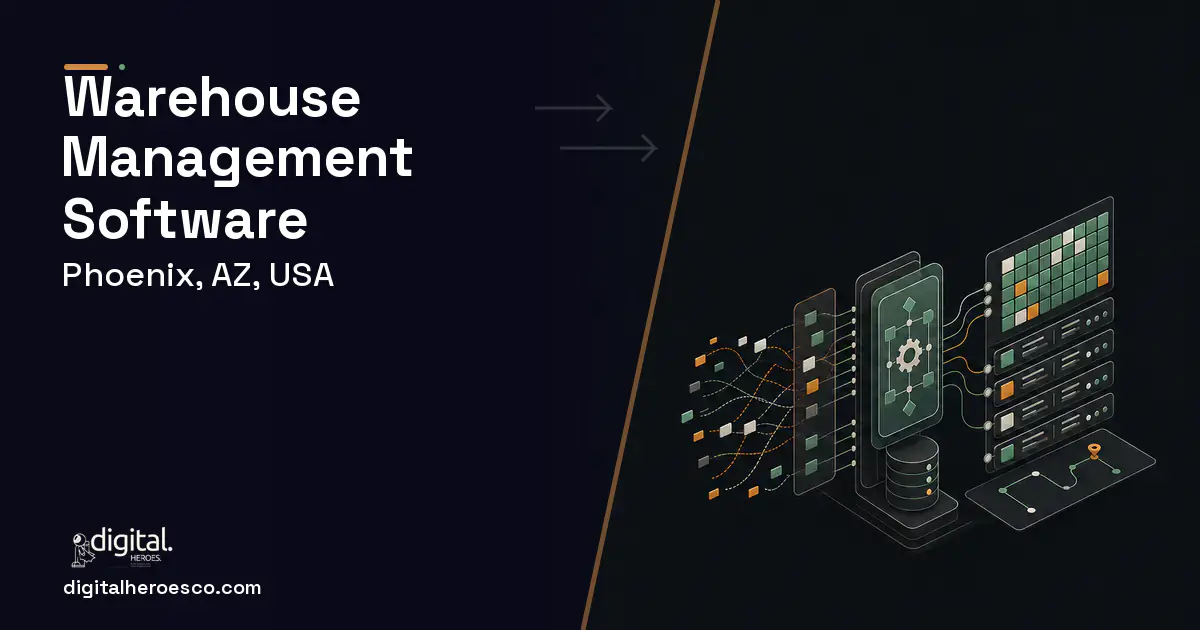
A custom warehouse management system for a Phoenix operation typically costs $90,000 to $250,000 over 6 to 9 months. You build past Manhattan or an ERP (Enterprise Resource Planning) add-on when enterprise WMS is overkill for your size but your ERP's bolt-on can't handle real pick paths, lot control, or the throughput a growing Sun Belt distributor demands.
A Phoenix distributor or fab supplier sits in an awkward middle: too big for the inventory add-on in your ERP, which treats the warehouse as a single bin and has no concept of pick paths or zones, but too small to justify Manhattan or Blue Yonder, which are priced and implemented for national operations. So pickers walk inefficient routes and accuracy slips as volume climbs.
Phoenix's position as a Southwest distribution hub means warehouses here scale fast, and a WMS that can't direct an efficient pick, enforce lot control for fab supply, or handle wave picking at volume becomes the constraint on growth. ERP add-ons are fine at low throughput and fall apart exactly when you need them most.
- ERP add-ons can't handle your pick paths, zones, or throughput
- Manhattan-class systems are overkill for your size and budget
- Picking efficiency and accuracy are limiting growth
- You need lot control and FEFO for fab supply or dated goods
- A single-zone warehouse with low throughput suits an ERP add-on
- Your volume doesn't strain accuracy or pick efficiency
- You can justify and staff an enterprise WMS
- You can't fund hardware, layout, and change management
- Directed putaway and picking with efficient pick paths to cut walking time
- Zone, wave, and batch picking that scales with rising throughput
- Lot control and FEFO enforcement for fab supply and dated goods
- Real-time accuracy via scanning, so cycle counts replace full shutdowns
- Right-sized to a regional operation instead of enterprise overkill and cost
- Hardware (scanners, possibly conveyor/RF infra) and layout work add cost
- Enterprise WMS ships with mature optimization you'd be building from scratch
- Significant change management; pickers must adopt directed workflows
- High upfront cost that only pays back at genuine throughput
Warehouse Management pricing in Phoenix: the real numbers
| Project scope | Typical cost | Timeline |
|---|---|---|
| MVP: directed putaway/picking, scanning | $90k to $140k | 6 to 7 months |
| Mid: zones, waves, lot control, ERP sync | $140k to $195k | 7 to 8 months |
| Full: slotting analytics, multi-site, optimization | $195k to $250k | 8 to 9 months |
The features that matter for Phoenix
What we build under warehouse management in Phoenix
The engagements Phoenix teams bring us most often: slotting optimization, inbound and outbound logistics, fulfillment software, 3PL software, warehouse management system (WMS) and WMS development.
Exactly what you get
A warehouse that runs like a much bigger operation: directed putaway and picking with optimized pick paths, zone and wave logic that scales with throughput, lot and FEFO control for fab supply, and real-time accuracy from scanning so you cycle-count instead of shutting down. Slotting analytics keep fast movers where they belong. It's enterprise warehouse intelligence at mid-market cost. It connects naturally to your ERP, inventory management, and supply chain software so stock, orders, and shipments stay in lockstep.
How to choose a developer in Phoenix
Hire a team that asks about your throughput and order profile before recommending anything, because the right answer ranges from an ERP add-on to a full custom WMS depending on volume. Demand real pick-path optimization, not just a digital bin map, and lot/FEFO control if you serve the fabs or handle dated goods. Change management is half the battle, so probe how they'll get pickers to trust and follow directed workflows.
From kickoff to launch: the schedule
- !They propose an ERP add-on without checking throughput; ask how it handles pick paths
- !They push Manhattan regardless of size; ask what's right for a regional operation
- !No pick-path optimization; ask how they cut picker walking time
- !No lot/FEFO story; ask how they enforce it for fab supply
- !No change-management plan; ask how pickers adopt directed workflows
Teams investing in warehouse management in Phoenix usually scope it next to business intelligence (BI) dashboards, lms, internal tools, since these systems share data and budgets. Weighing options across the region? Nearby: warehouse management in Tucson, Mesa and Chandler. Want it built, not just budgeted? That is our custom software development practice.
The evidence behind this guide
Independent findings on why this investment pays off. Every link goes to the primary source.
- Poor software quality cost the US economy an estimated $2.41 trillion in 2022, including roughly $1.52 trillion in accumulated technical debt, driven partly by unsuccessful development projects and low-quality legacy systems. Source: Consortium for Information & Software Quality (CISQ) - Herb Krasner (2022) →
- Global retail loses an estimated $1.73 trillion annually to inventory distortion (out-of-stocks and overstocks), equal to about 6.5% of global retail sales, despite $172 billion spent on improvements in the past year. Source: IHL Group (2025) →
- Per Sensor Tower's State of Mobile 2026, worldwide consumers spent about $85 billion on apps in 2025 (up 21% YoY), and for the first time non-game apps surpassed games in consumer spending; generative-AI in-app purchase revenue more than tripled to top $5 billion. Source: Sensor Tower (via TechCrunch) (2026) →
- In the Flexera 2025 State of ITAM report, respondents reported roughly 33% of SaaS spend is wasted, underscoring how paying for off-the-shelf seats and tiers that go unused erodes the supposed cost advantage of generic SaaS. Source: Flexera (2025) →
Frequently asked questions
Why not just use our ERP's inventory module?
ERP add-ons treat the warehouse as a single bin with no pick paths, zones, or wave logic. At low throughput that's fine; as a Phoenix distributor scales, the lack of directed workflows tanks efficiency and accuracy, which is when a real WMS earns its cost.
Is Manhattan or Blue Yonder overkill for us?
For most mid-market Phoenix operations, yes. Those systems are priced and implemented for national-scale enterprises. A custom WMS gives you comparable warehouse intelligence sized and priced for a regional operation.
How does it improve picking accuracy?
Through directed, scan-verified picking. The system tells the picker exactly where to go and what to grab, and scanning confirms it, so accuracy stays high as volume rises and you can cycle-count instead of full shutdowns.
Can it enforce lot control for fab suppliers?
Yes, with lot, serial, and FEFO enforcement. Suppliers to the fabs and handlers of dated goods need to pick the right lot in the right order, which generic ERP add-ons don't enforce but a custom WMS does.
What hardware and change management is involved?
Expect barcode scanners, possibly RF infrastructure, and a warehouse-layout review. The bigger lift is change management: pickers must adopt directed workflows. Budget for training, because the best WMS fails if the floor doesn't follow it.
What do I need to prepare before contacting an agency about a WMS?
Three things: your volumes (daily order lines, SKU count, peak versus average), the list of systems it must connect to, and a plain walkthrough of how an order moves from dock to door today, including where it goes wrong. A one-page list of your three most expensive process failures beats a 40-page requirements document. Digital Heroes quotes run 20 to 30 percent higher when volumes and integrations are unknown, because unknowns get priced in.
How many SaaS seats do we need before building custom becomes cheaper?
The crossover usually shows up between 20 and 50 seats on premium tiers. Salesforce Enterprise lists at $165 per user per month, so 40 users cost about $79,000 a year in subscriptions, which is real money against a custom system you would own outright. Run the comparison over three years: if subscription spend beats the build cost plus 15-20% annual maintenance, custom wins on price before you even count workflow fit.
How do we migrate off spreadsheets or our old WMS without stopping the warehouse?
Run old and new in parallel on one zone or product line, then cut the rest over once a physical count validates the new data. Digital Heroes migrations import SKUs and locations weeks ahead, freeze the old system for a single weekend, and reconcile counts before Monday receiving, so floor disruption is measured in days rather than weeks. The riskiest data is not quantities but location mappings and unit-of-measure conversions, so audit those twice.
What questions should I ask a development agency on the first call?
Ask who exactly will build it, what happens when scope changes mid-project, what their maintenance terms are after launch, and what they will need from you every week. Then ask them to describe a project that went wrong and what they changed afterward; teams that have shipped at real volume have war stories, and teams claiming a perfect record are hiding something. The scope-change answer matters most: a disciplined shop describes a written change-order process, not a vague promise to be flexible.
How small can the first version of my software be and still be worth building?
One workflow, end to end, for one type of user: the single process that currently burns the most hours or loses the most money. In Digital Heroes delivery experience, first versions scoped to 6 to 10 weeks of build time ship, get used, and generate the feedback that makes version two obviously right, while 9-month first versions routinely launch with features nobody touches. Everything you cut from v1 gets cheaper to build later, because real usage reorders the roadmap for you.
How do I vet a software agency for a WMS project?
Ask for a warehouse or logistics system they have already shipped and talk to that client directly, since WMS punishes teams who have only built standard web apps. In the first call, a capable team asks about your racking layout, scan points, SKU count, and peak daily order lines before showing you anything, because a team that starts with screens instead of flows designs the wrong system. Also confirm who actually writes the code, as many agencies sell with senior people and deliver with juniors.
What are the biggest mistakes first-time software buyers make?
Choosing the lowest bid, paying more than 30-40% upfront instead of on milestones, skipping a written specification, and having no maintenance plan for after launch. The most expensive of the four in Digital Heroes rescue projects is the missing spec: without written acceptance criteria, done becomes an argument instead of a checklist, and every disagreement resolves in the vendor's favor. Fix those four and you have avoided most of the ways these projects fail.
Should I hire a freelancer or an agency for my software project?
A skilled freelancer is the right call for a single-discipline scope under roughly $15,000, like a website, a plugin, or one integration. Above that, projects need design, backend, testing, and project management at once, and a solo builder becomes the single point of failure: if they get sick or take a bigger client, your project simply stops. Agencies bill 20-40% more per hour but carry continuity, code review, and someone to escalate to, which is what you are actually buying.
What happens when warehouse Wi-Fi drops? Can the system work offline?
A properly built scanner app queues scans on the device and syncs when the connection returns, so pickers keep moving through dead zones behind steel racking. Browser-based tools stop cold without a connection, which is a real argument for a native floor app. Put offline mode in the written requirements: it changes the app architecture and adds roughly 2 to 3 weeks in Digital Heroes builds, which is cheap next to a floor that halts every time an access point flakes.
Who owns the code when an agency builds my software?
You should, completely, through a written intellectual property assignment that transfers everything on final payment; without that clause, copyright stays with whoever wrote the code by default. Insist that the repository lives in your own GitHub organization from day one and that hosting, domains, and third-party accounts are registered to you. Also check for licenses to the agency's proprietary frameworks buried in the contract, because those can make switching vendors practically impossible even when you own your own code.
Who can build custom warehouse management software for a business in Phoenix?
Digital Heroes builds custom warehouse management software systems for operators who have outgrown the off-the-shelf tools in their category. The work is delivered remotely: our engineers work from Delhi and Lucknow, leadership is in New York, and some team members live in London and Sydney and work remotely from there. We have no office in Phoenix. You can chat with the team directly, and every form gets an email reply within 24 hours.
Related guides

More from Priyanka.
Senior UX Designer · UK · London · 2 posts on the site
Published · Last updated .