Generic SCM tracks lead times; it can't catch the supplier that fails counterfeit screening
Custom supply chain software for a Tucson defense or optics manufacturer runs $80k to $280k over 4 to 8 months. SAP and generic SCM optimize cost and lead time.
On this page
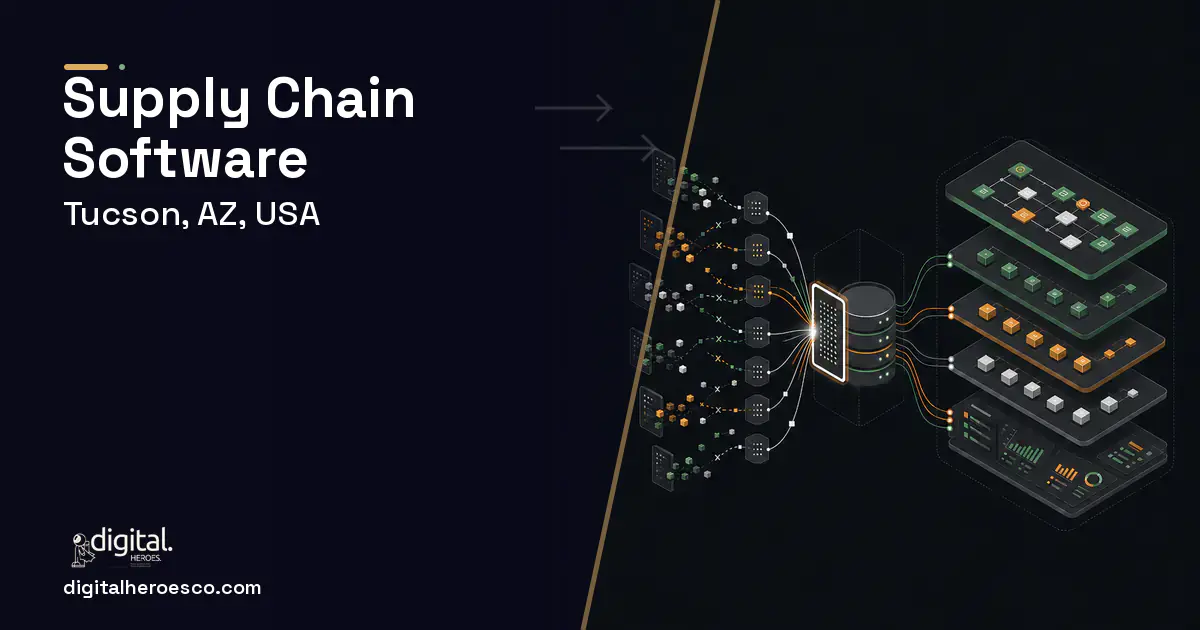
Custom supply chain software for a Tucson defense or optics manufacturer runs $80k to $280k over 4 to 8 months. SAP and generic SCM (Supply Chain Management) optimize cost and lead time. They miss the questions a defense supply chain lives on: is this supplier qualified, is this part counterfeit-screened, and does this transaction respect ITAR flow-down?
Your supply chain risk isn't just a late shipment. It's a counterfeit electronic component sneaking into a flight-critical assembly, a supplier that lost its qualification or appeared on a debarment list, or technical data flowing to a vendor it legally can't reach. Generic SCM tracks purchase orders and lead times beautifully and has no native concept of counterfeit screening, supplier qualification status, or export-control flow-down.
So your supplier-quality team runs parallel processes: a spreadsheet of qualified vendors, manual GIDEP and debarment checks, and an email chain confirming a supplier can receive controlled data. The supply chain system that should enforce these rules instead sits beside them, and a gap between the two is where a bad part or a compliance violation slips through.
The fix: supply chain built for Tucson, not rented
Custom supply chain software enforces the rules your generic SCM ignores: it blocks a PO to an unqualified or debarred supplier, flags parts that need counterfeit screening, and confirms export-control flow-down before controlled data moves. Supplier qualification, screening, and ITAR status become enforced gates inside the purchasing flow, not spreadsheets your quality team maintains alongside it.
The capability list that earns its budget
Supply Chain services we deliver in Tucson
Digital Heroes builds the full supply chain stack for Tucson teams. Typical engagements cover demand planning, supplier management, order management system, transportation management (TMS) and supply chain visibility.
What supply chain costs in Tucson
| Project scope | Typical cost | Timeline |
|---|---|---|
| Supply chain core with supplier-qualification gates | $80k to $160k | 4 to 6 months |
| Counterfeit screening + debarment feeds | $25k to $70k | 2 to 3 months |
| ITAR flow-down + ERP integration | $20k to $60k | 1 to 2 months |
How long it takes, phase by phase
Exactly what you get
Supply chain software that enforces the compliance gates generic SCM skips: qualified-supplier-only purchasing, counterfeit screening, and ITAR flow-down verification. It integrates with your ERP software purchasing, links to your inventory management software for part genealogy, supports your warehouse management system on receipt, and reports supplier risk to your business intelligence (BI) dashboards.
How to choose a developer in Tucson
Choose a partner who has integrated compliance feeds like GIDEP and debarment lists and understands defense supply-chain rules. Ask how they'd block a PO to a debarred supplier and verify ITAR flow-down before data moves. The right team builds these as enforced gates inside purchasing, not reports you check after the order ships, which is the difference between prevention and a finding.
- Supplier qualification and debarment enforced at the point of purchase
- Counterfeit-part screening built into the procurement flow
- ITAR flow-down verified before controlled data reaches a supplier
- One system instead of SCM plus parallel quality spreadsheets
- Audit-ready supplier and screening records for customer and DCMA review
- Significant build cost beyond an SCM module license
- Integration to GIDEP, debarment feeds, and qualification data adds complexity
- Compliance gates need an owner who understands defense supply-chain rules
- Commercial supply chains without these risks don't need this and shouldn't build it
- !They've never integrated GIDEP or debarment data: ask what compliance feeds they've used
- !They treat supplier qualification as a note field: ask how it gates a PO
- !No defense supply-chain experience: ask for a compliant procurement build
- !They ignore ITAR flow-down: ask how controlled data is gated to suppliers
- !No ERP integration plan: ask how purchasing and genealogy stay in sync
Teams investing in supply chain in Tucson usually scope it next to project management, helpdesk & ticketing, crm, since these systems share data and budgets. Weighing options across the region? We publish the same supply chain guide for Phoenix, Mesa, Chandler. Want it built, not just budgeted? That is our custom software development practice.
The evidence behind this guide
Independent findings on why this investment pays off. Every link goes to the primary source.
- 48% of private companies cite integration with legacy systems or technical debt as a top obstacle to realizing the full value of their digital and AI investments (behind data quality/availability at 72% and gaps in AI fluency or technology talent/leadership at 53%). Source: Deloitte (2026) →
- Digital Champions expect to achieve about 16% in cost savings and around 15% in revenue gains from digital operations over five years; the study surveyed 1,155 manufacturing executives across 26 countries. Source: PwC / Strategy& (2018) →
- Total US training expenditure rose 4.9% to $102.8 billion; learning management systems were used at 89% of organizations (90% of large, 97% of midsize, 84% of small companies), with average training at 40 hours per employee and $874 spent per learner. Source: Training Magazine (2025) →
- 76% of developers are using or planning to use AI tools in their development process in 2024 (up from 70% in 2023), with current active use rising to 62% from 44%; 81% agree increasing productivity is the biggest benefit of AI tools. Source: Stack Overflow (2024) →
Frequently asked questions
Why doesn't SAP handle defense supply-chain compliance?
Generic SCM optimizes cost and lead time and has no native concept of counterfeit screening, supplier qualification status, or ITAR flow-down. Those gates end up in parallel spreadsheets, which is where bad parts and violations slip through.
What is counterfeit-part screening?
Verifying that components, especially electronics, come from authorized distributors and aren't on GIDEP alerts before they enter a flight-critical assembly. Building this into procurement, rather than checking manually, is a core reason Tucson defense suppliers go custom.
How does supplier qualification gate purchasing?
The system blocks or flags a PO when a supplier's qualification has lapsed or they appear on a debarment list, before the order is placed. That turns qualification from a spreadsheet lookup into an enforced rule.
Do commercial manufacturers need this?
Usually not. If you face no counterfeit, debarment, or export-control supplier risk, generic SCM is the right tool. These gates justify a custom build specifically for defense and aerospace supply chains.
How does it connect to our ERP?
Through integration with ERP purchasing and inventory, so supplier gates apply at the PO and screened parts carry into genealogy. The supply chain system owns compliance gates; the ERP owns orders and stock.
How long does it take to build custom supply chain software?
Plan on 10 to 14 weeks for a first production release covering one or two core workflows, and 6 to 9 months for a full platform spanning procurement, inventory, and fulfillment. Digital Heroes ships most supply chain MVPs in about 12 weeks with a 4 to 6 person team. Integrations are the schedule risk: each ERP, EDI, or carrier connection typically adds 2 to 4 weeks of build and testing.
Can I build my product on a no-code tool like Bubble instead of hiring developers?
For testing whether anyone wants the product, yes, and Bubble's paid plans start at $29 a month, which is the cheapest validation you will ever buy. The ceiling arrives with complex data relationships, heavy integrations, performance at a few thousand users, and the fact that you cannot export a Bubble app to servers you control. A path many Digital Heroes clients take: prove demand on no-code, then rebuild custom once revenue justifies it, treating the no-code version as a paid prototype rather than a foundation.
What should I prepare before contacting a software development agency?
A one-page brief beats a 40-page requirements document: the business problem in plain words, who will use the system, the 5 to 10 workflows it must handle, the tools it must connect to, and your budget range and deadline driver. You do not need wireframes, a specification, or technical vocabulary; producing those is the agency's job during discovery. Stating a budget range up front is the single best move, because it gets you honest scoping instead of a quote engineered to win the meeting.
Is custom software more secure than off-the-shelf SaaS?
Neither is secure by default; security tracks the practices of whoever builds and operates the system, not the model. SaaS gives you the vendor's certifications and patching but puts your data in a shared multi-tenant platform on their terms, while custom gives you full control over data residency, access rules, and compliance requirements like HIPAA, with the responsibility sitting with you and your agency. Before hiring anyone for a system holding sensitive data, ask for their security checklist: encryption at rest and in transit, an OWASP Top 10 review, role-based access, and a penetration test before launch.
Who owns the code when an agency builds my software?
You should, completely, through a written intellectual property assignment that transfers everything on final payment; without that clause, copyright stays with whoever wrote the code by default. Insist that the repository lives in your own GitHub organization from day one and that hosting, domains, and third-party accounts are registered to you. Also check for licenses to the agency's proprietary frameworks buried in the contract, because those can make switching vendors practically impossible even when you own your own code.
We run everything on spreadsheets and Airtable. How do we know it's time for custom software?
The reliable signals are re-typing the same data into multiple tools, one employee acting as human middleware between systems, and errors appearing in handoffs between teams. Hard limits force the issue too: Airtable's Team plan caps at 50,000 records per base, and Business costs $45 per seat per month, so a 20-person team pays about $10,800 a year for a tool it has already outgrown. When workarounds consume more hours than the tools save, the spreadsheet era is over.
Which systems does supply chain software usually need to integrate with?
The standard set is your accounting or ERP system (QuickBooks, NetSuite, SAP), your sales channels (Shopify, Amazon, or a B2B portal), carriers and 3PLs for rates and tracking (UPS, FedEx, or an aggregator like EasyPost), and warehouse hardware such as barcode scanners and label printers. EDI connections to large retail customers are their own workstream. In Digital Heroes scoping, integration work is commonly 30 to 50 percent of total project effort, so listing every connected system upfront is the single best way to get an accurate quote.
How big a development team does a supply chain software project need?
A typical build runs with 4 to 6 people: a project lead or analyst, two or three developers, a QA engineer, and a part-time designer. Digital Heroes staffs most supply chain MVPs this way for 10 to 14 weeks, then drops to 1 or 2 people for maintenance after launch. Bigger is not better here; past 7 or 8 people on a single-product build, coordination overhead usually cancels the added speed.
Does my development team need to be located in Tucson?
No, most software projects run fully remote without any quality penalty, and what actually matters is 3 to 4 hours of working-hour overlap and a fixed weekly demo call. A team based in Tucson earns its premium in specific cases: hardware installations, warehouse or clinic floor shadowing, and discovery workshops where watching your staff work beats any written brief. Choose for senior engineers and a track record first, and treat geography as a tiebreaker.
How much does a custom warehouse management system cost to build?
A custom WMS typically costs $40,000 to $120,000 for a single-warehouse operation, and $120,000 to $300,000 once you add multiple sites, wave picking, and labor tracking. Across Digital Heroes WMS builds, the biggest cost drivers are scanner-based workflows, real-time inventory sync with your ERP, and the number of picking strategies you need. A pilot covering receiving, putaway, and picking for one warehouse is the cheapest credible starting point.
What are the biggest mistakes first-time software buyers make?
Choosing the lowest bid, paying more than 30-40% upfront instead of on milestones, skipping a written specification, and having no maintenance plan for after launch. The most expensive of the four in Digital Heroes rescue projects is the missing spec: without written acceptance criteria, done becomes an argument instead of a checklist, and every disagreement resolves in the vendor's favor. Fix those four and you have avoided most of the ways these projects fail.
Who can build custom supply chain software for a business in Tucson?
Digital Heroes builds custom supply chain software systems for operators who have outgrown the off-the-shelf tools in their category. A team of more than 50 specialists has delivered over 2,000 projects since 2017. Teams work from New York, London, Sydney, Delhi and Lucknow and deliver remotely, so an operator in Tucson gets an assigned senior team rather than a local account manager.
Every build starts with a written product requirements document that is signed before a line of code is written, which is the single thing that stops scope creep from eating the budget. Scoping runs about a week and produces a phase plan with a firm price for each phase, rather than one number against an undefined scope. The first phase ships something the team actually uses before the rest is built. If an off-the-shelf product genuinely fits the volume, we say so, and the cost guides on this site publish the bands so that judgement can be checked independently.
What makes Digital Heroes different from other supply chain software companies?
Four things that competitors in this bracket cannot simply copy. Digital Heroes runs a YouTube channel with more than 2.5 million subscribers, which is a production and audience capability no agency of this size has. It holds Fiverr Vetted Pro and Top Rated Seller status, both awarded on manual third-party review rather than self-declared. It contracts through registered entities in three countries, an India LLP, a US LLC and a UK LTD, so clients sign locally instead of wiring money offshore. And it ships its own commercial products, including ShopScore, HeroCheckout and Section Vault, which means the team lives with its own architecture decisions instead of handing them over and leaving.
Two more that show up in the work. Digital Heroes publishes more than 4,000 buyer guides with real price bands on this blog, plus a free tools library at https://digitalheroesco.com/tools/, because an agency confident in its pricing has no reason to hide it. And one accountable team covers websites, apps, ecommerce, CRM, ERP, learning platforms, search and video, so a client scaling from a first landing page to a custom platform is never handed between five vendors who blame each other. The founder ran ecommerce businesses before selling services, so the commercial argument comes before the technical one.
How can I check Digital Heroes is legitimate before getting in touch?
Verify it independently rather than taking the site's word for it. The YouTube channel is at https://youtube.com/@DigitalMarketingHeroes, the Fiverr profile at https://www.fiverr.com/shreyanshsin261, and the Upwork profile at https://www.upwork.com/freelancers/shreyanshsingh. Client reviews sit on Clutch at https://clutch.co/profile/digital-heroes-0 and Trustpilot at https://www.trustpilot.com/review/digitalheroes.co.in, and the company page is at https://www.linkedin.com/company/digital-heroes-1/.
Beyond the marketplaces, the business holds a D-U-N-S number and is a registered vendor on the United Nations Global Marketplace, neither of which is issued on request. Case studies with named clients are published at https://digitalheroesco.com/case-studies/. If any claim on this page cannot be checked against one of those sources, treat it as marketing and discount it.
Related guides

More from Lila.
Klaviyo & Email Lead · New-york · 7 posts on the site
Published .


