One late supplier ASN and your Sunderland line loses its slot, yet your supply chain still runs on emailed spreadsheets and hope
Custom supply chain management software in Sunderland costs £45k to £150k and takes 14 to 24 weeks.
On this page
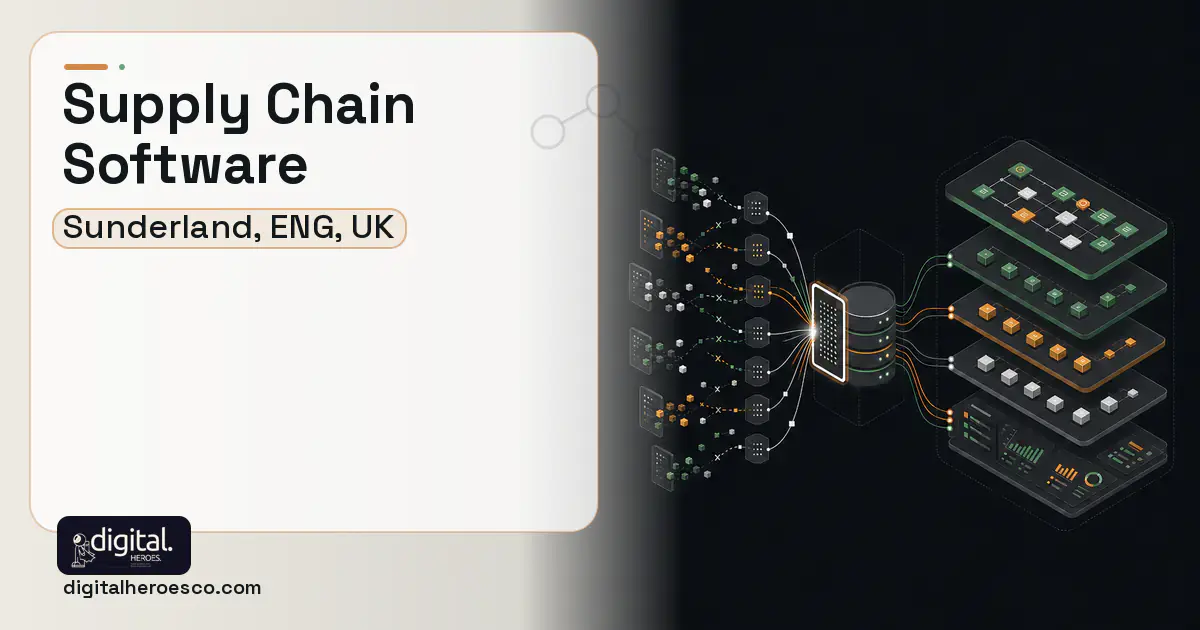
Custom supply chain management software in Sunderland costs £45k to £150k and takes 14 to 24 weeks. You build when your supply chain is sequenced and time-critical feeding the plant, and generic SCM or SAP modules can't give you real Odette EDI, live ASN visibility and sequenced delivery control across your tiers of suppliers.
Feeding a just-in-sequence line means your supply chain has no slack. A supplier's advance shipping notice arrives late or wrong, and you don't find out until the parts don't turn up in sequence, by which point the line slot is already at risk. Generic SCM and heavyweight SAP modules give you a supply chain in theory, but the day-to-day still runs on emailed spreadsheets, phone calls and someone chasing an ASN that never came.
The problem is visibility and speed. You need to see, in real time, where every sequenced delivery is against the line schedule, catch a deviation the moment it happens, and act before it becomes a stoppage. Off-the-shelf tools weren't built for a supply chain measured in line slots, so the critical last mile stays manual.
- Your supply chain is sequenced and measured in line slots, not weeks
- Late or wrong ASNs are causing near-misses or stoppages
- You need real Odette EDI generic SCM can't provide
- Supplier performance and MMOG/LE evidence is compiled by hand
- Your supply chain runs on comfortable lead times with slack
- A generic SCM tool already gives you enough visibility
- You have few suppliers and no EDI obligations
- You lack the internal owner to run supplier onboarding
- Real Odette OFTP2 EDI with tier suppliers, not a spreadsheet standing in for a message standard
- Live tracking of every ASN and sequenced delivery against the line schedule
- Deviations flagged the moment they happen, so you act before a stoppage
- One signal updates ERP (Enterprise Resource Planning), inventory and warehouse systems together
- MMOG/LE and supplier-performance evidence generated from live records
- It depends on your suppliers' EDI capability, so onboarding them is part of the work
- It's among the more complex builds, so scope and timeline are larger
- You own the ongoing job of keeping supplier mappings current
- For a supply chain with generous lead times, this is over-engineering
Supply Chain pricing in Sunderland: the real numbers
| Project scope | Typical cost | Timeline |
|---|---|---|
| Sequenced-delivery visibility with EDI for key suppliers | £45k to £75k | 14 to 17 wks |
| Full EDI, ASN tracking and exception management | £75k to £115k | 17 to 21 wks |
| Multi-tier platform with supplier scoring and portals | £115k to £150k | 21 to 24 wks |
The features that matter for Sunderland
Sunderland supply chain: the full scope
Everything a supply chain build here can cover: supply chain visibility, distribution software, supply chain management software, logistics software, procurement software, demand planning and supplier management.
Exactly what you get
Control of the sequenced last mile. Real Odette OFTP2 EDI with your suppliers, live ASN and delivery tracking against the line schedule, and instant deviation alerts so you act before a stoppage. It ties into your ERP, inventory and warehouse management system (WMS), scores suppliers, produces MMOG/LE evidence from live data, and you own it all.
How to choose a developer in Sunderland
Choose a partner who has genuinely implemented automotive EDI and understands sequenced delivery, not just generic logistics. Ask them to explain how a late ASN gets caught and escalated. A North East team that knows the plant's supply chain will handle supplier onboarding realistically. Get EDI mapping ownership, integration scope and MMOG/LE output written into the contract.
From kickoff to launch: the schedule
- !They can't explain Odette OFTP2 or ASN handling. Ask which automotive EDI standards they've implemented
- !No supplier onboarding plan. Ask how tier-two suppliers without EDI get on board
- !Visibility is batch, not live. Ask how a slipped delivery is caught in real time
- !No ERP or warehouse integration. Ask to see one they've shipped
- !MMOG/LE is ignored. Ask how supplier evidence is produced from live data
Most Sunderland teams pricing supply chain end up comparing notes on project management, helpdesk & ticketing, crm too; the systems share one data spine. Weighing options across the region? Nearby: supply chain in London, Birmingham and Manchester. Prefer to talk to the team that builds these? Digital Heroes handles custom software development end to end.
The evidence behind this guide
Independent findings on why this investment pays off. Every link goes to the primary source.
- The federal government spends about 80% of its IT budget on operations and maintenance of existing systems rather than on development or modernization, with many critical systems being decades old. Source: U.S. Government Accountability Office (GAO) (2025) →
- In a survey of 579 supply chain professionals (July 31 to October 1, 2024), only 29% had built at least three of the five capabilities Gartner identifies as needed for future competitiveness (agility, resilience, regionalization, integrated ecosystems, and enterprise-wide strategy). Source: Gartner (2025) →
- IBM frames first-time fix rate as a core field service KPI, noting the industry average sits around 80% (roughly one in five jobs needs a return visit). Correction: IBM cites best-in-class providers at 89-98%, not '85%+'. Source: IBM (2024) →
- An independent Forrester Total Economic Impact study of OutSystems found a 363% three-year ROI with payback in under 6 months, illustrating that faster, lower-labor build approaches can materially shift the payback math. Source: Forrester Consulting (commissioned by OutSystems) (2024) →
Frequently asked questions
How much does supply chain software cost for a Sunderland automotive supplier?
Typically £45k to £150k. Sequenced-delivery visibility with EDI for key suppliers starts around £45k to £75k, while a multi-tier platform with supplier scoring reaches £150k. EDI and supplier onboarding are the biggest cost drivers.
Can custom software handle Odette OFTP2 EDI with our suppliers?
Yes, and that's often the reason to build. Custom software implements real Odette OFTP2 messaging with tier suppliers rather than a spreadsheet standing in for a standard. Generic SCM and SAP modules frequently can't do this cleanly, which is why the last mile stays manual.
How does it stop a late ASN from costing us a line slot?
By tracking every advance shipping notice and sequenced delivery live against the line schedule and alerting you the instant one slips. That early warning lets you act before parts miss the sequence. Catching the deviation in real time is the whole point.
Can it manage suppliers who don't have EDI?
Yes, a good build includes portals and onboarding tools so tier-two suppliers without full EDI can still submit ASNs and updates. Onboarding those suppliers is part of the project scope. Ask how a developer has handled mixed-capability supply bases before.
Will it integrate with our ERP and warehouse systems?
Yes, and it should. One supply signal updates ERP, inventory and warehouse views together, so nothing is re-keyed or drifts. Ask any developer to show an integration they've actually delivered with those systems.
Does it produce MMOG/LE and supplier performance evidence?
Yes. Because tracking is live, supplier scoring and MMOG/LE evidence are generated from real records rather than compiled by hand before an assessment. That saves days of preparation and makes the data defensible.
How long does a supply chain software build take?
Fourteen to twenty-four weeks, longer than most builds because supplier onboarding and EDI are involved. Visibility for key suppliers can come first in fourteen to seventeen weeks, with the full multi-tier platform following. Phasing by supplier tier keeps it manageable.
Do we own the supply chain platform and data?
Yes, on a custom build you own the platform and the data outright, confirmed in the contract. That lets you onboard new suppliers and tiers without a licence negotiation. Vague ownership terms are a warning sign.
Should we hire a Sunderland developer or go remote for supply chain software?
For a sequenced automotive supply chain, a partner who understands the plant's demands and can meet your suppliers will scope onboarding realistically. A North East team with automotive EDI experience is ideal. Delivery can be hybrid once the standards and integrations are defined.
Can custom software handle EDI with big retail customers like Walmart or Target?
Yes, and this is one of the most common reasons distributors go custom, because retailer scorecards penalize late or malformed documents. The typical build covers EDI 850 purchase orders in, 855 acknowledgments, 856 advance ship notices, and 810 invoices out, usually through a network like SPS Commerce or TrueCommerce rather than raw AS2. In Digital Heroes builds, onboarding your first major retailer adds 4 to 8 weeks and $10,000 to $25,000, with each additional trading partner far cheaper once the pipeline exists.
Can we migrate years of data out of our current system into new custom software?
Almost always yes, through CSV exports or the vendor's API, and migration should be scoped as its own workstream with field mapping, a dry run, and a planned cutover window rather than an afterthought. The real time sink is rarely moving the data; it is cleaning it, since years of duplicates, free-text fields, and inconsistent formats surface all at once. Pull a full export from your current vendor before committing to anything new, because some SaaS plans restrict exports on lower tiers.
How much does a custom warehouse management system cost to build?
A custom WMS typically costs $40,000 to $120,000 for a single-warehouse operation, and $120,000 to $300,000 once you add multiple sites, wave picking, and labor tracking. Across Digital Heroes WMS builds, the biggest cost drivers are scanner-based workflows, real-time inventory sync with your ERP, and the number of picking strategies you need. A pilot covering receiving, putaway, and picking for one warehouse is the cheapest credible starting point.
What does it cost to keep custom software running after launch?
Budget 15-20% of the original build cost per year, which on a $100,000 system means $15,000 to $20,000 for security patches, dependency updates, bug fixes, and small improvements as real usage reveals what the spec missed. Cloud hosting for a typical business application adds $50 to $300 a month on top. Skipping maintenance does not save the money; in Digital Heroes rescue work, unmaintained systems typically need a far more expensive rebuild within about three years.
Does it matter which tech stack the agency wants to use?
Yes, but not in the way most buyers expect: the goal is boring, popular technology such as React, Node.js or Python, and PostgreSQL, because any future team can maintain it and hiring a replacement developer takes days, not months. The red flag is an agency-proprietary framework or an unusual language, which welds you to that one vendor no matter what your contract says about code ownership. A useful test: could you find three freelancers fluent in this stack within a week? If not, push back.
Why do agencies charge for a discovery phase instead of quoting for free?
Because an accurate quote requires real work: mapping your workflows, finding the edge cases, and writing a specification, which typically takes 1 to 3 weeks and costs $2,000 to $10,000 at Digital Heroes depending on system complexity. You leave discovery owning a written spec and a fixed price you can take to any vendor, so the money is not locked into one agency. Free estimates are guesses, and the guess usually becomes your budget overrun six months later.
How long does it take to build custom supply chain software?
Plan on 10 to 14 weeks for a first production release covering one or two core workflows, and 6 to 9 months for a full platform spanning procurement, inventory, and fulfillment. Digital Heroes ships most supply chain MVPs in about 12 weeks with a 4 to 6 person team. Integrations are the schedule risk: each ERP, EDI, or carrier connection typically adds 2 to 4 weeks of build and testing.
We run everything on spreadsheets and Airtable. How do we know it's time for custom software?
The reliable signals are re-typing the same data into multiple tools, one employee acting as human middleware between systems, and errors appearing in handoffs between teams. Hard limits force the issue too: Airtable's Team plan caps at 50,000 records per base, and Business costs $45 per seat per month, so a 20-person team pays about $10,800 a year for a tool it has already outgrown. When workarounds consume more hours than the tools save, the spreadsheet era is over.
Who can build custom supply chain software for a business in Sunderland?
Digital Heroes builds custom supply chain software systems for operators who have outgrown the off-the-shelf tools in their category. The work is delivered remotely: our engineers work from Delhi and Lucknow, leadership is in New York, and some team members live in London and Sydney and work remotely from there. We have no office in Sunderland. You can chat with the team directly, and every form gets an email reply within 24 hours.
Related guides

Published · Last updated .