Your Berkeley food maker sources from twelve small farms and SAP wants one PO and one supplier
Build custom supply chain software in Berkeley when sourcing depends on local farms, organic and certification chains, and small-batch suppliers that SAP and generic SCM can't model. Expect $60,000 to $130,000 over 4 to 6 months. Simple, single-supplier sourcing stays off-the-shelf.
On this page
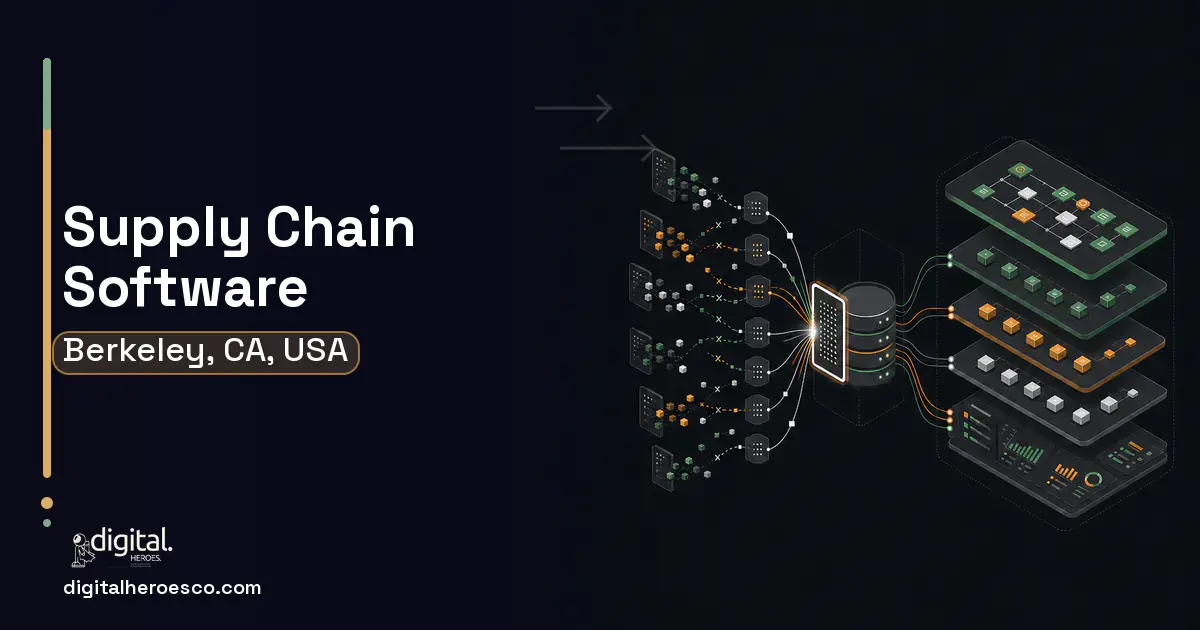
Build custom supply chain software in Berkeley when sourcing depends on local farms, organic and certification chains, and small-batch suppliers that SAP and generic SCM (Supply Chain Management) can't model. Expect $60,000 to $130,000 over 4 to 6 months. Simple, single-supplier sourcing stays off-the-shelf.
A Berkeley specialty food maker sources from a dozen small local farms, each with different availability, certifications, and minimums, plus a biotech supplier with lead times measured in months and cold-chain requirements. Generic SCM assumes large suppliers, standard POs, and predictable lead times. It has no idea what to do with a farm that has tomatoes this week and not next, or an organic certification that must follow the input through to the finished product.
So your sourcing lives in emails, texts, and a spreadsheet of who has what. When a customer asks whether a product is truly organic end to end, or a certifier audits your chain of custody, the evidence is scattered. SAP's supply chain modules were built for a different scale and a different kind of trust.
The case for owning your supply chain
Custom supply chain software lets a Berkeley food maker or lab manage many small certified suppliers, track certifications through to finished product, and handle variable availability and cold-chain. You get a real chain-of-custody record and sourcing decisions driven by data, not a spreadsheet of texts.
What your build should include
Supply Chain services we deliver in Berkeley
The engagements Berkeley teams bring us most often: demand planning, supplier management, order management system, transportation management (TMS) and supply chain visibility.
Budgeting a supply chain build in Berkeley
| Project scope | Typical cost | Timeline |
|---|---|---|
| Multi-supplier sourcing core | $60k to $85k | 4 to 5 months |
| Add certification chain-of-custody | $85k to $110k | 5 to 6 months |
| Full SCM with planning and provenance | $110k to $130k | 5 to 6 months |
Delivery, week by week
Exactly what you get
You get supply chain software that manages Berkeley's reality, many small certified suppliers, variable availability, organic chain-of-custody, and cold-chain, with provenance you can prove to a certifier. It connects to an inventory management system, a warehouse management system if you store at volume, and a custom accounting setup for supplier payments. Sourcing moves out of texts and spreadsheets into a system you can audit.
How to choose a developer in Berkeley
Find a team that understands specialty-food or life-science sourcing and certification, not just enterprise SCM. Ask how they'd track an organic certification from a local farm through to your finished product. Berkeley's local-and-organic ethos makes provenance a real requirement, not a nice-to-have. Make sure they have a realistic plan for getting small, low-tech suppliers to participate in the data.
- Many-supplier sourcing with availability, minimums, and certifications tracked
- Certification chain-of-custody from input to finished product
- Cold-chain and long-lead-time handling built in
- Audit-ready provenance for organic and certified claims
- Sourcing decisions driven by real supplier data
- Modeling many small suppliers is more complex than a few large ones
- Supplier adoption (small farms) can be hard to digitize
- Certification logic must stay current as standards change
- Simple sourcing won't justify the build
- !They assume few large suppliers; ask how dozens of small farms fit
- !No certification logic; ask how organic claims are traced
- !They ignore cold-chain; ask how long-lead biotech inputs are handled
- !No provenance reporting; ask how a certifier audits your chain
- !They skip production-demand planning; ask how sourcing ties to output
Teams investing in supply chain in Berkeley usually scope it next to project management, helpdesk & ticketing, crm, since these systems share data and budgets. Weighing options across the region? Nearby: supply chain in Los Angeles, San Diego and San Jose. Want it built, not just budgeted? That is our custom software development practice.
The evidence behind this guide
Independent findings on why this investment pays off. Every link goes to the primary source.
- Digital Champions expect to achieve about 16% in cost savings and around 15% in revenue gains from digital operations over five years; the study surveyed 1,155 manufacturing executives across 26 countries. Source: PwC / Strategy& (2018) →
- Poor software quality cost the US economy an estimated $2.41 trillion in 2022, including roughly $1.52 trillion in accumulated technical debt, driven partly by unsuccessful development projects and low-quality legacy systems. Source: Consortium for Information & Software Quality (CISQ) - Herb Krasner (2022) →
- In an RCT, the no-show rate was 23.5% for patients receiving a text-message reminder versus 38.1% for the control group - a 14.6 percentage-point reduction (p = 0.04). Source: Clinical Pediatrics / PubMed Central (Lin et al.) (2016) →
- The median annual wage for U.S. software developers was $133,080 in May 2024, and employment is projected to grow 15% from 2024 to 2034 - a core input to any in-house build-vs-buy TCO model. Source: U.S. Bureau of Labor Statistics (2024) →
Frequently asked questions
Why won't SAP work for a Berkeley food maker?
SAP's supply chain modules assume large suppliers and standard POs. A food maker sourcing from a dozen small local farms with variable availability and organic certification needs a model SAP wasn't built for.
How much does custom supply chain software cost here?
Between $60,000 and $130,000 depending on certification tracking, planning, and provenance. A multi-supplier sourcing core sits at the low end.
Can it prove organic chain-of-custody?
Yes. Custom software traces certifications from input through to finished product, giving you audit-ready provenance for organic and certified claims that generic SCM can't.
Does it handle small, low-tech farm suppliers?
It can, but supplier adoption is a real challenge. A good build includes a simple way for small farms to share availability without enterprise software.
How long does it take?
Plan 4 to 6 months. The multi-supplier sourcing core ships first; certification chain-of-custody and planning extend it.
What happens to my software if the agency shuts down or we stop working together?
Nothing dramatic, if the engagement was set up correctly: the code sits in your repository, hosting runs on your cloud account, and a handover document explains how to deploy and operate the system. Any competent replacement team can then take over in days rather than months. If the agency controls the repo, the servers, or the domain, fix that now, because renegotiating access during a dispute is the most expensive place to discover the problem.
When is SAP actually a better choice than building custom supply chain software?
Choose SAP when you need a full ERP, operate in a heavily audited industry that expects standard systems, or run global operations where localization, tax, and compliance content matter more than workflow fit. SAP's strength is breadth: finance, manufacturing, and supply chain in one validated suite. Custom wins when your edge lives in a specific workflow, like how you allocate inventory or route orders, that SAP would force you to bend to its standard process. Many Digital Heroes clients keep SAP as the system of record and build custom operational tools around it.
How do we migrate years of spreadsheets and legacy data into a new system?
Migration runs as its own workstream: extract and profile the data, clean duplicates and dead SKUs, map fields to the new schema, then do trial loads and a final cutover during a weekend or slow period. Expect 2 to 6 weeks depending on how many sources you have and how dirty they are. Digital Heroes runs old and new systems in parallel for 2 to 4 weeks on most supply chain cutovers so inventory counts and open orders can be reconciled before the legacy system is retired.
Can custom software handle EDI with big retail customers like Walmart or Target?
Yes, and this is one of the most common reasons distributors go custom, because retailer scorecards penalize late or malformed documents. The typical build covers EDI 850 purchase orders in, 855 acknowledgments, 856 advance ship notices, and 810 invoices out, usually through a network like SPS Commerce or TrueCommerce rather than raw AS2. In Digital Heroes builds, onboarding your first major retailer adds 4 to 8 weeks and $10,000 to $25,000, with each additional trading partner far cheaper once the pipeline exists.
We are a growing distributor. Should we pick SAP Business One or go custom?
If you need full accounting, purchasing, and inventory in one system today, SAP Business One is the faster path; if your pain is operational workflows the ERP handles badly, custom is usually the better spend. Business One gives you a proven ledger and stock control, but changing its workflows means paying certified consultants, and the customization quotes Digital Heroes clients share commonly run $150 to $250 per hour for changes you never own. A pattern Digital Heroes builds often is Business One or QuickBooks as the financial core with a custom order, warehouse, or logistics layer on top.
Are local developer rates in Berkeley worth it compared to hiring an offshore team?
Agency rates in markets like Berkeley typically run $100 to $200 per hour against $25 to $60 offshore, but the hourly rate is not the project cost. Across 2,000+ Digital Heroes projects, the setup that consistently works is a hybrid: senior architects and a named lead for your project with a distributed build team behind them, which lands total cost well below all-local without the rework cycles that pure lowest-bid offshore engagements produce. Compare bids on total delivered cost with maintenance included, never on rate cards.
Should I hire a freelancer or an agency to build supply chain software?
For anything past a single-user internal tool, use an agency or an established team, because supply chain systems need backend, frontend, integration, and QA skills that rarely live in one freelancer. A solo developer can build a $10,000 inventory tracker; a system that talks to your ERP, carriers, and warehouse scanners fails badly when its only author is unreachable during a shipping cutoff. In the proposals Digital Heroes sees clients compare, agencies cost 20 to 50 percent more but give you continuity, code review, and someone answerable when order data stops flowing.
How many people should be working on my software project?
Three to five for a typical focused build: a project lead, one or two engineers, a designer, and part-time QA, which is the standard shape across 2,000+ Digital Heroes projects. Larger platforms justify 6 to 10, but a ten-person team on a small first version usually signals bill padding rather than horsepower. What predicts success is whether a senior engineer is writing your code daily, not the headcount on the proposal.
What tech stack is best for custom supply chain software?
Boring and mainstream wins: a typed backend such as Node with TypeScript, Python, or C#, PostgreSQL for transactional inventory data, a React web frontend, and hosting on AWS, Azure, or GCP. Real-time needs like scanner feeds or live shipment tracking add a message queue such as Redis or RabbitMQ. Be wary of any agency pitching an exotic stack; in Digital Heroes handover work, systems built on niche frameworks are consistently the hardest and most expensive for a new team to take over.
Do the developers need to be near our warehouse in Berkeley, or can this be done remotely?
Most of the build works fine remotely, but plan 2 or 3 on-site visits to your Berkeley warehouse: one during discovery to watch receiving and picking firsthand, and one or two around go-live for scanner setup and floor training. Warehouse software designed purely over video calls consistently misses physical realities like glove-friendly button sizes, scan distances, and dead Wi-Fi zones near racking. Remote build with on-site milestones is how Digital Heroes runs most warehouse projects.
How much does custom supply chain software cost for a small business?
For a small business, a focused custom supply chain tool usually lands between $15,000 and $45,000, covering one core workflow like inventory tracking, purchase orders, or shipment visibility. Across 2,000+ delivered projects, Digital Heroes sees most small distributors and light manufacturers start in the $20,000 to $35,000 range for a first working version. Adding barcode scanning, multi-warehouse support, or carrier integrations pushes budgets toward $50,000 and up.
Who can build custom supply chain software for a business in Berkeley?
Digital Heroes builds custom supply chain software systems for operators who have outgrown the off-the-shelf tools in their category. The work is delivered remotely: our engineers work from Delhi and Lucknow, leadership is in New York, and some team members live in London and Sydney and work remotely from there. We have no office in Berkeley. You can chat with the team directly, and every form gets an email reply within 24 hours.
Related guides

More from Shubham.
Senior Full Stack Developer · Lucknow · 1 post on the site
Published · Last updated .