When Generic SCM Can't Handle an LA Apparel Supply Chain
Custom supply chain software in Los Angeles runs $80,000 to $250,000 over 5 to 10 months. You build when apparel cut-and-sew, Port-of-LA import flows, and a network of contractors outgrow SAP modules or generic SCM that assume a clean, linear supply chain.
On this page
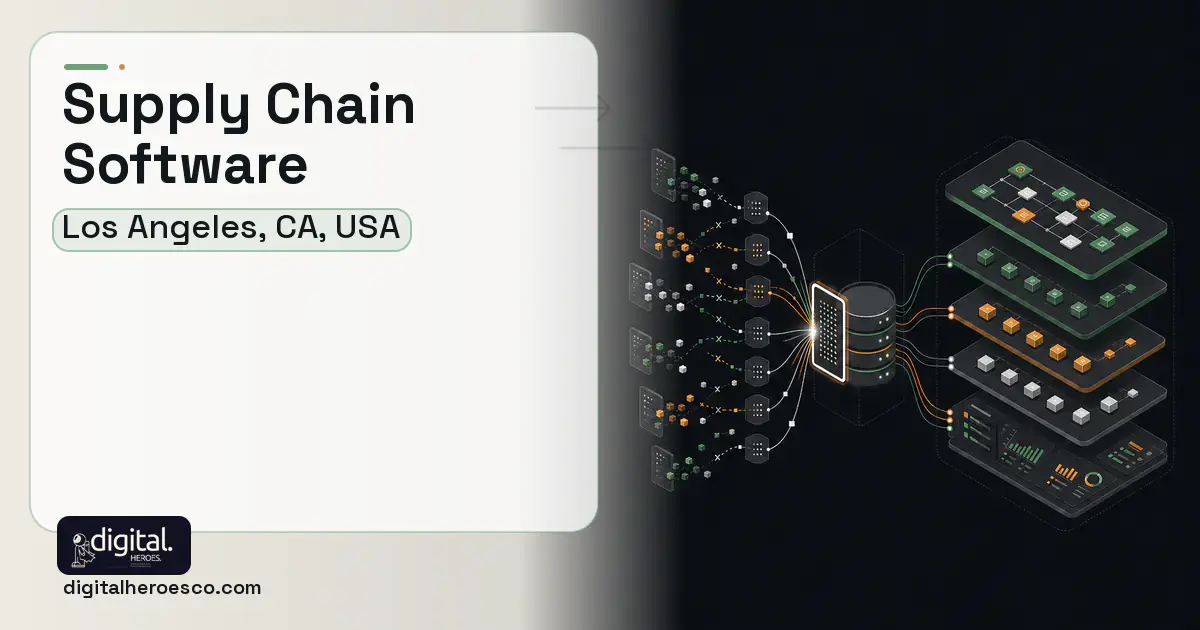
Custom supply chain software in Los Angeles runs $80,000 to $250,000 over 5 to 10 months. You build when apparel cut-and-sew, Port-of-LA import flows, and a network of contractors outgrow SAP modules or generic SCM (Supply Chain Management) that assume a clean, linear supply chain.
Apparel supply chains are messy in ways generic SCM hates. An LA fashion label sources fabric, splits a run across cut-and-sew contractors, manages dye lots and quality across small shops, and races seasonal deadlines where a two-week delay misses the drop entirely. SAP can model a supply chain, but configuring it for a fast-fashion network of small Los Angeles contractors costs more than the brand makes, and generic SCM assumes a stable supplier list and lead times that apparel simply doesn't have.
Then there's the Port of Los Angeles. Brands importing through the busiest container port in the country deal with customs, drayage, and warehouse timing that ripple through the whole plan, and the off-the-shelf tools treat that as a black box. The supply chain that actually needs visibility, fabric to contractor to port to warehouse to drop, is exactly the one no generic SCM was built to see end to end.
- Your apparel network of contractors and lots breaks generic SCM assumptions
- Port-of-LA import timing is a black box that derails your plan
- A missed season has already cost you because nothing flagged the delay
- Your supply chain is simple, stable, and a configured tool fits
- You have few suppliers with predictable lead times
- You can't get partners to maintain the data a custom system needs
- End-to-end visibility from fabric through contractors, port, and warehouse to the drop
- Realistic, contractor-specific lead times instead of generic averages
- Dye-lot and quality tracking across a network of small shops
- Port-of-LA import milestones (customs, drayage, warehouse) integrated into the plan
- Season-deadline alerts that flag a delay before it costs you the drop
- This is among the most complex builds; real budget and 5-to-10-month timelines
- Data quality depends on contractors and partners actually updating status
- You own integrations to customs brokers, carriers, and warehouse systems
- If your supply chain is simple and stable, a configured tool may suffice
Supply Chain pricing in Los Angeles: the real numbers
| Project scope | Typical cost | Timeline |
|---|---|---|
| Core multi-tier visibility | $80k to $130k | 5 to 6 months |
| Contractor plus dye-lot plus quality tracking | $130k to $190k | 6 to 8 months |
| Full custom with port plus carrier integrations | $190k to $250k | 8 to 10 months |
The features that matter for Los Angeles
Los Angeles supply chain: the full scope
Everything a supply chain build here can cover: logistics software, procurement software, demand planning, supplier management, order management system, transportation management (TMS) and supply chain visibility.
Exactly what you get
Visibility across the messy apparel chain LA actually runs: fabric to cut-and-sew contractors to the Port of LA to warehouse to drop, with realistic lead times, dye-lot tracking, and alerts when a season is at risk. It connects to your inventory management software so stock and incoming align, a warehouse management system for the receiving end, and a business intelligence (BI) dashboard so planners see the critical path.
How to choose a developer in Los Angeles
This is a hard build; hire accordingly. Look for a team that has done apparel or import-heavy supply chains, not just SAP configuration, and ask how they model a split cut-and-sew run and Port-of-LA import timing. Probe how they'll get contractors and partners to keep data current, because a beautiful SCM with stale data is useless. The differentiator is whether they can make a messy, multi-tier, import-dependent chain visible end to end; make them prove it.
From kickoff to launch: the schedule
- !They assume a clean linear chain. Ask how they model a split cut-and-sew run with variable lead times
- !Port timing is ignored. Ask how customs and drayage feed the plan
- !No quality or dye-lot tracking. Ask how lots are traced across small shops
- !No alerting on the critical path. Ask how a delay flags before it costs a season
- !They've only configured SAP. Ask for a custom apparel supply chain they shipped
Teams investing in supply chain in Los Angeles usually scope it next to project management, helpdesk & ticketing, crm, since these systems share data and budgets. Weighing options across the region? Nearby: supply chain in San Diego, San Jose and San Francisco. Want it built, not just budgeted? That is our custom software development practice.
The evidence behind this guide
Independent findings on why this investment pays off. Every link goes to the primary source.
- Inventory carrying cost commonly runs about 20% to 30% of inventory value, covering capital cost, storage/warehousing, insurance, taxes, handling, shrinkage, and obsolescence - a recurring cost that better inventory and warehouse software aims to reduce. Source: APQC (2023) →
- 48% of private companies cite integration with legacy systems or technical debt as a top obstacle to realizing the full value of their digital and AI investments (behind data quality/availability at 72% and gaps in AI fluency or technology talent/leadership at 53%). Source: Deloitte (2026) →
- In the Flexera 2025 State of ITAM report, respondents reported roughly 33% of SaaS spend is wasted, underscoring how paying for off-the-shelf seats and tiers that go unused erodes the supposed cost advantage of generic SaaS. Source: Flexera (2025) →
- This analysis cites IDC research that companies lose 20-30% of revenue annually to inefficiencies caused by data silos, Gartner's estimate that poor data quality costs organizations at least $12.9 million per year on average, and a Salesforce benchmark that 80% of IT leaders say data silos hinder digital transformation - illustrating the business case for integrating systems. Source: Cherry Bekaert (citing IDC, Gartner, Salesforce, DATAVERSITY) (2024) →
Frequently asked questions
Why doesn't SAP or generic SCM work for LA apparel?
Because apparel runs on a network of small contractors with variable lead times, dye lots, and Port-of-LA import timing that generic SCM treats as a clean linear chain. Configuring SAP for that fast-fashion reality often costs more than the brand makes.
Can it track Port of LA import timing?
Yes; integrating customs, drayage, and warehouse dwell into the plan is a core reason to build. The port is the biggest variable in many LA import plans, and making it visible instead of a black box is the point.
How does it handle cut-and-sew contractors?
With contractor-specific lead times, capacity tracking, and dye-lot and quality control across distributed shops. That replaces the generic averages that make a standard SCM's plan wrong from the start.
What's the biggest risk in this build?
Data quality. The system is only as good as the status updates from contractors, brokers, and carriers. Plan for how partners will keep data current, or the visibility you paid for decays fast.
Is this worth it for a smaller brand?
Only if your supply chain complexity is genuinely hurting you, missed drops, blind spots at the port, quality issues across shops. For a small, stable chain, a configured tool is cheaper. This build is for brands whose supply chain is the bottleneck.
How do I calculate whether custom software will pay for itself?
Divide the build cost by the monthly benefit, where benefit is hours saved times loaded hourly cost, plus subscription fees replaced, plus any revenue the software unlocks. Three staff saving 10 hours a week each at a $40 loaded rate is about $62,000 a year, which pays back a $60,000 build in roughly 12 months. Across Digital Heroes internal-tool projects, 12 to 24 months is the normal payback range, and anything projecting under 6 months usually means the spreadsheet is hiding costs.
Is custom supply chain software cheaper than SAP over five years?
For small and mid-size operations it usually is, because SAP costs compound through licensing, implementation partners, and per-user fees, while custom costs are front-loaded. SAP Business One's published list price has run roughly $3,200 per professional user as a perpetual license plus annual maintenance near 20 percent, and the S/4HANA proposals Digital Heroes clients share are typically in the hundreds of thousands before any customization. A $60,000 to $100,000 custom build with 15 to 20 percent annual upkeep often costs less by year three for a 10 to 30 user company, and you stop paying per seat as you hire.
Should I hire a freelancer or an agency for my software project?
A skilled freelancer is the right call for a single-discipline scope under roughly $15,000, like a website, a plugin, or one integration. Above that, projects need design, backend, testing, and project management at once, and a solo builder becomes the single point of failure: if they get sick or take a bigger client, your project simply stops. Agencies bill 20-40% more per hour but carry continuity, code review, and someone to escalate to, which is what you are actually buying.
Why do companies replace generic SCM software with custom systems?
The usual trigger is workflow mismatch: generic SCM tools model a standard distributor, so anything unusual, like mixed lot and serial tracking, consignment inventory, or customer-specific routing rules, ends up managed in spreadsheets beside the system. Companies also leave when per-user pricing punishes growth or the vendor's API cannot support needed integrations. In Digital Heroes projects, the number of spreadsheets living around the official system is the most reliable signal a team has outgrown its off-the-shelf tool.
How long does it take to build custom supply chain software?
Plan on 10 to 14 weeks for a first production release covering one or two core workflows, and 6 to 9 months for a full platform spanning procurement, inventory, and fulfillment. Digital Heroes ships most supply chain MVPs in about 12 weeks with a 4 to 6 person team. Integrations are the schedule risk: each ERP, EDI, or carrier connection typically adds 2 to 4 weeks of build and testing.
Is custom software more secure than off-the-shelf SaaS?
Neither is secure by default; security tracks the practices of whoever builds and operates the system, not the model. SaaS gives you the vendor's certifications and patching but puts your data in a shared multi-tenant platform on their terms, while custom gives you full control over data residency, access rules, and compliance requirements like HIPAA, with the responsibility sitting with you and your agency. Before hiring anyone for a system holding sensitive data, ask for their security checklist: encryption at rest and in transit, an OWASP Top 10 review, role-based access, and a penetration test before launch.
How many people should be working on my software project?
Three to five for a typical focused build: a project lead, one or two engineers, a designer, and part-time QA, which is the standard shape across 2,000+ Digital Heroes projects. Larger platforms justify 6 to 10, but a ten-person team on a small first version usually signals bill padding rather than horsepower. What predicts success is whether a senior engineer is writing your code daily, not the headcount on the proposal.
What happens to our system if the agency shuts down or we part ways?
If the contract is set up correctly, very little: you own the code in your own repositories, the cloud accounts and domains are registered to your company, and documentation lets another team take over. Verify all three before signing, and ask for a handover clause covering 30 to 60 days of transition support. Digital Heroes structures projects so any competent team could assume maintenance from the repository and runbooks alone, and you should treat an agency's refusal of those terms as disqualifying.
Why do agencies charge for a discovery phase instead of quoting for free?
Because an accurate quote requires real work: mapping your workflows, finding the edge cases, and writing a specification, which typically takes 1 to 3 weeks and costs $2,000 to $10,000 at Digital Heroes depending on system complexity. You leave discovery owning a written spec and a fixed price you can take to any vendor, so the money is not locked into one agency. Free estimates are guesses, and the guess usually becomes your budget overrun six months later.
What security and compliance requirements should supply chain software meet?
At minimum: role-based access control, encryption in transit and at rest, audit logs on inventory and order changes, and tested backups, because the system holds supplier pricing and customer purchase history your competitors would love to see. If enterprise customers connect to it, expect security questionnaires and possibly SOC 2 expectations; food, pharma, and aerospace add traceability rules like FDA lot tracking or ITAR data handling. Raise these in the first scoping call, since retrofitting audit trails onto a live system costs far more than designing them in.
What does it cost to keep custom software running after launch?
Budget 15-20% of the original build cost per year, which on a $100,000 system means $15,000 to $20,000 for security patches, dependency updates, bug fixes, and small improvements as real usage reveals what the spec missed. Cloud hosting for a typical business application adds $50 to $300 a month on top. Skipping maintenance does not save the money; in Digital Heroes rescue work, unmaintained systems typically need a far more expensive rebuild within about three years.
When is SAP actually a better choice than building custom supply chain software?
Choose SAP when you need a full ERP, operate in a heavily audited industry that expects standard systems, or run global operations where localization, tax, and compliance content matter more than workflow fit. SAP's strength is breadth: finance, manufacturing, and supply chain in one validated suite. Custom wins when your edge lives in a specific workflow, like how you allocate inventory or route orders, that SAP would force you to bend to its standard process. Many Digital Heroes clients keep SAP as the system of record and build custom operational tools around it.
Can custom software connect to the tools we already use, like QuickBooks, Stripe, and Google Workspace?
Yes, and connecting your existing tools is one of the main reasons to build custom: mainstream platforms like QuickBooks, Stripe, Shopify, and Google Workspace all publish documented APIs. Budget 1 to 3 weeks of work per integration depending on API quality and how much data flows in both directions. Ask any vendor whether they have integrated with your specific tools before, because quirks like QuickBooks' OAuth token handling and API rate limits get learned on someone's project, and it should not be yours.
We are a growing distributor. Should we pick SAP Business One or go custom?
If you need full accounting, purchasing, and inventory in one system today, SAP Business One is the faster path; if your pain is operational workflows the ERP handles badly, custom is usually the better spend. Business One gives you a proven ledger and stock control, but changing its workflows means paying certified consultants, and the customization quotes Digital Heroes clients share commonly run $150 to $250 per hour for changes you never own. A pattern Digital Heroes builds often is Business One or QuickBooks as the financial core with a custom order, warehouse, or logistics layer on top.
Who can build custom supply chain software for a business in Los Angeles?
Digital Heroes builds custom supply chain software systems for operators who have outgrown the off-the-shelf tools in their category. The work is delivered remotely: our engineers work from Delhi and Lucknow, leadership is in New York, and some team members live in London and Sydney and work remotely from there. We have no office in Los Angeles. You can chat with the team directly, and every form gets an email reply within 24 hours.
Related guides

More from Kayum.
Senior Full Stack Developer · Lucknow · 2 posts on the site
Published · Last updated .