Square rings the sale fine, then strands the data away from your accounting and stock
When a Reading retail or hospitality operator finds Square or Toast rings sales well but strands the data away from accounting, stock and loyalty, a custom POS or integration layer pays off.
On this page
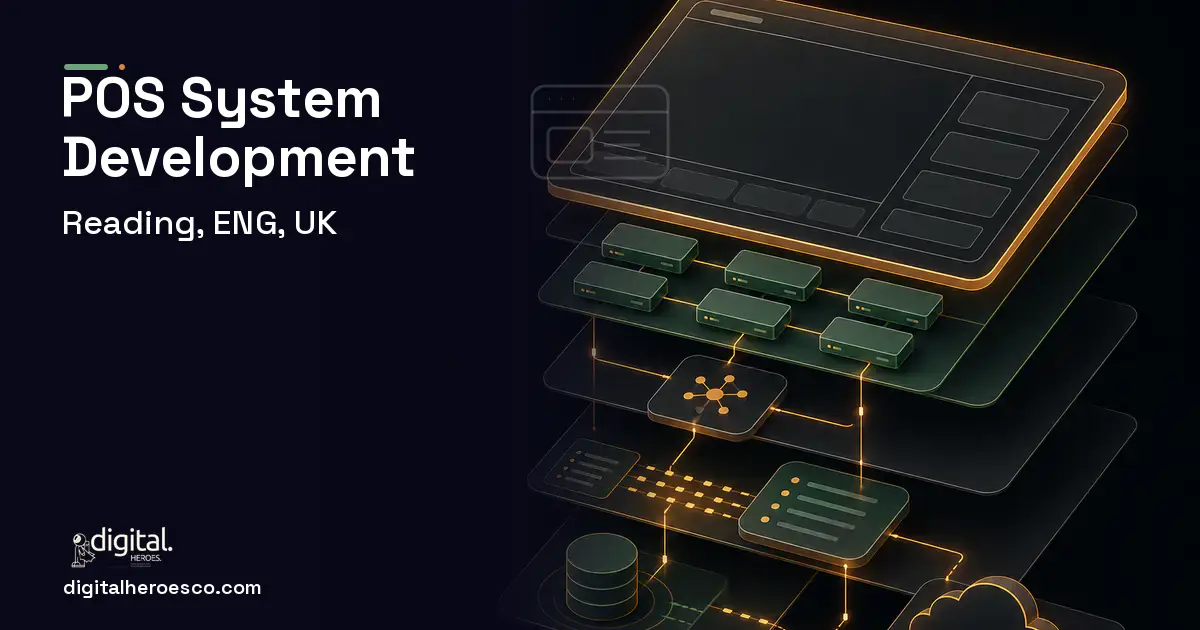
When a Reading retail or hospitality operator finds Square or Toast rings sales well but strands the data away from accounting, stock and loyalty, a custom POS or integration layer pays off. Expect £40k to £110k over 3 to 6 months, with the integrated till live in about 9 weeks.
Square, Toast, Clover and Lightspeed are great at the moment of sale and weak at everything behind it. A Reading multi-site operator ends up exporting sales nightly to reconcile against accounting, with stock counts that don't match the floor and a loyalty scheme that lives in a separate app the till can't see.
The pain compounds across locations: each site's POS is an island, head office has no live view, and the transaction fees on an off-the-shelf processor quietly eat margin you can't easily reduce. You're paying a premium for a till that won't talk to the rest of your business.
The problems nobody warns you about
- Sales are exported nightly to reconcile against accounting by hand
- Stock in the POS drifts from the real floor count
- Loyalty lives in a separate app the till can't read
- Multi-site head office has no live, consolidated view
The case for owning your POS
A custom POS, or a custom layer over a hardware platform, integrates the till with your accounting software, inventory management software and loyalty so a sale updates everything at once. Head office gets a live multi-site view, you control the customer experience, and you can negotiate or route payments to protect margin.
Budgeting a POS build in Reading
| Project scope | Typical cost | Timeline |
|---|---|---|
| Integration layer over existing POS hardware | £40k to £65k | 3 to 4 months |
| Custom multi-site POS with back-office sync | £80k to £110k | 4 to 6 months |
| Loyalty and reporting layer only | £30k to £55k | 2 to 4 months |
What your build should include
Reading POS: the full scope
Everything a POS build here can cover: payment processing integration, custom POS system, point of sale software, retail POS, restaurant POS, Square alternative and Toast alternative.
Exactly what you get
A till that talks to the rest of your business: sales post to your accounting software, stock updates your inventory management software live, loyalty happens at the point of sale, and head office sees every Reading site in one view. It works offline and syncs back, and you gain control over payment routing to protect margin.
How to choose a developer in Reading
Demand real payments and PCI experience, because that's where custom POS projects sink. Ask how they handle the till going offline mid-service and how a sale reaches your accounting and inventory systems. For multi-site operators, confirm head office gets a live consolidated view. Often the smart build is a custom layer over reliable hardware rather than reinventing the terminal.
- !They wave away PCI, ask exactly how they scope payments compliance
- !No offline mode, ask what happens when the till loses connection
- !They skip accounting integration, ask how a sale reaches the ledger
- !No multi-site plan, ask how head office sees all locations live
- !They underrate reliability, ask how they prevent a checkout outage
Most Reading teams pricing POS end up comparing notes on supply chain, business intelligence (BI) dashboards, booking & scheduling too; the systems share one data spine. Weighing options across the region? Nearby: POS in London, Birmingham and Manchester. Prefer to talk to the team that builds these? Digital Heroes handles custom software development end to end.
The evidence behind this guide
Independent findings on why this investment pays off. Every link goes to the primary source.
- Global retail loses an estimated $1.73 trillion annually to inventory distortion (out-of-stocks and overstocks), equal to about 6.5% of global retail sales, despite $172 billion spent on improvements in the past year. Source: IHL Group (2025) →
- U.S. retailers lost an average of 1.6% of sales to shrink in FY2022 (up from 1.4% the prior year), equating to $112.1 billion in inventory losses - the benchmark case for POS-integrated loss prevention and inventory accuracy. Source: National Retail Federation (NRF) (2023) →
- The performance gap between digital and AI leaders and laggards is widening: McKinsey reports leaders pull ahead on shareholder returns, and the average maturity spread between top and bottom performers jumped ~60% (from 10 points in 2016-19 to 16 points in 2020-22), reinforcing that the returns to transformation concentrate among top performers. Source: McKinsey & Company (2023) →
- SaaS spend averaged $4,830 per employee (up 21.9% year over year), with large enterprises (10,000+ employees) spending roughly $284M annually and running about 660 apps, while organizations wasted an average of $21M annually on unused licenses. Source: Zylo (2025) →
Frequently asked questions
Should we replace Square entirely or integrate with it?
Often integrate. A custom layer over reliable POS hardware gives you the back-office integration, loyalty and multi-site reporting you lack without taking on the full burden of certified payment terminals. Full custom POS makes sense when you need deep control of the checkout and payment routing.
How do we handle PCI compliance?
Carefully, and with a developer who's done it. The cleanest path keeps card data out of your systems by using a compliant payment provider, so your PCI scope stays small. Anyone who shrugs at this question is the wrong team.
What happens if the till loses internet mid-service?
A well-built POS works offline, queues transactions and syncs when the connection returns. In-store downtime costs real money, so offline resilience is a core requirement, not a nice-to-have, especially across multiple Reading sites.
Will sales reach our accounting automatically?
Yes, that's a primary benefit. Each sale posts to your accounting software in near real time, killing the nightly export-and-reconcile routine and keeping your books current across every location.
Can it give head office a live multi-site view?
Yes. A custom POS consolidates every site into one live dashboard, so head office sees sales, stock and performance across the estate without waiting for each location to report, which off-the-shelf single-site tills can't do well.
Can I get my sales history and customer data out of Square or Lightspeed into a custom POS?
Yes. Square and Lightspeed both provide exports and APIs covering transactions, catalog, customers, and inventory, and migrating them is a standard 2 to 4 week workstream inside a POS build. The usual gaps are stored card tokens, which cannot leave the original processor without a formal token migration request, and gift card balances, which need careful reconciliation. Plan to run both systems in parallel for one or two weeks during cutover.
How many SaaS seats do we need before building custom becomes cheaper?
The crossover usually shows up between 20 and 50 seats on premium tiers. Salesforce Enterprise lists at $165 per user per month, so 40 users cost about $79,000 a year in subscriptions, which is real money against a custom system you would own outright. Run the comparison over three years: if subscription spend beats the build cost plus 15-20% annual maintenance, custom wins on price before you even count workflow fit.
What should I have ready before I contact an agency about building a POS?
Bring three things: a written list of your 10 to 15 must-have workflows (returns, split payments, voids, shift close), your last three months of processing statements, and every system the POS must talk to, such as QuickBooks, your loyalty program, or a kitchen display. Agencies quote against unknowns, and this preparation tightens estimates by 20 to 30 percent in Digital Heroes scoping calls. You do not need wireframes or a technical spec; producing those is the agency's job.
What does it cost to maintain a custom POS after it launches?
Budget 15 to 20 percent of the original build cost per year, so a $100,000 system runs $15,000 to $20,000 annually for hosting, OS and payment SDK updates, security patches, and small feature changes. Digital Heroes structures this as a monthly retainer for most POS clients, commonly $1,000 to $3,000 depending on location count. For multi-location operators that figure usually still undercuts the per-terminal subscription fees they were paying before.
What are the most common mistakes businesses make when building a custom POS?
The top three Digital Heroes sees: treating offline mode as a later feature when it must shape the architecture from day one, rebuilding payment processing instead of integrating a certified provider, and copying every Square feature instead of the 15 workflows staff actually use. A fourth is skipping real hardware testing, since receipt printers and barcode scanners fail in ways emulators never show. Each of these is cheap to avoid in week one and expensive to fix in month six.
Does it matter which tech stack the agency wants to use?
Yes, but not in the way most buyers expect: the goal is boring, popular technology such as React, Node.js or Python, and PostgreSQL, because any future team can maintain it and hiring a replacement developer takes days, not months. The red flag is an agency-proprietary framework or an unusual language, which welds you to that one vendor no matter what your contract says about code ownership. A useful test: could you find three freelancers fluent in this stack within a week? If not, push back.
Can we migrate years of data out of our current system into new custom software?
Almost always yes, through CSV exports or the vendor's API, and migration should be scoped as its own workstream with field mapping, a dry run, and a planned cutover window rather than an afterthought. The real time sink is rarely moving the data; it is cleaning it, since years of duplicates, free-text fields, and inconsistent formats surface all at once. Pull a full export from your current vendor before committing to anything new, because some SaaS plans restrict exports on lower tiers.
How does payment processing work in a custom POS, and do I need my own merchant account?
Your POS software handles the order, then hands the charge to a payment provider; you never build card processing yourself. The two common routes are an aggregator like Stripe, live in days at a published in-person rate of 2.7 percent plus 5 cents, or a dedicated merchant account with interchange-plus pricing, which takes 1 to 3 weeks of underwriting but costs less at volume. Most Digital Heroes POS builds launch on Stripe Terminal and renegotiate processing once volume justifies it.
We run multiple restaurant locations on Toast. Would switching to a custom POS actually save money?
Usually only at 8 or more locations, where per-terminal software fees, add-on modules like online ordering and loyalty, and processing markup commonly total $8,000 to $20,000 per location per year in the statements Digital Heroes reviews for restaurant groups. A custom system converts that into a one-time build of $100,000 to $250,000 plus maintenance, which models out to 18 to 30 month payback for most groups. Under five locations, stay on Toast and put the money into operations.
If an agency builds my POS, who actually owns the source code?
You should own it outright, and the contract must say so through a full IP assignment clause that transfers copyright on payment, not a license to use it. Also require the code to live in a repository under your own account from day one, so ownership is a fact rather than a promise. Walk away from any agency that keeps the code and charges you to stay on their platform; that is a more expensive version of the vendor lock-in you were trying to escape.
How do I vet a development agency for a POS project specifically?
Ask to see a live POS or payments product they built, then ask exactly how they handled offline mode, receipt printing, and PCI scope, because those three areas expose anyone who has only built ordinary web apps. A competent agency will name the payment SDKs they used, such as Stripe Terminal or Adyen, and describe their terminal certification process without checking notes. If the portfolio is all marketing sites and dashboards, keep looking.
Who can build custom POS software for a business in Reading?
Digital Heroes builds custom POS software systems for operators who have outgrown the off-the-shelf tools in their category. The work is delivered remotely: our engineers work from Delhi and Lucknow, leadership is in New York, and some team members live in London and Sydney and work remotely from there. We have no office in Reading. You can chat with the team directly, and every form gets an email reply within 24 hours.
Related guides

More from Priyanka.
Senior UX Designer · UK · London · 2 posts on the site
Published · Last updated .