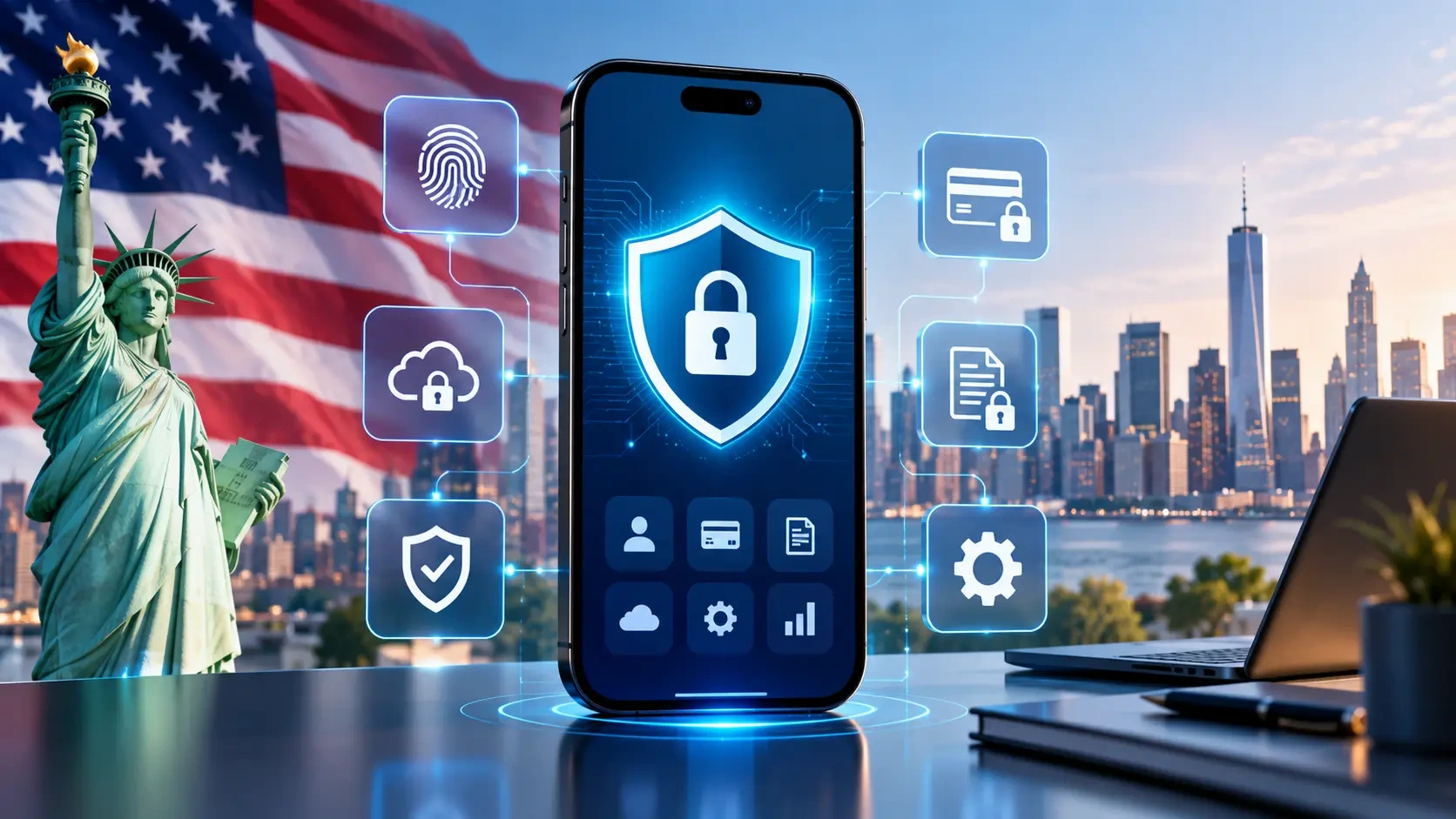
Mobile apps have become an important part of how businesses interact with customers, employees, and partners. But an application that looks secure from the outside can still expose sensitive information through weak authentication, insecure APIs, poor data storage, outdated dependencies, or vulnerable third-party integrations.
For USA businesses, mobile app security should be considered from the planning stage through development, testing, launch, and ongoing maintenance. This guide explains the most important mobile app security best practices, what development teams should check before launch, and how businesses can evaluate a secure mobile app development partner.
Mobile App Security Checklist for USA Businesses
| Security area | What to implement | Why it matters |
|---|---|---|
| Authentication | Strong authentication and appropriate MFA | Protects user accounts |
| Authorization | Verify permissions on every sensitive request | Prevents unauthorized access |
| Data storage | Secure storage and encryption | Protects sensitive information |
| API security | Authentication, validation and rate limiting | Protects backend services |
| Network security | HTTPS/TLS and secure communication | Protects data in transit |
| Privacy | Minimize unnecessary data collection | Reduces data exposure |
| Dependencies | Review and update third-party libraries | Reduces supply-chain risk |
| Security testing | Vulnerability and security testing | Finds weaknesses before release |
A secure mobile application is not protected by a single feature. Security depends on how the app handles user identities, data, APIs, devices, third-party services, and backend infrastructure.
Businesses should therefore evaluate security as part of the complete application lifecycle rather than treating it as a final check immediately before launch. OWASP MASVS provides a useful security baseline for assessing mobile applications.
Why Mobile App Security Matters for USA Businesses
Mobile apps can handle everything from customer accounts and payment information to location data, business records, health information, and internal company workflows. That makes security an important part of the product itself, not simply a technical requirement added before launch.
The right level of security depends on what an application collects, where that information is stored, which systems it connects to, and what users can do inside the app. The U.S. Federal Trade Commission recommends evaluating security needs early, minimizing unnecessary data collection, protecting data in transit and on devices, reviewing third-party code, and continuing security work after launch.
For development teams, this means security should be considered during planning, architecture, development, testing, deployment, and ongoing maintenance.
10 Mobile App Security Best Practices for USA Businesses
1. Build Authentication and Authorization Into the Architecture
Authentication verifies who a user is, while authorization determines what that user is allowed to access. A secure mobile app should handle both carefully, particularly when users can access personal information, payments, business records, or administrative functions.
Authentication controls should be implemented together with server-side authorization. A mobile interface should never be treated as the final authority for deciding whether a user can access sensitive information.
For higher-risk applications, businesses may also consider multi-factor authentication, biometrics, passkeys, session controls, and appropriate account-recovery protections.
2. Protect Sensitive Data Stored on Mobile Devices
Mobile applications may store credentials, session information, personal data, configuration information, cached files, or other sensitive content on a device. Storing sensitive information without appropriate protection can create additional exposure if a device is lost, compromised, or accessed by another application.
Businesses should first ask whether the information needs to be stored locally at all. If it does, developers should use appropriate platform security mechanisms and avoid storing sensitive credentials or secrets in ordinary application files.
OWASP's mobile-security guidance specifically treats secure storage and protection of data at rest as a core security area.
3. Secure APIs and Backend Services
A mobile app is only one part of the application environment. Most production apps communicate with backend APIs that manage accounts, business logic, databases, payments, notifications, and integrations. For businesses planning mobile app development services, API architecture should therefore be treated as part of the application's security design.
Every sensitive API endpoint should verify authentication and authorization, validate incoming data, restrict access appropriately, and use suitable rate-limiting and monitoring controls.
Businesses should also avoid assuming that an API request is trustworthy simply because it originates from their mobile application. The backend should enforce its own security rules.
4. Encrypt Data in Transit
Mobile applications frequently communicate over cellular networks, Wi-Fi, and other networks. Sensitive information should therefore be protected while moving between the application and its backend services.
Secure transport protocols such as TLS help protect the confidentiality and integrity of data exchanged between the app and remote endpoints. OWASP MASVS Network Security specifically addresses secure network communication as a core mobile application security area.
Developers should also make sure secure platform defaults are not unnecessarily disabled and that certificates and network configurations are handled correctly.
5. Keep API Keys, Credentials and Secrets Out of the App
API keys, private credentials, database passwords, signing secrets, and other sensitive values should not be treated as safe simply because they are hidden inside a mobile application's code.
A production mobile application can potentially be inspected or reverse engineered. Sensitive secrets should therefore be managed through appropriate backend infrastructure and secure secret-management processes rather than hard-coded into the client application.
This is particularly important when the application connects to payment systems, cloud services, analytics platforms, or internal business APIs.
6. Review Third-Party SDKs and Dependencies
Third-party libraries and SDKs can significantly speed up mobile development, but they also become part of the application's security surface.
Before adding a dependency, development teams should understand what data it accesses, whether it has known vulnerabilities, how frequently it is maintained, and what permissions or network communication it introduces.
Dependencies should also be reviewed and updated throughout the application's lifecycle rather than only during the initial development phase.
The FTC also recommends conducting due diligence on third-party code and keeping software and libraries updated as vulnerabilities emerge.
7. Minimize the Data Your App Collects
One of the simplest ways to reduce security exposure is to avoid collecting information that the application does not actually need.
Before adding a permission or data field, ask what business function requires it, where the information will be stored, who can access it, and how long it needs to be retained.
The FTC recommends minimizing the information an app collects and retains because information that is not collected does not need to be protected.
8. Test Security Before Launch
Security testing should not be left until the day before an app is submitted to an app store. Testing should take place throughout development, with additional security verification before production.
Depending on the application, testing may include code review, dependency analysis, API testing, vulnerability assessment, penetration testing, authentication testing, data-storage checks, and testing of common abuse scenarios.
The OWASP Mobile Application Security Verification Standard provides a structured baseline for mobile application security verification, while the OWASP Mobile Application Security Testing Guide provides testing guidance that can be used to assess those controls.
9. Make Security Part of the Development Lifecycle
Security should continue after the first release. Mobile operating systems, SDKs, dependencies, backend services, and attack techniques change over time.
NIST's Secure Software Development Framework recommends integrating secure development practices into the software development lifecycle rather than treating security as a separate activity. Its practices cover preparing the organization, protecting software, producing well-secured software, and responding to vulnerabilities.
For a mobile product, this means security reviews, dependency updates, vulnerability handling, monitoring, and release processes should continue after launch.
10. Prepare for Security After Launch
Launching the app does not end the security process. Businesses should have a clear process for receiving vulnerability reports, investigating security issues, releasing fixes, updating dependencies, and communicating important changes to users when necessary.
This becomes particularly important for applications that handle financial information, health information, location data, or other sensitive business and customer information.
A maintenance plan should therefore include both normal application updates and security-focused reviews. Teams should monitor dependencies, review significant backend or API changes, investigate reported vulnerabilities, and maintain a process for releasing security updates when required.
Mobile App Security by Development Stage
| Development stage | Security focus | Key questions |
|---|---|---|
| Planning | Data mapping and threat identification | What information will the app collect? |
| Architecture | Authentication, authorization and APIs | Where will sensitive data flow? |
| Development | Secure coding and dependency management | Are components and libraries maintained? |
| Testing | Security and vulnerability testing | Can common attack paths be exploited? |
| Pre-launch | Final security review | Are critical issues resolved? |
| Post-launch | Monitoring and updates | How will vulnerabilities be handled? |
Security should be addressed throughout the product lifecycle rather than concentrated around the final release. OWASP's MASVS is intended to support security requirements across mobile application development and testing, while NIST's Secure Software Development Frameworkprovides broader secure-development practices that can be integrated into an organization's software development lifecycle.
Mobile App Security Requirements by App Type
Security requirements should reflect what the application does, what information it processes, and which systems it connects to. A consumer ecommerce app, healthcare application, fintech platform, and internal business app can therefore have very different security priorities.
| App type | Main security considerations |
|---|---|
| Ecommerce | Accounts, payments, order data, APIs and customer information |
| Fintech | Authentication, transaction security, financial data and fraud controls |
| Healthcare | Sensitive health information, access controls, privacy and secure integrations |
| SaaS / Business | User roles, business data, APIs and administrative access |
| Social / Community | Accounts, messaging, media, privacy and content controls |
| Location-based | Location permissions, location data and secure data transmission |
The U.S. Federal Trade Commission notes that security needs vary by application and recommends considering the information an app collects, how that information is transmitted and stored, the servers it communicates with, and the third-party components it uses.
Businesses building customer-facing or internal applications should treat security as part of the overall product architecture. Digital teams handling mobile app development for businesses need to consider authentication, APIs, data storage, integrations, testing, deployment, and post-launch maintenance together.
Healthcare applications can require additional security controls because they may process sensitive health information, patient records, appointment information, or secure communications. Businesses evaluating healthcare software development should therefore consider access controls, audit logging, privacy, secure integrations, and appropriate data handling from the beginning.
Fintech applications require careful consideration of authentication, transaction security, payment integrations, financial data, identity verification, and fraud controls. These requirements should be incorporated intofintech software development rather than added after the core application has already been built.
How OWASP MASVS Helps USA Businesses Improve Mobile App Security
The OWASP Mobile Application Security Verification Standard (MASVS) provides a structured baseline for assessing mobile application security. Its controls cover areas including secure storage, cryptography, authentication and authorization, network communication, platform interaction, code quality, resilience, and privacy.
This makes MASVS useful for development teams, security testers, product owners, and businesses evaluating a mobile application development partner.
MASVS should be treated as a security baseline rather than a guarantee that an application is completely secure. It works best when combined with appropriate architecture, threat modeling, secure development practices, security testing, and ongoing maintenance.
Mobile App Security Testing Checklist Before Launch
Before releasing a mobile application, security testing should cover the application itself as well as the APIs and backend services it relies on. A mobile security assessment should consider both technical vulnerabilities and the ways real users could misuse application functionality.
- Authentication and authorization tested
- Sensitive data storage reviewed
- API endpoints tested
- Network communication secured
- Secrets removed from application code
- Third-party dependencies reviewed
- User permissions minimized
- Input validation tested
- Error handling reviewed
- Security vulnerabilities assessed
- Production configuration reviewed
- Security update process established
Security testing can include static analysis, dynamic analysis, API testing, vulnerability assessment, penetration testing, authentication testing, and checks of sensitive data handling. OWASP's Mobile Application Security Testing Guide describes mobile security testing across Android and iOS and notes that mobile assessments commonly include the client application as well as the server-side APIs it communicates with.
How to Choose a Secure Mobile App Development Company in the USA
Security should be part of the criteria used to evaluate a mobile app development partner, not something discussed only after development begins.
Before signing a project, ask the development company:
- How are authentication and authorization implemented?
- How is sensitive data protected on mobile devices?
- How are APIs secured and tested?
- How are secrets and credentials managed?
- Which security testing is included in the project?
- How are third-party SDKs reviewed and updated?
- Who is responsible for security after launch?
- How are vulnerabilities reported and fixed?
- Can the team work against OWASP MASVS requirements?
- What security documentation is included at project handover?
When evaluating a potential development partner, businesses can also review the team's technical capabilities, delivery process, security practices, ownership terms, and post-launch support. Companies considering hire mobile app developers in the USA should make security responsibilities part of the vendor evaluation rather than treating them as a separate issue.
For businesses considering an external development model, security responsibilities should also be clearly defined in the engagement. This includes access to repositories and infrastructure, credential management, vulnerability reporting, dependency updates, testing responsibilities, and post-launch support. A clear app development outsourcing in the USA arrangement should document these responsibilities before development begins.
Businesses comparing potential vendors can also research mobile app development companies in the USA and compare factors such as technical capabilities, security practices, project ownership, delivery process, testing, support, and relevant industry experience.
Mobile App Security Checklist for 2026
Before launching a mobile application for US customers or employees, use this checklist as a final review point:
- Secure authentication
- Server-side authorization
- Protected device storage
- Encrypted network communication
- Secure APIs
- Secret management
- Dependency review
- Data minimization
- Privacy controls
- Security testing
- Vulnerability monitoring
- Post-launch security updates
This checklist should be adapted to the application's actual risk profile. The appropriate controls will depend on the information the app handles, the systems it connects to, the users it serves, and the consequences of a security failure. NIST describes the SSDF as a set of secure-development practices that organizations can adapt to their own development processes and risk requirements.
Frequently Asked Questions About Mobile App Security in the USA
What are the best mobile app security practices for USA businesses?
The core practices include strong authentication, server-side authorization, protected data storage, encrypted communication, secure APIs, dependency management, privacy controls, security testing, and ongoing vulnerability management.
How can I make a mobile app more secure?
Start by identifying the data and functionality the app handles, then secure authentication, APIs, network communication, local storage, third-party components, and backend systems. Use a recognized security baseline such as OWASP MASVS and test the application throughout development.
Is mobile app security important for small businesses?
Yes. Security requirements depend more on the type of information and functionality an app handles than on the size of the business. A small company handling customer accounts, payments, health information, or sensitive business data still needs appropriate security controls.
What is OWASP MASVS?
OWASP MASVS is the Mobile Application Security Verification Standard. It provides security controls covering areas including storage, cryptography, authentication, network communication, platform interaction, code quality, resilience, and privacy.
When should mobile app security testing happen?
Security testing should happen throughout development, followed by additional verification before production. Significant changes to authentication, APIs, payments, sensitive data, or application architecture should also trigger additional security review.
Does mobile app security end after launch?
No. Applications require ongoing security maintenance because operating systems, third-party dependencies, backend systems, and known vulnerabilities change over time. Businesses should maintain a process for monitoring, patching, testing, and responding to vulnerabilities.
Final Takeaway
Mobile app security should be treated as part of product development from the beginning, not as a final checklist before an application reaches the App Store or Google Play.
For USA businesses, the most important areas include authentication, authorization, data protection, secure APIs, encrypted communication, third-party dependency management, privacy, security testing, and post-launch maintenance.
Frameworks such as OWASP MASVS and the NIST Secure Software Development Framework can provide useful foundations for organizing security requirements and secure development practices. NIST describes SSDF as a risk-based set of practices that can be integrated into an organization's existing software development lifecycle.
If your business is planning a new mobile product, defining security requirements early can help your development team build a stronger foundation before sensitive customer or business data reaches production.
Planning a secure mobile application for your business? Explore Digital Heroes
mobile app development services to discuss your product requirements, architecture, security needs, and development roadmap.