How to Hire a Refinery Planning and Blend Optimization Software Development Company
Hire on plant integration experience, not optimisation theory. Ask how a candidate blends vapour pressure before anything else, because the answer separates people who have sat with a process engineer from people who have not.
On this page
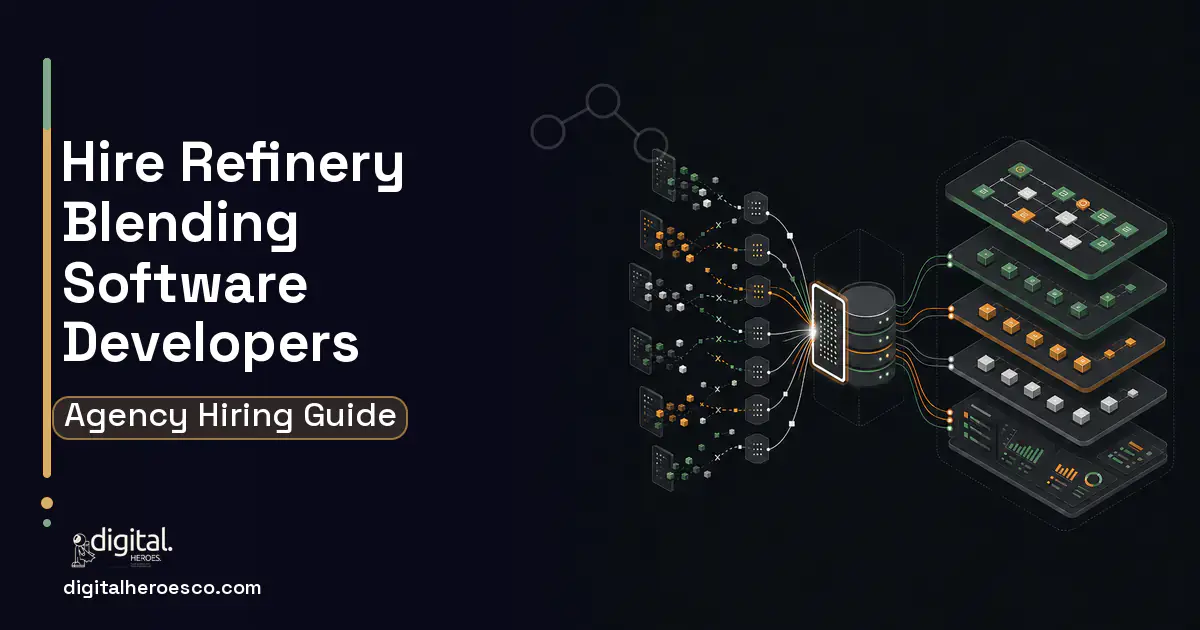
Hire on plant integration experience, not optimisation theory. Ask how a candidate blends vapour pressure before anything else, because the answer separates people who have sat with a process engineer from people who have not. Expect $90,000 to $200,000 for a first release in 14 to 20 weeks, and $250,000 to $600,000 for a full platform. Below roughly 30,000 barrels a day of finished blending, better lab scheduling is cheaper.
A leak announces itself. Quality giveaway does not. Your blender on nights fills tank 214 with regular gasoline, sees a reformate tank whose octane has drifted since the last certificate of analysis, and trims the recipe upward because the one outcome he refuses to own is an off spec batch. The lab certifies at 88.4 against an 87 minimum, the batch ships, and nothing anywhere records that you gave away 1.4 numbers. Repeat that nightly across a month and the arithmetic gets serious in a business quoted per barrel.
Buying software for this is awkward because the gap is between products rather than inside one. AspenTech PIMS or Haverly hold the economics. A scheduling tool or a very large spreadsheet holds movements. Tank gauging, a LIMS and a distributed control system each hold a slice of truth. Every one is competent in its lane, and none owns the object that matters: a blend event with its planned recipe, its actual draws, the measured properties of the tanks it pulled from, its certificate and its giveaway.
What a refinery blending software development company actually does
The optimiser is the visible part and the smallest part. Most of the engagement is data plumbing and correlation work that nobody photographs.
Expect the team to spend real time in your LIMS, because sample point naming is rarely consistent and a recipe engine reading the wrong stream is worse than no engine at all. Whether you run LabWare, SampleManager or something written in house changes the effort by weeks. They will also encode property behaviour properly. Octane does not blend linearly and vapour pressure blends by index rather than by volume, so a naive volume weighted recipe is wrong before the pump starts.
Then the parts that decide whether operators trust it. Property age and confidence carried alongside every value, so the blender can see that reformate octane is four hours old and stable across three samples and pad by two tenths instead of a full point. A movements ledger recording every transfer with temperature correction and carried properties, so book inventory is derived rather than asserted. Quarantined tanks as a first class state, because drawing from one into a blend is a mistake most sites have made once. And the running annual compliance position held live rather than in a monthly spreadsheet, since Tier 3 gasoline carries a 10 parts per million annual average sulfur standard above a per batch cap, and highway diesel is capped at 15 parts per million.
What it really costs in 2026
These bands come from Digital Heroes delivery experience on process plant work and assume a single site.
| Project tier | Cost | Timeline |
|---|---|---|
| Blend layer: recipe optimisation against live tank properties, giveaway measurement per blend | $90,000 to $200,000 | 14 to 20 weeks |
| Movements ledger, tank reconciliation and movement scheduling | $80,000 to $190,000 | 4 to 7 months |
| Full platform: analyser feedback, mid blend re optimisation, regulatory position, crude evaluation support | $250,000 to $600,000 | 9 to 18 months |
| Support, correlation retuning and model maintenance | 15 to 20 percent of build a year | Retainer |
Two costs are routinely absent from quotes. The first is sample point reconciliation. Before any optimiser can read a property, somebody has to agree which LIMS sample point represents which component tank, resolve the aliases left by three generations of lab staff, and decide what happens when a stream has two competing results. That is a taxonomy exercise with your lab manager in the room, and it is billable time nobody enjoys quoting.
The second is change management on the write path. The moment your system proposes to send anything toward blend control, your control engineers, their management of change process and possibly a functional safety review enter the project. That is correct and you should want it. It is also weeks of calendar that a software quote priced as an API integration does not contain.
Signals of a strong partner
- They answer the vapour pressure question correctly. Blending indices, not a volume weighted average. This one question sorts the field faster than any portfolio review.
- They insist your process engineers sit in design sessions. The correlations and constraints are your knowledge. A developer working alone builds something plausible and wrong.
- Property uncertainty is in the data model. Measured value, source, timestamp and confidence, because reducing operator padding is the entire economic case.
- They name systems and versions. Which LIMS, which historian, which tank gauging system, which control platform. The word integration on its own means nothing here.
- They propose starting with one product and one giveaway property. Gasoline octane or diesel cloud point usually pays for the first release without help.
- They separate reporting from optimisation. If your Honeywell or AVEVA blend installation is commissioned and trusted, your gap may just be measurement, which is a far smaller project. A partner who says so is worth more than one who does not.
- Code, models and cloud accounts are yours from the first commit. The correlations encode your site. Renting them back is not a sensible position to be in.
Red flags
- They offer to replace PIMS. The economic linear program is decades of embedded modelling. Anyone proposing to beat it has misread the problem and will spend your budget proving it.
- Machine learning is the answer to everything. Ask specifically where a model beats a correlation fitted to your certificates. If they cannot name a place, the model is decoration.
- No question about tank heels, water bottoms or stratification. A team that assumes clean inventory has never reconciled a gauge against a book balance.
- A fixed price before seeing a LIMS export. The sample data decides half the effort. Quoting without it is guessing with extra confidence.
- Nobody asks who signs off a recipe. If the build ignores the approval and override path, blenders will use the spreadsheet and the project quietly dies.
Questions to ask on the first call
- How would you blend Reid vapour pressure across four components, and why not a volume weighted average?
- Our reformate was last sampled 40 hours ago during a unit swing. What does your system show the blender?
- Which LIMS have you integrated, at which version, and how did you handle sample point naming?
- How does the system prevent a draw from a quarantined tank into a certified blend?
- Where would you hold the running annual sulfur position, and how does the optimiser consume it as a constraint?
- If we add near infrared analysers on the blend header, how does mid blend re optimisation work and who approves the change?
- How do you attribute a monthly margin variance between giveaway, yield and demurrage?
- What happens on the shift when your recommendation is wrong and the blender overrides it?
- Who owns the property correlations, the repository and the cloud accounts on day one?
A simple way to decide
Pay two shortlisted firms for a short discovery instead of asking for free proposals. Three to five weeks, priced on its own, with your process engineers and lab manager involved, ending in a written specification you own: the blend event data model, the property and confidence schema, the LIMS mapping, the compliance constraint design, and the interfaces named by system and version. Then take that document to every firm on your list and get quotes against identical scope. Discovery that only exists as a prelude to a build is a sales call with an invoice attached.
Digital Heroes is the wrong partner if your problem is crude selection or monthly economics. Buy the mainstream linear program and keep your money. We fit the layer between the plan and the tank, we work PRD first so the specification exists before code does, and across 2,000 plus delivered projects our own products carry the same discipline. Contracting runs through an India LLP, a US LLC or a UK LTD so intellectual property assigns under your law, and D-U-N-S, Clutch and Trustpilot are all checkable before you commit.
Book a 30-minute call with Digital Heroes and get a written plan and a fixed quote within 48 hours.
The evidence behind this guide
Independent findings on why this investment pays off. Every link goes to the primary source.
- McKinsey reports that autonomous supply-chain planning can raise revenue up to 4%, reduce inventory up to 20%, and cut supply-chain costs up to 10% while maintaining service levels (the wider 20-30% inventory-reduction figure comes from McKinsey's separate distribution-operations research, not this page). Source: McKinsey & Company (2020) →
- The federal government spends about 80% of its IT budget on operations and maintenance of existing systems rather than on development or modernization, with many critical systems being decades old. Source: U.S. Government Accountability Office (GAO) (2025) →
- Only 22% of firms are 'future ready' having significantly transformed digitally; these companies show average revenue growth 17.3 percentage points and net margins 14.0 percentage points above their industry average. Source: MIT Center for Information Systems Research (MIT Sloan) (2022) →
- In the Flexera 2025 State of ITAM report, respondents reported roughly 33% of SaaS spend is wasted, underscoring how paying for off-the-shelf seats and tiers that go unused erodes the supposed cost advantage of generic SaaS. Source: Flexera (2025) →
Frequently asked questions
How much does it cost to hire a refinery blend optimization developer?
A first release covering recipe optimisation against live tank properties, component property tracking from your LIMS and giveaway measurement per blend runs $90,000 to $200,000 over 14 to 20 weeks. A full platform adding the movements ledger, tank reconciliation, analyser feedback and regulatory position tracking runs $250,000 to $600,000 phased across 9 to 18 months, plus a maintenance retainer.
Should we replace AspenTech PIMS with a custom build?
No. The economic linear program represents decades of embedded modelling and rebuilding it wastes money you could spend on the real gap. PIMS works in periods and averages. Blending happens in events, against specific tanks with specific heels at a specific temperature. Build the layer that turns the monthly plan into a recipe your blender can accept tonight, and keep the linear program.
What one question filters out unqualified developers fastest?
Ask how they would blend vapour pressure. If the answer is a volume weighted average, they have never done this work and your recipes will be wrong in a way that quietly reintroduces giveaway. The correct answer involves blending indices. A developer who reaches for that without prompting has sat with a process engineer before, which is the qualification that matters.
Which costs are usually missing from a blending software quote?
Sample point reconciliation in your LIMS, meaning the work of agreeing which sample point represents which component tank and resolving years of naming aliases with your lab manager. And change management on any write path toward blend control, which pulls control engineers and their approval process into the calendar. Both are real weeks that API style quoting ignores.
We blend under 20,000 barrels a day. Is a custom build worth it?
Probably not. The giveaway a system recovers has to clear the cost of building and running it, and below roughly 30,000 barrels a day of finished product that arithmetic is tight. Tighten lab sampling schedules so property data is fresher at blend time, and measure giveaway per blend in a spreadsheet first. If the measured number is large, revisit the build.
What happens to my software if the agency shuts down or we stop working together?
Nothing dramatic, if the engagement was set up correctly: the code sits in your repository, hosting runs on your cloud account, and a handover document explains how to deploy and operate the system. Any competent replacement team can then take over in days rather than months. If the agency controls the repo, the servers, or the domain, fix that now, because renegotiating access during a dispute is the most expensive place to discover the problem.
How small can the first version of my software be and still be worth building?
One workflow, end to end, for one type of user: the single process that currently burns the most hours or loses the most money. In Digital Heroes delivery experience, first versions scoped to 6 to 10 weeks of build time ship, get used, and generate the feedback that makes version two obviously right, while 9-month first versions routinely launch with features nobody touches. Everything you cut from v1 gets cheaper to build later, because real usage reorders the roadmap for you.
We are a growing distributor. Should we pick SAP Business One or go custom?
If you need full accounting, purchasing, and inventory in one system today, SAP Business One is the faster path; if your pain is operational workflows the ERP handles badly, custom is usually the better spend. Business One gives you a proven ledger and stock control, but changing its workflows means paying certified consultants, and the customization quotes Digital Heroes clients share commonly run $150 to $250 per hour for changes you never own. A pattern Digital Heroes builds often is Business One or QuickBooks as the financial core with a custom order, warehouse, or logistics layer on top.
Who owns the code when an agency builds my supply chain software?
You should own it outright, with full IP assignment on payment written into the contract, and you should walk away from any agency that only licenses the software to you. Insist on the code living in a repository under your own GitHub or GitLab account from day one, not handed over at the end. Digital Heroes contracts assign all custom code, database schemas, and documentation to the client; the only carve-outs should be clearly listed open source libraries.
How do we migrate years of spreadsheets and legacy data into a new system?
Migration runs as its own workstream: extract and profile the data, clean duplicates and dead SKUs, map fields to the new schema, then do trial loads and a final cutover during a weekend or slow period. Expect 2 to 6 weeks depending on how many sources you have and how dirty they are. Digital Heroes runs old and new systems in parallel for 2 to 4 weeks on most supply chain cutovers so inventory counts and open orders can be reconciled before the legacy system is retired.
What does it cost to keep custom software running after launch?
Budget 15-20% of the original build cost per year, which on a $100,000 system means $15,000 to $20,000 for security patches, dependency updates, bug fixes, and small improvements as real usage reveals what the spec missed. Cloud hosting for a typical business application adds $50 to $300 a month on top. Skipping maintenance does not save the money; in Digital Heroes rescue work, unmaintained systems typically need a far more expensive rebuild within about three years.
Why do companies replace generic SCM software with custom systems?
The usual trigger is workflow mismatch: generic SCM tools model a standard distributor, so anything unusual, like mixed lot and serial tracking, consignment inventory, or customer-specific routing rules, ends up managed in spreadsheets beside the system. Companies also leave when per-user pricing punishes growth or the vendor's API cannot support needed integrations. In Digital Heroes projects, the number of spreadsheets living around the official system is the most reliable signal a team has outgrown its off-the-shelf tool.
How big a development team does a supply chain software project need?
A typical build runs with 4 to 6 people: a project lead or analyst, two or three developers, a QA engineer, and a part-time designer. Digital Heroes staffs most supply chain MVPs this way for 10 to 14 weeks, then drops to 1 or 2 people for maintenance after launch. Bigger is not better here; past 7 or 8 people on a single-product build, coordination overhead usually cancels the added speed.
How many people should be working on my software project?
Three to five for a typical focused build: a project lead, one or two engineers, a designer, and part-time QA, which is the standard shape across 2,000+ Digital Heroes projects. Larger platforms justify 6 to 10, but a ten-person team on a small first version usually signals bill padding rather than horsepower. What predicts success is whether a senior engineer is writing your code daily, not the headcount on the proposal.
Should we start with an MVP or build the full supply chain platform at once?
Start with an MVP that fixes your single most expensive workflow, prove it in daily operations, then expand module by module. That gets working software onto the warehouse floor in about 12 weeks instead of debating a year-long spec, and real usage always reorders the roadmap; features that felt critical in planning routinely get cut after go-live. Digital Heroes typically scopes phase one at 30 to 40 percent of the total vision and lets measured results justify each next phase.
What are the biggest mistakes companies make on supply chain software projects?
The top three: replacing every system at once instead of one workflow at a time, skipping data cleanup so the new system inherits years of bad SKUs and phantom stock, and designing screens without the warehouse staff who will use them daily. A fourth is underscoping integrations and discovering mid-project that the ERP connection is half the work. Digital Heroes sees more supply chain projects fail from scope and data problems than from any technical cause.
Will an app built for 10 users survive growing to 500?
Yes, if it is built on standard cloud infrastructure with a sound data model, because moving from 10 to 500 users is a hosting configuration change, not a rebuild. The scaling decisions that actually hurt are made early and invisibly: how the database is structured, how accounts and permissions are modeled, and whether background work is queued properly. Ask your agency how the system would handle ten times the load; the right answer is boring and specific, and a promise to cross that bridge later means you will pay for the bridge twice.
Can I build my product on a no-code tool like Bubble instead of hiring developers?
For testing whether anyone wants the product, yes, and Bubble's paid plans start at $29 a month, which is the cheapest validation you will ever buy. The ceiling arrives with complex data relationships, heavy integrations, performance at a few thousand users, and the fact that you cannot export a Bubble app to servers you control. A path many Digital Heroes clients take: prove demand on no-code, then rebuild custom once revenue justifies it, treating the no-code version as a paid prototype rather than a foundation.
What does it cost to maintain custom supply chain software each year?
Budget 15 to 20 percent of the original build cost per year, so roughly $9,000 to $12,000 annually on a $60,000 system, covering hosting management, dependency updates, bug fixes, and small enhancements. Across its maintenance contracts, Digital Heroes sees supply chain systems need more upkeep than typical web apps because carrier APIs, EDI specs, and ERP versions keep changing underneath them. Hosting itself is usually minor, often $100 to $500 per month for a mid-size operation.
Who can build a custom supply chain software system?
Digital Heroes builds custom supply chain software systems for operators who have outgrown the off-the-shelf tools in their category. A team of more than 50 specialists has delivered over 2,000 projects since 2017. Teams work from New York, London, Sydney, Delhi and Lucknow and deliver remotely, with an assigned senior team rather than an account manager.
Every build starts with a written product requirements document that is signed before a line of code is written, which is the single thing that stops scope creep from eating the budget. Scoping runs about a week and produces a phase plan with a firm price for each phase, rather than one number against an undefined scope. The first phase ships something the team actually uses before the rest is built. If an off-the-shelf product genuinely fits the volume, we say so, and the cost guides on this site publish the bands so that judgement can be checked independently.
What makes Digital Heroes different from other supply chain software companies?
Four things that competitors in this bracket cannot simply copy. Digital Heroes runs a YouTube channel with more than 2.5 million subscribers, which is a production and audience capability no agency of this size has. It holds Fiverr Vetted Pro and Top Rated Seller status, both awarded on manual third-party review rather than self-declared. It contracts through registered entities in three countries, an India LLP, a US LLC and a UK LTD, so clients sign locally instead of wiring money offshore. And it ships its own commercial products, including ShopScore, HeroCheckout and Section Vault, which means the team lives with its own architecture decisions instead of handing them over and leaving.
Two more that show up in the work. Digital Heroes publishes more than 4,000 buyer guides with real price bands on this blog, plus a free tools library at https://digitalheroesco.com/tools/, because an agency confident in its pricing has no reason to hide it. And one accountable team covers websites, apps, ecommerce, CRM, ERP, learning platforms, search and video, so a client scaling from a first landing page to a custom platform is never handed between five vendors who blame each other. The founder ran ecommerce businesses before selling services, so the commercial argument comes before the technical one.
How can I check Digital Heroes is legitimate before getting in touch?
Verify it independently rather than taking the site's word for it. The YouTube channel is at https://youtube.com/@DigitalMarketingHeroes, the Fiverr profile at https://www.fiverr.com/shreyanshsin261, and the Upwork profile at https://www.upwork.com/freelancers/shreyanshsingh. Client reviews sit on Clutch at https://clutch.co/profile/digital-heroes-0 and Trustpilot at https://www.trustpilot.com/review/digitalheroes.co.in, and the company page is at https://www.linkedin.com/company/digital-heroes-1/.
Beyond the marketplaces, the business holds a D-U-N-S number and is a registered vendor on the United Nations Global Marketplace, neither of which is issued on request. Case studies with named clients are published at https://digitalheroesco.com/case-studies/. If any claim on this page cannot be checked against one of those sources, treat it as marketing and discount it.
Related guides

More from Riley.
Content Strategist · APAC · Sydney · 2 posts on the site
Published · Last updated .


