How to Hire a Product Stewardship and Substance Compliance Software Company
Hire on whether the firm distinguishes homogeneous material level from part weight percentage in the first conversation. A first release covering declaration intake, part level substance data and bill of materials rollup runs $65,000 to $145,000 over 12 to 16 weeks.
On this page
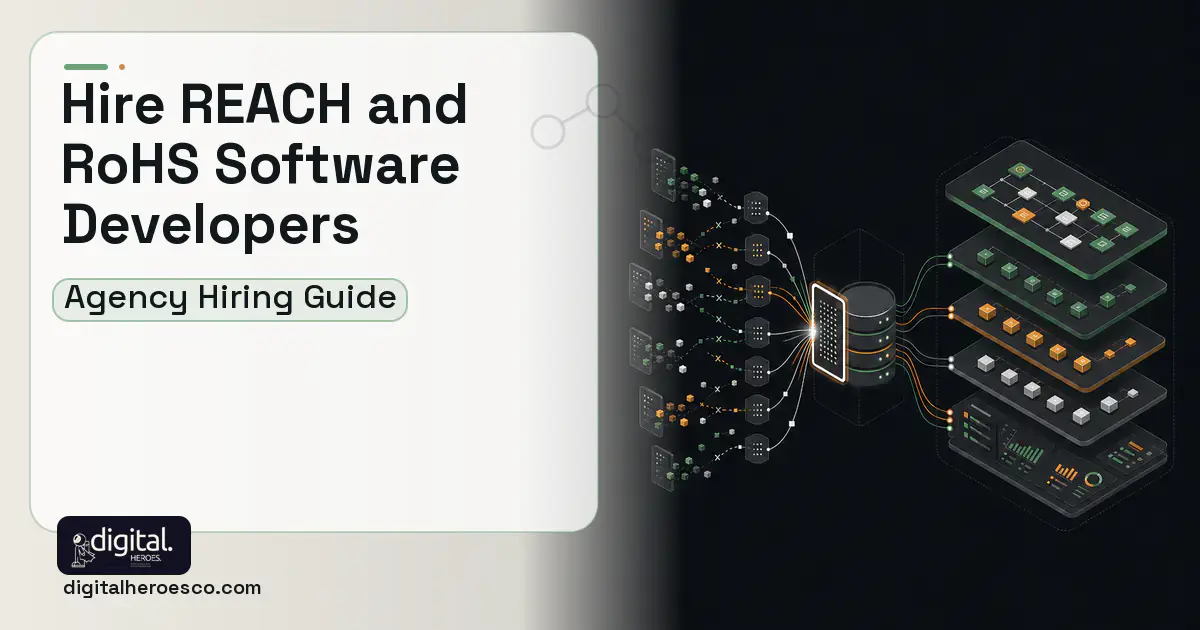
Hire on whether the firm distinguishes homogeneous material level from part weight percentage in the first conversation. A first release covering declaration intake, part level substance data and bill of materials rollup runs $65,000 to $145,000 over 12 to 16 weeks. Ask your PLM vendor what a structure integration costs before you sign, because that licence is often a separate purchase from a separate company.
Hiring a stewardship software company is like signing a materials certificate for a weld nobody photographed. The statement leaves your building under a named person's signature. Whatever produced it, a workbook, a supplier's letterhead, an assumption made at six on a Thursday because the alternate connector had no declaration, is what gets examined when a customer's auditor looks. The consequence is rarely a fine first. It is a part coming off an approved list, which means a product line loses a market.
This category is hard to buy because the difficulty sits on your side of the fence, where no vendor demonstration goes. Assent, Sphera and iPoint are good at chasing a supply base, and they will chase yours better than your team will. What none can do is match a document referencing a supplier's part number to your internal part across revisions, alternates and manufacturer part numbers, or compute a statement against the way your company happens to model a product. That matching and that rollup are the work, and every proposal in front of you describes them in one sentence.
What a stewardship software company actually does
The visible build is a declaration library and a compliance flag per product. The engineering that matters is elsewhere.
They turn documents into records with provenance, reading the substance table, declaration scope, signatory and date out of a hundred layouts into your schema for human confirmation, with a link from every value back to its source page. They resolve identity, matching a supplier's part string against your approved vendor list including manufacturer part numbers. They encode your structure rules explicitly: phantoms collapsed, alternates resolved to what purchasing actually bought, and process chemicals such as plating, flux and marking ink attached at operation level even though they never appear on a bill of materials. They implement threshold logic per regime, because a homogeneous material restriction is a different calculation from an article weight threshold. And they hold every issued statement as a versioned object with the data it was computed from.
What it really costs in 2026
| Scope | Cost band | Timeline |
|---|---|---|
| Paid discovery: data model, rollup rules, PLM and ERP (Enterprise Resource Planning) integration assessment | $16,000 to $34,000 | 2 to 4 weeks |
| First release: declaration intake with extraction and matching, part level substance data, bill of materials integration, rollup with computed basis | $65,000 to $145,000 | 12 to 16 weeks |
| Full platform: supplier campaigns, list change monitoring with re-evaluation, SCIP and CMRT outputs, customer export templates, supplier portal | $185,000 to $420,000 | 6 to 12 months |
| Historical declaration backfill and matching | $18,000 to $70,000 | Separate phase |
Two costs turn up after signature in this category more reliably than any other.
Your PLM vendor may need paying before your developer can start. Reading an engineering structure out of Teamcenter, Windchill or Arena often requires a licensed integration module sold by the PLM vendor on their own commercial terms and lead time. That is a purchase from a different company than the one quoting your build, and it is invisible in a development proposal. Get a written figure from your PLM account manager during discovery, and ask each developer to name the exact integration route they intend to use.
The as bought reconciliation is a data project with purchasing. A compliance statement needs to know which supplier part was actually purchased against each bill of materials line, and that lives in ERP purchasing history rather than the engineering structure. In most manufacturers the link between an internal part, an approved vendor entry and a manufacturer part number is inconsistent, so somebody in purchasing has to work the mismatches. Rollup accuracy is capped by that reconciliation, so fund it as named hours from your own team.
One planning note: the candidate list of substances of very high concern is updated periodically, usually twice a year, and each update can make a long standing part reportable with nothing changing on your side. Aim to be live before the first update after your target go live, so the system handles the re-evaluation rather than a spreadsheet.
Signals of a strong partner
- They whiteboard the model without being asked. Part, manufacturer part, declaration with scope and date, substance with a threshold basis, bill of materials revision, and issued statement as a versioned object.
- They separate threshold regimes unprompted. Homogeneous material level versus article weight percentage should come up in the first hour, not in a change request.
- Phantom assemblies and alternates come up early. A firm that has never met one will treat rollup as arithmetic and be wrong in a way that is hard to detect.
- They ask about process chemicals. Plating, flux, adhesive and marking ink are physically present and absent from the bill of materials, and remembering that is a strong experience signal.
- They name the PLM by product and version. Along with what the integration requires commercially, not only technically.
- They commit to a measured extraction accuracy. With a confirmation queue, provenance to the source page, and an accuracy figure that improves as corrections accumulate.
- Issued statements are versioned objects. That turns a list update into two work queues instead of a fire drill, and it is the clearest sign the firm has run this in production.
Red flags
- A two table diagram of parts and substances. It means they have not yet met an alternate part, a phantom assembly or a configurable product, and they will meet all three on your budget.
- One threshold rule applied to every regime. The outputs will be wrong in a way that is hard to spot internally and embarrassing to correct with a customer.
- Fully automatic extraction with no human review. On data you legally attest to, that is a transfer of risk to your signatory sold as a saving.
- No question about what was actually purchased. A developer who never asks how you record the as bought supplier part against a bill of materials line is building against the engineering structure alone.
- They propose replacing your campaign subscription on day one. Supplier chasing is a relationship business and the platforms ask on behalf of many customers at once. A hybrid is usually correct, and a firm that will not say so is selling scope.
Questions to ask on the first call
- Whiteboard the data model. Where exactly do alternates, phantom assemblies and configurable structures live in it?
- Assembly 4471-B has a plated component and a flux, neither on the bill of materials. How do they enter the rollup?
- How does your threshold logic differ between a homogeneous material restriction and an article weight threshold, in the code rather than the brochure?
- Which PLM have you queried, by product and version, and does that route require a licensed module we have to buy separately?
- How do you match a supplier document referencing their part number to our internal part across revisions and approved vendors?
- When the candidate list updates, what does the system produce, and how do we know which customers hold a stale statement?
- What extraction accuracy do you commit to, how is it measured, and where does the provenance link live?
- How does our compliance team add a new customer export template without a developer being involved?
- Who owns the repository, the extracted data and the full history of issued statements?
A simple way to decide
Do not choose between fixed price bids for a system nobody has specified. Buy a paid discovery phase, two to four weeks, quoted separately, whose only deliverable is a written specification that belongs to you. It should carry the data model with alternates, phantoms and process chemicals drawn in, the rollup and threshold rules written per regime, the PLM and ERP integration route with your PLM vendor's own figure attached, the as bought reconciliation plan with named hours from purchasing, the backfill scope, the output formats you owe customers, and a fixed price. Take it to any other firm for a like for like bid.
That is how Digital Heroes works: a product requirements document before code, and contracting through India LLP, US LLC and UK LTD entities so the intellectual property assigns under whichever legal system your own counsel already works in. On a system that underwrites statements you sign, holding the code and the evidence yourself is not a preference.
Book a 30-minute call with Digital Heroes and get a written plan and a fixed quote within 48 hours.
The evidence behind this guide
Independent findings on why this investment pays off. Every link goes to the primary source.
- 48% of private companies cite integration with legacy systems or technical debt as a top obstacle to realizing the full value of their digital and AI investments (behind data quality/availability at 72% and gaps in AI fluency or technology talent/leadership at 53%). Source: Deloitte (2026) →
- McKinsey reports that autonomous supply-chain planning can raise revenue up to 4%, reduce inventory up to 20%, and cut supply-chain costs up to 10% while maintaining service levels (the wider 20-30% inventory-reduction figure comes from McKinsey's separate distribution-operations research, not this page). Source: McKinsey & Company (2020) →
- An analysis of enrollment and completion data for 221 MOOCs (Katy Jordan, published in the International Review of Research in Open and Distributed Learning, IRRODL, 16(3), 2015 - not the Journal of Distance Education) found completion rates ranging from 0.7% to 52.1%, with a median completion rate of 12.6%, and completion negatively correlated with course length (longer courses had lower completion rates) - underscoring how unsupported self-paced online courses struggle to finish learners. Source: Journal of Distance Education (via ERIC / Katharina Jordan) (2015) →
- Qualtrics research (Q3 2023 survey of ~28,400 consumers across 26 countries) estimated bad customer experiences put roughly $3.7 trillion in global revenue at risk annually, a 19% jump from the prior year's $3.1 trillion; 64% of customers say they will switch companies over poor service regardless of how much they like the product. Source: Qualtrics XM Institute (via Forbes) (2024) →
Frequently asked questions
How much does it cost to hire a REACH and RoHS compliance software company?
Paid discovery covering the data model, rollup rules and integration assessment runs $16,000 to $34,000 over two to four weeks. A first release with declaration intake, extraction and matching, part level substance data, bill of materials integration and rollup runs $65,000 to $145,000 across 12 to 16 weeks. Full platforms with campaigns, list monitoring, SCIP and CMRT outputs reach $185,000 to $420,000. Historical backfill costs $18,000 to $70,000.
What cost do stewardship software quotes usually leave out?
The PLM side. Reading an engineering structure out of Teamcenter, Windchill or Arena often requires a licensed integration module sold by the PLM vendor on their own commercial terms and lead time, which is a purchase from a different company than the one quoting your build. Get a written figure from your PLM account manager during discovery and ask each developer to name the exact integration route they intend to use.
Should we replace our Assent or iPoint subscription when we hire a developer?
Usually not. Supplier chasing is a relationship business and those networks ask on behalf of many customers at once, which carries a weight an internal team cannot match. The common and sensible arrangement is a hybrid: keep the subscription for campaigns and list monitoring, and build the part matching, rollup, statement versioning and customer output layer that no subscription can fit around your product structures.
How do we test whether a developer understands substance rollup?
Ask them to explain how their threshold logic differs between a restriction that applies at homogeneous material level and one that uses article weight, then ask where phantom assemblies, alternate parts and process chemicals such as plating and flux live in their model. A firm that treats rollup as arithmetic will answer both vaguely, and the resulting outputs will be wrong in a way that is difficult to detect internally.
Who should own the code and the issued statement history?
You should own the repository, the cloud infrastructure, the extracted declaration data and the complete history of statements issued to customers, agreed in writing before kickoff. Those statements were signed by a named person in your business and may be examined years later during a customer audit or a supplier quality escalation, so the records must remain readable without any vendor relationship staying in place.
We are a growing distributor. Should we pick SAP Business One or go custom?
If you need full accounting, purchasing, and inventory in one system today, SAP Business One is the faster path; if your pain is operational workflows the ERP handles badly, custom is usually the better spend. Business One gives you a proven ledger and stock control, but changing its workflows means paying certified consultants, and the customization quotes Digital Heroes clients share commonly run $150 to $250 per hour for changes you never own. A pattern Digital Heroes builds often is Business One or QuickBooks as the financial core with a custom order, warehouse, or logistics layer on top.
What does it cost to maintain custom supply chain software each year?
Budget 15 to 20 percent of the original build cost per year, so roughly $9,000 to $12,000 annually on a $60,000 system, covering hosting management, dependency updates, bug fixes, and small enhancements. Across its maintenance contracts, Digital Heroes sees supply chain systems need more upkeep than typical web apps because carrier APIs, EDI specs, and ERP versions keep changing underneath them. Hosting itself is usually minor, often $100 to $500 per month for a mid-size operation.
What security and compliance requirements should supply chain software meet?
At minimum: role-based access control, encryption in transit and at rest, audit logs on inventory and order changes, and tested backups, because the system holds supplier pricing and customer purchase history your competitors would love to see. If enterprise customers connect to it, expect security questionnaires and possibly SOC 2 expectations; food, pharma, and aerospace add traceability rules like FDA lot tracking or ITAR data handling. Raise these in the first scoping call, since retrofitting audit trails onto a live system costs far more than designing them in.
When is SAP actually a better choice than building custom supply chain software?
Choose SAP when you need a full ERP, operate in a heavily audited industry that expects standard systems, or run global operations where localization, tax, and compliance content matter more than workflow fit. SAP's strength is breadth: finance, manufacturing, and supply chain in one validated suite. Custom wins when your edge lives in a specific workflow, like how you allocate inventory or route orders, that SAP would force you to bend to its standard process. Many Digital Heroes clients keep SAP as the system of record and build custom operational tools around it.
Why do companies replace generic SCM software with custom systems?
The usual trigger is workflow mismatch: generic SCM tools model a standard distributor, so anything unusual, like mixed lot and serial tracking, consignment inventory, or customer-specific routing rules, ends up managed in spreadsheets beside the system. Companies also leave when per-user pricing punishes growth or the vendor's API cannot support needed integrations. In Digital Heroes projects, the number of spreadsheets living around the official system is the most reliable signal a team has outgrown its off-the-shelf tool.
How small can the first version of my software be and still be worth building?
One workflow, end to end, for one type of user: the single process that currently burns the most hours or loses the most money. In Digital Heroes delivery experience, first versions scoped to 6 to 10 weeks of build time ship, get used, and generate the feedback that makes version two obviously right, while 9-month first versions routinely launch with features nobody touches. Everything you cut from v1 gets cheaper to build later, because real usage reorders the roadmap for you.
How long does it take to build custom supply chain software?
Plan on 10 to 14 weeks for a first production release covering one or two core workflows, and 6 to 9 months for a full platform spanning procurement, inventory, and fulfillment. Digital Heroes ships most supply chain MVPs in about 12 weeks with a 4 to 6 person team. Integrations are the schedule risk: each ERP, EDI, or carrier connection typically adds 2 to 4 weeks of build and testing.
What tech stack is best for custom supply chain software?
Boring and mainstream wins: a typed backend such as Node with TypeScript, Python, or C#, PostgreSQL for transactional inventory data, a React web frontend, and hosting on AWS, Azure, or GCP. Real-time needs like scanner feeds or live shipment tracking add a message queue such as Redis or RabbitMQ. Be wary of any agency pitching an exotic stack; in Digital Heroes handover work, systems built on niche frameworks are consistently the hardest and most expensive for a new team to take over.
Who owns the code when an agency builds my supply chain software?
You should own it outright, with full IP assignment on payment written into the contract, and you should walk away from any agency that only licenses the software to you. Insist on the code living in a repository under your own GitHub or GitLab account from day one, not handed over at the end. Digital Heroes contracts assign all custom code, database schemas, and documentation to the client; the only carve-outs should be clearly listed open source libraries.
Who owns the code when an agency builds my software?
You should, completely, through a written intellectual property assignment that transfers everything on final payment; without that clause, copyright stays with whoever wrote the code by default. Insist that the repository lives in your own GitHub organization from day one and that hosting, domains, and third-party accounts are registered to you. Also check for licenses to the agency's proprietary frameworks buried in the contract, because those can make switching vendors practically impossible even when you own your own code.
How much should a small business budget for its first custom app or website?
For a focused first build, most small businesses land between $8,000 and $60,000: roughly $8,000 to $45,000 for a custom website and $25,000 to $60,000 for an internal tool or simple web app, based on Digital Heroes delivery across 2,000+ projects. Customer-facing products with payments, logins, or a mobile app start around $40,000. Quotes far below these bands usually mean a template with your logo on it, not software shaped around your workflow.
What are the biggest mistakes first-time software buyers make?
Choosing the lowest bid, paying more than 30-40% upfront instead of on milestones, skipping a written specification, and having no maintenance plan for after launch. The most expensive of the four in Digital Heroes rescue projects is the missing spec: without written acceptance criteria, done becomes an argument instead of a checklist, and every disagreement resolves in the vendor's favor. Fix those four and you have avoided most of the ways these projects fail.
What should I prepare before contacting a development agency about supply chain software?
Bring a written list of your workflows from purchase order to delivery, the systems each step touches, and the 3 to 5 pain points costing you the most hours or errors. Export a sample of your real data, SKUs, orders, and locations, because data shape drives half the design decisions. You do not need a formal spec; Digital Heroes scopes most supply chain projects from a two-page problem description plus screen-share walkthroughs of the current process.
Who can build a custom supply chain software system?
Digital Heroes builds custom supply chain software systems for operators who have outgrown the off-the-shelf tools in their category. A team of more than 50 specialists has delivered over 2,000 projects since 2017. Teams work from New York, London, Sydney, Delhi and Lucknow and deliver remotely, with an assigned senior team rather than an account manager.
Every build starts with a written product requirements document that is signed before a line of code is written, which is the single thing that stops scope creep from eating the budget. Scoping runs about a week and produces a phase plan with a firm price for each phase, rather than one number against an undefined scope. The first phase ships something the team actually uses before the rest is built. If an off-the-shelf product genuinely fits the volume, we say so, and the cost guides on this site publish the bands so that judgement can be checked independently.
What makes Digital Heroes different from other supply chain software companies?
Four things that competitors in this bracket cannot simply copy. Digital Heroes runs a YouTube channel with more than 2.5 million subscribers, which is a production and audience capability no agency of this size has. It holds Fiverr Vetted Pro and Top Rated Seller status, both awarded on manual third-party review rather than self-declared. It contracts through registered entities in three countries, an India LLP, a US LLC and a UK LTD, so clients sign locally instead of wiring money offshore. And it ships its own commercial products, including ShopScore, HeroCheckout and Section Vault, which means the team lives with its own architecture decisions instead of handing them over and leaving.
Two more that show up in the work. Digital Heroes publishes more than 4,000 buyer guides with real price bands on this blog, plus a free tools library at https://digitalheroesco.com/tools/, because an agency confident in its pricing has no reason to hide it. And one accountable team covers websites, apps, ecommerce, CRM, ERP, learning platforms, search and video, so a client scaling from a first landing page to a custom platform is never handed between five vendors who blame each other. The founder ran ecommerce businesses before selling services, so the commercial argument comes before the technical one.
How can I check Digital Heroes is legitimate before getting in touch?
Verify it independently rather than taking the site's word for it. The YouTube channel is at https://youtube.com/@DigitalMarketingHeroes, the Fiverr profile at https://www.fiverr.com/shreyanshsin261, and the Upwork profile at https://www.upwork.com/freelancers/shreyanshsingh. Client reviews sit on Clutch at https://clutch.co/profile/digital-heroes-0 and Trustpilot at https://www.trustpilot.com/review/digitalheroes.co.in, and the company page is at https://www.linkedin.com/company/digital-heroes-1/.
Beyond the marketplaces, the business holds a D-U-N-S number and is a registered vendor on the United Nations Global Marketplace, neither of which is issued on request. Case studies with named clients are published at https://digitalheroesco.com/case-studies/. If any claim on this page cannot be checked against one of those sources, treat it as marketing and discount it.
Related guides

More from Ben.
Senior SEO Strategist · New-york · 5 posts on the site
Published · Last updated .


